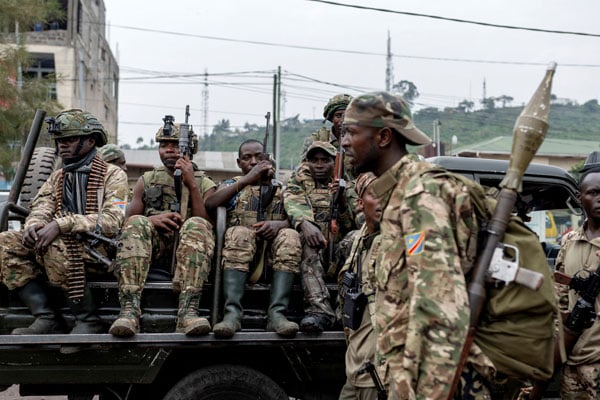
Battle: Dar es Salaam vs Nairobi

Battle: Dar es Salaam vs Nairobi

Msalato ishaanza kutoa taswira 👇🏾
IMG_4073.jpeg
 
Hapa kikwete alikua anawaeleza raia wa mkoa wa Kagera walale kwa amani na kwamba no force can threaten us in this region.
View: https://youtu.be/aDci72DG9D4?si=b4mn-L0ArSvQ4t2y. Hii ni baada ya choko choko za kale kajamaa ka Rwanda kuleta ngendembwe. Raisi kikwete alieleza wazi na kumpigia mfano Amin Dada wa Uganda ya kwamba hatukuamua tu kumfurusha kwenye mipaka yetu bali pia tuliamua kumnyang’anya madaraka. Hiki Ndio kitakachomkuta Kagema akijichangaya nasi. Kutokea hapo kijamaa kikaufyata mkia wake.

Wewe choko Njoo mwaiofhawaii jifunze historia ya bongo malaya hii 🤣🤣

wabongo tunajiamini alafu mabeyo na bosi wake wakaenda pale mpakani kutapika shiiiit ili kile kitolu kisikie kwa masikio yake 😛😛
 

View: https://x.com/CNangaa/status/1807035434897154361

rise to power

DRC: Who is Corneille Nangaa, the man leading the M23 rebels?​

By The Africa Report
Posted on January 31, 2025 13:35
Corneille Nangaa, leader of the AFC, a political-military coalition of political parties and rebel groups including the M23, in Goma on 30 January 2025. (Tony Karumba/AFP)

Corneille Nangaa, leader of the AFC, a political-military coalition of political parties and rebel groups including the M23, in Goma on 30 January 2025. (Tony Karumba/AFP)

Former election-chief-turned-rebel-leader Corneille Nangaa has gone from overseeing Congo’s contested 2018 election to leading a powerful insurgency against the DRC’s President Félix Tshisekedi.​

Now head of the Congo River Alliance (CRA) and allied with the Rwanda-backed M23, Corneille Nangaa Yubeluo has seized key cities, including Goma, and vows to march on Kinshasa. Sentenced to death in absentia, he remains at the centre of the DRC’s escalating conflict. How did he rise to power?

Born on 9 July 1970 in what is now Haut-Uele Province in the DRC, Nangaa started his career far from the battlefield. He studied economics at the University of Kinshasa before working with international organisations, including the UN Development Programme.

His political breakthrough came in 2015 when he was appointed president of the Independent National Electoral Commission (CENI) under then-president Joseph Kabila. He was responsible for organising the delayed 2018 elections and controversially declared Félix Tshisekedi the winner. His tenure at CENI ended in 2021 amid allegations of electoral fraud and US sanctions for “undermining DRC elections“.

Why did he turn against the Congolese government?​

Initially aligned with the ruling elite, Nangaa later distanced himself from President Tshisekedi. Ahead of the 2023 elections, Nangaa said that the 2018 result had been manipulated in a secret deal between Tshisekedi and Kabila, which Tshisekedi denies.

If I created the monster, I think it is up to me to defeat it

In August 2023, Nangaa reemerged as a key figure in the DRC’s armed conflicts, launching the CRA – a coalition of 17 political parties, two political groups and armed militias. Among them was the March 23 Movement (M23), an insurgent group backed by Rwanda. Nangaa has since positioned himself as a leading figure in the rebellion against Tshisekedi’s government.

What is Nangaa’s role in the conflict?​

By early 2025, Nangaa and M23 had taken control of Goma, the capital of North Kivu, and were advancing towards Bukavu. In a press conference from Goma, he reiterated that Tshisekedi had never legitimately won the presidency and stated: “If I created the monster, I think it is up to me to defeat it.” He and his allies have made it clear that their ultimate objective is to seize power in Kinshasa.

The conflict has led to widespread violence, with more than 100 people killed and hundreds more injured. Hospitals in Goma are overwhelmed, and the city is grappling with water and electricity shortages.

Africa Insights​

Diplomatic efforts to end the fighting have made little progress, and regional bodies like the Southern African Development Community (SADC) are debating whether to withdraw their peacekeeping forces.

Why was he sentenced to death?​

In August 2024, a military court in Kinshasa sentenced Nangaa, along with several M23 leaders, to death in absentia for treason, war crimes and insurrection. The US and EU imposed further sanctions on him and his coalition for “fueling instability” and attempting to overthrow the Congolese government.

Despite the sentence, Nangaa remains active on the battlefield. His alliance is expanding its influence beyond North Kivu, with reports suggesting he aims to extend operations to the mineral-rich southeast, particularly Katanga, where opposition to Tshisekedi is strong. His strategy appears to be not only military but also political and is seeking broader support beyond the Tutsi community, historically associated with M23.

What’s next for the M23 rebellion?​

As the CRA and M23 consolidate power in the east, the DRC’s government finds itself increasingly isolated. Calls for dialogue with M23 are growing within regional blocs, but Tshisekedi remains firm in refusing negotiations. Meanwhile, Rwandan President Paul Kagame has dismissed international criticism and warned South Africa – whose troops are deployed in the region – not to interfere.

With Kinshasa struggling to contain the rebellion and international actors divided on how to respond, the conflict shows no sign of ending soon.


Congo's army and Burundian allies slow M23 rebel's southern march​

Reuters
latest07pix-data.jpg


Friday, January 31, 2025
m23pix-data.jpg

Members of the M23 rebel group gather to supervise Congolese potential recruits for the M23 rebel group before being taken to training centres run by M23 rebels, amid clashes between M23 rebels and the Armed Forces of the Democratic Republic of the Congo (FARDC), in Goma, North Kivu province in eastern Democratic Republic of the Congo, January 30, 2025. PHOTO/ REUTERS


By Reuters
News agency
Thomson Reuters

What you need to know:​

  • Global powers including the United States, Britain and France have called for an end to the fighting and have sought to pressure Rwandan President Paul Kagame to end his support for M23.
Congolese troops with support from Burundi's army appeared on Friday to be holding back a push south by Rwandan-backed rebels seeking to expand their grip on eastern Congo in a weeks-old advance that has raised fears of a broader regional conflict.

Earlier this week the Tutsi-led M23 rebels seized Goma, the largest city in the east of Democratic Republic of Congo - home to lucrative gold, coltan and tin ore mines - before shifting their focus to Bukavu in neighbouring South Kivu province.

After early progress, however, three sources including South Kivu governor Jean-Jacques Purusi Sadiki told Reuters the Congolese army and its allies were succeeding in holding the rebels back.

One person with direct knowledge of the fighting said a force of around 1,500 including Congolese troops, Burundian soldiers and local militia fighters had deployed to defend the town of Nyabibwe some 50 km (30 miles) from Bukavu.

The source declined to be identified for security reasons.

"The risk of regionalisation of the conflict is real," one African diplomat told Reuters on Friday. "The Rwandan, Congolese and Burundian armies are already clashing on the ground in eastern Congo."

Well-trained and professionally armed, M23 is the latest in a long line of Rwandan-supported, Tutsi-led rebel movements to emerge in Congo's volatile eastern borderlands in the wake of two successive wars stemming from Rwanda's 1994 genocide.

Kigali has rejected the findings of U.N. investigators that it has sent thousands of soldiers and equipment into Congo to support M23.

RISK OF REGIONAL WAR
Relations between Rwanda and Burundi are already hostile. Fighting between their two armies in Congo would heighten the risk, expressed by the United Nations, of a repeat of the kind of regional war that killed millions between 1996 and 2003, most from hunger and disease.

The U.N. said on Thursday that there were reports of Rwandan forces crossing into Congo in the direction of Bukavu. Rwanda did not immediately respond to a request for comment.

"It is a known fact that Burundians are fighting alongside the (Congolese army)," M23 spokesman Willy Nangaa told Reuters. "There are thousands of them."

U.N. sources estimate there are several thousand Burundian troops, mainly in South Kivu, where they are deployed in support of the Congolese army at the request of the government in Kinshasa.

On Sunday, Rwanda told the U.N. Security Council that there were 10,000 Burundian troops there.

Burundi's military has declined to comment on this week's developments in Congo.

A Burundian official, who asked not to be named, acknowledged that, after having received increasing requests for help from Kinshasa in the past two years, Burundi had deployed between 8,000 and 10,000 soldiers in Congo.

"Our country has also paid a heavy price, which is why we have asked our two neighbours to sign a ceasefire and negotiate," the official said, referring to Congo and Rwanda.

Uganda, meanwhile, which also has troops in eastern Congo to take on Ugandan rebels based there, on Friday said it would "adopt a forward defensive posture" due to the fighting between Congo's army and M23.

FEELING SURROUNDED
Global powers including the United States, Britain and France have called for an end to the fighting and have sought to pressure Rwandan President Paul Kagame to end his support for M23.

Following a meeting with Congo's President Felix Tshisekedi in Kinshasa, France's Foreign Minister Jean-Noel Barrot was in Kigali to meet with Kagame on Friday.

But analysts say a reluctance by world powers to take on Rwanda, other global distractions and on-the-ground military realities will complicate efforts to defeat the rebels.

Bukavu last fell to rebels in 2004 to a previous Tutsi-led insurgency that rights groups accused of civilian killings and widespread rape.

At the packed football stadium in Bukavu on Thursday, authorities sought to recruit civilian volunteers to defend the city as the crowd chanted "Free Goma".

"It's been 30 years that we've been victims of war and done nothing. But today, the youth are standing up to be on the front lines," said Fiacre Kalugusha, a man in the crowd.

"Sometimes gunshots ring out in the city and this also contributes to reinforcing the psychosis," said Helene, a Bukavu resident. "We feel surrounded by M23, and it is scary."

 
Back
Top Bottom