Battle: Dar es Salaam vs Nairobi
You are using an out of date browser. It may not display this or other websites correctly.
You should upgrade or use an alternative browser.
You should upgrade or use an alternative browser.
Battle: Dar es Salaam vs Nairobi

Geza Ulole
Platinum Member
- Oct 31, 2009
- 76,175
- 107,754
What do u mean mature manner? Have i posted a lie? R those the kind of highways u brag over here?Mzee either uamue tudebate in a mature manner ama debate iishe. Nimetaja barabara zaidi ya tano ambazo ni dual carriageway. Wewe unazidi kupost hii barabara moja. You are not a very serious person. Uko na utoto.

Tony254
JF-Expert Member
- May 11, 2017
- 16,016
- 16,435
Hebu angalia hii barabara imejengwa juzi tu hapa angalia af niambie unaonaje roads za Tz [emoji116][emoji116]
Hii barabara ya Kigamboni iko sawa.
Tony254
JF-Expert Member
- May 11, 2017
- 16,016
- 16,435
Not more than 30 years.White elephant u will have to pay to use that road n Mchina will own that road for next 100 years!
Tony254
JF-Expert Member
- May 11, 2017
- 16,016
- 16,435
Halafu miradi zote za Kenya ni white elephant kulingana na wewe.White elephant u will have to pay to use that road n Mchina will own that road for next 100 years!

mkorinto
JF-Expert Member
- Jun 11, 2014
- 32,088
- 39,587
Thika road ni 40 km. Huwezi kuilinganisha na kibarabara cha 19 km!!
tungeweka bei na gharama kwanza kabla ukimbilie kuandika hiki ulichoandika,thika highway ni pesa ngapi???
Tony254
JF-Expert Member
- May 11, 2017
- 16,016
- 16,435
Ilikamilika 2010, miaka kumi zilizopita na bei ilikuwa 30 billion pesa ya Kenya. Ilikuwa ni mradi wa kwanza kubwa Wachina kujenga Kenya.tungeweka bei na gharama kwanza kabla ukimbilie kuandika hiki ulichoandika,thika highway ni pesa ngapi???
Geza Ulole
Platinum Member
- Oct 31, 2009
- 76,175
- 107,754
Halafu miradi zote za Kenya ni white elephant kulingana na wewe.
ECONOMY
Private firm to pick toll fees on Nairobi Expressway for 27 years
TUESDAY AUGUST 18 2020

Work in progress on Nairobi Expressway. FILE PHOTO | NMG
The private company funding construction of the Nairobi Expressway will operate the road for 27 years to recoup funds spent in the project before ceding it to the State.
The Kenya National Highways Authority (KeNHA) said the private firm will be granted concession to operate the road and recover funds through charging motorists toll fees.
KeNHA did not disclose the firm but said the deal has already been signed paving the way for construction of Kenya’s first double-decker expressway at an estimated cost of Sh59 billion and financed under the public-private partnership (PPP) model.
China Road and Bridge Corporation (CRBC) will build the 27.1km road linking the Jomo Kenyatta International Airport (JKIA) to Nairobi-Nakuru highway.
The project launched in October last year and will take three years to complete, is expected to reduce heavy traffic on Mombasa Road which usually starts from Mlolongo to the city centre.
“The private company will be granted a concession to build, operate and transfer the project for 30 years that includes a construction period of three years and thereafter an operation & maintenance period of 27 years,” KenHA said.
KeNHA and the private company had early this month invited firms to apply for consultancy services to monitor construction of the road and its performance for one year upon completion.
The state agency in charge of roads closed the bids on August 4 but is yet to publicly disclose the consulting firm picked to offer advisory services for the project.
The Nairobi Expressway involves a four-lane and six-lane dual carriageway within the existing median of Mombasa Road/Uhuru Highway/Waiyaki Way and 10 interchanges.
The toll charges will be kept in a special fund to finance maintenance of the highways and repayment of other roads built by private contractors but fail to generate enough funds to pay investors due to low number of users.
Toll fees were introduced in the late 1980s but were scrapped in the mid-90s in favour of the roads maintenance levy currently charged at Sh18 per litre for petrol and diesel.
Private firm to pick toll fees on Nairobi Expressway for 27 years
Geza Ulole
Platinum Member
- Oct 31, 2009
- 76,175
- 107,754
The Chinese company will make $1 bln from Tollgate collection!Halafu miradi zote za Kenya ni white elephant kulingana na wewe.
Nairobi Should Rethink Its Colonialist Approach to Urban Design
The road being built in Nairobi is for the rich. Even if it will no longer traverse the city’s major park, it’s not the future-thinking urban design that Kenya needs.
Patrick Gathara
11. November 2019, 21:41 MEZ
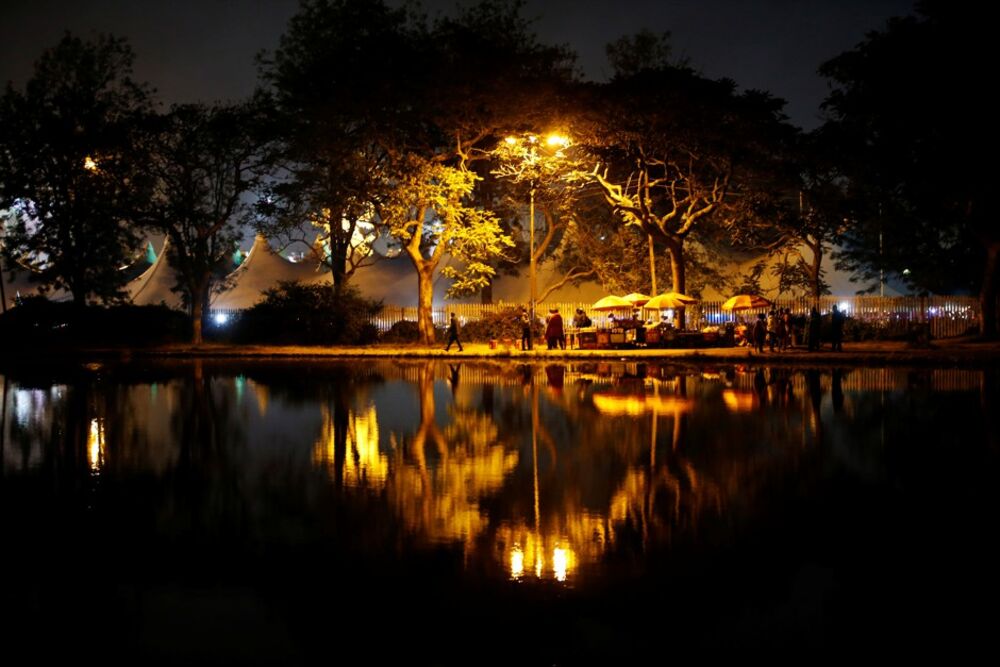
People enjoying Uhuru Park in Nairobi, Kenya, just after the beginning of the new year, January 1, 2019. Thomas Mukoya/Reuters
In this article
TWTR
TWITTER INC
43.23
USD
-2.10-4.63%
Following a public furor, at the end of last month, the Kenyan government backed off a plan to build a 17-mile, four-lane expressway through the historic Uhuru Park (Freedom Park), one of the few remaining public parks in Nairobi. The construction of the road will proceed but it will circumvent the park. Nonetheless, the road still has opponents, and with good reason.
Announced by President Uhuru Kenyatta in mid-October, the expressway is expected to cost 62 billion Kenyan shillings ($620 million), with the government directly shouldering a quarter of the cost and the rest extracted over 30 years as a toll charge from motorists using the expressway and paid to the China Road and Bridge Corporation.
Nairobi, Kenya’s capital city, was originally premised on a neighborhood concept, with approximately 30 percent of the city devoted to open public spaces. Over time, many of these spaces have been lost to urban sprawl while some are threatened by encroachment. Uhuru Park, one of six major remaining open public spaces, has itself lost land to a football stadium, a high-end hotel, and a members-only golf club.
The proposed expressway is not a serious attempt to deal with congestion. By the government’s own admission it is a road for those who “are able to afford it,” a public subsidy for the rich.
In the 1990s, Wangari Maathai (who would go on to win the Nobel Peace Prize in 2004) famously led Kenyans in successfully blocking government plans to build a 60-story skyscraper in the park. Thanks to her efforts, the park today is still as she described it in her memoir, Unbowed: “A large green swath … Its lawns, paths, boating lake, and stands of trees provide millions of [mostly poor] people in Nairobi with a natural environment for recreation, gatherings, quiet walks, or simply a breath of fresh air.” Thanks to outcry from Nairobians, it has been saved again, but even if the road will no longer traverse the park, it is still controversial.
https://www.bloomberg.com/citylab?in_source=postr_index
The government claims the road is necessary to alleviate the city’s horrendous traffic congestion, which is estimated to cost the country’s economy up to $1 billion a year. However, it is unlikely to do so. Building more and wider roads does not necessarily lead to less congestion: While more road space creates more capacity, this does not account for what economists call induced demand—basically, more people will choose to drive, undoing any gains in speed and time.
It is a phenomenon Nairobians are familiar with. For more than a decade, the government has been implementing an ambitious road expansion program, gobbling up many tens of billions of dollars, yet the roads seem to fill almost as fast as the country can build them. In that time, the number of registered vehicles has more than tripled. Despite some improvements in average traffic speeds, the city still has, according to the World Bank, one of the world’s longest average journey-to-work times.
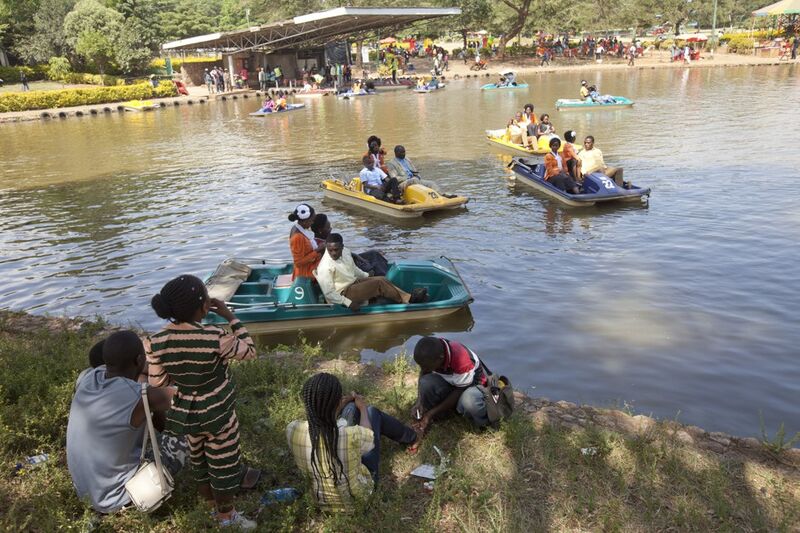
People taking boat rides at Uhuru Park in 2018.
Sayyid Abdul Azim/AP
As the government builds more roads and as incomes rise, more Nairobians are ditching walking. According to the Project on Integrated Urban Development Master Plan for City of Nairobi, of the nearly 4.8 million trips made each day in Nairobi in 2004, half were on foot. Ten years later, that had fallen to 40 percent, many turning to public transport or motorcycles, whose numbers had exploded. Among the rich few who can afford cars—which includes most of the city’s politicians and decision-makers—walking or biking are almost never considered. According to one study, no trip to work by bicycle was reported by people from households earning more than $480 per month.
It is therefore unsurprising that discouraging car use as a means of eliminating congestion is not really considered. Lip service is paid to ideas like pedestrianization of streets and car-free days, but there is no indication of any actual seriousness in implementing the proposals.
When it comes to mobility, the city has always prioritized the needs of its wealthiest residents above all else. Nairobi’s love affair with the automobile and the classist segregation of public spaces it represents has a long history. Jacqueline Klopp of Columbia University and Winnie Mitullah of Nairobi University point out that “European settlers and officials ‘planned’ the city of Nairobi around personalized transport which facilitated physical segregation in terms of mobility.” By 1928, the city had the highest per-capita car ownership in the world.
Little changed after Kenya secured independence in 1963. The new black elite yearned for the trappings enjoyed by the whites they were replacing and among these were cars. Following the colonial lead, they built roads for themselves and thought little of their poor countrymen who were forced by poverty, and as they saw it, backwardness, to walk.
Ever since, roads and cars have become synonymous with modernity and development. Visions of a futuristic Nairobi, like these videos posted on Twitter by the permanent secretary in the State Department for Housing and Urban Development, always seem to picture development as fewer people and more cars and roads.
As more Kenyans have taken to the roads, and clogged them up, the classist entitlement has manifested itself in the phenomenon of “overlapping” pioneered by matatus, the privately owned minibuses that form the backbone of the city’s chaotic public transport system. Overlapping is simply driving on the wrong side of the road, or on pedestrian walkways or through petrol stations to avoid a traffic jam. Senior government officials (and enterprising private citizens) have illegally arrogated themselves police escorts, strobe lights, and sirens to enable them cut through the congested roads. But even without these accoutrements, it is not rare to find the rich denizens with their trademark giant SUVs, simply flashing their hazard lights and taking off on the wrong side, safe in the knowledge that many cops are too scared of to whom they might be connected to stop them.
The apartheid on the roads is also replicated in policy: roads for the rich and not much else for everyone else. The proposed expressway is, by the government’s own admission, a road “for Kenyans who are able to afford it.” This amounts to little more than a public subsidy to allow the rich to escape congestion, rather than a serious attempt to deal with it.
Nairobi needs to get over its infatuation with the car. The way to do it is to focus on the needs of the majority who still walk, bike, or take matatus, and to encourage more to do so. That means, rather than expressways, the city should be building walkways and bike lanes and pedestrianizing the business districts. The city should also be investing in mass transit, not just talking about it. Rather than drive, the default should be to walk or to take mass transit. The good news here is that the vast majority of city residents are already ahead of the curve. It is government that needs to catch up.
However, like all breakups, it will not be painless. It will need a fundamental restructuring of how the city works. Take jobs, for example. “Nairobi is a city built for car owners, who can reach about 90 percent of jobs within an hour,” says a 2017 World Bank study. From central Nairobi, only 20 percent of all jobs are accessible within an hour using the matatu network, and only 5.8 percent within 45 minutes. By comparison, the same study noted, 54 percent of jobs in greater London were accessible from the city center using public mass transit. So planning must take into account the spatial distribution of jobs and match it to where the people are.
Given the vast amounts invested in transport infrastructure and in residential or commercial building stock, some with an expected lifetime of over 100 years, cities can get locked into development paths even when they recognize that change is necessary. It is thus important to realize that decisions on building expressways today have the potential to railroad Nairobi into a path that continues to benefit its wealthiest, at the expense of everyone else, for decades to come.
Why Do Nairobi's Elite Bring a Colonialist Mentality to Urban Design?
Tony254
JF-Expert Member
- May 11, 2017
- 16,016
- 16,435
Hii PPP model inatumika sana Marekani na Ulaya. Wewe mtu wa Dar Slum huwezi kuifahamu.ECONOMY
Private firm to pick toll fees on Nairobi Expressway for 27 years
TUESDAY AUGUST 18 2020
Work in progress on Nairobi Expressway. FILE PHOTO | NMG
The private company funding construction of the Nairobi Expressway will operate the road for 27 years to recoup funds spent in the project before ceding it to the State.
The Kenya National Highways Authority (KeNHA) said the private firm will be granted concession to operate the road and recover funds through charging motorists toll fees.
KeNHA did not disclose the firm but said the deal has already been signed paving the way for construction of Kenya’s first double-decker expressway at an estimated cost of Sh59 billion and financed under the public-private partnership (PPP) model.
China Road and Bridge Corporation (CRBC) will build the 27.1km road linking the Jomo Kenyatta International Airport (JKIA) to Nairobi-Nakuru highway.
The project launched in October last year and will take three years to complete, is expected to reduce heavy traffic on Mombasa Road which usually starts from Mlolongo to the city centre.
“The private company will be granted a concession to build, operate and transfer the project for 30 years that includes a construction period of three years and thereafter an operation & maintenance period of 27 years,” KenHA said.
KeNHA and the private company had early this month invited firms to apply for consultancy services to monitor construction of the road and its performance for one year upon completion.
The state agency in charge of roads closed the bids on August 4 but is yet to publicly disclose the consulting firm picked to offer advisory services for the project.
The Nairobi Expressway involves a four-lane and six-lane dual carriageway within the existing median of Mombasa Road/Uhuru Highway/Waiyaki Way and 10 interchanges.
The toll charges will be kept in a special fund to finance maintenance of the highways and repayment of other roads built by private contractors but fail to generate enough funds to pay investors due to low number of users.
Toll fees were introduced in the late 1980s but were scrapped in the mid-90s in favour of the roads maintenance levy currently charged at Sh18 per litre for petrol and diesel.
Private firm to pick toll fees on Nairobi Expressway for 27 years

Naton Jr
JF-Expert Member
- Oct 5, 2016
- 7,866
- 19,253
Hawana highway ndefu kutuzidiInawezekana ikawa ni kweli kwamba mna highway ndefu kutuzd lkn hata kwetu highway ipo na inaongezwa urefu nadhani hapo baadae czan kuna nchi ukanda huu itakuwa na highway ndefu km Tz.

joto la jiwe
JF-Expert Member
- Sep 4, 2017
- 26,111
- 46,621
Sisi tuna miundombinu nchi nzima inayowafikia raia wote sio mijini pekee kama ninyiAsante kwa kukubali kuwa Kenya ina miundo mbinu hatari kwenye miji yetu.
Naton Jr
JF-Expert Member
- Oct 5, 2016
- 7,866
- 19,253
Sasa kama maisha yenu yenyewe ndio haya, hivi unapata wapi guts za kujadili mambo ya miundombinu wakati kula tu ni shida?Sasa wewe umepata mjadala wa adabu ukiendelea halafu umeamua kuipaka mavi. Nilitegemea watoto wawe wamelala sasa. Huu si muda wa watoto kuchangia mada za watu wazima.
joto la jiwe
JF-Expert Member
- Sep 4, 2017
- 26,111
- 46,621
Wazee wa misifaa [emoji23][emoji23][emoji23]Mzee una ufahamu kuwa Kenya inajenga barabara ya kufa mtu sasa hivi tunavyozungumza? Barabara ambayo ni aina yake Afrika nzima? Barabara ambayo inapatikana US, Germany au Japan lakini sio Afrika? Unafahamu hilo? Barabara linaitwa Nairobi expressway. Bonge la barabara.
Geza Ulole
Platinum Member
- Oct 31, 2009
- 76,175
- 107,754
Tunatumia public private partnership kwa sababu sisi tuna investors ambao wako tayari kumwaga hela kwetu. The biggest PPP project in East Africa ni Lake turkana wind farm. Iligharimu takriban $670 million.
Hapa ndo Mchina huwafinya 👇 😀 😀 👇Tunatumia public private partnership kwa sababu sisi tuna investors ambao wako tayari kumwaga hela kwetu. The biggest PPP project in East Africa ni Lake turkana wind farm. Iligharimu takriban $670 million.
https://www.businessdailyafrica.com...or-27-years/3946234-5610816-mvv6sw/index.htmlKeNHA did not disclose the firm but said the deal has already been signed paving the way for construction of Kenya’s first double-decker expressway at an estimated cost of Sh59 billion and financed under the public-private partnership (PPP) model.
Private firm to pick toll fees on Nairobi Expressway for 27 years
Tony254
JF-Expert Member
- May 11, 2017
- 16,016
- 16,435
Wacha nikupe mradi ambao upo Kenya ila haupo Tanzania. Tuna mradi wa wind power ambao inagenerate 310 MW. Hii ndio the biggest windpower project in Africa. Ilizinduliwa mwaka wa 2018 na iligharimu pesa za Kitanzania trilioni moja nukta tatu yaani Tsh 1.3 Trilion.Hii barabara serikali yako wameijenga kutokana na presha ya wananchi kumuona rais wenu anazingua wanapomfananisha na Magu, km cvyo wala asingelikubali kuingia gharama za wachina kuwakalia kwa almost 27yrs mkilipa toll fees.
Poleni sana Wakenya mmeanza kupanic na kufanya miradi icyo tija huku mkiumiza wananchi.
Pili tuna mradi wa kugenerate geothermal power. Kenya inaviwanda vinavyozalisha karibu 800MW kwa kutumia Geothermal. Kenya ni nchi ya nane duniani kwa kuzalisha umeme kwa kutumia Geothermal. Nyie hamna viwanda vya kuzalisha umeme vya Geothermal na pia hamna viwanda vya kuzalisha umeme kutumia upepo ambavyo vina ukubwa kama wa Kenya
Tony254
JF-Expert Member
- May 11, 2017
- 16,016
- 16,435
Wewe nakupuuza tu. Wacha niendelee kujadili na watu wazima.Sasa kama maisha yenu yenyewe ndio haya, hivi unapata wapi guts za kujadili mambo ya miundombinu wakati kula tu ni shida? View attachment 1579666View attachment 1579668

ichoboy01
JF-Expert Member
- Mar 6, 2017
- 82,235
- 163,928
kimara kibaha hio ni phase ya kwanza inakuja phase ya pili mpaka chalinze jumla itakua 90kmsThika road ni 40 kilometres.
Tony254
JF-Expert Member
- May 11, 2017
- 16,016
- 16,435
Hio Lake Turkana ina investors kutoka Denmark
Similar Discussions
-
KONGAMANO LA KIMATAIFA LA SACCA 2026 / 2026 SACCA CONGRESS DAR ES SALAAM
- Started by Bagamoyo
- Replies: 2
-
 Tanzania’s Dar es Salaam port surges ahead of Kenya’s Mombasa in global efficiency ranking
- Started by Zack Abdul
- Replies: 0
-
Kuchagua POS Bora kwa Maduka jijini Dar es Salaam
- Started by BIASHARABORA
- Replies: 2
-
-
 Need Someone in Dar es Salaam to Handle Tasks for You? (On-Ground Support in Tanzania)
- Started by Powell Gonzalez
- Replies: 1