Battle: Dar es Salaam vs Nairobi

Battle: Dar es Salaam vs Nairobi

wewe nyoko Aga Khan Hospitals Mombasa na Kisumu are also referral and private!

YOU ARE HERE

You are here​

Home | Press Centre | Spotlights | Aga Khan Health Services


  • A nurse attends to an infant at the Aga Khan Medical Centre in Kisii, Kenya.
    AKDN / Lucas Cuervo Moura

Aga Khan Health Services

Providing integrated health care in East Africa


MORE SPOTLIGHTS BY​

GEOGRAPHY:Tanzania
AGENCY:Aga Khan Foundation, Aga Khan Health Services, Aga Khan University
THEMATIC AREA:Health

LANGUAGES​


E-mailSharePrint


“Many of our health facilities in Kenya and Tanzania started as small clinics focused on maternal and child health. Today AKDN runs a fully integrated health ecosystem in both countries, which is centred on four main hospitals, two in-patient medical centres and almost 100 outreach health centres, collectively providing care to nearly 1.8 million people in the region,” said Dr Gijs Walraven, Director of Health, AKDN.
AKDN’s health contributions in East Africa have expanded greatly since our precursor established the first health centre in Dar es Salaam in 1929. Three agencies are involved. The Aga Khan Foundation (AKF) and the Aga Khan Health Services (AKHS) work in community-based primary health care, providing information for communities, training health workers, contributing to policy and reaching vulnerable groups with low-cost, proven medical technologies. This is complemented by curative services in institutions ranging from dispensaries to health centres to full-service hospitals.
The Aga Khan University (AKU) undertakes world-class research and provides specialist health care through its teaching hospitals. It aims to produce leaders who will generate a lasting impact on the communities they serve. Its School of Nursing and Midwifery has contributed to the development of health workers in East Africa for over 20 years, in a region where nurses and midwives represent more than 85 percent of the health workforce and are often the only point of care. Almost 200 doctors have graduated from its Master of Medicine programme, which offers learning relevant to practice in Africa.
AKDN uses a hub-and-spokes health system to effectively integrate different levels of care. This provides health promotion and prevention activities at the community level, easily accessible primary healthcare centres for more serious illnesses and hospitals when needed for specialist services. Such integration goes beyond the healthcare system. The health of a community is heavily influenced by the socio-cultural environment: whether babies are getting sufficient nutrition; if clean water and sanitation facilities are available; what barriers exist to seeking health care. AKDN agencies work together and with partners to address the wider needs of societies, in turn improving health.

akhs-tanzania-telemedicine.jpg
akhs-tanzania-telemedicine.jpg

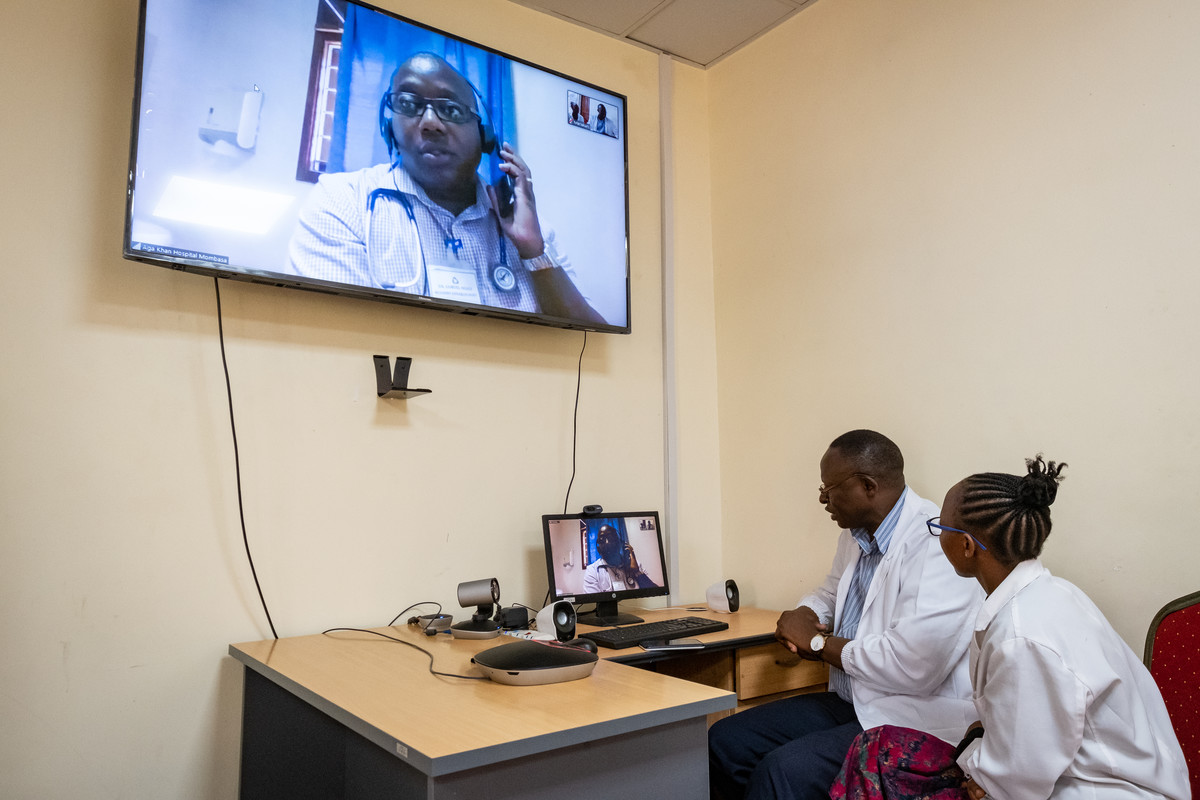
Digital health tools such as teleconsultations and remote learning enable many patients and medical staff to avoid the costs, inconvenience and environmental impact of travel.
AKDN / Lucas Cuervo Moura

Partnering for impact
Partnerships are key to our success in strengthening healthcare systems. We work with governments, local authorities and local and international partners.

One such partner is the Agence Française de Développement (AFD) Group, with whom we have collaborated in East Africa for over 15 years. AFD has provided more than US$ 120 million in financing to AKDN to support the health sector in East Africa. Together we have made the hospitals in Kisumu and Mombasa into referral facilities for the local population and established a high-level cancer and cardiology centre in Nairobi.

In 2019, AFD contributed 10 million euros to support the Tanzania Comprehensive Cancer Project (TCCP), while AKDN made a 3.3 million euro contribution. "The TCCP project will improve infrastructure, expand access to screening and detection services, and initiate a joint research agenda across all levels of the local health sector,” said Dr Walraven.

Examples include the new ultrasound machine enabling improved cancer screening at the Ocean Road Cancer Institute in Dar es Salaam, and the mammography machine at the Bugando Medical Centre, improving the early detection of cancers.

At the onset of the global pandemic in Tanzania in March 2020, AKDN and AFD signed an agreement to establish a dedicated infectious diseases unit in the Aga Khan Hospital, Dar es Salaam and Aga Khan Medical Centre, Mwanza.

The latest grant, of 2.3 million euros, comes from Proparco, AFD's private-sector subsidiary. The grant was awarded to the Aga Khan Hospitals in East Africa as part of the "Health in Common" Initiative and will help improve access to health care. As well as the hospitals, the grant will benefit 94 medical and outreach centres in Kenya and Tanzania.

Another significant partnership is a nine million euro programme funded by the European Union and AKF to combat the impacts of COVID-19. AKF, AKHS and AKU are taking a multi-sector approach against the pandemic and its impacts in Kenya, Uganda, Tanzania and Mozambique, prioritising health system strengthening.

The programme includes disseminating COVID-19 prevention messages, reinforcing national health facilities’ resources, providing rapid response funds to civil society organisations to support vulnerable community members and providing entrepreneurship and employment skills training and start-up funds to young people. So far, we have:
  • reached more than 42,000 community members with accurate messaging about COVID-19;
  • conducted 9,500 COVID-19 tests within low-income communities in Kenya;
  • renovated a defunct hospital ward, now a key facility for treating severe cases of COVID-19, at the Amana Referral Hospital in Dar es Salaam;
  • used digital health platforms to train health workers and lab technicians;
  • provided eHealth medical equipment in other areas in the region, aiming to provide COVID-19 training to a further 650 health workers; and
  • provided items such as PPE, tests and processing equipment, or ventilators in 22 health facilities across the region.
“One of the areas where we’ve received quite a bit of disquiet lately in terms of the supply chain are the gloves. And I’m seeing they are one of the items that have been donated here today. You donate with your ears on the ground about the users and what is needed urgently,” said Hon. Charles Dadu, County Executive Committee Member for Health, Kilifi County, Kenya, on behalf of a recipient health facility.

At the end of the 30-month programme, we aim to have directly supported more than 140,000 people by improving their knowledge, resources and opportunities. Find out more.

Collaborated with who? Kuna mahali umesoma Government of Kenya hapo?🤣🤣🤣 We mzee jifunze kusoma na kuelewa.

One such partner is the Agence Française de Développement (AFD) Group, with whom we have collaborated in East Africa for over 15 years. AFD has provided more than US$ 120 million in financing to AKDN to support the health sector in East Africa. Together we have made the hospitals in Kisumu and Mombasa into referral facilities for the local population and established a high-level cancer and cardiology centre in Nairobi.
 
With no IMIC ni either mukuje Kenya au muendee India. 🤣 🤣 🤣
Yaani unafananisha institute na The Integrated imaging & molecular centre (IMIC) ambayo ni Part of Kenyatta University Hospital! Ina hata vitanda 50?
 
Collaborated with who? Kuna mahali umesoma Government of Kenya hapo?🤣🤣🤣 We mzee jifunze kusoma na kuelewa.

One such partner is the Agence Française de Développement (AFD) Group, with whom we have collaborated in East Africa for over 15 years. AFD has provided more than US$ 120 million in financing to AKDN to support the health sector in East Africa. Together we have made the hospitals in Kisumu and Mombasa into referral facilities for the local population and established a high-level cancer and cardiology centre in Nairobi.
That referral title for Aga Khan Hospitals in Kisumu and Mombasa was given by GoK!
 
Kuzaana sio tatizo kama Unayamudu maisha,hapa tatizo ni umaskini ndio unaofanya uone kuzaa sana ni tatizo,Kama income yako ni kati ya tsh 2M watoto wanne unawamudu,Na hata ikiwa chini ya 2M lakini juu ya tsh 1.5M unawamudu pia..Yani tusizae kwasababu wazungu hawazai?hapa sijaona ukimake any sense
Kwa nini China walisema kila familia izae mtoto mmoja tu? Unajua ni kwa nini? Halafu ni Watanzania wangapi wanapata mshahara wa tsh 2 million kwa mwezi? Nipo sure ni less than 2% ya Watanzania. So umetoa mfano mbaya ukizingatia kwamba majority ya Watanzania ni masikini na hawawezi kumudu watoto wanne na kuwapa maisha mazuri. Hii ni fact tu. Watanzania wengi mapato yao kwa mwezi ni kidogo sana na bado wanazaa watoto tano au sita. Hii inafanya watoto wasipate masomo bora na hata kutomaliza shule kwa sababu ya kukosa karo. Lishe bora pia inakuwa ni tatizo, yaani balanced diet.
 

France to open its airspace to Tanzanian airlines​


FRIDAY JULY 08 2022​

ATCL pic

Summary

  • Areas of interest that had been agreed by experts during the meeting include opening Paris and Marseille for designated airlines of Tanzania as long-haul routes and long-haul cargo between the two countries.


Alex pic

By Alex Nelson Malanga
More by this Author

Dar es Salaam. Tanzanian airlines will soon be able to fly to and from Paris, Marseille, Mayotte and Reunion, thanks to the review of the Bilateral Air Services Agreement (Basa) between Tanzania and France.

In a fresh bid to facilitate the recovery of the aviation sector that has been hit hard by Covid-19 pandemic, experts from the two countries last week met in Mayotte – a French administrative territory – to review the pact that was signed in1978.

The Citizen understands that the review of Basa in the belief that it was definitely overtaken by events, saw four areas of interest being agreed upon in the new accord that will be signed shortly once institutional formalities of the two countries have been completed.

Areas of interest that had been agreed by experts during the meeting include opening Paris and Marseille for designated airlines of Tanzania as long-haul routes and long-haul cargo between the two countries.

They also agreed to add Mayotte and Reunion destinations which are not in the list of entry points for the Tanzanian designated airlines in the current Basa.

The new Basa also provides a room for code-sharing arrangements between airlines from Tanzania and France and those from third countries.

ADVERTISEMENT

The Tanzanian delegation to the Basa negotiations was led by the assistant director air transport and meteorological services for the Ministry of Works and Transport, Mr Paul Chiganga.

The delegation consisted of experts from Tanzania Civil Aviation Authority (TCAA), Tanzania Airports Authority (TAA), Zanzibar Airports Authority (ZAA) and representatives from Air Tanzania Company Limited (ATCL) and Precision Air.

Mr Chiganga said addition of Mayotte and Reunion destinations in the current Basa will allow the Tanzanian airlines to operate between points in Tanzania and those two important destinations which are all in the administrative territory of France.

On the question of opening Paris and Marseille for designated airlines of Tanzania as long-haul routes and long-haul cargo, he said it was important for Tanzanian airlines to expand their networks.

“Having in mind the plans by ATCL to acquire an all-cargo freighter in the near future, we agreed, during the negotiations, to open up Paris and Marseille for long-haul cargo between the two countries,” said Mr Chiganga in the document seen by The Citizen.

Adding: “We further agreed to open Mayotte (short-haul) for cargo from Tanzania and vice versa, for ATCL and Precision Air in future.”

He exuded his optimism that allowing code sharing arrangements between airlines from the two countries and airlines from third countries will create ample room for flight network expansion of designated airlines of Tanzania and France.

ATCL managing director Ladislaus Matindi told The Citizen that the review of the Basa will enable the national carrier to expand its footprints, with Mayotte topping the list of priorities, to start with.

“Preparations to start flying to Mayotte are done. We need some arrangements and soon we will start flying,” the ATCL boss recounted.

Precision Air’s marketing and corporate communications manager Hilary Mremi said the review of Basa will open doors for business.

“The review of Basa will open doors for partnership with French airlines,” said Mr Mremi.

Like ATCL, Precision Air, also expressed its interest to start with flying to Mayotte, saying preparations have already started.

The review of Basa suggests that the two countries are dancing to the tune of the celebratory current situation whereby airspaces are being opened globally after their closure of, most of them, for more than two years.

The head of the French delegation and co-chair of the negotiations meeting, Mr Emmanuel Vivet, said it was the first time that France hosted a big negotiation of that magnitude with another country in Mayotte.

“So, we are not taking this occasion lightly and the people of Mayotte feel a great presence of Paris in Mayotte by just deciding that the negotiations on air transport services should be held here” noted Mr Vivet, who doubles as the French Civil Aviation Authority director general.

The 1978 Basa will cease to be in effect once the new agreement is signed and entered into force.


Bugando Heart Institute​

Construction of a Cardiac Institute (+ Cath lab):​


BMC is currently expanding its medical care in a number of super specialitiesincluding Cardiothoracic Surgery and Cardiology, due to the growing burden of heart diseases in the region. This has been associated with high mortality and morbidities due to lack of advanced and accessible cardiovascular services in this region.

The number of patients with heart diseases has been on increase at BMC, overriding the available resources, thus calling for a need to expand the cardiovascular services.

It is also now estimated 30-40% of patients attended at Jakaya Kikwete Cardiac Institute (JKCI) in Dar es Salaam, are from this zone. In 2017, among Paediatric patients with heart disease at BMC, 17% of them required surgery and were referred to JKCI. Majority of them could not afford to pay for transport, accommodation and surgical costs.

Thus, BMC in collaboration with Mwanza Regional Commissioner (Hon.John Mongella) and the Ministry of Health, Community Development, Gender, Elderly and Children has developed a proposal for development of Bugando Cardiac Institute in Mwanza to meet the increasing demand of this superspecialized Heart Service in this region.

Currently the sketch of the building (16 floors, twins, see below) has been completed. The construction of building is expected to cost 59billion.

bhi.jpg


Yaani unafananisha institute na The Integrated imaging & molecular centre (IMIC) ambayo ni Part of Kenyatta University Hospital! Ina hata vitanda 50?
IMIC pekee can accommodate 100 patients. Narudia Tanzania mzima pamoja na Zanzibar hakuna any molecular imaging centre for the public.
 
Back
Top Bottom