Battle: Dar es Salaam vs Nairobi

Battle: Dar es Salaam vs Nairobi

Tony, you are too smart than this bhana. Yani meli ishushe na kuondoka bila kuchukua mzigo mpya? Na doubt kama ulishaingia hata bandarini na kuona tu vile wana operate. Meli za magari tu ndio zina shusha na kuondoka bila kusubiria mzigo wa kuondokea. Na ndio maana ni ghali sana kusafirisha magari kuliko kontena.
Hawana idea na chochote na hawajui chochote ila ukiwaskiliza na english yao unaeza sema ni wasoni kumbe mapunga😂😂😂😂😂😂
 
😂😂😂😂 siku hzi thika country iko under nairobi metro😂😂😂😂😂 Mungu weee
EU7LaKiVAAEP9Xj.png

Unajiabisha dogo... Angalau ungechunguza maana ya neno "Metropolis"
 
Will Egyptian company build Dodoma stadium? Listen from 1:06:00


Egyptian Minister inspects Tanzania hydroelectric dam​

Housing Minister oversees construction work at Julius Nyerere hydroelectric dam in Tanzania being built by Egyptian consortium

Dominic Ellis
|Nov 10|
magazine
5 min read


Egypt’s Housing Minister Assem al-Gazzar has carried out an inspection of construction works at the Julius Nyerere hydroelectric dam in Tanzania, which is being developed by an Egyptian consortium of Arab Contractors and Elsewedy Electric at a cost of £2.19 billion.

According to a report by Egypt Independent, Gazzar says that Egyptian President Abdel Fattah al-Sisi is periodically following the project’s progress and explains that his visit is to check up on the project’s implementation.

He adds that the project is a reflection of the relationship between the two African countries, and will help Tanzania progress, providing further electrical power and higher development rates.

Since its inception in December 2018, the project has been carried out smoothly.

Gazzar was accompanied by a Housing Ministry delegation and the Egyptian coalition implementing the project, where he inspects work done at the main dam and the river diversion tunnel, which has been finally finalised.

The project team anticipates that this month will see the river’s course diverted, the report adds.

The power station is located across the Rufiji River in the Stiegler’s Gorge, at the Selous Game Reserve in the Morogoro region, 220 kilometres southwest of Dar es Salaam, the commercial capital and largest city in Tanzania.

The project aims to generate 2,115MW of electricity to provide Tanzania’s energy needs, as well as controlling water levels during flood periods and satisfy the state’s water needs. The 134-dam will have a storage capacity of 34 million cubic meters of water. It will be 100-kilometres long and 1,350 square kilometres in area, while the earth embankment will be 3.7 million cubic metres.

The Egyptian Independent report states that the powerhouse will be above-ground and consist of nine vertical Francis turbines with capacity ranging from 200MW to 300MW each, and power generators with a capacity of 1,200MW each. Power transformers of 235-353MVA each, with a combined capacity of 2,470MVA will be installed. The plant will also include a 400kV switch yard.

Additional infrastructure will include electric switch gears, a protection system and fire detection system, along with an auxiliary power supply, DC systems, cooling and sewage systems.

Furthermore, 10kms of internal roads will be constructed, along with 15kms of residential roads. 350 permanent houses and 3,000 secondary houses.


Egypt’s Housing Minister inspects Tanzania’s Julius Nyerere dam construction​


Egypt Independent

November 8, 2020
12:47 pm

Egypt%E2%80%99s-Housing-Minister-inspects-Tanzania%E2%80%99s-Julius-Nyerere-dam-constructions.jpeg

Egyptian Housing Minister Assem al-Gazzar on Saturday inspected construction work of the Julius Nyerere hydroelectric dam project in Tanzania, which is being worked on by an Egyptian consortium of Arab Contractors and Elsewedy Electric at a cost of US$2.9 billion.

Gazzar said that Egyptian President Abdel Fattah al-Sisi is periodically following the project’s progress, and explained that his visit is to check up on the project’s implementation.

This project reflects the distinguished relations between both nations, he said, and comes to help Tanzanian people as it will provide further electrical power and higher development rates.

The minister added that since its inception in December 2018 the project has been carried out smoothly, with continuous cooperation between the Egyptian and Tanzanian sides to resolve all obstacles.

Gazzar held an expanded meeting reviewing the volume of work conducted at the dam project thus far. He was accompanied by a Housing Ministry delegation and the Egyptian coalition implementing the project, where they inspect work done at the main dam and the river diversion tunnel, which has been fully finalized.

It is anticipated that this month will see the river’s course diverted.

The power station is set to located across the Rufiji River in the Stiegler’s Gorge, at the Selous Game Reserve in the Morogoro region 220 kilometers southwest of Dar es Salaam, the commercial capital and largest city of Tanzania.

The project’s goal is generating electricity of 2,115 MW to provide Tanzania’s energy needs, as well as controlling water levels during flood periods and satisfy the state’s water needs.

The 134-meter dam will have a storage capacity of 34 million cubic meters of water. The reservoir will be 100-kilometers long and 1,350 square kilometers in area, while the earth embankment will be 3.7 million cubic meters.

The powerhouse will be above-ground and consist of nine vertical Francis turbines with capacity ranging from 200 MW to 300 MW each, and power generators with a capacity of 1,200 MW each. Power transformers of 235-353 MVA each with a combined capacity of 2,470 MVA will be installed. The plant will also include a 400 kV switch yard.

Additional infrastructure will include electric switch gears, a protection system and fire detection system, along with auxiliary power supply, DC systems, cooling and sewage systems.

The construction of 10-kilometer internal roads, 15-kilometer long residential roads, 350 permanent houses and 3,000 secondary houses are also part of the project.


Egyptian housing minister checks workflow of Tanzanian dam, hydropower station​


The dam, with a length of 1,025 metres and a height of 131 metres, is being built by a consortium of Egyptian companies, the Arab Contractors and Elsewedy Electric​


Ahram Online , Saturday 7 Nov 2020

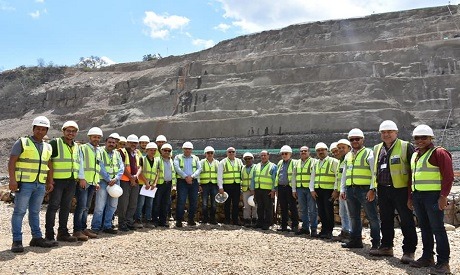
Egyptian Minister of Housing Assem El-Gazzar and business officials followed up on the workflow of a

Egyptian Minister of Housing Assem El-Gazzar and business officials followed up on the workflow of a project to establish Tanzania's $2.9 billion Julius Nyerere dam (Courtesy of the Housing Ministry)


Print



Share/Bookmark


reading-2.png

Views: 3141


line_re.jpg

Related
line_re.jpg

line_re.jpg

Egyptian Minister of Housing Assem El-Gazzar and a group of business officials followed up on the workflow of a project to establish Tanzania's $2.9 billion Julius Nyerere Dam and hydropower station on the Rufiji River, the ministry said in a statement.

The project comprises a main dam with a concrete body, and four other saddle dams to form a reservoir with a capacity to impound approximately 34 billion cubic meters of water.

The dam, with a length of 1,025 metres and a height of 131 metres, is being built by a consortium of Egyptian companies, the Arab Contractors and Elsewedy Electric.
Also, the hydropower station has been under construction since 2019 and is projected to produce 2,115 megawatts of power.

Gazzar said Egyptian President Abdel-Fattah El-Sisi follows up on the workflow of the project on a regular basis.

He added that the visit comes within the framework of special relations between the two countries, and Egypt’s keenness to implement this vital project that would provide electricity to the people of Tanzania, and help boost development rates.

Gazzar and the officials toured the project site, including a fully-drilled tunnel to divert the water of the river, the statement read; adding that it is expected that the diversion would be carried out during this month.

The officials also checked on three tunnels that carry water from the reservoir to the turbines, and the hydropower station that has nine turbines.

Gazzar hailed the workflow of the project, which started in December 2018, and stressed on the continuous cooperation between the Egyptian and Tanzanian sites to remove any obstacles facing the implementation process.

The minister was accompanied by the head of the Central Agency for Reconstruction Mahmoud Nassar, Arab Contractors CEO Sayed Farouk, Elsewedy Electric CEO Ahmed El-Sewedy, and other officials.

During the visit, Nassar said the project aims to contain the floods of the Rufiji river, generate electricity, and protect the environment.

Concerning the hydropower station, Nassar said it would be the largest in Tanzania, with a generation rate of 6,307 gigawatts per hour.

As many as 5,233 labourers are taking part in the project, including 526 Egyptians, 3,974 Tanzanians, and 733 workers from other countries, an Egyptian Cabinet statement read in September, after a meeting between Prime Minister Mostafa Madbouly and a number of ministers.

"President Abdel-Fattah El-Sisi has given directives to implement the project at the highest level of quality to showcase the Egyptian contracting sector's capabilities to complete major projects," Madbouly told officials at the meeting.

 
Tony, you are too smart than this bhana. Yani meli ishushe na kuondoka bila kuchukua mzigo mpya? Na doubt kama ulishaingia hata bandarini na kuona tu vile wana operate. Meli za magari tu ndio zina shusha na kuondoka bila kusubiria mzigo wa kuondokea. Na ndio maana ni ghali sana kusafirisha magari kuliko kontena.
Kwn magari ndio hayasafirishwi kw container sio..
 
Will Egyptian company build Dodoma stadium? Listen from 1:06:00


Egyptian Minister inspects Tanzania hydroelectric dam​

Housing Minister oversees construction work at Julius Nyerere hydroelectric dam in Tanzania being built by Egyptian consortium

Dominic Ellis
|Nov 10|
magazine
5 min read


Egypt’s Housing Minister Assem al-Gazzar has carried out an inspection of construction works at the Julius Nyerere hydroelectric dam in Tanzania, which is being developed by an Egyptian consortium of Arab Contractors and Elsewedy Electric at a cost of £2.19 billion.

According to a report by Egypt Independent, Gazzar says that Egyptian President Abdel Fattah al-Sisi is periodically following the project’s progress and explains that his visit is to check up on the project’s implementation.

He adds that the project is a reflection of the relationship between the two African countries, and will help Tanzania progress, providing further electrical power and higher development rates.

Since its inception in December 2018, the project has been carried out smoothly.

Gazzar was accompanied by a Housing Ministry delegation and the Egyptian coalition implementing the project, where he inspects work done at the main dam and the river diversion tunnel, which has been finally finalised.

The project team anticipates that this month will see the river’s course diverted, the report adds.

The power station is located across the Rufiji River in the Stiegler’s Gorge, at the Selous Game Reserve in the Morogoro region, 220 kilometres southwest of Dar es Salaam, the commercial capital and largest city in Tanzania.

The project aims to generate 2,115MW of electricity to provide Tanzania’s energy needs, as well as controlling water levels during flood periods and satisfy the state’s water needs. The 134-dam will have a storage capacity of 34 million cubic meters of water. It will be 100-kilometres long and 1,350 square kilometres in area, while the earth embankment will be 3.7 million cubic metres.

The Egyptian Independent report states that the powerhouse will be above-ground and consist of nine vertical Francis turbines with capacity ranging from 200MW to 300MW each, and power generators with a capacity of 1,200MW each. Power transformers of 235-353MVA each, with a combined capacity of 2,470MVA will be installed. The plant will also include a 400kV switch yard.

Additional infrastructure will include electric switch gears, a protection system and fire detection system, along with an auxiliary power supply, DC systems, cooling and sewage systems.

Furthermore, 10kms of internal roads will be constructed, along with 15kms of residential roads. 350 permanent houses and 3,000 secondary houses.


Egypt’s Housing Minister inspects Tanzania’s Julius Nyerere dam construction​


Egypt Independent

November 8, 2020
12:47 pm

Egypt%E2%80%99s-Housing-Minister-inspects-Tanzania%E2%80%99s-Julius-Nyerere-dam-constructions.jpeg

Egyptian Housing Minister Assem al-Gazzar on Saturday inspected construction work of the Julius Nyerere hydroelectric dam project in Tanzania, which is being worked on by an Egyptian consortium of Arab Contractors and Elsewedy Electric at a cost of US$2.9 billion.

Gazzar said that Egyptian President Abdel Fattah al-Sisi is periodically following the project’s progress, and explained that his visit is to check up on the project’s implementation.

This project reflects the distinguished relations between both nations, he said, and comes to help Tanzanian people as it will provide further electrical power and higher development rates.

The minister added that since its inception in December 2018 the project has been carried out smoothly, with continuous cooperation between the Egyptian and Tanzanian sides to resolve all obstacles.

Gazzar held an expanded meeting reviewing the volume of work conducted at the dam project thus far. He was accompanied by a Housing Ministry delegation and the Egyptian coalition implementing the project, where they inspect work done at the main dam and the river diversion tunnel, which has been fully finalized.

It is anticipated that this month will see the river’s course diverted.

The power station is set to located across the Rufiji River in the Stiegler’s Gorge, at the Selous Game Reserve in the Morogoro region 220 kilometers southwest of Dar es Salaam, the commercial capital and largest city of Tanzania.

The project’s goal is generating electricity of 2,115 MW to provide Tanzania’s energy needs, as well as controlling water levels during flood periods and satisfy the state’s water needs.

The 134-meter dam will have a storage capacity of 34 million cubic meters of water. The reservoir will be 100-kilometers long and 1,350 square kilometers in area, while the earth embankment will be 3.7 million cubic meters.

The powerhouse will be above-ground and consist of nine vertical Francis turbines with capacity ranging from 200 MW to 300 MW each, and power generators with a capacity of 1,200 MW each. Power transformers of 235-353 MVA each with a combined capacity of 2,470 MVA will be installed. The plant will also include a 400 kV switch yard.

Additional infrastructure will include electric switch gears, a protection system and fire detection system, along with auxiliary power supply, DC systems, cooling and sewage systems.

The construction of 10-kilometer internal roads, 15-kilometer long residential roads, 350 permanent houses and 3,000 secondary houses are also part of the project.


Egyptian housing minister checks workflow of Tanzanian dam, hydropower station​


The dam, with a length of 1,025 metres and a height of 131 metres, is being built by a consortium of Egyptian companies, the Arab Contractors and Elsewedy Electric​


Ahram Online , Saturday 7 Nov 2020

Egyptian Minister of Housing Assem El-Gazzar and business officials followed up on the workflow of a

Egyptian Minister of Housing Assem El-Gazzar and business officials followed up on the workflow of a project to establish Tanzania's $2.9 billion Julius Nyerere dam (Courtesy of the Housing Ministry)


Print


Share/Bookmark


reading-2.png

Views: 3141


line_re.jpg

Related
line_re.jpg

line_re.jpg

Egyptian Minister of Housing Assem El-Gazzar and a group of business officials followed up on the workflow of a project to establish Tanzania's $2.9 billion Julius Nyerere Dam and hydropower station on the Rufiji River, the ministry said in a statement.

The project comprises a main dam with a concrete body, and four other saddle dams to form a reservoir with a capacity to impound approximately 34 billion cubic meters of water.

The dam, with a length of 1,025 metres and a height of 131 metres, is being built by a consortium of Egyptian companies, the Arab Contractors and Elsewedy Electric.
Also, the hydropower station has been under construction since 2019 and is projected to produce 2,115 megawatts of power.

Gazzar said Egyptian President Abdel-Fattah El-Sisi follows up on the workflow of the project on a regular basis.

He added that the visit comes within the framework of special relations between the two countries, and Egypt’s keenness to implement this vital project that would provide electricity to the people of Tanzania, and help boost development rates.

Gazzar and the officials toured the project site, including a fully-drilled tunnel to divert the water of the river, the statement read; adding that it is expected that the diversion would be carried out during this month.

The officials also checked on three tunnels that carry water from the reservoir to the turbines, and the hydropower station that has nine turbines.

Gazzar hailed the workflow of the project, which started in December 2018, and stressed on the continuous cooperation between the Egyptian and Tanzanian sites to remove any obstacles facing the implementation process.

The minister was accompanied by the head of the Central Agency for Reconstruction Mahmoud Nassar, Arab Contractors CEO Sayed Farouk, Elsewedy Electric CEO Ahmed El-Sewedy, and other officials.

During the visit, Nassar said the project aims to contain the floods of the Rufiji river, generate electricity, and protect the environment.

Concerning the hydropower station, Nassar said it would be the largest in Tanzania, with a generation rate of 6,307 gigawatts per hour.

As many as 5,233 labourers are taking part in the project, including 526 Egyptians, 3,974 Tanzanians, and 733 workers from other countries, an Egyptian Cabinet statement read in September, after a meeting between Prime Minister Mostafa Madbouly and a number of ministers.

"President Abdel-Fattah El-Sisi has given directives to implement the project at the highest level of quality to showcase the Egyptian contracting sector's capabilities to complete major projects," Madbouly told officials at the meeting.


Mkuu huyu jamaa sio anataka kujihakikishia support juu ya uhasama wake dhidi ya Ethiopia in case maamuzi yakiamuliwa na AU?
 
Mkuu huyu jamaa sio anataka kujihakikishia support juu ya uhasama wake dhidi ya Ethiopia in case maamuzi yakiamuliwa na AU?
sina uhakika juu ya hilo ila nadhani ni muhimu kuwa na mahusiano mazuri nao! Wahabeshi si wa kuaminika kihivyoo! Maana sidhani kama nao watakaaa kimya kama South Sudan au nchi yeyote Upstream wakiamua kujenga hydropower nao! Mara nyingi ni bora kukaa neutral kwenye ugomvi wa watu!
 
Tony, you are too smart than this bhana. Yani meli ishushe na kuondoka bila kuchukua mzigo mpya? Na doubt kama ulishaingia hata bandarini na kuona tu vile wana operate. Meli za magari tu ndio zina shusha na kuondoka bila kusubiria mzigo wa kuondokea. Na ndio maana ni ghali sana kusafirisha magari kuliko kontena.
Carter nani amekudanganya kuwa kila wakati meli linapotua bandarini kushusha mizigo lazima lipakie mizigo ndio ling'oe nanga? Itakuwa huelewi maana ya transshipment wewe.
 
Si nyie Wabongo huwa mnasema Wakenya wote ni wajinga.
Sio wote ila wengi wao wanaakili mbovu sn za kusujudia wazungu ila huyo amewapa ukweli wao wazungu, ni wakenya wachache sn wako km huyo PLO lumumba, hata viongozi wenu ndo wajinga kabisa wanaamini mzungu ni mungu.

Elimu Haina msaada kabisa kwa wakenya walio wengi ndo mana ni kawaida kuona mkenya akisaliti nchi yake kwa vipesa kdg toka kwa wazungu, elimu imefeli kabisa kumkomboa mkenya.
 

Congolese singer Tshala Muana freed​


TUESDAY NOVEMBER 17 2020​

Tshala Muana.

Congolese singer Tshala Muana (centre) with supporters after she was released from custody on November 17, 2020. PHOTO | COURTESY | PPRD

Summary

  • She was arrested following the release of her song, which was seen as critical of the government of DR Congo President Felix Tshisekedi.


General Image

By PATRICK ILUNGA
More by this Author

Congolese singer Tshala Muana was Tuesday released from police custody following pressure from Joseph Kabila's PPRD party.

The singer was arrested Monday in the capital Kinshasa. This followed last week's release of her song, which was seen as critical of the government of DR Congo President Felix Tshisekedi.

Tshala Muana is a known supporter of Joseph Kabila, Tshisekedi's predecessor.

The song chides a leader who is ungrateful to his mentor. The mentor is not mentioned in the song but it is believed to be a reference to Kabila who helped Tshisekedi form a coalition that led to the formation of his government last year.

 
Sio wote ila wengi wao wanaakili mbovu sn za kusujudia wazungu ila huyo amewapa ukweli wao wazungu, ni wakenya wachache sn wako km huyo PLO lumumba, hata viongozi wenu ndo wajinga kabisa wanaamini mzungu ni mungu.

Elimu Haina msaada kabisa kwa wakenya walio wengi ndo mana ni kawaida kuona mkenya akisaliti nchi yake kwa vipesa kdg toka kwa wazungu, elimu imefeli kabisa kumkomboa mkenya.
Wewe umewahi kukutana na Mkenya yeyote kweli ama unakariri tu mlichofunzwa na CCM enzi za Nyerere kuhusu Wakenya?
 
Kwani mlikuwa mumepoteza heshima?
Yah Tanzania ndiyo ilikuwa nchi inayiheshimika zaidi hapa EA kiuchumi mpk kijeshi ila viongozi walituangusha sn but cku hz tumeirudisha heshima yetu thus y tunatamba hapa EA na hakuna nchi ya kutusumbua kwa ss, unaweza ukaona jinc tunavyokwenda kujitegemea kiuchumi.

Tuna finance miradi mikubwa mfano bwawa la umeme jnhp kwa pesa za ndani $2.9bln, pesa za uchaguzi zaidi ya tshs330 bln ni pesa za ndani hvyo mambo ya kuomba omba cku hz tumeachia kenya
 
Back
Top Bottom