Why the government has to print money
By
DOMNIC OMONDI | October 6th 2020 at 08:00:00 GMT +0300
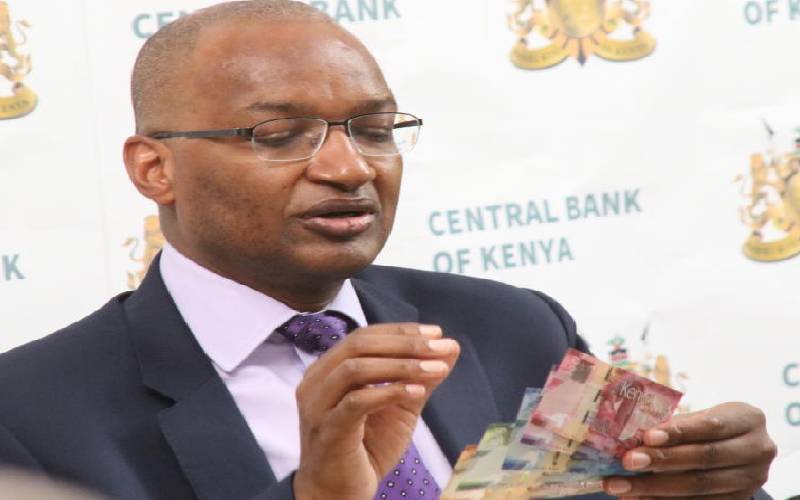
Central Bank of Kenya Governor Patrick Njoroge. [File, Standard]
The government, like any other individual or business, occasionally runs out of money, with its bank account at the
Central Bank of Kenya (CBK) reading zero.
However, it has certain statutory obligations that it must meet, whether it is broke or not. Some of them, such as debt payments and pension, are urgent and leave no room for delays.
The easiest way out is for the Treasury to request its bank to credit some money into its account as a temporary measure, allowing it to meet its obligations. This type of facility is known as an
overdraft facility.
But in plain language,
this is printing of money that is not supported by any economic activity.
This is what happened between September 18 and September 25, when the government took an overdraft facility of Sh15 billion that experts say was precipitated by the adverse effects of Covid-19, which has hurt the country’s tax base.
“It (overdraft facility) is supposed to function as a temporary source of cash whenever the Treasury does not meet its target debt raising,” said Ndoho Wahoro, the CEO of Euclid Capital and former director-general of public debt management at the Treasury.
Should the government issue security, a bond, for example, and most of the offers come in at higher interest rates, then a responsible CBK would advise the Treasury to take an overdraft, said Wahoro.
He added that the facility is taken to cover urgent pending bills, including emergencies, priority payments such as local loans, or emergency measures such as the Covid-19 crisis.
Around this time, the government might also have paid some syndicated or Chinese loans, according to Churchill Ogutu, a financial expert at Genghis Capital, an investment bank.
The government might have also tapped into money it expected to get from the local market by issuing short-term securities of Sh24 billion.
However, it only received offers of Sh7.1 billion and ended up accepting Sh6.6 billion from investors.
Even worse, most of the money that was accepted was rolled over, meaning it was used to repay maturing loans.
The current cash crunch was further aggravated by poor revenue performance, which was a result of reduced economic activities after the pandemic hit the country in March. As a result, CBK had to credit some money into the Treasury’s Consolidated Fund. Excess printing, however, is highly discouraged.
The law only allows the government to take an overdraft facility of up five per cent of the gross recurrent revenue as reported in its latest audited financial statements. This is put at Sh68.5 billion for the year to June 2020.
And with the government having already borrowed Sh46 billion, it still has room to add another Sh12.5 billion through the overdraft facility.
The limit
“The limit for the year ending June 30, 2020, is Sh68.5 billion, while in the previous financial year it was Sh65.7 billion based on the gross recurrent revenue for the year ended 30 June 2018, which are the latest audited financial statements at the date of approval of these financial statements,” said CBK in its financial statement for the year ending June 2020.
With an overdraft account, a bank covers the payments a customer has made that would otherwise be rejected, or in the case of cheques, would bounce.
At CBK, interest is charged at the Central Bank Rate, which is currently at seven per cent.
Printing of money went overboard in the early 1990s, a period that was also characterised by high inflation, which is the rate at which the prices of goods and services increase over a given period, typically a year. The early 1990s were difficult times for Kenya. There was an aid embargo as Western countries put pressure on Kenya to allow for multiparty elections. This left the government with a huge Budget hole.
“The escalating fiscal deficit had to be financed from money printing,” said the International Monetary Fund (IMF) in a paper that evaluated Kenya’s inflation from independence to 1996.
Besides excess money in circulation, this period was characterised by a severe shortage of foreign exchange, price decontrol following inadequate supplies of essential commodities, and increased spending in the run-up to the 1992 elections, according to the IMF.
As a result, inflation touched an all-time high of 61.54 per cent in January 1994. There was too much money chasing too few goods.
In other words, Sh1,000 in January 1994 could barely buy half of what it bought in January the previous year.
Three years later, the Central Bank converted this overdraft facility that exceeded statutory limits into a loan at an interest rate of three per cent, which is repayable by 2039.
This loan is guaranteed by a deed executed by the Cabinet Secretary of the National Treasury.
Why the government has to print money