what's the GoT waiting? it should do the same i suggest to start with Brookside milk products! Beaten at their own game sio?
Local glass manufacturer, Kioo Limited likely to trigger Dar, Nairobi
 ippmedia.com/en/business/local-glass-manufacturer-kioo-limited-likely-trigger-dar-nairobi
May 27, 2020
27
May 2020
The Guardian Reporter
Dar es Salaam
Business
The Guardian
Local glass manufacturer, Kioo Limited likely to trigger Dar, Nairobi
IN contravention of East African Community’s free market protocol, Kenyan authorities have imposed a 25 percent excise duty on Kioo Limited’s glass exports to the country.
In a statement released yesterday, Kioo Limited it has raised the issues with the relevant ministries in the country but has also approached East African Court Justice to urgently intervene as the tax imposed is a clear violation of the EAC’s Customs Union Protocol.
Kenya recently enacted the Business Laws (Amendment) Act, 2020 which amended the Excise Duty Act of 2015 by imposing the new tax on imported glass bottles (excluding glass bottles for packaging pharmaceutical products) at a rate of 25 percent with effect from March 18, 2020.
“Under the Excise Duty Act, there are no exemptions granted to goods imported into Kenya from East African Community partner states and the new excise duty rate of 25 percent will therefore apply to glass bottles imported into Kenya from Tanzania,” the Dar es Salaam based company said in its statement.
The company further added that the amendment will result in an increase in the cost of imported glass bottles compared to those which are locally manufactured in Kenya hence impose a tariff barrier.
“The integration pillars of the East African Community include, the establishment of a Customs Union and a Common Market. Articles 75 and 76 of the Establishment of the East African Community Treaty, respectively provided for establishment of the Customs Union and Common Market,” said the statement.
The company explained that under the Customs Union Protocol, member states commit to deepen and strengthen trade among themselves hence agreed to eliminate internal tariffs and other charges of equivalent effect as well as eliminated non-tariff barriers to boost intra-regional trade.
The statement added that the Customs Union Protocol on the establishment of the East African Community Common Market is aimed at accelerating economic growth and development by providing for free movement of goods, labour, services, capital and the right of establishment within the EAC bloc.
“Kenya’s recent actions with respect to the excise duty on glass from Tanzania contravene the provisions of the EAC Treaty. Kenya is an important market of glass and glass products manufactured by Kioo,” the company lamented.
It also said that this will affect Kenyan glass purchasers as they will have to rely only on glass produced within Kenya adding that there are two glass producers in Kenya and they, together, cannot meet the total domestic demand but also do not currently have the capability to supply the technology that Kioo offers.
It said that Tanzania and Kenya have more or less the same cost structures and market potential because while Tanzania has local gas available, Kenya has local soda ash both of which are major cost drivers in the business and almost neutralize the advantage to both countries.
“During current Covid 19 outbreak when markets are already badly affected, this has come as a body blow to Kioo Limited,” the statement noted saying the company converts locally available materials into value added finished product as championed by President John Magufuli’s industrialization drive.
Kioo is one of the largest manufacturers of container glass for the soft drinks, beverage, beer, liquor and food industry in the EAC bloc with the most modern and technically capable plant which offers best quality, light weight and cost reduction opportunities to customers.
The statement went on that Kioo has invested significantly over the years to enhance the capabilities of the plant and it employs over 600 people in direct employment and many more indirectly that support the business. It elaborated that currently, the plant has a capacity to produce about 400 tons of glass per day and it exports almost 60 percent of its products after meeting local demand.
Why glass production in Kenya is grinding to a halt
By
JECKONIA OTIENO | January 6th 2019 at 00:00:00 GMT +0300
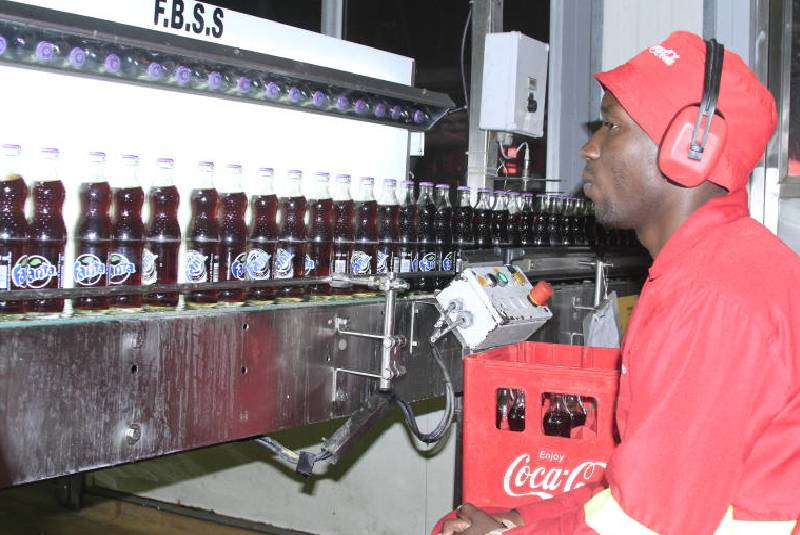
A section of Coca-cola manufacturing plant in Nairobi on October 24, 2018 [David Njaaga, Standard]
BUSINESS NEWS
Companies that use glass for packaging are bypassing the local manufacturers and sourcing from other countries
The blazing, churning automatic machines inside Kenya’s oldest glass manufacturing company could grind to a halt and with it hundreds of jobs lost.
This is attributed to unfavourable business environment that has exposed Kenya’s only two glass manufacturers, Milly Glass Works and Consol Glass Kenya, to stiff - at times unfair - competition from foreign firms.
The two are among only three glass manufacturing companies in East Africa, the third being Kioo Limited in Tanzania.
Companies that use glass for packaging are bypassing the local manufacturers and sourcing from other countries, thus forcing the local firms to find market elsewhere. Most of the imports are from Egypt.
SEE ALSO: 'Hug glove' gives Canada family bit of normalcy in pandemic
Documents in our possession show that between August and December last year, 499 40-foot containers with empty bottles entered the country through Mombasa port.
Largest bottlers
Most of it was imported by Kenya’s largest bottlers, Coca Cola Company - through Almasi, Equator and Nairobi Bottlers - and East African Breweries through UDV (Kenya) Limited.
Between July and December last year, the two companies imported 288 40-foot containers from Misr Glass Manufacturing Company, an Egyptian firm.
Close to three quarters of the total imports into Kenya were actually from Misr Glass with some containers being brought in by other spirit packers such as Patialla and Crywan.
While local manufacturers do not blame firms for bypassing their products, they say the move is driving them out of business. They argue that they have the capacity and have been supplying the companies for years.
SEE ALSO: Glass manufacturer targets growth with fresh upgrade
Milly Glass Managing Director Mohamed Rashid says one of the main reasons why local bottlers are going for foreign bottles is the high cost of doing business.
“Most of these industries are going outside the country because with rising cost of production, prices have to increase to cover overheads,” he says.
For the past 18 months, Mr Rashid says, Coca Cola, which was a regular customer, has not bought a single bottle from the company.
It must not be lost that the cost of production in Egypt is lower mainly because of cheaper energy costs and direct government subsidies given to the glass manufacturers.
The Oxford Business Group reports that in 2016, the Egyptian government announced a four-year, five-pillar strategy to help transition the country into a major regional industrial centre and export hub.
SEE ALSO: Hell hath no fury like political sponsor rattled
“The strategy sets specific targets to support this, including increasing the annual industrial growth rate to eight per cent, the industrial contribution to GDP to 21 per cent and non-oil exports by an annual rate of 10 per cent through to 2020,” says the report.
Local companies also imported bottles from Pragati Glass Gulf LLC and Al Zain both of Oman.
“We produce most glass products used in Kenya but now we do not have the market which makes it untenable and if factors do not change then we shall have to make a decision,” says Rashid.
The sentiments have been echoed by Consol Managing Director Joe Mureithi, who argues that the glass manufacturers are facing an uncertain future.
“All we ask for is for the Government to protect the manufacturing industry so that local companies that use glass can buy from local producers,” says Mr Mureithi.
Ripple effect
If glass manufacturers close down, the ripple effect will be felt far and wide, first among them being job losses.
Milly Glass employs 550 workers with suppliers of raw materials to the factory including Kenya Power, Tata Magadi Soda Company, fuel and liquified gas companies. Local firms have stock of up to 8months. Alongside this would be loss of tax revenue running into millions of shillings.
Rashid says the solution is simple. “President Uhuru Kenyatta has named manufacturing as one of the key pillars of his Big Four Agenda; reducing the cost of doing business is one sure way of achieving this agenda.”
He says over the past four years, the cost of electricity has risen by 45 per cent while costs of fuel and liquified gas have also risen by 45 per cent and 30 per cent respectively.
Why glass production in Kenya is grinding to a halt