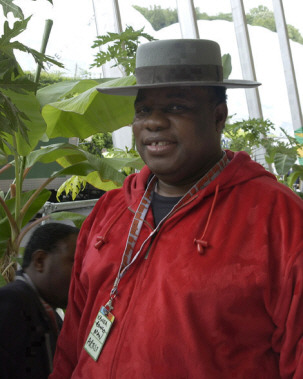
TODAY as he walks the busy streets of Dar es Salaam, not many people recognise him. But for music enthusiasts of the 1980s and early 1990s, the name Cosmas Chidumule rings a bell. Since he became a born-again Christian way back on July 6, 1993, Chidumule, best known for his stint in those good old days with Mlimani Park Orchestra, has kept a low profile. He is no longer spotted in dance-halls and night clubs. Instead, he now devotes most of his time to taking part in crusades, fellowships and church services alongside his fellow gospel singers.
In an interview with THISDAY last week, Chidumule talked of a complete makeover, from beer-gulping and cigarette-chewing secular artiste to a demon-rebuking Jesus fanatic. "When I made the decision to accept the Lord as my saviour, some people did not expect me to survive in that kind of a life style, but I've been able to do it without any problem," he says, smiling. "Before, I would spend hours in night clubs, but when I met Jesus he transformed me and as you see, I am now a God-fearing fellow. It is God who gave me inspiration that led to my change of heart," he adds.
The time Chidumule accepted God as his saviour, he still had commitments in dance-halls as he was a key member of Remmy Ongalla's Orchestra Super Matimila. "I decided to leave dance music and sing for the Lord because I could not serve two masters at the same time. The devil is a liar and deceiver," he says. The gifted singer talked of emptiness in his life despite his successful career that had spanned two decades and recounted how he hooked his existence to the devil worship.
Only months after accepting the Lord as his saviour, he released his maiden album 'Yesu ni Bwana'. Born in Songea District, Ruvuma Region but brought up in Tanga Region, Chidumule also remembers his experience in music before becoming a born-again Christian. His illustrious musical career dates back to the early 1970s when he joined Continental Africa band, whose base was in Songea, Ruvuma Region.
After a brief stint with the band, he left for Dar es Salaam to join Butiama Jazz band at the request of the band's proprietor Mustapha Mukwega, who was reportedly a close friend of the Father of the Nation, Mwalimu Julius Nyerere.
"It was Mwalimu who gave him (Mukwega) music equipment. That's why he decided to name the band Butiama, which is Mwalimu's home village," recalls Chidumule.
In 1973, he parted ways with Butiama band and joined Wema Abdallah's Western Jazz band before crossing over to Urafiki Jazz band. 'Tausi Karuka' is one of the songs he composed while with the band. His fairy-tale marriage with Urafiki Jazz band came to an end in 1978 when he joined Dar International Jazz band, where he teamed up with the late Marijani Rajab to release a number of hit numbers.
The songs include 'Rufaa ya Kifo', which propelled the band to the higher heights of success.
In late 1978, Chidumule and some of his colleagues were forced to call it quit after the band's proprietor opted to sell music equipment they had been using. After a brief self-exile, he joined Orchestra Mlimani Park. But it was not until 1986 that his presence at Sikinde was noticed when he teamed up with Muhidin Gurumo, Maalim Kinyasi and Kassim Mponda, among others, to release a chart-bursting song 'Barua kwa Mama', which dominated local radio stations for years.
The other hit numbers he composed for Siknde include 'Naijibu Telegram', 'Pesa Siyo Dawa ya Penzi' and 'Tumetoka Mbali'.
In 1983, he left Sikinde to join Orchestra Vijana Jazz. A year later, Sikinde suffered a blow when seven key musicians, including band leader Gurumo and Hassan Bitchuka, crossed over to Orchestra Safari Sound (OSS). Sensing the danger of being overshadowed by other bands, the band's management asked Chidumule to rejoin the band. Its decision paid dividends as the absence of Gurumo and Bitchuka was never felt.
Only days after rejoining Sikinde, Chidumule composed an evergreen hit song 'Neema', which literally became a national anthem. Later, he temporarily hang up his mike and travelled to Mahenge in Morogoro Region where he became a businessman, engaging in timber trade.m Later, he briefly hang up his mike before joining Orchestra Super Matimila, where he teamed up with Remmy Ongalla to release a number of hit numbers, including 'Mrema' and 'Narudi Nyumbani (remix)'.
"My greatest wish is that through music I can contribute to the happiness of the people and somehow be a beacon of hope that everything is possible if the Lord is willing," says Chidumule. Chidumule's transformation struck a familiar chord in the vast and versatile Tanzanian secular music industry that has seen a host of famed artists abandon secular music for gospel. Among them are Mzee Makasy, once the proprietor and leader of the now defunct Orchestra Makassy, and Remmy Ongalla, former leader of Orchestra Super Matimila.