FMES: Tuwakumbuke Wanamichezo Africa!

FMES: Tuwakumbuke Wanamichezo Africa!

[ame="http://http://www.youtube.com/watch?v=WbEIgyGPvGE"]http://http://www.youtube.com/watch?v=WbEIgyGPvGE[/ame]

[ame="http://http://www.youtube.com/watch?v=gX3IDVPCrXk&feature=related"]http://http://www.youtube.com/watch?v=gX3IDVPCrXk&feature=related[/ame]

[ame="http://http://www.youtube.com/watch?v=HrblTdklSS8&feature=related"]http://http://www.youtube.com/watch?v=HrblTdklSS8&feature=related[/ame]
 
Ringo Madlingozi

Ringo Madlingozi is a Cape Town-born South African singer, producer and songwriter who rose to fame when he and his band Peto won the Shell Road to Fame contest in 1986.

He later formed a group called Gecko Moon with Alan Cameron, a fellow Peto member. Their popular hit was Green-Green, which was a crossover track and was well received by music lovers.

Since his debut solo album, Vukani, which sold tens of thousands of copies, he has been unstoppable and moving up the music ladder.

He has subsequently scooped multiple awards for his albums, the South African Music Awards (SAMA) and the Kora All African Music Awards, where, among others, he won the Best Male Artist in Southern Africa and the African continent Awards.

He collaborated with international acclaimed group UB40 as part of the United Nations global AIDS awareness program, recording the Xhosa lyrics of Cover Up. Brian Travers, UB40's saxophonist, describes Ringo's music as "fantastic".

In May 2003, Ringo Live was recorded at the State Theatre in Pretoria and released in both DVD and CD format in August of the same year. The Ringo Live CD has sold an excess of 150,000 units, reaching multi-platinum status with the DVD selling over 60,000 units.

The DVD was in the top five national charts and top 10 international charts due to its excellent production quality.

In 2004 Ringo released an album titled Baleka which has thus far sold over 75,000 units and continues to sell. On that album he worked with Dillon O'Bryan, the composer of the song Soul to Soul by The Temptations and Bob Thiele Jnr.

Love Songs, a compilation, was released on 14 February 2006 sold over 25,000 copies within the first month of its release.

On the local front he has produced the world renowned artist Miriam "Mama Africa" Makeba and Durban Gospel greats Avante. Mama Africa's CD was nominated and received a number of local and international awards.

Due to popular demand of the Ringo Live DVD and CD, Ringo recorded a sequel, which is the Ringo Live2 recording in the same format of DVD and CD in September 2006.

In it he features Mama Busi Mhlongo; popstar Thembisile Ntaka; rap's gentle giant, Hip-Hop Pantsula and locally unknown, but internationally acclaimed Xhosa Spiritual Traditional artist, Ncumisa Bhonga.

Background

Ringo was born in Gugulethu, Cape Town, in 1964.

A chance encounter with renowned producer and head of Island Records, Chris Blackwell, changed the course of Ringo's creative life.

"Blackwell chided me for not sticking to what I know best – my people, my language and my culture," Ringo says. "It was as if a bright light had been turned on in my mind and this led directly to the recording of my debut album, Vukani."

The album marked a new direction for Ringo. Literally meaning "Wake Up" the album firmly rooted Ringo in the African pop genre, giving expression to the "ukuxhentsa" rhythms that had inspired the singer in his youth when he used to listen to "amagqirha" or traditional healers in his neighborhood and appreciate their rhythms.

The addition of a contemporary sound whilst still being grounded in the tradition of the Xhosa guitar, cemented what has now become known as the "Ringo" sound.

The sound has found its expression in several other releases, each one building on the success of the last. Among these are Sondelani (1997), Mamelani (1998) and Into Yam' (1999), Buyisa (2000), Ntumba (2002)and Baleka (2004).

They've earned Ringo several awards including Best Male Vocalist in 1998 and 1999 at the South African Music Awards as well as Best Male Artist (Southern Africa) and Best Male Artist (South Africa) and Best Male Vocalist (African Continent) at the 1998 and 1999 Kora awards respectively.

His energetic live shows have also earned Ringo acclaim.

In 2003 he wowed the European audiences who either attended or watched on their national television channels the North Sea Jazz Festival (Den Hague, Netherlands) and Festival de Jazz De Vitoria Gastteiz Airtel (Spain).

In 2004 he performed at the New Orleans Jazz Festival. He has performed in European countries such as United Kingdom, France, Netherlands, Spain and Germany
 
[ame="http://http://www.youtube.com/watch?v=qcAb12CT2kA"]http://http://www.youtube.com/watch?v=qcAb12CT2kA[/ame]

[ame="http://http://www.youtube.com/watch?v=rKtn2jH3exA&feature=related"]http://http://www.youtube.com/watch?v=rKtn2jH3exA&feature=related[/ame]
 
chuma.jpg


- Hii ilikuwa ni moja ya siku ya aibu kubwa sana kwa taifa letu, Mwalimu alikwenda Uwanja wa Taifa kusimamia mchezo wa mpira wa miguu kati ya timu yetu na Sudan, akifuatana na Rais wa Sudan General Numeiri, lakini kufika uwanjani ikawa aibu ya the Century kwani viongozi wetu wa soka nchini walisahau kuleta jezi za timu yetu na ikabidi wacheze wakiwa vifua wazi, hapa Rais wa Sudan akisaliamana na wachezaji wetu.

- Pamoja na kwamba nilikuwa dogo sana, lakini ninakumbuka hawa wachezaji hapa pichani ni wa kwanza kushoto Mohamed Chuma (No. 2 Bandari Club Mtwara), Omar Zimbwe (No. 5 African Sport Tanga), Captain Abdulrahman Juma No. 6 (Yanga Club), Kitwana Manara (No. 9 Yanga Club), na Kibaden King (No. 10 Simba Sports) ilikuwa in the 1970s.


Respect.

FMEs!
 
Oliver 'Tuku' Mtukudzi

Zimbabwean Oliver Mtukudzi is a truly great guitarist, vocalist, performer and composer. He must be one of the few people to have a beat named after him:'tuku'! This came about purely from his fans and Tuku stresses that he was the last to know. The unique tuku beat comes from a blend of Zimbabwean mbira with the faster Zulu township mbaqanga.

Oliver started out as a professional musician when he joined the Wagon Wheels in 1977. Now, along with his own band The Black Spirits, his appealing voice, captivating guitar rhythms and superb dance moves make his live performances really fantastic to experience. In his thrilling live performance at the Barbican, London in 2001, the audience went quite wild in their appreciation: they were up dancing right from the start. The same thing happened at the London Jazz Festival 2002 when Oliver and his band were at the Royal Festival Hall.

Mtukudzi sings in Shona interspersed with a bit of English, and the lyrics often have special or hidden messages. Many of his songs give advice on life. He has a great many recordings to his credit. On the album Ndega Zvangu Oliver sings accompanying himself on acoustic guitar, without his band, because of the tragic deaths of his brother, keyboard player Robert, guitarist Job Muteswa, and drummer Sam Mutowa and he dedicates the album to them.

Both the CD Tuku Music, 1998, and the follow-up album, Paivepo, released in 2000 include beautiful ballads. For example, 'Mabaza' from Tuku Music, which gives imagery pointing to the devastating effects of AIDS, is truly exquisite.

On the CD of 2001, Bvuma-Tolerance, one of the tracks, 'Wasakara', has become the unofficial anthem of the opposition parties in Zimbabwe. Another song, 'Akoromoka Awa', is a moving tribute in which Tuku mourns his late colleagues Sam, Job and Inga and his late brother Robert.

As well as performing and recording music Mtukudzi has starred in 2 major Zimbabwean movies, Jit (1990) and Neria (1991) and there are soundtrack CDs of both of these. He has also written a musical about Zimbabwe's street children. Indeed one of the tracks on the album Ziwere MuKobenhavn is 'Street kid'. Another project that Mtukudzi is a part of is Mahube, a collaboration of musicians from Southern Africa that began in 1998.

In 1995 Mtukudzi represented Zimbabwe at the SADC music festival in Harare. Futher afield he performed at the MASA Festival in Abidjan in March 1997. 2002 was a big year for the band to appear at festivals and celebrations: the Arts Alive Festival, the International Jazz Festival in Zimbabwe, Tuku's 50th birthday celebration at the Joy of Jazz Festival, then the Music for Food initiative and Botswana's Independence Day celebrations.

Over the last 5 years Tuku's music has deservedly made a significant impact on the world-wide music scene. At WOMAD Reading in 2001 Mtukudzi's show was broadcast live on Radio 3's regular World Routes programme. At a workshop later that day he spoke of his music being able to diffuse tension and emphasised that it is for everybody.

One of Oliver's albums released in 2002 is entitled Vhunze Moto (see CDs). A track from it, 'Ndakuvara' won the 2002 Kora Award for Best African Arrangement. The other album, Shanda, is a multimedia tribute in film, DVD and CD formats which explores Tuku's achievements using live recordings and interviews. He has won numerous awards and has featured in many TV programmes and prestigious magazines, for example Time Africa's article entitled 'The People's Voice' together with his picture on the front cover. In the 2003 Kora Awards Tuku won not only the Best Male Artist: Southern Africa Award but also the Lifetime Achievement Award. Tuku's 47th album,Tsivo (revenge), is an acoustic studio work recorded in his own studio in Norton, Zimbabwe. Its 12 tracks have great lyrics and beautiful acoustic sounds: typical yet highly appealing and original Tuku style for 2004!
 
yanga ndani ya maracana


IMG_0004.JPG

kikosi cha yanga kikipozi ndani ya wanja la maracana huko brazil mwaka 1974. waliokaa tokla shoto ni bona max, maulid dilunga, michael clement, moshi dayan na gibson sembuli. waliosimama toka shoto ni satchmo, athumani kilambo, elias michael, said sanga, abdulrahman juma na omar kapera. hiki ndicho kikosi kilichoiliza simba nyamagana mwaka huo wa 1974, mara baada na wao kutoka katika ziara ya poland.
- Wakulu hiyo jezi walioavaa Yanga, enzi hizo ukiitwa "uzi", acha bwana!

Respect.

FMEs!
 
[ame="http://http://www.youtube.com/watch?v=LfdI-Nw0kkM&feature=PlayList&p=58BA7EE4D9AF1DD9&playnext=1&playnext_from=PL&index=24"]http://http://www.youtube.com/watch?v=LfdI-Nw0kkM&feature=PlayList&p=58BA7EE4D9AF1DD9&playnext=1&playnext_from=PL&index=24[/ame]
 
Picture_014.jpg


Komandoo Hamza Kalala

Hamza Kalala "Komandoo" ni mpigaji solo maarufu sana nchini, aliyeanza kupiga muziki katika bendi ya Vijana Jazz ya Hemedi Maneti, baadaye alitoka na kwenda kuanzisha UDA Jazz "Kumba Kumba" vibao kama "Niliruka ukuta" "Maria" ulikuwa ni upigaji wake Komandoo.

Respect.

FMEs!


Kipchoge Keino: Sprinter Kenya.

i1378_KEINOKip1972.jpg

(born January 17, 1940, Nandi Hills, Kenya) Kenyan distance runner, who won four Olympic medals. Keino's father, a long-distance runner, encouraged his son in the sport. Keino herded goats and trained in Kenya's hill country, which prepared him well for high-altitude competition. He emerged as a leading distance runner during the mid-1960s, setting world records in the 3,000 metres (7 min 39.6 sec) and the 5,000 metres (13 min 24.2 sec).

At the 1968 Olympics in Mexico City, Keino suffered from severe abdominal pains (later attributed to gallbladder problems). Despite warnings from doctors, he competed in six distance races in eight days.

In his first final-the 10,000 metres-the Kenyan's pain became unbearable, and he collapsed on the infield with just two laps to go. In the 5,000-metre final Keino earned a silver medal, finishing 0.2 sec behind Tunisian Mohammed Gammoudi. In the 1,500 metres Keino faced race favourite Jim Ryun of the United States. Despite his pain, Keino, with help from teammate Ben Jipcho, set a furious pace over the length of the race, negating Ryun's powerful finishing kick. Keino won the race by 20 metres.

At the 1972 Games in Munich, West Germany, Keino won a silver medal in the 1,500 metres and a gold medal in the 3,000-metre steeplechase.Keino and his wife took in more than 100 orphaned children and had seven of their own. His success on the track and his commitment to the welfare of Kenya made him one of the nation's most beloved heroes. Later Keino served as president of the National Olympic Committee Kenya.

Kipchoge Keino
kipchoge%20keino1.jpg

Kipchoge Keino


One of Kenya's greatest Olympic athletes, Kipchoge ‘Kip' Keino is also one of the world's most admired sporting heroes. His courage and determination in winning a gold and silver medal in the 1968 Olympics, despite suffering from gallstones, endeared him to sports lovers around the world. That drive and single-minded determination to succeed against the odds has today made him one of the great benefactors to underprivileged children in Kenya.

Training

Keino is best known for his training at 1,800 metres above sea level, which helped introduce high-altitude training as a technique to improve running time at any altitude. A member of the Nandi tribe, he worked as a physical training instructor in the Kenya police force before becoming an athlete.

International Career

Keino began his international running career in 1962 when he set a Kenyan record in the one mile race and at the 1962 Commonwealth Games in Perth, Western Australia where he came eleventh in the three miles race. At the 1964 Olympics in Tokyo, Keino represented Kenya in their first games as an independent nation, finishing fifth in the 5,000 metres and barely missed the 1500 m final.

Later in 1964 he set two world records, at 3,000 metres with a time of 7 mins 39.6 secs and at 5,000 metres with a time of 13 mins 24.2 secs. In both 1964 and 1965, at the first and second African Games, he was champion at the 1,500 metres and 5,000 metres.On August 27, 1965, Keino lowered the 3000 m world record by over 6 seconds to 7:39.6 at his first attempt at the distance.Later in that year he broke the 5000 m world record held by Ron Clarke clocking 13:24.2. At the 1966 Commonwealth Games, Keino won the titles in both the one mile and three mile events.

Keino's most acclaimed international victory came at the 1968 Olympics in Mexico City, where, after having to jog a mile to the stadium because the bus from the Olympics Village was stuck in traffic, he won the 1500 metres with an Olympic record time of 3 mins 34.9 secs (defeating American great Jim Ryun in a memorable duel).

The mark stood until 1984. He also won the silver medal in the 5000 metres event despite an acute gallbladder infection. At the 1972 Olympics in Munich, West Germany, he won his second Olympic gold medal, in the 3000 metres steeplechase, and also won a silver medal in the 1500 metres.

Charity

Keino retired from the track in 1973
, a Kenyan hero, but there was much still to come from this remarkable man. Kip and his wife Phyllis purchased a farm in Eldoret which they converted into an orphanage, the Kip Keino Children's Home. "We started with two children, then it went to six, then ten. Now it's up to 90. We give them shelter and love. Many of these children who lived with us as orphans have gone to university, some are doctors, and when you see them with their own families living well in society, I feel very happy," he says.
In 1987, he shared Sports Illustrated magazine's "Sportsmen and Sportswomen of the Year" award with seven others, characterized as "Athletes Who Care," for his work with orphans. The Keino family realised a lifelong dream in 2000 with the creation of the Kip Keino School, funded by various donations. Almost 300 children age 6-13 attend the school. His son Martin, the only one to follow in his racing footsteps, was a two-time NCAA champion and highly successful pace-setter.

Hall of fame

In 1996 Kipchoge Keino was inducted into the World Sports Humanitarian Hall of Fame.


- Wakuu this is great story na inatakiwa kutufanya all Africans kuwa proud to be Africans.

Respect.


FMEs!
 
Akon : Hip Hop & RB Star.


akon-picture-1.jpg


Aliaune Badara Akon Thiam,

better known by his middle and stage name Akon (pronounced /&#712;e&#618;k&#594;n/),<sup class="reference" id="cite_ref-0">[1]</sup> is a Senegalese-American R&B singer-songwriter, record producer, businessman, and philanthropist. He rose to prominence in 2004 following the release of "Locked Up", the first single from his debut album Trouble. His second album, Konvicted, earned him a Grammy Award nomination of the single "Smack That". He has since founded two record labels, Konvict Muzik and Kon Live Distribution.

He is known as one of the most successful and versatile R&B singers of the 21st century, grossing over 30 million dollars a year according to Forbes. Akon often sings hooks for other artists and is currently accredited with over 200 guest appearances and 36 Billboard Hot 100 songs. He is the first solo artist to hold both the number one and two spots simultaneously on the Billboard Hot 100 charts twice.<sup class="reference" id="cite_ref-1">[2]</sup> He has had 6 Grammy Awards Nominations and has produced many hits for artist such as Lady Gaga, T-Pain, Leona Lewis.

Akon has claimed in interviews that his full name is Aliaune Damala Bouga Time Puru Nacka Lu Lu Lu Badara Akon Thiam<sup class="reference" id="cite_ref-2">[3]</sup> although there is some ambiguity and debate about Akon's legal name and birth date. Akon is usually credited as Aliaune Thiam.<sup class="reference" id="cite_ref-RS_3-0">[4]</sup><sup class="reference" id="cite_ref-4">[5]</sup> In addition to the longer form, Akon's full name has been reported both as Aliaune Badara Thiam and Alioune Badara Thiam <sup class="reference" id="cite_ref-5">[6]</sup> and About.com claims that this middle name has never been independently verified.<sup class="reference" id="cite_ref-About.com_6-0">[7]</sup>


In regards to his birth date, some media institutions have reported that Akon was born in 1981. Other sources, including the AP, have indicated that Akon was born in 1973 and was delivered by Senegalese doctor Magueye Seck. Legal documents released by The Smoking Gun list Akon's name as Aliaune Damala Thiam and his date of birth as 1973-04-30<sup class="reference" id="cite_ref-7">[8]</sup> or 1973-04-16,<sup class="reference" id="cite_ref-8">[9]</sup> however the BBC states he was born on 14 October 1981.
Early life

As the son of Senegalese percussionist Mor Thiam, Akon was raised in a musical setting and taught to play several instruments including the djembe. He was born in St. Louis, Missouri, U.S., so that he would not have to go through the immigration process, but he lived in Dakar, Senegal until the age of 7, split time between America and Senegal until he was 15, then he moved permanently to Jersey City, New Jersey.<sup class="reference" id="cite_ref-VH1_interview_9-0">[10]</sup>


During Akon's alleged time in jail for three years, he began to understand his music abilities and developed an appreciation for his musical background. Akon's unique blend of West-African-style, skills and moves eventually caught the ears of executives at Universal. Akon began writing and recording tracks in his home studio. The tapes found their way to SRC/Universal, which released Akon's debut LP Trouble in June 2004. The album is a hybrid of Akon's silky, West African-styled vocals mixed with East Coast and Southern beats. Most of Akon's songs begin with the sound of the clank of a jail cell's door with him uttering the word "Konvict".<sup class="reference" id="cite_ref-10">[11]</sup>
Personal life and allegations

Akon is a Muslim,<sup class="reference" id="cite_ref-11">[12]</sup> as he explains he has never drunk alcohol due to his faith. He has also been rumored to have three wives, however he has since revealed that he only has one, named Tomeka. Akon claims he has six children with three different women in an interview with Blender.<sup class="reference" id="cite_ref-Blender_12-0">[13]</sup> Akon claims to have great relationships with all his children, and that he wishes to keep his family protected from the public eye.


He also states that his religion made him a better person, and provides guidance to how he acts among others in life.<sup class="reference" id="cite_ref-13">[14]</sup>
He also has his own charity for underprivileged children in Africa called Konfidence Foundation.<sup class="reference" id="cite_ref-14">[15]</sup> Akon owns a diamond mine in South Africa and denies the existence of blood diamonds (also known as "conflict diamonds") saying, "I don't even believe in conflict diamonds. That's just a movie. Think about it. Ain't nobody thought about nothing about no conflict diamonds until the movie came out."<sup class="reference" id="cite_ref-15">[16]</sup>


However, he has since stated that he does accept that blood diamonds exist, and that he is partial-owner of an African mine that is dedicated to avoiding use of blood diamonds while also donating profits to local communities.<sup class="reference" id="cite_ref-16">[17]</sup> He allegedly had a previous occupation as a drug dealer but has stated in interviews that he's never used drugs, though some of his lyrics would suggest otherwise.<sup style="white-space: nowrap;" title="This claim needs references to reliable sources from September 2009" class="noprint Template-Fact">[citation needed]</sup>


"The Smoking Gun" reported in April 2008 that much of Akon's purported criminal and incarceration history has been dramatically embellished.<sup class="reference" id="cite_ref-17">[18]</sup><sup class="reference" id="cite_ref-18">[19]</sup><sup class="reference" id="cite_ref-19">[20]</sup> In particular, Akon's claims to be part of an auto-theft ring and his claim to have spent three years in prison were challenged with court records and interviews with detectives involved in Akon's case.


According to "The Smoking Gun's" article, Akon was not convicted of any crime and did not serve any time in prison from 1999 to 2002 as previously claimed. He stated that "The Smoking Gun's" attempt to "discredit" him "makes no sense as it is something he is trying to forget."


Akon retorted that he never spent 3 years in prison consecutively, but many shorter sentences that add up to three years, and cites that as the mis-understanding by The Smoking Gun's article <sup class="reference" id="cite_ref-20">[21]</sup> Despite his alleged criminal history, Akon proclaims that he has turned his life around.<sup style="white-space: nowrap;" title="This claim needs references to reliable sources from September 2009" class="noprint Template-Fact">[citation needed]</sup>
Career

2004&#8211;05: Debut: Trouble

Akon's solo debut album, Trouble was released on June 29, 2004. It spawned the singles "Locked Up" and "Lonely", "Belly Dancer (Bananza)", "Pot Of Gold", and "Ghetto." The album was the first release of his new record label Konvict Music. The inspiration for his debut single allegedly came from his three-year stint in prison for &#8216;grand theft auto'.<sup class="reference" id="cite_ref-RS_3-1">[4]</sup>remixed by DJ Green Lantern to include verses from rappers 2PacThe Notorious B.I.G.


"Locked Up" reached the top 10 in the U.S. and the top five in the UK. "Ghetto" became a radio hit when it was and In 2005, he released the single "Lonely" (which samples Bobby Vinton's "Mr. Lonely"). The song reached the top five on the Billboard Hot 100, and topped the charts in Australia, the UK and Germany.


His album also climbed to number one in the UK in April, 2005. When music channel The Box had a top ten weekly chart, which was calculated by the amount of video requests, Akon's "Lonely" became the longest running single on the top of the chart, spanning over fifteen weeks. Akon then released another single featuring with a New Zealand rapper, Savage with the single Moonshine, which had become a success in both New Zealand and Australia, becoming number one in the New Zealand charts.


In 2005, He made his first critically acclaimed guest appearance on Young Jeezy's debut album, Let's Get It: Thug Motivation 101, with the song "Soul Survivor." In December the same year his manager, Robert Montanez was killed in a shooting after a dispute in New Jersey.
2006&#8211;07: Konvicted


Akon's second album, Konvicted was released on November 14, 2006. It included collaborations with Eminem, Snoop Dogg and Styles P. The first single "Smack That" featuring Eminem was released in August 2006 and peaked at number two on the Billboard Hot 100 for five consecutive weeks.


"I Wanna Love You," (featuring Snoop Dogg) was the second single released in September, it would go on to earn Akon his first number-one single on the Billboard Hot 100, and Snoop's second. "I Wanna Love You" topped the U.S. charts for two consecutive weeks.


In January 2007, a third single "Don't Matter" which earned him his first solo number one and second consecutive Hot 100 chart topper was released. "Mama Africa" was released as a European single in July 2007, making it the fourth overall single from the album reaching just 47 in the UK.


To coincide with the release of the Platinum (deluxe) edition of the album "Sorry, Blame It on Me" was the album's fifth single, debuted in August 2007 on the Hot 100 at number seven. The deluxe version was fully released on August 28, 2007. The final single was confirmed by Akon to be "Never Took the Time."<sup class="reference" id="cite_ref-21">[22]</sup>


Konvicted debuted at number two on the Billboard 200, selling 286,000 copies in its first week. After only six weeks, KonvictedBillboard 200 for 28 consecutive weeks and peaked at number two on four different occasions. On November 20, 2007, the RIAA certified the album &#8216;triple platinum' with 3 million units sold in the US.


It has sold more than 4 million copies worldwide. sold more than one million records in the U.S. and more than 1.3 million worldwide. The album was certified platinum after seven weeks, and after sixteen weeks it was certified double platinum. It stayed in the top twenty of the


On October 5, 2006, Akon broke a record on the Hot 100, as he achieved the largest climb in the chart's 48-year-history with "Smack That" jumping from number 95 to 7. The leap was fueled by its number six debut on Hot Digital Songs with 67,000 downloads. The record has since been broken several times. In December 2006, Akon's "Smack That" was nominated for Best Rap/Sung Collaboration at the 49th Annual Grammy Awards, but lost to Justin Timberlake and T.I.'s "My Love".

Respect.

FMEs!
 
Filbert Bayi: The Icon of Tanzania Sports & Athletism.


filbert-bayi.jpg


bayiWR.jpg


Filbert Bayi (born June 23, 1953) is a former Tanzanian middle-distance runner of the 1970s who set the world records for 1500 metres in 1974 and the mile in 1975. He is still the current 1500 m Commonwealth Games record holder.
Career

Born in Arusha, Tanzania, his greatest moment was arguably the 1500 m final at the 1974 Commonwealth Games in Christchurch, New Zealand, when he won the gold medal ahead of New Zealand runner John Walker and Kenyan Ben Jipcho.


Bayi set a new world record of 3 min 32.16 s, ratified by the IAAF as 3:32.2, and Walker went under the old world record set by Jim Ryun as well. Third place Jipcho, fourth place Rod Dixon, and fifth place Graham Crouch also ran the fourth, fifth, and seventh fastest 1500 m times to that date. It is still classed as one of the greatest 1500 m races of all time.


There was no jockeying for position in the race; Bayi led from the beginning in a fast pace and was 20 metres ahead at 800 metres, the other runners strung out in a line behind him.


In 1975, Bayi broke Ryun's eight-year-old mile record by clocking 3:51.0 in Kingston, Jamaica on 17 May. The record was short-lived as Walker became history's first sub-3:50 miler on 12 August of the same year, running 3:49.4 at Goteborg.


It was hoped that the Bayi-Walker clash would continue but, because Tanzania boycotted the 1976 Summer Olympics in Montreal, it never materialized. However, since Bayi was suffering from a bout of malaria shortly before the Olympics, he may not have been able to challenge Walker even had there been no boycott. Bayi won a silver medal in the 3000 m steeplechase at the 1980 Summer Olympics in Moscow. He ran 8:12.5 behind Bronislaw Malinowski.


He won 1500 race at the 1973 All-Africa Games, leaving the famous Kipchoge Keino to silver. Bayi successfully defended his title in the 1978 All-Africa Games
Later life

After retirement Bayi has spent much effort in setting up the Filbert Bayi Foundation which aims to guide young sporting talent in Tanzania. It is based in Mkuza, about 50 km from Dar es Salaam. The complex also aims to educate young people about HIV and AIDS, plus ways of getting out of poverty. The foundation started in 2003. Bayi has also opened a Primary and Nursery school based in Kimara, as well as the Secondary school which is based in Kibaha.


The schools have been partnered with Barlby High School as part of the Dreams and Teams project set up by the British Council/Youth Sport Trust. The school hosted students from Barlby High School in January - February 2008.

Respect.

FMEs!
 
Ben Jipcho: Kenya's Athletic Icon.


3316803.jpg


Ben Jipcho (born March 1, 1943) is a former athlete from Kenya, who won the silver medal in the 3,000 metres Steeplechase at the 1972 Summer Olympics, behind his teammate Kipchoge Keino.


Jipcho won 5,000 metres race in the 1973 All-Africa Games. He also won the golden medal in the 5,000 metres and 3,000 metres Steeplechase, and the bronze medal in the 1,500 metres at the 1974 Commonwealth Games in Christchurch, New Zealand.


Jipcho may be as well-known for his role in Keino's victory over Jim Ryun1968 Summer Olympics in Mexico City as for his own athletic accomplishments. in the high altitude Sacrificing his own chances for a medal to team tactics, he pulled Keino through a 56 second first 400 meters before being passed by his teammate with 800 meters to go and drifting back into the pack. By that point, Keino had established a lead of 20 meters or more, which Ryun's famous finishing speed could not erase.


His granddaughter Esther Chemutai is also a runner <sup class="reference" id="cite_ref-0">[1]</sup>, while he is a distant uncle to the siblings Linet Masai and Moses Masai <sup class="reference" id="cite_ref-triumph_1-0">[2]</sup>.

Respect.

FMEs!
 
dj mkongwe choggy sly (kati, RIP) akiwa na mshiriki na baadaye mshindi wa mashindano ya kwanza ya kucheza breakdance, abdul shalamar (kuia), kwenye ukumbi wa silversands.

- Wooow! longtime ago, Mungu ameuweke mahali pema peponi another icon wa muziki Disco nchini Tanzania, Mkulu wangu Chogo Salum a.k.a Choggy Sly, Chogo alianzia enzi hizo bwalo la maofisa wa jeshi Msasani later known as Msasani Beach akipiga disco kwa kushirkiana na another icon Mkulu John Peter Pantalakis au a.k.a JPP.

- Huo ulikuwa ni wakati mgumu sana wa maisha bongo maana ndio zilikuwa zile enzi za waya mkali, mafuta ya gari kwa mgawo maalum na hakuna mafuta at all on the week ends au uyapate kwa mwendo wa kuruka katika mazingara ambayo ni ya hatari sana, yaani uwani mwa nyumba ya mrushaji ambako ni karibu sana na jikoni kwenye moto wa kuni na mkaa.

- I do not care what masaa sita ndani ya Disco, unasahau taabu zote za bongo, na muziki ukiisha unarudia tena reality, again Mungu amlaze mahali pema peponi Mkulu Choggy Sly!

Respect.


FMEs!
 
m_%2828%29.jpg


- Wachezaji mashuhuri sana nchini wa enzi hizo, kuanzia kushoto mwenye mpira Zamoyoni Mogella Golden Boy kutoka Simba Sports, kushoto mlinzi wa Yanga Yusuf Bana na kati kati ni Athuman China.

Respect.


FMEs!


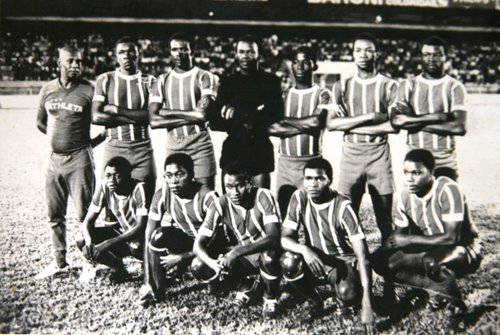
- Timu maarufu ya soka enzi hizo ya Cosmopolitan Club, kutokea Kariakoo, ilikuwa ni timu iliyokuwa ikiwatesa sana Yanga na Simba, kwenye ligi ya ubingwa wa Wilaya ya Ilala.

- Hapa ninawakumbuka wachezaji kama wa kwanza chini kushoto Msomali, wa kwanza chini kulia Jummane Masuminti na kocha wao aliyesimama wa kwanza kushoto Mansur Magram, na wa kwanza aliyesimama kushoto Msuba.

Respect.


FMEs!

 
Abedi Pele Samuel: Ghana's Iconic Soccer Player.


sn_Abedi-Pele-Ayew.jpg


9-Africa-32.jpg


Abedi Ayew, also known as Abedi "Pele" (born November 5, 1964) is a former Ghana International football player and captain. He was named African Footballer of the Year in 1991, 1992 and 1993. Additionally, Pelé named him as one of the top 125 greatest living footballers in March 2004.

Playing career

Abedi Pele was one of the pioneers of African football in Europe. One of the first great African players to make an impact on European club football, he played for teams in Switzerland, Germany, Italy and most famously France where he was very instrumental in Marseille's prominence in the European Champions League during the early 1990s. Amongst his international accolades, he was often included in FIFA "All-star" selections and captained the African all-stars in their victory over their European counterparts in the Meridian Cup of 1997.


He left Ghana after the '82 African Cup for Qatar. After a short spell with F.C. Zurich in Switzerland he returned to Ghana but, after both KotokoHearts of Oak failed to signed him, joined AS Dragons FC de l'OuéméBenin. and of He would later return to Ghana and play for Real Tamale United for a season.


He started his European career in France with Chamois Niort, then Montpellier and Lille, before he moved to Olympique Marseille. He later joined Lyon. He also played for Torino of Italy, where he won the Best Foreign Player in Serie A, before finishing his European sojourn with 1860 Munich. Abedi Pele went on to sign a 2 year contract with Al Ain FC in the United Arab Emirates and was nominated as one of the best foreign players to play in the UAE league.


He was the captain of Ghana's national football team for 6 years (1992&#8211;199 and was one of the first African football players to finish highly in FIFA World Player of the Year lists in 1991 and 1992. He is arguably Africa's most decorated and honored football player ever, winning the France Football Magazine African player of the year award 3 times, the BBC sports person of the year, and the Confederation of African Football version twice. He was also awarded the golden ball award for being the best player at the 1992 African Cup of Nations, and was the "man of the match" in Marseille's historic European Champions League final win over AC Milan in 1993.


Abedi Pele played for Ghana 73 times and is considered the greatest football player in his country's history, and among the best in Africa. He is the top goal scorer for Ghana's Black Stars in its 50 year footballing history with 33 goals. He was a fixture in the African Championships of the 1980s and 90s with his national team, and a member of Ghana's victorious team in the 1982 African Cup of Nations, but he never had an opportunity to play in the FIFA World Cup, as the Black Stars failed to qualify for the competition during his career.


However, he was arguably the most dominant figure on the African football scene for nearly a decade. His performance in the 1992 African Cup of Nations is often cited as one of the most outstanding football displays by any player in a single tournament. His native Ghana reached the finals of the Cup that year, only to lose on penalties in the final to Ivory Coast after Abedi was suspended because of a Yellow cardSemi-final match against Nigeria.


Prior to that, his 3 spectacular goals against Zambia, Congo and Nigeria proved crucial in putting Ghana through to their 7th appearance in a CAN final - and their first final in 10 years. The performance earned him the added nickname of "The African Maradona". His solo run goal against Congo in the quarter finals is often compared to Maradona's 2nd against England in the 1986 world cup. His backheader goal against Nigeria from the edge of the opponent's penalty box also heralded international acclaim.


Abedi holds the record for most appearances at the Nations Cup Finals, beating even the legendary Roger Milla of Cameroon to the record. He made his first appearance at the 13th Nations Cup Finals in Libya in 1982 and for the next 16 years (ending at the 21st Finals in Burkina Faso) continued to grace the most prestigious football tournament on the continent, first as a member of Ghana's squad rising to become captain in 1991. Aside from his acclaimed exploits at the 1992 competition, Abedi also earned much acclaim for his 3 goals at the 1996 competition - where he lead Ghana to the semi finals of the competition despite critics expecting him to be in the twilight of his career.


At the club level, he was a key figure in Olympique de Marseille's dominance of the French league - resulting in 4 league championships and 2 European Champions League finals appearances. An attacking midfielder, Abedi became as famous for his sublime dribbling skills as well as a talent for scoring spectacular and often very important goals. Many such goals became regular "Goals of the Week" on ITN's weekly "European Football" program.


At Marseille, he was a member of the team's "Magical Trio", along with Jean Pierre Papin and Chris Waddle - spearheading perhaps Europe's strongest league side of the early 1990s. Abedi was the only remaining member of the trio still with the side when Marseille defeated AC Milan in the 1993 Champions league final in Munich.


Ayew has the singular honour of participating in more FIFA organized charity matches than any other African player. He is very popular in many African countries, especially the French-speaking countries because of his exploits in France. In countries such as Nigeria and South Africa, football fans still wear T-shirts bearing his name. He has become one of the continent's most respected and important ambassadors. Abedi Pele is a member of FIFA's Football Committee, and of the player status committees of both FIFA and CAF.


That explains why the South African FA made him a Spokesperson for their 2006 World Cup bid. Abedi is considered one of the best players in World History to not appear at the FIFA World Cup, and perhaps the greatest African football player ever. In appreciation of Abedi's devout services to the country, the Ghanaian government awarded him the country's highest honour, the Order of the Volta (civil division). He thus becomes the first Ghanaian sportsman to be so honoured.


On 29 January 1997, the first UEFA-CAF Meridian Cup All-Star Match between Europe and Africa was played in S.L. Benfica's Estádio da Luz in Lisbon Portugal and was televised in 100 countries worldwide, including 30 in Africa, for a 60 million audience. Former Olympique de MarseilleVincent Guérin had equalised for Europe just before half-time, midfielder Abedi Pele was on target with a stunning goal early in the first half and, after it was the 1998 African Player of the Year, Mustapha Hadji, who struck Africa's 78th-minute winner in the 2-1 win.<sup class="reference" id="cite_ref-uefa_meridian_1-1">[2]</sup>
After retirement

<dl><dt>CAF-UEFA All Star</dt></dl> In 2001, the UEFA-CAF Meridian Cup All-Star Match format was changed slightly for the second All-Star Match to bring together great players aged between 35 and 45 who now revel in their &#8216;veteran' status and play the game purely for pleasure. The squad sparked off memories of great footballing moments at club and international level<sup class="reference" id="cite_ref-uefa_meridian_1-2">[2]</sup>
<dl><dt>Football Ambassador</dt></dl> In June 2001 he was nominated by the present government of Ghana to serve as the next Chairman of the FA, an opportunity he later gave up for a more experienced former coach of Ghana for which in his own words said that this was to be an opportunity to learn from his superiors.
At present he owns a second division club, called Nania F.C., with the future hopes of nurturing the young talent to augment the fledging league of the country. He has also been involved with various Charity work across the Continent.
<dl><dt>Controversy</dt></dl> He was recently embroiled in a serious alleged Second Division Promotion Play-off bribery scandal<sup class="reference" id="cite_ref-National_Middle_League_3-0">[4]</sup> for which the Football Association found him and others guilty. The guilty verdict attracted fines and suspensions of Abedi and others, but these have been quashed by the Appeals Committee of the Football Association after determining that there were irregularities in the initial judgement<sup class="reference" id="cite_ref-Appeals_Decision_4-0">[5]</sup> of the Ghana Football Association. T


he allegations stem from an astonishing 31-0 victory recorded by his club, Nania FC over a much respected Okwawu United side. A similarly farcical 28-0 result was recorded in another second division match played between Great Mariners and Tudu Mighty Jets on the same weekend. The clubs involved in that Second Division Promotion Play-off Zone III match were also investigated and subject to the prospect of stiff penalties and demotions.


Despite his vehement denials,<sup class="reference" id="cite_ref-National_Middle_League_3-1">[4]</sup> Abedi had been chastised by some members of the Ghanaian media, who were demanding that strong punitive actions be taken against him, by Ghana's football governing body as well as the legal system.<sup class="reference" id="cite_ref-Ghana_Football_5-0">[6]</sup> His wife Maha Ayew was on 3 November 2008 banned from football against this Manipulations Scandal.<sup class="reference" id="cite_ref-6">[7]</sup>


He currently features in the EA Sports FIFA 07 and FIFA 08 video game as a star of their Classic eleven.<sup class="reference" id="cite_ref-Fifa_07_7-0">[8]</sup>
Respect.

FMEs!
 
[FONT=Arial, Helvetica, sans-serif]John Akibua: Uganda's Best Sprinter


[/FONT]<!-- google_ad_section_start -->
2. John Akibua (b. 3. born December 1949 died 1997)


Hailing from the east coast, Akibua is the 1st Olympic champion that Uganda has ever produced and the only Ugandan to break an Olympic record. In 1972 at the summer Olympics in Munich, Akibua set a world record of 47.82 seconds.

He is credited with introducing the "Victors' lap of honour" when a spectator handed him a Ugandan flag after his victory and he ran around the track with it draped around his shoulders.
Respect.

FMEs!

[FONT=Arial, Helvetica, sans-serif]
[/FONT]
 
coamo1984_new.jpg


San Blas Half Marathon (Coamo, Puerto Rico) 1984. The leaders: Zacaria Barie (25) and Gidamis Shahanga (26) from Tanzania,
and Mike Musyoki from Kenya. Hardly seen in the back is Marti Vainio from Finland. Barie won the race in 1:04:53, Shahanga
second in 1:05:12 and Musyoki third in 1:05:35. Vainio finished 31th with 1:12:06

Shahanga Wins LA Marathon
: Published: February 20, 1984

Gidamis Shahanga of Tanzania
pulled away in the late going and Jacqueline Gareau of Canada was strong all the way as they won the men's and women's titles in the 1984 Los Angeles International Marathon run today on the Summer Olympics course.


Shahanga broke loose from Joseph Nzau of Kenya with two miles to go and scored a comfortable 21-second victory in a time of 2 hours 10 minutes 19 seconds. Nzau was second in 2:10:40 and Gerald Nijboer of the Netherlands was third in 2:10:53.

Chris Schallert of Los Angeles was the top American man, finishing in eighth place at 2:15:16. Miss Gareau, of Montreal, dueled Ann Audain of New Zealand most of the way and won in 2:31:57. Niss was second in 2:32:07. Her teammate, Mary O'Connor, was third in 2:33:44.
Respect.

FMEs!
 
Suleiman Nyambui (born February 13, 1953) is a former athlete from Tanzania who won the silver medal in 5000 metres at the 1980 Summer Olympics. He also won a bronze medal at the 1978 All-Africa Games, and twice (1987 and 1988) triumphed at the Berlin Marathon.


Attended the University of Texas at El Paso (UTEP) from 1978 to 1982, where, as an older aged athlete (he was 29 when he graduated), he won four straight NCAA titles in the 10,000 meters - one of only five Division I men to ever accomplish such a feat. He also won 3 straight NCAA titles in the 5,000 meters while at UTEP and was the 1980 NCAA Cross Country champion. In a memorable Millrose Games race in New York in February 1981, Nyambui broke the world indoor 5,000 meter record with a 13:20.4, just head of Alberto Salazar who broke the American indoor 5,000 meter record

Respect.


FMEs!


78mxc.jpg
 

Similar Discussions

Back
Top Bottom