FMES: Tuwakumbuke Wanamichezo Africa!

FMES: Tuwakumbuke Wanamichezo Africa!

DSC_8540.JPG


Yanga Africans: Tanzania 1970s.
 
FMES
Tukumbushe bana maana wengine tulikua vitoto sanasana
Mkuu tukumbushe na Vijana Jazz enzi za ...toka tulipohamia Masaki mchezo wa kuomba chumvi hakuna kila nyumba in mbwa...
 
Boke Matambalya ( Timu ya netiboli ya Jeshi la Wananchi wa Tanzania)
Nasekile Anthony, Sodani Khalid, Fatuma Kihombo ( Nyanda Za juu miaka ya sabini walikuwa wanawake wa Shoka)
 
Sipho Mabuse

hotstix.jpg


Sipho "Hotstix" Mabuse was born in Johannesburg on 2 November 1951. Mabuse got his start in the African soul group the Beaters in the mid-1970s. After a successful tour of Zimbabwe they changed the group's name to Harari. When they returned to their homeland in South Africa they began to draw almost exclusively on American-style funk, soul, and pop music, sung in Zulu and Sotho as well as English.


He has also recorded and produced for, amongst others, Miriam Makeba, Hugh Masekela, Ray Phiri and Sibongile Khumalo. Mabuse is responsible for "Burn Out" in the early 1980s which sold over 500,000 copies, and the giant mbaqanga (traditional Zulu) hit of the late 1980s, "Jive Soweto".

His daughter is the singer Mpho Skeef.

- Enzi za 1980s, kulitokea kibao kikali sana kwa jina la "Zanzibar" hasa katika kumbi za Disco, huyu ndiye aliyeimba ule wimbo saafi sana.

Respect.


FMEs!
 
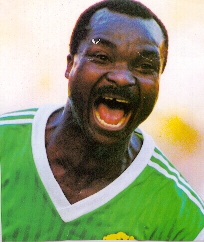
<table border="0" cellpadding="0" cellspacing="0"><tbody><tr><td align="left" valign="top"><center>Roger Milla
milla.jpg

</center>
Roger Milla (born Albert Roger Mooh Miller, May 20, 1952) is a Cameroonian former football forward. He was one of the first African players to be a major star on the international stage. He played in three World Cups for the Cameroon national team. He achieved international stardom at 38 years old, an age at which most footballers have retired, by scoring four goals at the 1990 World Cup, helping the Cameroon team reach the quarter-finals.

He was named one of the 125 greatest living football players in 2004 by the legendary Brazilian football player Pelé.

National team


While playing in France, he made his first appearance for the Cameroon national team. He was a member of Cameroon's team at the 1982 FIFA World Cup, having a goal disallowed against Peru in their first match. Cameroon went out with three draws from their three first-round games. Two years later, he was part of the squad competing at the 1984 Summer Olympics in Los Angeles, California.

He first retired from international football in 1987, and eventually moved to Réunion in the Indian Ocean for his retirement.
However, in 1990, he received a phone call from the President of Cameroon Paul Biya, who pleaded with him to come out of retirement and rejoin the national team. He agreed, and went to Italy with the Indomitable Lions for the 1990 World Cup.


1990 World Cup


38-year old Milla emerged as one of the tournament's major stars. He scored four goals in Italy, celebrating each one with a dance around the corner post that has become a popular goal celebration ever since. Two of his goals came against Romania in Cameroon's second game, and two more came in extra time against Colombia in the last 16 to carry Cameroon to the quarter-finals &#8211; the furthest an African team has ever advanced at the World Cup (Senegal matched this feat in 2002).

In the quarter-final match against England, Milla confirmed his super-sub legend, entering in the second half with Cameroon trailing 1-0 and setting up a brilliant goal and drawing a penalty shot to give Cameroon the lead before eventually losing.

1994 World Cup


Milla returned to the 1994 FIFA World Cup at the age of 42, being the oldest player ever to appear in a World Cup. Cameroon were knocked out in the group stages; however, Milla scored a goal against Russia, setting a record as the oldest goalscorer in a World Cup tournament.

Post-playing career


He is now an itinerant ambassador for African causes. In 2004, he was named to the FIFA 100, a list of the 125 greatest living footballers selected by Pelé in conjunction with FIFA's centenary celebrations.

Best African Player of the century


In 2006, Milla was chosen for best African player of the last century, ending up ahead of El Khatib and Hassan. The election was held by the CAF, the African football association
.
- Hii ni another great story out of Africa.

Respect.

FMEs!
</td><td align="left" width="20" valign="top">
</td><td align="left" valign="top"><table border="0" cellpadding="0" cellspacing="0"><tbody><tr><td width="120">
</td><td>
</td></tr><tr><td width="120">
</td><td>
</td></tr><tr><td width="120">
</td><td>
</td></tr><tr><td width="120">
</td><td>
</td></tr><tr><td width="120">
</td><td>
</td> </tr> <tr> <td width="120">
</td> <td>
</td> </tr> <tr> <td width="120">
</td> <td>
</td> </tr> <tr> <td width="120">
</td> <td>
</td> </tr> <tr> <td width="120">
</td> <td>
</td></tr></tbody></table></td></tr></tbody></table>
 
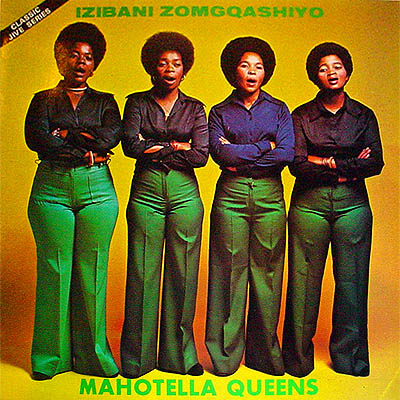
Mahotella Queens

Mahotella Queens , South African vocal group formed in 1964 by songwriter Robert Bopape. One of the most popular dance bands in South Africa, they often perform with the support of other established singers (including Mahlathini, the "Lion of Soweto" ) and the vocal group Abafana. Though the Queens are prolific recording artists, only a few of their albums are available outside South Africa; these include Phezula Eqhudeni (1983), Thokozile (198, Women of the World (1993), and Sebai Bai (2001).
mahotella.jpg


mahotella.jpg


MANTCD060.jpg


tmq_kazet.jpg


article_mahotella.jpg


Mkulu FMES, najaribu kuweka hizi picha za hawa 'wadada' matata wa enzi hizo toka bondeni zagoma, kama vipi niwekee sawa
 
[ame="http://http://www.youtube.com/watch?v=4GvrVIQ3QbE"]http://http://www.youtube.com/watch?v=4GvrVIQ3QbE[/ame]


[ame="http://http://www.youtube.com/watch?v=NXUgexeE-w8&feature=related"]http://http://www.youtube.com/watch?v=NXUgexeE-w8&feature=related[/ame]


[ame="http://http://www.youtube.com/watch?v=jWFOLyjqb28&feature=related"]http://http://www.youtube.com/watch?v=jWFOLyjqb28&feature=related[/ame]


[ame="http://http://www.youtube.com/watch?v=kamd3h6YCfI&feature=related"]http://http://www.youtube.com/watch?v=kamd3h6YCfI&feature=related[/ame]


[ame="http://http://www.youtube.com/watch?v=WSjMfnwWvN4&feature=related"]http://http://www.youtube.com/watch?v=WSjMfnwWvN4&feature=related[/ame]


Enjoy
 
Mzwakhe Mbuli


Mzwakhe Mbuli, a devout former Deacon at Apostolic Faith Mission Church in Naledi Soweto South Africa, known as "The People's Poet, Tall man, Mbulism", is a popular poet and mbaqanga singer in South Africa. He was born in Sophiatown in 1958, but his family was forced to move to Soweto when the government bulldozed his home town .

His works include a book of poems, Before Dawn (1989), and albums Change is Pain (1986), Unbroken Spirit (1989), Resistance and Defence (1992), and Africa (1993). His poems are mainly in English but draw on his native Zulu as well as traditional praise poetry and rap. His best-known poem is Change is Pain, a protest piece about oppression and revolution, which was initially banned until growing pressure forced South Africa to allow more freedom of speech. His first performance group was called "Khuvhangano".

Throughout the 1980s Mzwakhe was repeatedly detained by the authorities and denied a passport to travel while playing a leading role in the Cultural activities of the United Democratic Front. His international career began in 1990 in Berlin, Germany when he shared the stage with Youssou N'dour, Miriam Makeba and Thomas Mapfumo. An imposing figure, standing well over 6 foot tall, he performed at the funeral of Chris Hani, the assassinated head of the South African Communist Party, and at the presidential inauguration Nelson Mandela in 1994. In 1996 Mbuli was invited to London to co-host, with British poet and activist Benjamin Zephaniah, the Two Nations Concert at the Albert Hall to honor President Nelson Mandela on his visit to London . Later in the year, he returned to the UK to join Peter Gabriel], Youssour N'dour and other prominent African artists to record the fundraising Aids Album.

Mbuli was convicted in March 1999 for armed robbery and possession of a hand grenade - crimes he has consistently denied committing; he and his supporters have always insisted he was framed by the government for speaking out against corruption. He was held at the Leeuwkop Maximum Security Prison, until his release in November 2003. His most recent release is Mbulism.
From Wikipedia

back to top
Like Mzwakhe Mbuli? You might also like...
Ihashi Elimhlophe West Nkosi Mbongeni Ngema Sipho Gumede Condry Ziqubu Bhekumuzi Luthuli Tsepo Tshola Dilika


Mzwakhe Mbuli's Best Songs
1. Uyeyeni
2. Many Years Ago
3. Giya
4. Nkosi Sikelela
5. It's Sad In This World
6. Song for God
7. Mbulism
8. Ngenxa Yothando
9. Ndimbeleni
10. Lusaka

 
[ame="http://http://www.youtube.com/watch?v=RGPeQjFy6xw&feature=PlayList&p=279CF716B6AA5D98&playnext=1&playnext_from=PL&index=1"]http://http://www.youtube.com/watch?v=RGPeQjFy6xw&feature=PlayList&p=279CF716B6AA5D98&playnext=1&playnext_from=PL&index=1[/ame]

[ame="http://http://www.youtube.com/watch?v=W6vqJ4RKHFU&feature=related"]http://http://www.youtube.com/watch?v=W6vqJ4RKHFU&feature=related[/ame]

[ame="http://http://www.youtube.com/watch?v=3wwHd0PCF_c&feature=related"]http://http://www.youtube.com/watch?v=3wwHd0PCF_c&feature=related[/ame]
 
t4.jpg


kocha wa taifa stars marcio maximo toka brazil akiwa na wakongwe wa soka ambao toka shoto ni kipa james kisaka, kipa juma pondamali na beki athumani chama.


Respect.


FMES!

 
Hugh Masekela


BIOGRAPHY

Hugh Ramopolo Masekela was born on April 4, 1939, in Witbank, South Africa. He began singing and playing piano as a child. But at age 14, after seeing the film, YOUNG MAN WITH A HORN, where Kirk Douglas portrays American Jazz trumpeter, Bix Beiderbecke, he took up trumpet, given to the young Hugh by Archbishop Trevor Huddleston, the anti-apartheid chaplain at St. Peters Secondary School.

Masekela had been greatly moved by the music he heard on the 78 RPM gramophone records of Louis Armstrong, Jelly Roll Morton, Bessie Smith, Ma Rainey, Chick Webb, Ella Fitzgerald, Sy Oliver, Duke Ellington, Count Basie, Coleman Hawkins, Cab Calloway, Fats Waller, Sarah Vaughan, Louis Jordan, The Ink Spots, the Mills Brothers, Billie Holiday and Charlie Christian.

In his teens, he fell in love with Dizzy Gillespie, George Shearing, Miles Davis, Clifford Brown, John Coltrane, Cannonball Adderley, Horace Silver, Art Blakey, Lee Morgan, Kenny Dorham, Oscar Peterson, Bud Shank, Dave Brubeck, Paul Desmond, Stan Getz, Jackie & Roy Kral, June Christy Shorty Rogers, Gerry Mulligan, Chet Baker, Bud Powell and Mahalia Jackson.

After Huddleston asked the leader of the then Johannesburg "Native" Municipal Brass Band, Uncle Sauda, to teach Hugh the rudiments of trumpet playing, the young boy quickly proceeded to master the instrument. Soon, some of Hugh's music-loving schoolmates also became interested in playing instruments, leading to the formation of the Huddleston Jazz Band, South Africa's very first youth orchestra. Hugh went on to play in other dance bands led by the great Zakes Nkosi, Ntemi Piliso, Elijah Nkwanyana and Kippie Moeketsi. By 1956, Hugh joined Alfred Herbert's African Jazz Revue.

Following a Manhattan Brothers tour of the country in 1958, Masekela wound up in the orchestra for the KING KONG musical written by Todd Matshikiza. KING KONG set South Africa's first record &#8211; breaking blockbuster theatrical success, touring the country for a sold-out year with Miriam Makeba and the Manhattan Brothers' Nathan Mdledle in the lead. The musical later went to London's West-End for two years.

At the end of 1959, Dollar Brand (later known as Abdullah Ibrahim), Kippie, Jonas, Makhaya Ntshoko, Johnny Gertze and Hugh formed the Jazz Epistles, the first African jazz group to record an LP and perform to record-breaking audiences in Johannesburg and Cape Town through late 1959 to early 1960.

Following the March 21, 1960, Sharpeville Massacre - where 69 peacefully protesting Africans were mercilessly mowed down and the government banned gatherings of ten or more people - and the increased brutality of the Apartheid state, Hugh finally left the country. Hugh was helped by Trevor Huddleston and international friends like Yehudi Menuhin and John Dankworth, who got him admitted into London´s Guildhall School of music.

Miriam Makeba, who was already enjoying major success in the United States, along with Harry Belafonte, Dizzy Gillespie and John Mehegan later helped Hugh obtain admission to the Manhattan School of Music in New York. It was during this time that Hugh had the opportunity to meet Louis Armstrong, who a few years earlier had sent the Huddleston Jazz Band a trumpet after the chaplain told the trumpet king about the band he had helped start back in South Africa.

Masekela began recording extensively with Miriam Makeba and can be heard adding his trumpet, singing and arranging talents to some of the singer's very best records. By 1963, the trumpeter had recorded his first solo album, TRUMPET AFRICAINE, and the following year, Makeba and Masekela were wed.

The trumpeter's breakthrough record was his engaging 1965 live performance, THE AMERICANIZATION OF OOGA BOOGA, which was produced by the late Tom Wilson, who had also produced Bob Dylan and Simon & Garfunkle's debut successes.

Masekela and Makeba divorced in 1966 and the trumpeter soon relocated to Los Angeles. In no time at all, the trumpeter began to take charge of his own career. He was attracting a sizable concert following on the West Coast and could be heard playing his brand of African influenced popular music alongside, or along with, emerging rock bands (The Byrds, Bob Marley).

He began recording for MCA's hip pop subsidiary, UNI Records, where he and business partner, producer Stewart Levine, released such signature Masekela performances as THE EMANCIPATION OF HUGH MASEKELA (1966), the wondrous African collection AFRICA '68 and, of course, Masekela's biggest hit ever, 1968's "Grazing In The Grass," from THE PROMISE OF A FUTURE.

By 1970, Masekela and Levine formed Chisa Records, a Motown subsidiary, which featured the recordings of Masekela as well as The Crusaders (it was Hugh who suggested they drop "Jazz" from their name), Letta Mbulu and Monk Montgomery. There were about seven releases in the Chisa series, including Hugh's own RECONSTRUCTION (1970) and HUGH MASEKELA AND THE UNION OF SOUTH AFRICA (1971), before the label folded.

Levine and Masekela moved their Chisa operation to Blue Thumb Records (1972-74), where Masekela began to seriously dig back into his African jazz heritage. Masekela moved to Guinea (where, at the time, Miriam Makeba was living), then Liberia and then on to Ghana shortly after recording (in London) the historical HOME IS WHERE THE MUSIC IS with the great African reed player, Dudu Pukwana.

In 1973, while in Nigeria, Masekela met Fela Kuti, who inspired the trumpeter to explore the "afro-beat" music that Kuti and Cameroonian sax player Manu DiBango were experiencing worldwide popularity with. Masekela loved what he heard and teamed with the Ghanaian band, Hedzoleh Soundz for a successful collaboration that lasted nearly five years. They first recorded an album that included the amazing "Languta" and, most successfully again in 1974 to produce the record I AM NOT AFRAID, featuring some of Hugh's most enduring compositions - "In the The Market Place," "African Secret Society" and "Coal Train (Stimela)," numbers he still performs to enthusiastic audiences today.

By 1975, Hugh was lured back to "hit-making music" by the newly launched American label, Casablanca Records - which would later house some of the decade's best disco music (Masekela even recorded briefly as "Disco Kid" at the label's inception). Continuing to work with his African musical associates, notably Stanley Todd, Masekela created four albums that continued his supreme reign as a true world music emissary, easily engaging disco, pop and soul music with various African forms - notably on 1977's YOU TOLD YOUR MAMA NOT TO WORRY.

After a tour and two exceptional African jazz albums with Herb Albert, Hugh reunited with Miriam Makeba in 1980 to play a Christmas Day concert in Lesotho, where 75,000 people came to see them after they had been away from the region for 20 years.

In 1981, Hugh moved to Botswana, where he started the Botswana International School of Music with Dr. Khabi Mngoma. Several years later, Hugh had his record label, Britain's Jive Records, help him set up a mobile studio in Gaborone, where he recorded the great TECHNO-BUSH, which launched his first dance hit, "Don't Go Lose It Baby." In 1985, shortly after recording WAITING FOR THE RAIN, Masekela had to leave with his band Kalahari for England after the South African Defense Force massacred his friend George Phahle and his wife Lindi Phahle along with 14 other people in the pretext of raiding "communist terrorist camps" manned by South African Anti-Apartheid activists.

While in England, Hugh recorded one of his greatest works, TOMORROW (this writer's introduction to Hugh Masekela and still his favorite Masekela record!), which featured Hugh's next hit, "Bring Him Back Home" (a.k.a. "Mandela"). While there, Hugh also conceived, with playwright and songwriter Mbongeni Ngema, the mbaqaga musical SARAFINA, which found great success on Broadway in 1988. After touring with Paul Simon's GRACELAND - which included a number of prominent African musicians including Ladysmith Black Mambazo and Miriam Makeba - Masekela finally was able to return home, following the unbanning of political parties and the release of Nelson Mandela in 1990.

In 1991, Masekela launched his first tour of South Africa, called Sekunjalo - This Is It! with the bands Sankomota and Bayete - happily caught on the joyous DVD release, HOMECOMING CONCERT. The extravagant four-month tour sold out throughout the country's major cities. Now, happily living in his South African home, Masekela signed in 1995 with Columbia Records, which reissued his 1982 album, HOME, as well as the recent recordings, BLACK TO THE FUTURE and SIXTY (both issued by the Shanachie label in the United States).

Masekela continues to maintain a very active tour schedule, spreading his musical message of peace, harmony and unity throughout the world. He can also be heard adding his distinctive voice and flugelhorn to many other world artists' recordings - from some of Bob Marley's earliest recordings to Buena Vista Social Club bassist Cachaito Lopez's 2001 solo record.
 
[ame="http://http://www.youtube.com/watch?v=AgYhTTZXP4g"]http://http://www.youtube.com/watch?v=AgYhTTZXP4g[/ame]

[ame="http://http://www.youtube.com/watch?v=XKCk8o5xzaM&feature=related"]http://http://www.youtube.com/watch?v=XKCk8o5xzaM&feature=related[/ame]

[ame="http://http://www.youtube.com/watch?v=0FxkNDudQgI&feature=related"]http://http://www.youtube.com/watch?v=0FxkNDudQgI&feature=related[/ame]
 
Maximo.jpg


KOCHA MKUU WA TAIFA STARS MARCIO MAXIMO AKIWA NA KOCHA WA VIJANA (KULIA), MWALIMU WA MAZOEZI YA VIUNGO (KATI) KOCHA WA MAKIPA JUMA PONDAMALI (SHOTO) NA MENEJA WA TIMU LEOPORD TASSO MUKEBEZI.


- Wakuu historia ni kwamba Jumapondamali ndiye aliyekua kipa wetu katika timu ya taifa iliyoshiriki kwenye finali ya kombe la Africa, kule Lagos Nigeria mwaka 1980 na Leopord Tasso Mukebezi, ndiye aliyekua beki namba 4 wa hiyo national team yetu iliyokwenda finali.

Respect.

FMEs!
 
Brenda Fassie

Born in 1964 in Langa, South Africa; died on May 9, 2004, in Johannesburg, South Africa; daughter of Sarah (an amateur pianist); married Nhlanhla Mbambo, 1989 (divorced, 1991); children: Bongani (son, with musician Dumisani Ngubeni).

Known as the "Madonna of the Townships" or simply as the "undisputed queen of the vocals," and generally deemed one of South Africa's biggest female pop stars of recent years, Brenda Fassie notched a long string of infectious pop hits. Her music was deeply woven into the fabric of South African life, and more than once her music played a role in the country's tumultuous political scene. A major talent whose popularity survived several waves of musical fashion and extended at its height to Europe and the United States, Fassie struggled with personal demons before dying a tragically early death in 2004.

Fassie was born in 1964 in Langa, in one of apartheid-era South Africa's black townships near Cape Town. Her mother, Sarah, an amateur pianist, named her after the American country-pop star Brenda Lee. At the age of four she formed a little vocal group called the Tiny Tots. She became something of a local celebrity, and when top South African producer Koloi Lebona came to town in 1979, local musicians raved about her voice and guided the producer to her mother's house.

"There was something special about her voice," Lebona was quoted as saying on South Africa's News24 website. "I knew it was the voice of the future." According to an EMI label biography quoted on the South African music.org.za website, Fassie asked with characteristic brashness, "So when are we going to Joburg [Johannesburg]?" Lebona agreed to let Fassie finish her education while living with his family in segregated Johannesburg's Soweto township, and she soon joined a vocal trio called Joy and then joined another successful act, Blondie and Papa.

By 1983 Fassie had formed an act of her own called Brenda and the Big Dudes, and that year she had a breakthrough hit with "Weekend Special," singing in the disco-flavored "bubblegum" style. "Weekend Special" sold over 200,000 copies and had an extended life in cover versions and remixes, including one by New York producer Van Gibbs in 1986 that spent eight weeks on Billboard magazine's Hot Black Singles chart. The song's international success led to a Fassie tour of the United States, Europe, Australia, and Brazil.

After parting ways with the Big Dudes, Fassie partnered with producer Sello "Chicco" Twala to record the 1989 album Too Late for Mama. Among several hits that became widely known in South Africa's black townships was "Black President," a single that looked forward to the dismantling of the country's apartheid system. That song was banned for a time by the South African government, but Fassie's popularity only increased.

Despite these successes, Fassie's personal life was in disarray. She had a son named Bongani out of wedlock with Big Dudes member Dumisani Ngubeni in the 1980s, and she divorced her first husband, Nhlanhla Mbambo, in 1991, two years after marrying him. The reason for the divorce was rumored to be spousal abuse. In 1993 Fassie faced the twin stresses of her mother's death and the dissolution of her working relationship with Twala. Fassie fell into the grip of cocaine addiction and developed a reputation for missing concerts. Her popularity sank, and she reached a grim low point in 1995 when she awakened in a Johannesburg hotel next to the dead body of her lesbian lover, Poppie Sihlahla, who had suffered a drug overdose.

Fassie checked into a drug rehabilitation center and made a serious effort to reform. She would, however, battle addiction on and off for the rest of her life. She attempted a comeback in 1996 by recording two duets with Zairean vocalist Papa Wemba, but it was after she reteamed with Twala that her career once again really took off. Twala produced her album Memeza, which was recorded in 1997 and went on to become South Africa's top-selling album in 1998. The album's title meant "shout," and Fassie was quoted by the BBC News website as saying that the album and its title track reflected her own life. "I'd been shouting and shouting and no one wanted to hear me. When I sing this song, I want to cry," she said. Another song from the album was used in the 1999 election campaign of the African National Congress party, and Fassie performed at the inauguration of South African president Thabo Mbeki.

Fassie, like R&B star Aaliyah of the United States, had a voice that adapted itself well to the dance beats of the moment. "Her songs," noted the authors of World Music: The Rough Guide, "can seem a barely comprehensible mish-mash of the latest township lingo but they have that quality of sticking in the minds of her listeners." In the late 1990s Fassie successfully made the transition from bubblegum to the hip-hop and techno-influenced kwaito style, with its predominantly Xhosa, Zulu, and Sotho lyrics.

After Memeza, Fassie enjoyed a string of huge successes. Nomakanjani (1999), Amadlozi (2000), and Mina Nawe (2001) were all top sellers, and for four years in a row Fassie took home the South African Music Awards' prize for the Best-Selling Album of the Year. She also won the Kora Award for Best Female Artist twice, and declared, according to the News24 website, that "I'm going to become the Pope next year. Nothing is impossible." In 2001 Fassie toured the United States once again, and her international reputation seemed to be on the rise. In December of that year Time magazine devoted a three-page article to Fassie, calling her the "Madonna of the Townships." Her South African fans referred to her as "Ma-Brrr."

Fassie's recordings, incuding a 2001 greatest hits album, 2002's Myekeleni, and 2004's Mali, continued to sell well, and Fassie remained a top concert draw all over Africa. On April 25, 2004, however, Fassie was admitted to a Johannesburg hospital when a severe asthma attack resulted in cardiac arrest, and she died on May 9. Her funeral was attended by both Mbeki and Nelson Mandela. "It should never be forgotten that Fassie was always enveloped by a deep sadness," editorialized the newspaper ThisDay, as quoted on the SouthAfrica.info website. "In Fassie's case the causes are not hard to find: she grew up black and a woman in a country that hated black people and women. ... For every Fassie who makes it out, who knows how many others are lost to drugs, AIDS, and general despair? Who knows how a Weekend Special turns out?"

by James M. Manheim
Brenda Fassie's Career

Brought to Johannesburg by producer Koloi Lebona at age 16, 1979; formed group Brenda and the Big Dudes, 1983; recorded hit "Weekend Special," 1983; worked with producer Sello "Chicco" Twala; released hit album Too Late for Mama, 1989; suffered from substance abuse problems; strong comeback, late 1990s; released Memeza, 1998; had top-selling album in South Africa for four years in a row.
 
m%2B%2827%29.jpg

pichani mambosasa akifanya vitu vyake siku ya yanga na simba uwanja wa nyamagana, mwanza, mwaka 1974 mbele ya kitwana manara popat wa yanga huku beki mkali shaaban baraza wa simba sc

Respect.

FMEs!

 
[ame="http://http://www.youtube.com/watch?v=wfbukOrPPqo"]http://http://www.youtube.com/watch?v=wfbukOrPPqo[/ame]

[ame="http://http://www.youtube.com/watch?v=i9MUvfmY604&feature=related"]http://http://www.youtube.com/watch?v=i9MUvfmY604&feature=related[/ame]

[ame="http://http://www.youtube.com/watch?v=jxOepJiw4K4&feature=related"]http://http://www.youtube.com/watch?v=jxOepJiw4K4&feature=related[/ame]

[ame="http://http://www.youtube.com/watch?v=VrrrdQEYxkc&feature=related"]http://http://www.youtube.com/watch?v=VrrrdQEYxkc&feature=related[/ame]
 
hughmasekela.jpg


Hugh Masekela: Msome Mkulu Balatanda pale juu.


09294_resized_brenda_fassie300.png


Brenda Fassie RIP: Msome Mkulu Balatanda kule juu.

Respect.

FMEs!
 
Sello 'Chicco' Twala

Chicco
Born: 1963, South Africa


Arranger, producer, singer and instrumentalist Sello "Chicco" Twala grew up with music because his father operated an illegal club, or shebeen, in Soweto. Rejecting an earlier plan to become a traffic cop, Chicco opened a disco, but then driven by a desire to play music himself, he took up percussion and practiced assiduously to reach a professional level. In the '70s, Chicco played in soul bands including Umoja and Sipho "Hotstix" Mabuse's Harari. An architect of the disco and bubblegum revolution, Chicco first made a name as a performer in the mid-'80s, but went on to produce major stars, including Yvonne Chaka-Chaka and more recently Brenda and the Big Dudes. Chicco made his first triple platinum release in 1987, a record that included the song "We Miss You Manelo," a thinly veiled reference to Nelson Mandela, still a prisoner on Robben Island at the time. In 1990, Chicco collaborated with poet Mzwakhe Mbuli on the song "Papa Stop the War." A longtime admirer of music from other parts of Africa, especially Ghana's Osibisa and Nigeria's Fela Kuti, Chicco then took time off to travel and explore the continent. Chicco's sweet soul ballad "Peace Song," recorded by an all-star South African cast and released in 1992, played an important role in fostering the atmosphere of national unity that preceded South Africa's first democratic election in April 1994. The other major producer of South African disco and bubblegum, Dan Tshanda, developed the Dalom Kids and Splash, bands whose shows feature up to ten keyboards and no other instruments on stage.
 
[ame="http://http://www.youtube.com/watch?v=r3j_bPviO34"]http://http://www.youtube.com/watch?v=r3j_bPviO34[/ame]

[ame="http://http://www.youtube.com/watch?v=VpmCUEDUpu0&feature=related"]http://http://www.youtube.com/watch?v=VpmCUEDUpu0&feature=related[/ame]

[ame="http://http://www.youtube.com/watch?v=mTqCGxb_1hg&feature=related"]http://http://www.youtube.com/watch?v=mTqCGxb_1hg&feature=related[/ame]
 

Similar Discussions

Back
Top Bottom