Ok so the trains you ordered can only go as fast as 160km/h but your rail road can support trains that you don't have that can move at speeds of 200km/h? 😂😂
So why are you bragging about a hypothetical 200km/h train that you don't have when you are ordering a slower 160km/h train?
Wakati nyie Watanzania mna tabia mbaya ya kuongea ongea bila matendo tuta tuta tuta Mozambique hawaongei wao wanatenda. Hii project nimeifuatilia kwa karibu sana tangia miaka mitatu zilizopita. Mozambique wanaanza kuproduce gas mbele yenu, shame on you na jinsi mlivyokuwa mkipiga makelele huku kuhusu 30 billion dollar gas plant. Bure kabisa.
Cc joto la jiweGeza Uloleeliakeemtuusan
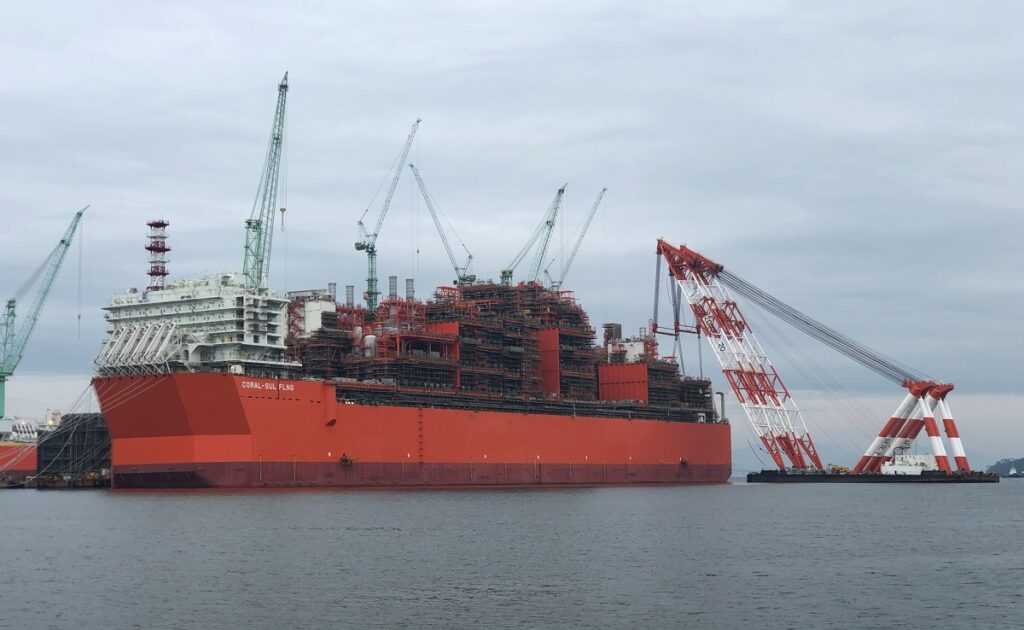
January 4, 2022, by Sanja Pekic The Coral-Sul FLNG vessel, the first floating LNG facility to be in the deep waters of the African continent, has arrived in Mozambique from Samsung Heavy Industries’ shipyard in South Korea.
Illustration; Courtesy of Eni
The FLNG vessel, with a capacity of 3.4 million tonnes of LNG per year, will be specifically located in the Rovuma basin offshore Mozambique.
It will produce gas from the Coral offshore gas field. The field has approximately 16 trillion cubic feet of gas in place. Italian oil and gas Eni, the leader of this project, discovered it back in May 2012.
Specifically, Coral South is a landmark project for the industry; it is to project Mozambique onto the global LNG stage through the development of gas resources.
The Institute of National Petroleum of Mozambique (INP) informed of the arrival of the vessel in the Rovuma Basin on 3 January 2022.
The production at Coral-Sul FLNG will start in the second half of 2022, and it will contribute to increasing gas availability in the country.
To remind, Coral South Project achieved Final Investment Decision in 2017. The construction of the FLNG hull and topside modules started in September 2019.
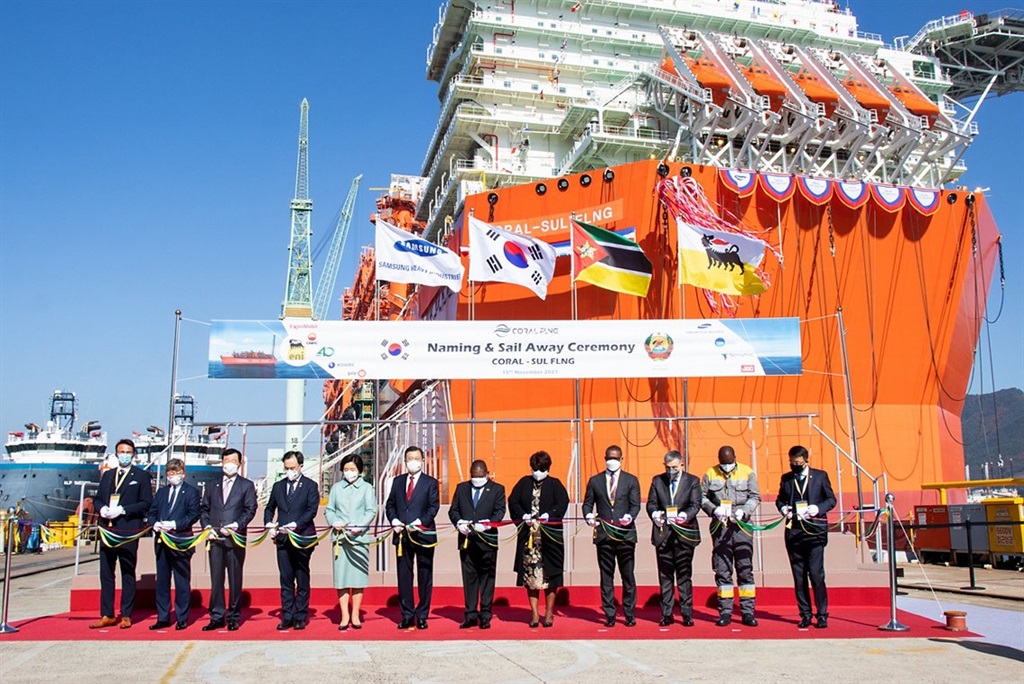
Samsung Heavy Industries was responsible for the entire vessel construction process; from hull design to commissioning, as well as topside production design and manufacturing. SHI held the official launch ceremony of the Coral-Sul FLNG in November 2021.
Notably, SHI has built three out of four FLNG orders placed around the world so far
The Coral Sul Floating LNG plant leaves South Korea for Mozambique
Eni
Africa's first floating liquified natural gas plant has arrived in Mozambique and gas production is on track to begin in the second half of the year.
The Coral South project is the first of a few planned projects which will exploit a significant gas find in the offshore Rovuma Basin.
The vessel's arrival is yet another reminder of South Africa's comparatively slow pace in developing its gas economy, an industry expert says.
After a seven-week voyage, Africa's first-ever deep-sea floating Liquified Natural Gas (LNG) facility has entered Mozambican waters, marking a major milestone ahead of imminent production from an offshore gas field.
The floating plant - known as the Coral Sul FLNG – arrived in Area 4 of the Rovuma Basin this week, Mozambique's National Petroleum Institute announced.
The plant is critical to the $7 billion (about R110 billion) Coral South project, which is operated by Italian oil and gas company Eni. It will produce and sell gas extracted from the southern part of the field.
The 220 000 ton vessel, the main component of which was constructed by Samsung Heavy Industries in South Korea, is the first FLNG built for deep waters and the first specifically built for Africa. Some 432 meters long and 66 meters wide, the plant has the capacity to liquefy 3.4 million tons of natural gas per year.
It will be linked to six subsea gas producing wells, with its LNG earmarked to be sold exclusively to BP under a 20-year offtake agreement signed in 2016.
Eni's partners in Area 4 are ExxonMobil, the China National Petroleum Corporation, Empresa Nactional de Hidrocarbonetos, Galp Energia, and the Korea Gas Corporation. Gearing up for production
The Coral Sul FLNG embarked on its voyage from South Korea on 15 November and entered Mozambiquan waters on 3 January.
According to the National Petroleum Institute, the vessel's arrival is "a milestone in the project's implementation".
Since arriving in Mozambican waters, a complex process of anchoring, surveys, inspections and certifications had begun with a view to issuing the vessel with an operating license so that production can start as planned in the second half of the year.
According to Eni's website, the installation campaign includes mooring and hook-up operations at a water depth of around 2000 meters by means of 20 mooring lines that weigh 9000 tons in total.
The Coral South project will see Eni providing specialist training for more than 800 Mozambican workers, who will be employed in the project's operational phase. The company said it has committed to a "huge programme of work" for local communities to improve their access to basic services such as education, clean water and health care, while supporting long-term, diversified, sustainable socio-economic growth.
Coral South is one of a number of energy projects located in the Rovuma basin.
Also under construction is TotalEnergies' substantially larger $20 billion Mozambique LNG project. Work is yet to resume after the site was evacuated in March last year as a result of nearby Islamic State terrorist attacks.
Still awaiting a final investment decision is ExxonMobil's $30 billion Rovuma LNG project, which was delayed in 2020 in light of an oil price collapse amid the Covid-19 pandemic.
"It is great news for Mozambique and the region that Coral FLNG is now in Mozambique, ahead of commissioning," said Paul Eardley-Taylor, Standard Bank's head of oil and gas for Southern Africa.
"3.4 million tons per annum of LNG can support 4 GW of base load cleaner gas to power and demonstrates that Mozambique's LNG developments continue, despite the pandemic and other challenges," he said.
Across the border in South Africa, the government has long paid lip service to developing a gas economy, but the pace has been frustratingly slow for many industry proponents. Climate concerns have made it more difficult than ever for oil and gas companies to pursue new projects – as shown by fierce opposition to Shell's plans to conduct seismic surveys off SA's Wild Coast.
The arrival of the Coral Sul FLNG is yet another reminder of where South Africa could have been, if it had sprang into action sooner to develop a local gas economy said Niall Kramer, an independent energy consultant.
"It's just frustrating that the world is moving ahead and we are talking about things and not doing what we said we would do," he said. "I think that there's almost an intentional delay in the assumption that if government talk about it and set up a committee and have a meeting, that's enough to pacify business. But it's not."
Kramer said gas will undoubtedly be part of the energy mix in the transition away from fossil fuels and toward renewables – as is outlined in the Integrated Resource Plan 2019, the national electricity infrastructure roadmap.
South Africa needs to develop an environment that's attractive to investors in gas, the likes of who are investing in neighbours like Nambia and Mozambique despite the political and security challenges, said Kramer.
While he recognises there has been some progress – most recently was the release of a draft gas master plan – Kramer said South Africa's gas and renewables policy and execution suffers from "sheer ineptitude" and a "lack of vision" on the transition path toward renewables.
bado nipo dodoma mpk sasa, watu wa huku.. wananchi, viongozi wanasema mama hana mpango wa kuiendeleza dodoma kama rais aliepita alivyokuwa anafanya.. atatekeleza tu ile mirad iliyokuwa approved/iliyotengewa fedha tayar..
huyu mama.. 2025 vita yake itakuwa kubwa sana.. aangalie watu wasije wakamwondoa kwenye urais au hata uhai
Ok so the trains you ordered can only go as fast as 160km/h but your rail road can support trains that you don't have that can move at speeds of 200km/h? 😂😂
So why are you bragging about a hypothetical 200km/h train that you don't have when you are ordering a slower 160km/h train?
It's not hypothetical that our infrastructure can accommodate maximum speed of over 200km/hr. We're starting with 160km/hr, in the near future we might need 220km/r express train that only stops at major stations (Dar - Moro - Dom -Tabo - Mwa).
bado nipo dodoma mpk sasa, watu wa huku.. wananchi, viongozi wanasema mama hana mpango wa kuiendeleza dodoma kama rais aliepita alivyokuwa anafanya.. atatekeleza tu ile mirad iliyokuwa approved/iliyotengewa fedha tayar..
huyu mama.. 2025 vita yake itakuwa kubwa sana.. aangalie watu wasije wakamwondoa kwenye urais au hata uhai
Sponsor wake alishasema wakati wanaweka jiwe la msingi la kujenga ikulu mpya kipindi cha Magu, kuwa, katika uongozi wao hawakutaka Ikulu iwe mbali na pwani.
It's not hypothetical that our infrastructure can accommodate maximum speed of over 200km/hr. We're starting with 160km/hr, in the near future we might need 220km/r an express train that only stops at major stations (Dar - Moro - Dom -Tabo - Mwa).
I wasn't talking about your infrastructure having hypothetical specs, I was talking about the hypothetical 200km/h trains you feel you'll need in the future that you deem unnecessary now. Why waste money on 160km/h trains when you could just get the more superior 200km/h trains now?
Wakati nyie Watanzania mna tabia mbaya ya kuongea ongea bila matendo tuta tuta tuta Mozambique hawaongei wao wanatenda. Hii project nimeifuatilia kwa karibu sana tangia miaka mitatu zilizopita. Mozambique wanaanza kuproduce gas mbele yenu, shame on you na jinsi mlivyokuwa mkipiga makelele huku kuhusu 30 billion dollar gas plant. Bure kabisa.
Cc joto la jiweGeza Uloleeliakeemtuusan
January 4, 2022, by Sanja Pekic The Coral-Sul FLNG vessel, the first floating LNG facility to be in the deep waters of the African continent, has arrived in Mozambique from Samsung Heavy Industries’ shipyard in South Korea.
Illustration; Courtesy of Eni
The FLNG vessel, with a capacity of 3.4 million tonnes of LNG per year, will be specifically located in the Rovuma basin offshore Mozambique.
It will produce gas from the Coral offshore gas field. The field has approximately 16 trillion cubic feet of gas in place. Italian oil and gas Eni, the leader of this project, discovered it back in May 2012.
Specifically, Coral South is a landmark project for the industry; it is to project Mozambique onto the global LNG stage through the development of gas resources.
The Institute of National Petroleum of Mozambique (INP) informed of the arrival of the vessel in the Rovuma Basin on 3 January 2022.
The production at Coral-Sul FLNG will start in the second half of 2022, and it will contribute to increasing gas availability in the country.
To remind, Coral South Project achieved Final Investment Decision in 2017. The construction of the FLNG hull and topside modules started in September 2019.
Samsung Heavy Industries was responsible for the entire vessel construction process; from hull design to commissioning, as well as topside production design and manufacturing. SHI held the official launch ceremony of the Coral-Sul FLNG in November 2021.
Notably, SHI has built three out of four FLNG orders placed around the world so far
$7B vs $30B, hii ni mobile haiitaji muda mrefu kuijenga, hii ni temporary wakati tunayojenga ni permanent plant la lazima itachukua muda mrefu kukamilika
I wasn't talking about your infrastructure having hypothetical specs, I was talking about the hypothetical 200km/h trains you feel you'll need in the future that you deem unnecessary now. Why waste money on 160km/h trains when you could just get the more superior 200km/h trains now?
We need both, with high speed trains you can have multiple set of units with different speeds. The 160km/r can make frequent stops while the 200km/h can stop at major stations. For now we're starting with 160km/h as we have a steep curve to learn.
$7B vs $30B, hii ni mobile haiitaji muda mrefu kuijenga, hii ni temporary wakati tunayojenga ni permanent plant la lazima itachukua muda mrefu kukamilika
It's not hypothetical that our infrastructure can accommodate maximum speed of over 200km/hr. We're starting with 160km/hr, in the near future we might need 220km/r express train that only stops at major stations (Dar - Moro - Dom -Tabo - Mwa).
Kitu usijojua kuhusi lng ya tz ni tofauti na mozambique in tz kuna producers kama 4 halafu kila producer alitaka offshore lng facility kama ya mozambique sisi tukasema No what we want ni one shared onshore lng facility hata baada ya reserves kuisha mtambo utabaki tz unlike mozambique mtambo umejengwa juu ya meli na inapakia hukohuko baharini kina kirefu na reserves zao zikiisha wanaondoka na meli yao yenye mtambo wa lng sisi hatutaki hivyo mtambo wetu utakuwa ni mali ya serikali wale producers kila mmoja atapewa quarter yake katika kuchakata gas.
JamiiForums uses cookies to help personalise content, tailor your experience and to keep you logged in if you register.
By continuing to use this site, you are consenting to our use of cookies.