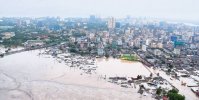
Lia pole pole kabla ya kijiji cha uvuvi cha dar-is-always-a-slum kimewzwe na bahari hindi
View attachment 1959372
Pia Mombasa, though siamini bado..,
Experts say Mombasa will not sink in 100 years
By Philip Mwakio
Marine experts have published scientific evidence of the sea level rising along the coast.
This comes a week after revelations on the possibility of Mombasa Island sinking.
However, experts drawn from the Kenya Marine Fisheries Research (KMFRI) maintained that although the rise is causing land loss, the island would not sink in the next 100 years.
“Rise of sea levels by only a few tens of centimetres could result in loss of land due to erosion and inundation of low lying coastal areas, salt water into coastal ecosystems and into ground water systems, and loss of terrestrial and marine biodiversity.
This may have wide economic, cultural and ecological repercussions,” said KMFRI Research Scientist and Physical Oceanographer Charles Magori.
trend
Speaking at the KMFRI headquarters at Mkomani, Mombasa on Thursday, Dr Magori said that 20 years of monthly sea level data observed by the Mombasa gauge station discloses a rising trend of about two millimeters per year.
ADVERTISEMENT
- The East African
- News
- East Africa
East Africa’s coast is slowly sinking
SATURDAY JULY 19 2014
East Africa's coast could be under water by 2080. Photo/FILE
Summary
- Frequent tidal waves, rising water levels, thinning beaches and heat waves due to global warming are signs of the changing fortunes of the region’s coastal areas.
- Many of the hotels and homes on the beachfront are building massive sea walls, after some of the earlier structures were eroded by the rising waves. The replacements are reinforced with rebar.
ADVERTISEMENT
It is about 6pm and Rashid Gerald is lying on the sand in the shade of a coconut palm, relaxed. He is enjoying the full frontage of Kenyatta beach in Mombasa on Kenya’s coast. As I approach him, his eyes are fixed on me.
“Do you want a floater?” he asks. I politely decline and proceed to sit by his side. While I sample some cowrie shells tucked by the floaters and beach costumes which he hires out, we strike a conversation.
Occasionally, our talk is interrupted as Gerald tends to his clients, mostly local tourists out to savour the glories of the white sandy beaches.
“Business has been good, especially because the locals are coming out to the beach more frequently. But today, I have to close early because the water has reached the shore, and the tides are getting rougher; the divers are warning people to stay on the shore,” he says.
Only experienced swimmers stay in the water. The children and learners are reduced to playing with water on the shore. Even beach volley ball, a popular evening pastime isn’t happening any more.
“Of late, the water and tides have been coming early. In the late 1990s we would spend the evening in the water until the moon appeared. That isn’t the case anymore,” Gerald says.
ADVERTISEMENT
“Are you aware that Mombasa will sink in a few years because of the effects of climate change?” I ask.
Gerald laughs it off, as he starts packing his items, signalling the end of business for the day. Slowly, the beach gets deserted, with a few people heading to the nearby restaurants and bars.
Earlier in the day, I had visited Fort Jesus. The fort, now a Unesco World Heritage Site, was built by the Portuguese in 1591 on the shores of the Indian Ocean in Mombasa. A closer look shows that it is wearing a new coat of paint.
A curator who wishes not to be named says that they have repainted the historic site twice in the past five years, mostly because of the heat, which wears the paint out fast.
Looking at the ocean through its windows, one can see that the water, which in 2005 was a decent distance away, is now as close as 15 metres away at high tide. One can also see the water marks, left on the fortress during high tide.
“The rocks are submerged and guests who would normally go to cool their bodies in the water cannot do that anymore. The tides are high and dangerous in the evenings,” the curator says.
In Mombasa’s South Coast, the story is the same. When Dan Stiles settled in Diani in 1997, the beachfront was perfect — the sand was white and virgin. This slowly started to change, with dirt constantly being dumped on his beachfront.
The sand then turned brown and eventually the beachfront thinned out. Over the years, he has seen sand accumulate on the entire stretch of the beach, deposited by the high tide.
“The tide is now attacking my beach fence, whereas in 1997 it never reached within two metres of it. Since my home is on raised ground some 30 metres from the high tide mark, I figure I have about 10 years before I have to move. There is not much I can do about that,” he says.
Many of the hotels and homes on the beachfront are building massive sea walls, after some of the earlier structures were eroded by the rising waves. The replacements are reinforced with rebar.
Mr Stiles says that on his walks down the beach he has been noticing that the palm trees are being washed away by the rising tide.
“These trees were very tall and were probably at least 30 years old. Since 1997, three rows of palm trees have been inundated by an elevated high tide and washed out. Here in East Africa, global warming with its predicted sea rise is not a future threat — it is here now,” he says.
Mr Stile’s predicament is one of many signs showing the changing fortunes of the Kenyan and East African coast.
A new report by the Inter-governmental Panel on Climate Change also says that Mombasa and other parts of the East African coast could sink in the next half century as a result of rising water levels due to climate change.
East Africa’s coastal areas are facing an increasing range of stresses and shocks including frequent tidal waves, rising water levels, thinning beaches and heat waves. Climate change is here and it will affect the future of the coastal areas.
The Kenyan coastline that covers close to 600 kilometres is host to towns such as Malindi, Mombasa, Lamu, Kiwayu, Manda and Wasini islands while the Tanzanian coastline that extends 800 kilometres boasts of islands such as Chumbe, Fundo, Bawe, Zanzibar, Unguja and Pete.
In May, Kenya’s Cabinet Secretary for Water and Environment Judy Wakhungu warned that the future of the coastal cities and villages was in doubt due to increasingly erratic climate change and rising seas.
“We are seeing the coast, islands and habitats facing a threat of submerging. Scientists have also seen signs in Watamu and Ngomeni on the North Coast, where large swathes of land are now either submerged or lie waste because of the intrusion of salty water from the sea,” said Prof Wakhungu.
“We have also seen a change in the weather patterns within these areas with prolonged droughts, water scarcity and high temperatures. If we do not do something about it, then we will no longer have the tourist hub that Mombasa is.”
She added that the Coast Development Authority has built a 300-metre protection wall on the seafront in an effort to protect Ngomeni village from wave erosion.
Climate-related disasters are projected to increase in frequency and intensity with long-term effects. According to the United Nations Fourth Assessment IPCC report, Mombasa and other East African towns, cities and islands along the coast are likely to be submerged by 2080.
“Higher sea levels will threaten low-lying coastal areas and small islands especially those within the Western Indian Ocean,” the IPCC report reads.
The report estimates that since the beginning of the 20th century, the sea level has been rising at a rate of about two millimetres per year, with the average fastest recorded rates along the global coastline (four millimetres per year) occurring in the 1990s.
“It is estimated that about 17 per cent of Mombasa, or 4,600 hectares of land area will be submerged with a sea level rise of only 0.3 metres.
At the same time, there will be large areas that may be rendered uninhabitable as a result of flooding or water logging, or will be agriculturally unsuitable due to salt stress, especially in the peri-urban space where agriculture is practised,” the report says.
Most sandy beaches and other features including historical and cultural monuments such as Fort Jesus, Vasco Da Gama Pillar, several beach hotels, industries, ship-docking ports and human settlements have been affected by the rise in the sea level.
Erick Okuku, a marine researcher at the Kenya Marine and Fisheries Research Institute in Mombasa says that the entire East African coastline is staring at various impacts of climate change.
Potential impacts
“The increased coastal storm damage and flooding as well as sea shore erosion and loss of coral reefs is contributing to the loss of biodiversity, fisheries and recreational opportunities; these are just some of the potential impacts of a rise in the sea level that could affect the East African coastline,” says Mr Okuku.
Peter Abenje, deputy director at the Meteorological Department says that recent events such as floods, submerging of the Vasco Da Gama pillar and high temperatures are a result of climate change.
“We have participated in the IPCC report and have given the way forward so as to avert major crises in the near future. The current rising sea levels are a result of the melting of the ice at the poles and we are seeing major areas along the coastline being affected,” says Mr Abenje.
“These coastal regions have witnessed land use changes, natural phenomena such as storms, cyclones and tsunamis. They are also experiencing a changing ocean and wave patterns that explain the heat changes,” says Mr Abenje.
In 2004, the Indian Ocean experienced a tsunami and the Kenyan Coast experienced flooding in late 2006/early 2007, which exemplifies the risks that the coastline faces.
During the flooding in Mombasa in 2006, Kenya Red Cross estimated that approximately 60,000 people were affected while the Health Ministry issued a cholera alert.
Another report titled, Climate Change and Coastal Cities: The Case of Mombasa, published by SAGE on behalf of International Institute for Environment and Development, says that low altitude, high temperatures and humidity levels are the factors contributing to East Africa’s coast’s high level of vulnerability to climate change.
Tom Kimeli, an environmental researcher, says that the current temperature changes will have an adverse effect on the coastline.
“We are staring at ecosystem disruption, migration and the possible extinction of various species of fauna, flora and micro-organisms. We are also seeing several hotels building walls which in the years to come will be submerged.
This means no more beaches, no more hotels and a decline in tourism, one of the key economic benefits of the coastlines,” says Mr Kimeli.
According to Mr Kimeli, the use of fertilisers that leads to soil degradation, pollution especially from gas emissions, poor waste management systems, blocked sewerage and drainages and poor agricultural land use are the main reasons driving the climate change.
Mitigation measures
“However, we are not condemned. We can work around this to mitigate the effects,” says Mr Kimeli.
“The government has formulated policies on carbon emissions, proper land use and I believe the county government along the coastline together with the environmental agencies is addressing the waste management issues.”
So is building of walls around the beach front establishments a solution?
“It is one of the solutions. As it is, the water levels are high and during the tidal waves, it is better to be prepared. The walls come in handy on this front as it helps with erosion too,” Mr Kimeli says.
While Kenya is yet to formulate a strategy to tackle climate change, Tanzania has taken various actions in order to mitigate its vulnerability to climate change. It has already done an assessment of vulnerability and adaptation to climate change in agriculture, water, coastal resources and forestry.
In March 2013, the Tanzanian Ministry of Environment publicly launched the National Climate Change Strategy that outlines ways in which the country will handle climate change.
These include the identification of appropriate technology, handling pollution, proper land use, proper mechanisms for coastal erosion control, alternative technologies to enhance water availability, the protection and conservation of coastal and marine ecosystems and the decentralisation of coastal systems management.