IMF wathibitisha, Serikali imeishiwa!

IMF wathibitisha, Serikali imeishiwa!

Tunaongelea hali ya sasa ya kiuchumi na muelekeo wake, Wakuu wamejaribu kuchambua bila ya kuingiza siasa ndani wacha tubakie kwenye mkondo huo tafadhali...

Hali ya sasa ya kiuchumi ina nini? juzijuzi (May 2011) Mawaziri wa fedha wa Afrika nzima wamekutana na IMF na hakuna hata mmoja ambae hajalalamika, uzuri ni kwamba Tanzania na matatizo yote ya kiuchumi yaliopo duniani, imebaki kifua mbele na kupanda chart. Tunakoelekea si kubaya, ni juzi tu tumetangaziwa kutoka Australia kuwa wawekezaji kwenye migodi ya Anglo Gold wataanza kulipa kodi baada ya kuwachiwa kwa muda mrefu na mikataba mibovu aliyosaini Mkapa, au hili hamlijui?

Huwezi kuongelea uchumi wa nchi bila kuongelea siasa, kumbuka hilo, siasa za nchi nji baba mmoja mama mmoja na uchumi wa nchi. Leo maandamnao ya kila siku ya CHADEMA yanasaidia nini katika uchumi wetu? kuweni wa kweli, mnajaribu kupinda pinda mambo, nimeweka data hapo juu na nimeweka maswali ya msingi kabisa ya kipima joto na nimewaambia kama atakuja mtu atajibu na kuonesha "negative" mimi naachana na kushabikia siasa za CCM. Mpaka sasa hakuna hata mmoja wenu aliye hata thubutu tu, waca kujibu. Mnataka kuleta pumba leteni wakati FF hayuko ulingoni. Leo ni mimi na nyinyi, leteni pumba zenu mimi ntawachambulia na kuweka mchele pembeni.

Huo mchele wa mwanzo nimewamwagia haya utieni mchanga kama mnaweza.
 
Ni nani leo katika Africa ambae hana tatizo la kiuchumi, lakini bora ya Tanzania mara elfu inaonesha kuwa tutakuwa na mafanikio, wenzetu wako hohehahe:

AFRICAN FINANCE MINISTERS BRIEFING
[h=2]Africa Faces 'Considerable Risks' From Global Downturn[/h] IMF Survey online


September 25, 2011

  • Shocks for Africa from new downturn could be worse than in last crisis
  • Africa has little extra policy space to mitigate further crisis effects
  • Authorities weigh steps to cut infrastructure deficit, boost food security

African economies face considerable risks from a renewed global economic downturn, African finance ministers told a Washington news briefing.
They added that the continent's economies are still on the recovery path from the previous global crisis and are in the process of restoring critical economic buffers.
The ministers also stressed that Africa was bracing for adverse effects from the economic problems in the euro zone, with export receipts and remittances particularly vulnerable. They noted that, as a new global downturn threatened, African countries were more interconnected than ever before with their neighbors and with their principal markets.
The ministers' September 24 briefing, on the sidelines of the 2011 IMF–World Bank Annual Meetings, followed release of the IMF's latest global economic forecast, which said the world economy is in a dangerous new phase. The forecast said global activity has weakened and become more uneven, confidence has fallen sharply recently, and downside risks are growing. The report noted that emerging markets now face even more volatile capital flows and, along with low-income countries, diverse export conditions.
Tanzanian Finance Minister Mustafa Mkulo said he had noted a growing consensus that a majority of Africa's trading and development partners-the advanced economies-would most likely experience a second round of severe economic downturn. "Our economies are interconnected as never before in many ways, from trade to financial flows," Mkulo stated. "In that regard, the risks to the African economies, and especially the East African economies, are considerable."
Strong policies
Mkulo recalled that three years ago Africa had been hit hard by the global economic crisis as export demand fell and financial flows declined. "Our collective and bilateral response helped to shield our economies from the deeper downturns. Our strong policy frameworks were supported by fiscal and foreign reserves buffers. As a result, our countercyclical policy responses helped to swiftly reverse the adverse trends."
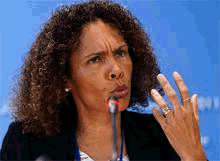
CAR092511A-1.gif
Tanzania's Mkulo: ‘Our economies are interconnected as never before in many ways, from trade to financial flows' (IMF photo)


Economic shocks from the euro area crisis and from problems in other advanced economies could be stronger and possibly more severe than during the last crisis, Mkulo said. "Our economies are still on the recovery path and in the process of restoring critical economic buffers. There is real danger that the modest progress we have attained in meeting some of the Millennium Development Goals will be eroded by an ensuing global economic crisis."
The Gambia's Finance Minister, Mambury Njie, observed that a decade of sound policies had enabled African countries to withstand the global economic crisis of 2008–09. However, recent developments in the global economy posed downside risks to sub-Saharan Africa, particularly through heightened pressures on the balance of payments, reduced export demand, and declining government revenue.
"The risks are even greater this time around as we have already used up large parts of our macroeconomic policy buffers, specifically fiscal space and external reserves, to mitigate the impact of the crisis," Njie said.
Lower export earnings
Finance Minister Cristiana Duarte said Cape Verde had felt the impact of the global crisis in its external accounts, mainly from lower export earnings and falling remittances. She said 90 percent of Cape Verde's exports went to Italy, Portugal, and Spain, leaving the African island nation particularly vulnerable to the crisis in the euro zone. "We are an open economy, so the international crisis is hard on Cape Verde," she said.
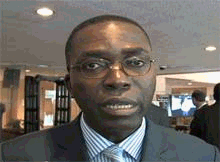
CAR092511A-2.gif
The Gambia's Njie: ‘The risks are even greater this time around as we have already used up large parts of our macroeconomic policy buffers' (IMF photo)


The Cape Verde authorities' response had been to support demand by promoting public investment, Duarte said. Deficit and debt levels had risen but within sustainable limits. The government had resolved to access only concessional financing and to avoid tapping commercial markets.
Democratic Republic of Congo Finance Minister Ponyo Mapon Matata said the extended global crisis was having a growing adverse effect on developing countries. The Congolese government was striving to contain its fiscal balance within the limits of macroeconomic stability. "Despite the difficult macroeconomic situation, we are trying, with prudent policies, to improve basic infrastructure and the education and health sectors."
The ministers called for prompt action by advanced countries to address the growing threat of a new global downturn.
"Now more than ever, political institutions in the advanced economies need to rise to the current economic challenges to take the urgent action necessary to address weaknesses in bank and household balance sheets in order to restore confidence and prevent a global recession," Njie said.
CAR092511A-3.gif
Cape Verde's Duarte on global slowdown effects: ‘We are an open economy, so the international crisis is hard on Cape Verde' (IMF photo)


Njie also said that, in view of African countries' limited policy space, "the international community must stand ready to provide additional concessional financing and policy advice to the innocent bystanders impacted by the crisis."
Infrastructure deficit
The ministers also proposed additional policy action to mitigate the impact of a continued global economic downturn, focusing on addressing Africa's infrastructure deficit and improving its food security.
Matata told the briefing that Africa's infrastructure problems were aggravating the impact of higher food prices. He said the solution to higher food costs lay in boosting Africa's domestic food production and easing supply constraints on agricultural products throughout the continent. Construction of better roads to carry farm production to markets was an essential first step in this direction.
Njie said the Gambia planned to scale up resources for infrastructure investment in the farm sector. "We are putting agriculture and food security first. These are priority areas given the recent increases in food prices."
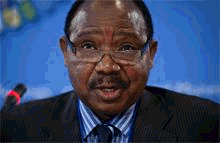
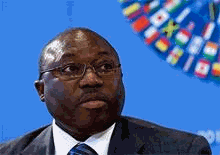
CAR092511A-4.gif
Democratic Republic of Congo's Matata: ‘Instead of each state looking for special solutions for its economy, we should have joint projects' (photo: World Bank)


Njie described a national agricultural investment program that had been launched to boost agriculture's contribution to GDP while also ensuring food security through targeting investment in land preparation and supply of agricultural inputs. Budget allocations to the Gambia's agricultural sector had been doubled and would continue to be increased.
Matata said Africa's most serious infrastructure problem was its energy supply deficit. "No industrial development can be accomplished without an energy supply that is reliable and sufficient."
Regional integration
Regional integration-examples include groupings such as the East African Community, the Economic Community of West African States, and the Southern African Development Community-could be the solution to Africa's infrastructure deficit, Matata said. African countries should mobilize their development partners to support projects that encouraged such integration, he added. "Instead of each state looking for special solutions for its economy, we should have joint projects that generate electricity and could supply the entire subregion and beyond."
Mkulo said energy was a problem for Tanzania, which experienced frequent power outages. "If we improve energy, we shall improve production. If we improve production, we shall improve employment. And if we improve employment, we shall create more economic growth," Mkulo said.
Mkulo suggested that if the international community could invest in Tanzania's power sector, the situation could be eased. He added that Tanzania was opening up its energy production to private sector participation.
Source: IMF -- Resident Representative Office in Tanzania
 
Once a country uses more than 50% of its budget to pay salaries and allowances, its a sure fact its economy is destined to fail miserably. That is what we have been doing for as long as we can remember. Sometimes you wonder all those Drs and Professors of economics are when the country is heading to the dogs. A whole professor of economic and he cant do any meaningful thing about our economy!

does CCM have a chance to listen to professors of economics? - by the way, do you need the professor of economics to advice on economic turnround???
 
Tafadhali, kuna mkopo usioelezwa ni wanini siku hizi? IMF wana sheria zao za mikopo, na la kwanza inabidi wakupe masharti ambayo kama huyatimizi hawakupi, sasa wewe unaleta habari za kufikirika, mashangi sijui nini, wewe barabara alizotuwachia Nyerere hapa bila magari kama yale unafikiri kuna sehemu utazipita? wachaaa, usione sasa hivi Kikwete anajitahidi kutandaza mabarabara ukadhani ndio kote kupo hivyo.

Halafu unaongelea safari za kikwete, unafikiri anakwenda kucheza huko anakokwenda? ni nani anaetaka kusafiri kila siku? inafaa umpe sifa Kikwete kwa kufanya kazi kwa bidii usiku na mchana. Wewe hii Tanzania ya Kikwete leo ndio Tanzania ilivyokuwa hapo nyuma? maendeleo kila pembe lakini mnajidai kuyafumbia macho. Kikwete ndio Rais pekee wa Tanzania aliotangaza rasmi "hafi mtu kwa njaa hapa" na kweli, ni nani mwingine ambae hawajafa watu kwa njaa Tanzania hii.

Unaujuwa wakati wa Nyerere wewe> au unausikia tu? tulikuwa hatujui cha kukila kesho nini, unapanga foleni hjui kinachotolewa leo nini> kama ni mchele au unga au sukari. Leo unakwenda kuchaguwa untaka mchele wa wapi? Mbeya, Shinyanga, Ifakara, Mwanza, Pakistan, Thailand, India? yalikuwepo hayo wakati wa Mtakatifu? wacheni chuki binafsi tazameni ukweli.

duh!! kumbe upeo mdogo kiasi hiki!! sishangai jamii yako ni hiyo hiyo ya akina kikwete
 
Ni nani leo katika Africa ambae hana tatizo la kiuchumi, lakini bora ya Tanzania mara elfu inaonesha kuwa tutakuwa na mafanikio, wenzetu wako hohehahe:

AFRICAN FINANCE MINISTERS BRIEFING
Africa Faces 'Considerable Risks' From Global Downturn

IMF Survey online


September 25, 2011

  • Shocks for Africa from new downturn could be worse than in last crisis
  • Africa has little extra policy space to mitigate further crisis effects
  • Authorities weigh steps to cut infrastructure deficit, boost food security

African economies face considerable risks from a renewed global economic downturn, African finance ministers told a Washington news briefing.
They added that the continent's economies are still on the recovery path from the previous global crisis and are in the process of restoring critical economic buffers.
The ministers also stressed that Africa was bracing for adverse effects from the economic problems in the euro zone, with export receipts and remittances particularly vulnerable. They noted that, as a new global downturn threatened, African countries were more interconnected than ever before with their neighbors and with their principal markets.
The ministers' September 24 briefing, on the sidelines of the 2011 IMF–World Bank Annual Meetings, followed release of the IMF's latest global economic forecast, which said the world economy is in a dangerous new phase. The forecast said global activity has weakened and become more uneven, confidence has fallen sharply recently, and downside risks are growing. The report noted that emerging markets now face even more volatile capital flows and, along with low-income countries, diverse export conditions.
Tanzanian Finance Minister Mustafa Mkulo said he had noted a growing consensus that a majority of Africa's trading and development partners-the advanced economies-would most likely experience a second round of severe economic downturn. "Our economies are interconnected as never before in many ways, from trade to financial flows," Mkulo stated. "In that regard, the risks to the African economies, and especially the East African economies, are considerable."
Strong policies
Mkulo recalled that three years ago Africa had been hit hard by the global economic crisis as export demand fell and financial flows declined. "Our collective and bilateral response helped to shield our economies from the deeper downturns. Our strong policy frameworks were supported by fiscal and foreign reserves buffers. As a result, our countercyclical policy responses helped to swiftly reverse the adverse trends."
CAR092511A-1.gif
Tanzania's Mkulo: ‘Our economies are interconnected as never before in many ways, from trade to financial flows' (IMF photo)


Economic shocks from the euro area crisis and from problems in other advanced economies could be stronger and possibly more severe than during the last crisis, Mkulo said. "Our economies are still on the recovery path and in the process of restoring critical economic buffers. There is real danger that the modest progress we have attained in meeting some of the Millennium Development Goals will be eroded by an ensuing global economic crisis."
The Gambia's Finance Minister, Mambury Njie, observed that a decade of sound policies had enabled African countries to withstand the global economic crisis of 2008–09. However, recent developments in the global economy posed downside risks to sub-Saharan Africa, particularly through heightened pressures on the balance of payments, reduced export demand, and declining government revenue.
"The risks are even greater this time around as we have already used up large parts of our macroeconomic policy buffers, specifically fiscal space and external reserves, to mitigate the impact of the crisis," Njie said.
Lower export earnings
Finance Minister Cristiana Duarte said Cape Verde had felt the impact of the global crisis in its external accounts, mainly from lower export earnings and falling remittances. She said 90 percent of Cape Verde's exports went to Italy, Portugal, and Spain, leaving the African island nation particularly vulnerable to the crisis in the euro zone. "We are an open economy, so the international crisis is hard on Cape Verde," she said.
CAR092511A-2.gif
The Gambia's Njie: ‘The risks are even greater this time around as we have already used up large parts of our macroeconomic policy buffers' (IMF photo)


The Cape Verde authorities' response had been to support demand by promoting public investment, Duarte said. Deficit and debt levels had risen but within sustainable limits. The government had resolved to access only concessional financing and to avoid tapping commercial markets.
Democratic Republic of Congo Finance Minister Ponyo Mapon Matata said the extended global crisis was having a growing adverse effect on developing countries. The Congolese government was striving to contain its fiscal balance within the limits of macroeconomic stability. "Despite the difficult macroeconomic situation, we are trying, with prudent policies, to improve basic infrastructure and the education and health sectors."
The ministers called for prompt action by advanced countries to address the growing threat of a new global downturn.
"Now more than ever, political institutions in the advanced economies need to rise to the current economic challenges to take the urgent action necessary to address weaknesses in bank and household balance sheets in order to restore confidence and prevent a global recession," Njie said.
CAR092511A-3.gif
Cape Verde's Duarte on global slowdown effects: ‘We are an open economy, so the international crisis is hard on Cape Verde' (IMF photo)


Njie also said that, in view of African countries' limited policy space, "the international community must stand ready to provide additional concessional financing and policy advice to the innocent bystanders impacted by the crisis."
Infrastructure deficit
The ministers also proposed additional policy action to mitigate the impact of a continued global economic downturn, focusing on addressing Africa's infrastructure deficit and improving its food security.
Matata told the briefing that Africa's infrastructure problems were aggravating the impact of higher food prices. He said the solution to higher food costs lay in boosting Africa's domestic food production and easing supply constraints on agricultural products throughout the continent. Construction of better roads to carry farm production to markets was an essential first step in this direction.
Njie said the Gambia planned to scale up resources for infrastructure investment in the farm sector. "We are putting agriculture and food security first. These are priority areas given the recent increases in food prices."
CAR092511A-4.gif
Democratic Republic of Congo's Matata: ‘Instead of each state looking for special solutions for its economy, we should have joint projects' (photo: World Bank)


Njie described a national agricultural investment program that had been launched to boost agriculture's contribution to GDP while also ensuring food security through targeting investment in land preparation and supply of agricultural inputs. Budget allocations to the Gambia's agricultural sector had been doubled and would continue to be increased.
Matata said Africa's most serious infrastructure problem was its energy supply deficit. "No industrial development can be accomplished without an energy supply that is reliable and sufficient."
Regional integration
Regional integration-examples include groupings such as the East African Community, the Economic Community of West African States, and the Southern African Development Community-could be the solution to Africa's infrastructure deficit, Matata said. African countries should mobilize their development partners to support projects that encouraged such integration, he added. "Instead of each state looking for special solutions for its economy, we should have joint projects that generate electricity and could supply the entire subregion and beyond."
Mkulo said energy was a problem for Tanzania, which experienced frequent power outages. "If we improve energy, we shall improve production. If we improve production, we shall improve employment. And if we improve employment, we shall create more economic growth," Mkulo said.
Mkulo suggested that if the international community could invest in Tanzania's power sector, the situation could be eased. He added that Tanzania was opening up its energy production to private sector participation.
Source: IMF -- Resident Representative Office in Tanzania

Faizafoxy: one silly question. does one need to go to school to learn that extravagance is dangerous to any economy? even at household level?
 
Hii ni dalili tosha kuwa JK nchi imemshinda kabisa, halafu nashangaa kabisa kuna mijitu humu sijui ni mifisadi kucha kutetea serikali legelege.
 
Hali ya sasa ya kiuchumi ina nini? juzijuzi (May 2011) Mawaziri wa fedha wa Afrika nzima wamekutana na IMF na hakuna hata mmoja ambae hajalalamika, uzuri ni kwamba Tanzania na matatizo yote ya kiuchumi yaliopo duniani, imebaki kifua mbele na kupanda chart. Tunakoelekea si kubaya, ni juzi tu tumetangaziwa kutoka Australia kuwa wawekezaji kwenye migodi ya Anglo Gold wataanza kulipa kodi baada ya kuwachiwa kwa muda mrefu na mikataba mibovu aliyosaini Mkapa, au hili hamlijui?

Huwezi kuongelea uchumi wa nchi bila kuongelea siasa, kumbuka hilo, siasa za nchi nji baba mmoja mama mmoja na uchumi wa nchi. Leo maandamnao ya kila siku ya CHADEMA yanasaidia nini katika uchumi wetu? kuweni wa kweli, mnajaribu kupinda pinda mambo, nimeweka data hapo juu na nimeweka maswali ya msingi kabisa ya kipima joto na nimewaambia kama atakuja mtu atajibu na kuonesha "negative" mimi naachana na kushabikia siasa za CCM. Mpaka sasa hakuna hata mmoja wenu aliye hata thubutu tu, waca kujibu. Mnataka kuleta pumba leteni wakati FF hayuko ulingoni. Leo ni mimi na nyinyi, leteni pumba zenu mimi ntawachambulia na kuweka mchele pembeni.

Huo mchele wa mwanzo nimewamwagia haya utieni mchanga kama mnaweza.

Katika kutengeza sera za kiuchumi hisia au itikadi za kisiasa huachwa kando kwa minajili ya kusolve uteterekaji wa kiuchumi kama nchi lakini kama unadhani wanaojaribu kuchallenge initiative za serikali katika hilo wamuona adui kiukweli uchumi wetu utakua ni time bomb in near future..
Afu tutaendelea kuwafurahia wawekezaji wa kigeni tena wa madini mpaka lini? wakati tunachopata ni kama tone baharini?
 
duh!! kumbe upeo mdogo kiasi hiki!! sishangai jamii yako ni hiyo hiyo ya akina kikwete

Wewe uliekuwa na upeo mkubwa jibu haya maswali rahisi kabisa:


  1. Weka idadi ya barabara za lami kabla ya Kikwete
  2. Weka idadi ya Shule kabla ya Kikwete
  3. Weka idadi ya Waalimu kabla ya Kikwete
  4. Weka idadi ya Zahanati kabla ya Kikwete
  5. Weka idadi ya Viwanda kabla ya Kikwete
  6. Weka idadi ya Utalii kabla ya Kikwete
  7. Weka idadi ya Umeme kabla ya Kikwete
  8. Weka idadi ya Maji kabla ya Kikwete
  9. Weka idadi ya kazi kabla ya Kikwete
  10. Weka idadi ya biashara kabla ya Kikwete
  11. Weka idadi ya umaskini kabla ya Kikwete
  12. Weka idadi ya kilimo kabla ya Kikwete
  13. Weka idadi ya bidhaa zinazopita bandari zetu kabla ya Kikwete
  14. Weka akiba ya fedha tulokuwa nayo kabla ya Kikwete
 
ndo watu wakome kuchagua li ccm...

Ili kukomesha watu kuichaguwa CCM, jibu haya maswali, ukishindwa basi tutaendelea kuichanguwa CCM:


  1. Weka idadi ya barabara za lami kabla ya Kikwete
  2. Weka idadi ya Shule kabla ya Kikwete
  3. Weka idadi ya Waalimu kabla ya Kikwete
  4. Weka idadi ya Zahanati kabla ya Kikwete
  5. Weka idadi ya Viwanda kabla ya Kikwete
  6. Weka idadi ya Utalii kabla ya Kikwete
  7. Weka idadi ya Umeme kabla ya Kikwete
  8. Weka idadi ya Maji kabla ya Kikwete
  9. Weka idadi ya kazi kabla ya Kikwete
  10. Weka idadi ya biashara kabla ya Kikwete
  11. Weka idadi ya umaskini kabla ya Kikwete
  12. Weka idadi ya kilimo kabla ya Kikwete
  13. Weka idadi ya bidhaa zinazopita bandari zetu kabla ya Kikwete
  14. Weka akiba ya fedha tulokuwa nayo kabla ya Kikwete
 
Katika kutengeza sera za kiuchumi hisia au itikadi za kisiasa huachwa kando kwa minajili ya kusolve uteterekaji wa kiuchumi kama nchi lakini kama unadhani wanaojaribu kuchallenge initiative za serikali katika hilo wamuona adui kiukweli uchumi wetu utakua ni time bomb in near future..
Afu tutaendelea kuwafurahia wawekezaji wa kigeni tena wa madini mpaka lini? wakati tunachopata ni kama tone baharini?
quote_icon.png
By FaizaFoxy

Hali ya sasa ya kiuchumi ina nini? juzijuzi (May 2011) Mawaziri wa fedha wa Afrika nzima wamekutana na IMF na hakuna hata mmoja ambae hajalalamika, uzuri ni kwamba Tanzania na matatizo yote ya kiuchumi yaliopo duniani, imebaki kifua mbele na kupanda chart. Tunakoelekea si kubaya, ni juzi tu tumetangaziwa kutoka Australia kuwa wawekezaji kwenye migodi ya Anglo Gold wataanza kulipa kodi baada ya kuwachiwa kwa muda mrefu na mikataba mibovu aliyosaini Mkapa, au hili hamlijui?

Huwezi kuongelea uchumi wa nchi bila kuongelea siasa, kumbuka hilo, siasa za nchi nji baba mmoja mama mmoja na uchumi wa nchi. Leo maandamnao ya kila siku ya CHADEMA yanasaidia nini katika uchumi wetu? kuweni wa kweli, mnajaribu kupinda pinda mambo, nimeweka data hapo juu na nimeweka maswali ya msingi kabisa ya kipima joto na nimewaambia kama atakuja mtu atajibu na kuonesha "negative" mimi naachana na kushabikia siasa za CCM. Mpaka sasa hakuna hata mmoja wenu aliye hata thubutu tu, waca kujibu. Mnataka kuleta pumba leteni wakati FF hayuko ulingoni. Leo ni mimi na nyinyi, leteni pumba zenu mimi ntawachambulia na kuweka mchele pembeni.

Huo mchele wa mwanzo nimewamwagia haya utieni mchanga kama mnaweza.

Kwanza jibu hilo kwenye red linahusiana na huo usemi wako, au huwa unasoma nusu nusu?
 
Uchumi wa tanzania kuna jamaa walikuwa wanatudanganya utajengwa na wawekezaji waliokuwa wanawafuata kila mwezi marekani na ulaya. Sasa tumefikia wapi? Hivi tuna nidhamu kiasi gani ya kutumia mapato ya ndani ambayo ni kodi za wananchi? nani katudanganya kuwa tunawexa kufanya kitu chochote, hata kama ni kibaya kiasi gani, bila kupata madhara yoyote?Well, mwisho wa siku kila mtu ataubeba msalaba wake...ukweli ni kuwa uchumi wetu sasa hivi uko hoi bin taabani. Na kibaya sioni mtu mwenye maarifa wa kutunasua hapa tulipo. Kitu ninachoona ni kile kile....business as usual!!
 
Kwahiyo kama Marekani na Ulaya na waafrika wengine wamefeli, na sisi ni lazima tufeli? nani kasema hivyo? Wengine tunachokifanya huwa tumeondoa kabisa neno failure!!!Naona wengine mnalikumbatia kama ndio salamu mkiulizwa kwanini mambo yanaenda vibaya...and guess what!!!! that is where the diffference starts!!!!!


Ni nani leo katika Africa ambae hana tatizo la kiuchumi, lakini bora ya Tanzania mara elfu inaonesha kuwa tutakuwa na mafanikio, wenzetu wako hohehahe:

AFRICAN FINANCE MINISTERS BRIEFING
Africa Faces 'Considerable Risks' From Global Downturn

IMF Survey online


September 25, 2011
  • Shocks for Africa from new downturn could be worse than in last crisis
  • Africa has little extra policy space to mitigate further crisis effects
  • Authorities weigh steps to cut infrastructure deficit, boost food security
African economies face considerable risks from a renewed global economic downturn, African finance ministers told a Washington news briefing.
They added that the continent's economies are still on the recovery path from the previous global crisis and are in the process of restoring critical economic buffers.
The ministers also stressed that Africa was bracing for adverse effects from the economic problems in the euro zone, with export receipts and remittances particularly vulnerable. They noted that, as a new global downturn threatened, African countries were more interconnected than ever before with their neighbors and with their principal markets.
The ministers' September 24 briefing, on the sidelines of the 2011 IMF–World Bank Annual Meetings, followed release of the IMF's latest global economic forecast, which said the world economy is in a dangerous new phase. The forecast said global activity has weakened and become more uneven, confidence has fallen sharply recently, and downside risks are growing. The report noted that emerging markets now face even more volatile capital flows and, along with low-income countries, diverse export conditions.
Tanzanian Finance Minister Mustafa Mkulo said he had noted a growing consensus that a majority of Africa's trading and development partners-the advanced economies-would most likely experience a second round of severe economic downturn. "Our economies are interconnected as never before in many ways, from trade to financial flows," Mkulo stated. "In that regard, the risks to the African economies, and especially the East African economies, are considerable."
Strong policies
Mkulo recalled that three years ago Africa had been hit hard by the global economic crisis as export demand fell and financial flows declined. "Our collective and bilateral response helped to shield our economies from the deeper downturns. Our strong policy frameworks were supported by fiscal and foreign reserves buffers. As a result, our countercyclical policy responses helped to swiftly reverse the adverse trends."
CAR092511A-1.gif
Tanzania's Mkulo: ‘Our economies are interconnected as never before in many ways, from trade to financial flows' (IMF photo)


Economic shocks from the euro area crisis and from problems in other advanced economies could be stronger and possibly more severe than during the last crisis, Mkulo said. "Our economies are still on the recovery path and in the process of restoring critical economic buffers. There is real danger that the modest progress we have attained in meeting some of the Millennium Development Goals will be eroded by an ensuing global economic crisis."
The Gambia's Finance Minister, Mambury Njie, observed that a decade of sound policies had enabled African countries to withstand the global economic crisis of 2008–09. However, recent developments in the global economy posed downside risks to sub-Saharan Africa, particularly through heightened pressures on the balance of payments, reduced export demand, and declining government revenue.
"The risks are even greater this time around as we have already used up large parts of our macroeconomic policy buffers, specifically fiscal space and external reserves, to mitigate the impact of the crisis," Njie said.
Lower export earnings
Finance Minister Cristiana Duarte said Cape Verde had felt the impact of the global crisis in its external accounts, mainly from lower export earnings and falling remittances. She said 90 percent of Cape Verde's exports went to Italy, Portugal, and Spain, leaving the African island nation particularly vulnerable to the crisis in the euro zone. "We are an open economy, so the international crisis is hard on Cape Verde," she said.
CAR092511A-2.gif
The Gambia's Njie: ‘The risks are even greater this time around as we have already used up large parts of our macroeconomic policy buffers' (IMF photo)


The Cape Verde authorities' response had been to support demand by promoting public investment, Duarte said. Deficit and debt levels had risen but within sustainable limits. The government had resolved to access only concessional financing and to avoid tapping commercial markets.
Democratic Republic of Congo Finance Minister Ponyo Mapon Matata said the extended global crisis was having a growing adverse effect on developing countries. The Congolese government was striving to contain its fiscal balance within the limits of macroeconomic stability. "Despite the difficult macroeconomic situation, we are trying, with prudent policies, to improve basic infrastructure and the education and health sectors."
The ministers called for prompt action by advanced countries to address the growing threat of a new global downturn.
"Now more than ever, political institutions in the advanced economies need to rise to the current economic challenges to take the urgent action necessary to address weaknesses in bank and household balance sheets in order to restore confidence and prevent a global recession," Njie said.
CAR092511A-3.gif
Cape Verde's Duarte on global slowdown effects: ‘We are an open economy, so the international crisis is hard on Cape Verde' (IMF photo)


Njie also said that, in view of African countries' limited policy space, "the international community must stand ready to provide additional concessional financing and policy advice to the innocent bystanders impacted by the crisis."
Infrastructure deficit
The ministers also proposed additional policy action to mitigate the impact of a continued global economic downturn, focusing on addressing Africa's infrastructure deficit and improving its food security.
Matata told the briefing that Africa's infrastructure problems were aggravating the impact of higher food prices. He said the solution to higher food costs lay in boosting Africa's domestic food production and easing supply constraints on agricultural products throughout the continent. Construction of better roads to carry farm production to markets was an essential first step in this direction.
Njie said the Gambia planned to scale up resources for infrastructure investment in the farm sector. "We are putting agriculture and food security first. These are priority areas given the recent increases in food prices."
CAR092511A-4.gif
Democratic Republic of Congo's Matata: ‘Instead of each state looking for special solutions for its economy, we should have joint projects' (photo: World Bank)


Njie described a national agricultural investment program that had been launched to boost agriculture's contribution to GDP while also ensuring food security through targeting investment in land preparation and supply of agricultural inputs. Budget allocations to the Gambia's agricultural sector had been doubled and would continue to be increased.
Matata said Africa's most serious infrastructure problem was its energy supply deficit. "No industrial development can be accomplished without an energy supply that is reliable and sufficient."
Regional integration
Regional integration-examples include groupings such as the East African Community, the Economic Community of West African States, and the Southern African Development Community-could be the solution to Africa's infrastructure deficit, Matata said. African countries should mobilize their development partners to support projects that encouraged such integration, he added. "Instead of each state looking for special solutions for its economy, we should have joint projects that generate electricity and could supply the entire subregion and beyond."
Mkulo said energy was a problem for Tanzania, which experienced frequent power outages. "If we improve energy, we shall improve production. If we improve production, we shall improve employment. And if we improve employment, we shall create more economic growth," Mkulo said.
Mkulo suggested that if the international community could invest in Tanzania's power sector, the situation could be eased. He added that Tanzania was opening up its energy production to private sector participation.
Source: IMF -- Resident Representative Office in Tanzania
 
Faizafoxy: one silly question. does one need to go to school to learn that extravagance is dangerous to any economy? even at household level?

To have a fridge at home was extravagant at the time of Nyerere, to use Colgate was extravagant, to have a car was extravagant, to have a TV was extravagant. Extravagant is what you perceive and how stagnant you are it is never the rule of economics. Remember how a big failure Nyerere was economically?

It is highly suicidal to economize on expenditures to your economy, to fuel economic growth you have to be extravagant in all aspects. How can you have a growth without spending? simple economy rule; "the more you spend the more you earn the more you earn the more you spend". That is the only way you can measure your growth, you can never ever measure growth by not spending. Be real.
 
Kumbe baadhi ya watu wanaovaa kijani, wana hoja nzito na ubongo wao unafanya kazi wakiacha propoaganda za kichama! bigup Mchambuzi!
 
Kwahiyo kama Marekani na Ulaya na waafrika wengine wamefeli, na sisi ni lazima tufeli? nani kasema hivyo? Wengine tunachokifanya huwa tumeondoa kabisa neno failure!!!Naona wengine mnalikumbatia kama ndio salamu mkiulizwa kwanini mambo yanaenda vibaya...and guess what!!!! that is where the diffference starts!!!!!

Soma vizuri, wakati wenzetu wame "fail" sisi tumeonesha "success" na tumepanda chart. Mbona mnaandika pumba, huwa hamsomi kinachoandikwa?
 
Uchumi wa tanzania kuna jamaa walikuwa wanatudanganya utajengwa na wawekezaji waliokuwa wanawafuata kila mwezi marekani na ulaya. Sasa tumefikia wapi? Hivi tuna nidhamu kiasi gani ya kutumia mapato ya ndani ambayo ni kodi za wananchi? nani katudanganya kuwa tunawexa kufanya kitu chochote, hata kama ni kibaya kiasi gani, bila kupata madhara yoyote?Well, mwisho wa siku kila mtu ataubeba msalaba wake...ukweli ni kuwa uchumi wetu sasa hivi uko hoi bin taabani. Na kibaya sioni mtu mwenye maarifa wa kutunasua hapa tulipo. Kitu ninachoona ni kile kile....business as usual!!

Uchumi wa Tanzania unaonesha kukuwa kwa kasi ya ajabu toka Kikwete achukuwe madaraka, na data zote zonaonesha hivyo, za ndani na nje ya Tanzania na juu huko tumebandika "data" kutoka CIA. Unazo mbadala weka, wacha kutuandikia pumba, tunataka mchele:

soma hii kutoka kwa watu wa uchumi, sio pumba zako:

[TABLE="class: contentpaneopen"]
[TR]
[TD="class: contentheading"]Tanzania's economy to grow by 6.9 pc in 2012, report shows [/TD]
[TD="class: buttonheading, width: 100%, align: right"] [/TD]
[/TR]
[/TABLE]
[TABLE="class: contentpaneopen"]
[TR]
[TD="class: createdate"] Monday, 18 July 2011 22:49 [/TD]
[/TR]
[TR]
[TD] digg

By Alawi Masare
The Citizen Reporter
Dar es Salaam. Tanzania's economy is expected to grow by 6.9 per cent this year and 7.3 per cent in 2012, a new report shows.This is below the government's target of growing by 7.3 per cent this year. According to the report titled "African Economic Outlook," which was released yesterday in Dar es Salaam, the country's economic growth faces great risks including increasing fiscal deficit, and an inflationary pressure from fuel and food prices.

"The infrastructure deficit such as lack of reliable energy may pose a threat to the struggling economic growth not only in Tanzania but also in other countries," said Prof Mthuli Ncube, the African Development Bank (AfDB) chief economist. Last May, the International Monetary Fund (IMF) cut its 2011 growth forecast for Tanzania to 6 per cent from 7.2 per cent in March, saying frequent power outages would hurt output while food and fuel prices could push inflation to higher levels.

However, unveiling the current report, Prof Ncube said the country had a promising future since it was ranked among the ten fastest growing countries in Africa. Other countries include the Democratic Republic of Congo (DRC), Nigeria, Liberia, Ethiopia, Mozambique, Zimbabwe, Botswana, Angola and Ghana.

Prof Ncube also warned that the infrastructure deficit was still a challenge in many African countries that affected their growth.However, the report warns that following recent political crises in North Africa as well as high food and fuel prices, growth of other African economies would likely slow down to 3.7 per cent in 2011 from 4.9 per cent last year.

However, the report predicts that things may change in 2012 and Africa would rebound to a 5.8 per cent growth. The 10th edition of the African Economic Outlook was prepared by four teams from AfDB, OECD development centre, the United Nations Development Programme (UNDP) and the United Nations Economic Commission for Africa (Uneca).

Prof Ncube called for inclusive growth in African countries in order to realise fast and sustainable economic development.He also noted that sub-Saharan African countries were expected to perform better than North Africa next year. While Sub-Saharan Africa countries are expected to record a 5.8 per cent growth, the North African sub region would grow at 0.7 per cent in 2011, down from 4.6 per cent experienced in 2010.
source: Tanzania

[/TD]
[/TR]
[/TABLE]
 
What are your solutions? Hakuna politics katika niliyoyataja hapo juu ni pure economic solutions. Wakibana matumizi serikali itakuwa na hela ya kufidia budget deficit iliyotajwa na IMF inayowafanya waende kukopa katika commercial banks.

Ufisadi Rais JK mwenyewe amekubali 30% of public finance zinaliwa na mafisadi nchini. Ufisadi wa nchi hii uko aina mbili wa kificho kama EPA nk. na wa katika posho na malipo yasiyoelezeka mfano allowance, nk. Serikali ikiweza kumudu kusimamia fedha za wananchi basi mapato na government coffins zitaongezeka.

Kukopa nchini ni hatari kwa kunasababisha interest rate hike na credit squeeze. Wakipunguza kukopa nchini kutachangia interest rate katika mabenki kushuka na hivyo watu wa kawaida kuweza kumudu kukopa katika mabenki nk.


Siasa nazo zinaharibu uchumi wa nchi hii kwani wanasiasa ndio wamekuwa wachumi siku hizi matokeo vitu vinapoteza mwelekeo.

hapo kwenye nyekundu, have you consider the issue of money supply against the potential output in our economy as the interest rate will be low?you have to think abosolutily on sustanability levels of inflation as money supply and investment in lager campanies within our country is concern, that might lead us to hyperinflation.
 
Kwanza jibu hilo kwenye red linahusiana na huo usemi wako, au huwa unasoma nusu nusu?

Kwanza nilikuwa sifahamu kama Chadema wanaandamana "kila siku" pili hata wakiandamana "kila siku" ni portion ndogo sana ya work force inayokuwa idle ukilinganisha na total population inayokuwa kazini kiasi kwamba inaweza kuparalyze uchumi wetu, tatu niwie radhi siwezi kujibu kila nukta kwani naona twaenda nje ya muktadha kwa kuanza kujadili siasa badala ya hali halisi ya kiuchumi..
 
  1. Weka idadi ya barabara za lami kabla ya Kikwete Vs Idadi ya magari kabla na baada ya Kikwete
  2. Weka idadi ya Shule kabla ya Kikwete Vs Idadi ya wanafunzi kabla na Baada ya Kikwete
  3. Weka idadi ya Waalimu kabla ya Kikwete Vs idadi ya madarasa na vitendea kazi kabla na baada ya Kikwete
  4. Weka idadi ya Zahanati kabla ya Kikwete Vs Idadi ya wagonjwa, wauguzi na madawa kabla na Baada ya kikwete
  5. Weka idadi ya Viwanda kabla ya Kikwete Vs Huitaji wa Bidhaa kabla na baada ya Kikwete
  6. Weka idadi ya Utalii kabla ya Kikwete Vs Maendeleo ya Technologia ya kutangaza utalii kabla na baada ya Kikwete
  7. Weka idadi ya Umeme kabla ya Kikwete Vs mahitaji ya umeme kabla na baada ya Kikwete
  8. Weka idadi ya Maji kabla ya Kikwete Vs mahitaji ya maji kabla na baada ya Kikwete
  9. Weka idadi ya kazi kabla ya Kikwete Vs mahitaji ya kazi kabla na baada ya Kikwete
  10. Weka idadi ya biashara kabla ya Kikwete Vs Ulipaji wa kodi wa hizo biashara kabla na baada ya Kikwete
  11. Weka idadi ya umaskini kabla ya Kikwete Vs Umasikini wa FIKRA kabla na baada ya Kikwete
  12. Weka idadi ya kilimo kabla ya Kikwete Vs Kilimo???? hiki cha msimu, nchi zilizoendelea hawana huo msamiati!
  13. Weka idadi ya bidhaa zinazopita bandari zetu kabla ya Kikwete Vs bidhaa zinazolipiwa ushuru kabla na baada ya Kikwete
  14. Weka akiba ya fedha tulokuwa nayo kabla ya Kikwete Vs Kushindwa kuwalipa waajiri wake mishaara mwisho wa mwezi
 
Back
Top Bottom