Je, Biblia ya ukweli/Halisi ni ipi?

Je, Biblia ya ukweli/Halisi ni ipi?

Basi kama ww ni muisilamu na Sio Muumini jibu lako umepatia [emoji106]

Ila Ungekuwa Muumini ungeaAmini Kauli hii ya Haki ya Allah
[emoji116][emoji116]

)يآ أيها الذين آمنوا آمنوا بالله و رسوله والكتاب الَذي نزل على رسوله والكتاب الذي أنزل من قبل. ومن يكفر با لله و ملا ئكته و كتبه و رسله واليوم الآخر فقد ضل ضلالا بعيدا(.
“Enyi mlio amini! Muaminini Mwenyezi Mungu na Mtume wake na Kitabu kilicho teremshwa kwa mtume wake na Kitabu kilicho teremshwa kabla yake. Na mwenye kumkufuru Mwenyezi Mungu na Malaika wake na Vitabu vyake na Mitume wake, na siku ya mwisho, hakika amepotea upotovu ulio mbali (na haki).“Qur’an tukufu
Hapo umejionesha ulivyo poyoyo. Kuna dhehebu liliongelewa kwenye hiyo aya?

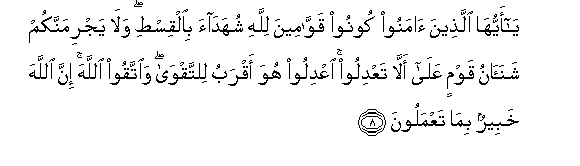
Wewe acha upoyoyo. Soma hii unambie umeelewa nini...

5_8.gif

Qur'an 5:8. Enyi mlio amini! Kuweni wasimamizi madhubuti kwa ajili ya Mwenyezi Mungu mkitoa ushahidi kwa haki. Wala kuchukiana na watu kusikupelekeeni kutofanya uadilifu. Fanyeni uadilifu. Hivyo ndio kuwa karibu mno na uchamngu. Na mcheni Mwenyezi Mungu. Hakika Mwenyezi Mungu anazo khabari za mnayo yatenda. 8
 
Hapo umejionesha ulivyo poyoyo. Kuna dhehebu liliongelewa kwenye hiyo aya?

Wewe acha upoyoyo. Soma hii unambie umeelewa nini...

5_8.gif

Qur'an 5:8. Enyi mlio amini! Kuweni wasimamizi madhubuti kwa ajili ya Mwenyezi Mungu mkitoa ushahidi kwa haki. Wala kuchukiana na watu kusikupelekeeni kutofanya uadilifu. Fanyeni uadilifu. Hivyo ndio kuwa karibu mno na uchamngu. Na mcheni Mwenyezi Mungu. Hakika Mwenyezi Mungu anazo khabari za mnayo yatenda. 8
Sasa umeniaminisha Hakika ww sio MUUMINI ni muislamu tena ni wa dirisha dogo!
Hivi unaniita poyoyo! Na Mimi nikikutukana mtusi mkubwa na ww?! Huoni itakuwa Faraka??

Allah kwa kinywa cha Muhammad Amekuagiza
[emoji1370][emoji1370]
ادْعُ إِلَىٰ سَبِيلِ رَبِّكَ بِالْحِكْمَةِ وَالْمَوْعِظَةِ الْحَسَنَةِ ۖ وَجَادِلْهُم بِالَّتِي هِيَ أَحْسَنُ ۚ إِنَّ رَبَّكَ هُوَ أَعْلَمُ بِمَن ضَلَّ عَن سَبِيلِهِ ۖ وَهُوَ أَعْلَمُ بِالْمُهْتَدِينَ ( 125 )
Waite waelekee kwenye Njia ya Mola wako Mlezi kwa hikima na mawaidha mema, na ujadiliane nao kwa namna iliyo bora. Hakika Mola wako Mlezi ndiye anaye mjua zaidi aliye ipotea Njia yake, na Yeye ndiye anaye wajua zaidi walio ongoka.

Au naye unamuona poyoyo ww ndie mjuzi unaye mjua Aliye Ongoka??

Hiyo aya uliyo weka anzisha Uzi utajibiwa kwa nguvu ya.5!
Dhahir eeh?![emoji56]
 
Bible inatuambia kila aliyetundikwa msalabani amelaaniwa na mungu.
Katika kumbukumbu la Torati 21:23, Mungu anamwambia Musa kwamba mtu " aliyetundikwa katika mti amelaaniwa na Mungu".
FaizaFoxy Unaposoma biblia kuwa makini biblia sio mashairi kama koran , Koran ndio haina muendelezo wa Habari kutoka verse moja kwenda nyingine

Kumbukumbu la Torati 21: linaweka wazi aliyetundikwa amelaaniwa na Mungu kwa sababu zilizo taja kwenye verse zilizopita
21:22 Akiwa mtu ametenda dhambi ipasayo kufa, akauawa, nawe ukamtundika juu ya mti;

Turudi kwenye mada ya Allah kuwa muongo, na usirudie tena ku chomoa mistari na kuweka hoja zako dhaifu
 
FaizaFoxy Unaposoma biblia kuwa makini biblia sio mashairi kama koran , Koran ndio haina muendelezo wa Habari kutoka verse moja kwenda nyingine

Kumbukumbu la Torati 21: linaweka wazi aliyetundikwa amelaaniwa na Mungu kwa sababu zilizo taja kwenye verse zilizopita
21:22 Akiwa mtu ametenda dhambi ipasayo kufa, akauawa, nawe ukamtundika juu ya mti;

Turudi kwenye mada ya Allah kuwa muongo, na usirudie tena ku chomoa mistari na kuweka hoja zako dhaifu


Zawadi yako hii,

Let us first of all see how GOD Almighty forces the Will, or makes creations do what they wouldn't normally do.

Pay special attention to 2 Samuel 12:11:


2 Samuel 12

1 And the Lord sent Nathan unto David. And he came unto him, and said unto him, There were two men in one city; the one rich, and the other poor.

2 The rich man had exceeding many flocks and herds:

3 But the poor man had nothing, save one little ewe lamb, which he had bought and nourished up: and it grew up together with him, and with his children; it did eat of his own meat, and drank of his own cup, and lay in his bosom, and was unto him as a daughter.

4 And there came a traveller unto the rich man, and he spared to take of his own flock and of his own herd, to dress for the wayfaring man that was come unto him; but took the poor man's lamb, and dressed it for the man that was come to him.

5 And David's anger was greatly kindled against the man; and he said to Nathan, As the Lord liveth, the man that hath done this thing shall surely die:

6 And he shall restore the lamb fourfold, because he did this thing, and because he had no pity.

7 And Nathan said to David, Thou art the man. Thus saith the Lord God of Israel, I anointed thee king over Israel, and I delivered thee out of the hand of Saul;

8 And I gave thee thy master's house, and thy master's wives into thy bosom, and gave thee the house of Israel and of Judah; and if that had been too little, I would moreover have given unto thee such and such things.

9 Wherefore hast thou despised the commandment of the Lord, to do evil in his sight? thou hast killed Uriah the Hittite with the sword, and hast taken his wife to be thy wife, and hast slain him with the sword of the children of Ammon.

10 Now therefore the sword shall never depart from thine house; because thou hast despised me, and hast taken the wife of Uriah the Hittite to be thy wife.


11 Thus saith the Lord, Behold, I will raise up evil against thee out of thine own house, and I will take thy wives before thine eyes, and give them unto thy neighbour, and he shall lie with thy wives in the sight of this sun.

12 For thou didst it secretly: but I will do this thing before all Israel, and before the sun.


13 And David said unto Nathan, I have sinned against the Lord. And Nathan said unto David, The Lord also hath put away thy sin; thou shalt not die.

14 Howbeit, because by this deed thou hast given great occasion to the enemies of the Lord to blaspheme, the child also that is born unto thee shall surely die.

15 And Nathan departed unto his house. And the Lord struck the child that Uriah's wife bare unto David, and it was very sick.

16 David therefore besought God for the child; and David fasted, and went in, and lay all night upon the earth.

17 And the elders of his house arose, and went to him, to raise him up from the earth: but he would not, neither did he eat bread with them.

18 And it came to pass on the seventh day, that the child died. And the servants of David feared to tell him that the child was dead: for they said, Behold, while the child was yet alive, we spake unto him, and he would not hearken unto our voice: how will he then vex himself, if we tell him that the child is dead?

19 But when David saw that his servants whispered, David perceived that the child was dead: therefore David said unto his servants, Is the child dead? And they said, He is dead.

20 Then David arose from the earth, and washed, and anointed himself, and changed his apparel, and came into the house of the Lord, and worshipped: then he came to his own house; and when he required, they set bread before him, and he did eat.

21 Then said his servants unto him, What thing is this that thou hast done? thou didst fast and weep for the child, while it was alive; but when the child was dead, thou didst rise and eat bread.

22 And he said, While the child was yet alive, I fasted and wept: for I said, Who can tell whether God will be gracious to me, that the child may live?

23 But now he is dead, wherefore should I fast? can I bring him back again? I shall go to him, but he shall not return to me.

24 And David comforted Bathsheba his wife, and went in unto her, and lay with her: and she bare a son, and he called his name Solomon: and the Lord loved him.

25 And he sent by the hand of Nathan the prophet; and he called his name Jedidiah, because of the Lord.

26 And Joab fought against Rabbah of the children of Ammon, and took the royal city.
27 And Joab sent messengers to David, and said, I have fought against Rabbah, and have taken the city of waters.

28 Now therefore gather the rest of the people together, and encamp against the city, and take it: lest I take the city, and it be called after my name.

29 And David gathered all the people together, and went to Rabbah, and fought against it, and took it.

30 And he took their king's crown from off his head, the weight whereof was a talent of gold with the precious stones: and it was set on David's head. And he brought forth the spoil of the city in great abundance.

31 And he brought forth the people that were therein, and put them under saws, and under harrows of iron, and under axes of iron, and made them pass through the brick-kiln: and thus did he unto all the cities of the children of Ammon. So David and all the people returned unto Jerusalem.


Question: Since king David's wives, whom some of them were also Saul's former wives (2 Samuel 12:8), were chaste, and weren't prostitutes for men, nor did they ever do it in day light (before GOD Almighty's declaration), then wouldn't this clearly and indisputably prove that GOD Almighty here:


1- Made them, beyond their own wills, prostitute in day light.


2- Took over their wills, and made them do the Will of GOD Almighty without any choice for them.


3- The wives had absolutely no choice but to become prostitutes for a time, because GOD Almighty made them such, even if they were chaste in their ordinary lives.
 
Zawadi yako hii,

Let us first of all see how GOD Almighty forces the Will, or makes creations do what they wouldn't normally do.

Pay special attention to 2 Samuel 12:11:


2 Samuel 12

1 And the Lord sent Nathan unto David. And he came unto him, and said unto him, There were two men in one city; the one rich, and the other poor.

2 The rich man had exceeding many flocks and herds:

3 But the poor man had nothing, save one little ewe lamb, which he had bought and nourished up: and it grew up together with him, and with his children; it did eat of his own meat, and drank of his own cup, and lay in his bosom, and was unto him as a daughter.

4 And there came a traveller unto the rich man, and he spared to take of his own flock and of his own herd, to dress for the wayfaring man that was come unto him; but took the poor man's lamb, and dressed it for the man that was come to him.

5 And David's anger was greatly kindled against the man; and he said to Nathan, As the Lord liveth, the man that hath done this thing shall surely die:

6 And he shall restore the lamb fourfold, because he did this thing, and because he had no pity.

7 And Nathan said to David, Thou art the man. Thus saith the Lord God of Israel, I anointed thee king over Israel, and I delivered thee out of the hand of Saul;

8 And I gave thee thy master's house, and thy master's wives into thy bosom, and gave thee the house of Israel and of Judah; and if that had been too little, I would moreover have given unto thee such and such things.

9 Wherefore hast thou despised the commandment of the Lord, to do evil in his sight? thou hast killed Uriah the Hittite with the sword, and hast taken his wife to be thy wife, and hast slain him with the sword of the children of Ammon.

10 Now therefore the sword shall never depart from thine house; because thou hast despised me, and hast taken the wife of Uriah the Hittite to be thy wife.


11 Thus saith the Lord, Behold, I will raise up evil against thee out of thine own house, and I will take thy wives before thine eyes, and give them unto thy neighbour, and he shall lie with thy wives in the sight of this sun.

12 For thou didst it secretly: but I will do this thing before all Israel, and before the sun.

13 And David said unto Nathan, I have sinned against the Lord. And Nathan said unto David, The Lord also hath put away thy sin; thou shalt not die.

14 Howbeit, because by this deed thou hast given great occasion to the enemies of the Lord to blaspheme, the child also that is born unto thee shall surely die.

15 And Nathan departed unto his house. And the Lord struck the child that Uriah's wife bare unto David, and it was very sick.

16 David therefore besought God for the child; and David fasted, and went in, and lay all night upon the earth.

17 And the elders of his house arose, and went to him, to raise him up from the earth: but he would not, neither did he eat bread with them.

18 And it came to pass on the seventh day, that the child died. And the servants of David feared to tell him that the child was dead: for they said, Behold, while the child was yet alive, we spake unto him, and he would not hearken unto our voice: how will he then vex himself, if we tell him that the child is dead?

19 But when David saw that his servants whispered, David perceived that the child was dead: therefore David said unto his servants, Is the child dead? And they said, He is dead.

20 Then David arose from the earth, and washed, and anointed himself, and changed his apparel, and came into the house of the Lord, and worshipped: then he came to his own house; and when he required, they set bread before him, and he did eat.

21 Then said his servants unto him, What thing is this that thou hast done? thou didst fast and weep for the child, while it was alive; but when the child was dead, thou didst rise and eat bread.

22 And he said, While the child was yet alive, I fasted and wept: for I said, Who can tell whether God will be gracious to me, that the child may live?

23 But now he is dead, wherefore should I fast? can I bring him back again? I shall go to him, but he shall not return to me.

24 And David comforted Bathsheba his wife, and went in unto her, and lay with her: and she bare a son, and he called his name Solomon: and the Lord loved him.

25 And he sent by the hand of Nathan the prophet; and he called his name Jedidiah, because of the Lord.

26 And Joab fought against Rabbah of the children of Ammon, and took the royal city.
27 And Joab sent messengers to David, and said, I have fought against Rabbah, and have taken the city of waters.

28 Now therefore gather the rest of the people together, and encamp against the city, and take it: lest I take the city, and it be called after my name.

29 And David gathered all the people together, and went to Rabbah, and fought against it, and took it.

30 And he took their king's crown from off his head, the weight whereof was a talent of gold with the precious stones: and it was set on David's head. And he brought forth the spoil of the city in great abundance.

31 And he brought forth the people that were therein, and put them under saws, and under harrows of iron, and under axes of iron, and made them pass through the brick-kiln: and thus did he unto all the cities of the children of Ammon. So David and all the people returned unto Jerusalem.


Question: Since king David's wives, whom some of them were also Saul's former wives (2 Samuel 12:8), were chaste, and weren't prostitutes for men, nor did they ever do it in day light (before GOD Almighty's declaration), then wouldn't this clearly and indisputably prove that GOD Almighty here:


1- Made them, beyond their own wills, prostitute in day light.


2- Took over their wills, and made them do the Will of GOD Almighty without any choice for them.


3- The wives had absolutely no choice but to become prostitutes for a time, because GOD Almighty made them such, even if they were chaste in their ordinary lives.
Mzee wa C&P huwa sisomi copy paste zako
 
FaizaFoxy Unaposoma biblia kuwa makini biblia sio mashairi kama koran , Koran ndio haina muendelezo wa Habari kutoka verse moja kwenda nyingine

Kumbukumbu la Torati 21: linaweka wazi aliyetundikwa amelaaniwa na Mungu kwa sababu zilizo taja kwenye verse zilizopita
21:22 Akiwa mtu ametenda dhambi ipasayo kufa, akauawa, nawe ukamtundika juu ya mti;

Turudi kwenye mada ya Allah kuwa muongo, na usirudie tena ku chomoa mistari na kuweka hoja zako dhaifu


Ongeza na hii upate kutulia


The evil and lying Spirits of GOD Almighty:


What do the following verses mean? Do they mean that GOD Almighty made these people, beyond their wills, evil and liars?


1 Samuel 16:16 "Let our lord command his servants here to search for someone who can play the harp. He will play when the evil spirit from God comes upon you, and you will feel better."


1 Samuel 18:10 "The next day an evil spirit from God came forcefully upon Saul. He was prophesying in his house, while David was playing the harp, as he usually did. Saul had a spear in his hand..." ANOTHER EVIL SPIRIT FROM GOD?! Again, it is only metaphoric.


1 Samuel 19:9 "But an evil spirit from the LORD came upon Saul as he was sitting in his house with his spear in his hand. While David was playing the harp,..." ANOTHER EVIL SPIRIT FROM GOD?!


1 Kings 22:22 " 'By what means?' the LORD asked. " 'I will go out and be a lying spirit in the mouths of all his prophets,' he said. " 'You will succeed in enticing him,' said the LORD. 'Go and do it.'

1 Kings 22:23 "So now the LORD has put a lying spirit in the mouths of all these prophets of yours. The LORD has decreed disaster for you."

2 Chronicles 18:21 " 'I will go and be a lying spirit in the mouths of all his prophets,' he said. " 'You will succeed in enticing him,' said the LORD. 'Go and do it.'


Some important questions:


1- What do the evil and lying Spirits of GOD Almighty mean here?


2- Do they mean that the targeted people were made evils and liars, beyond their own wills?


  • So for example, were they made to make certain lies that they would not have made if the Lying Spirit didn't come upon them?

  • Were they made to become evil in certain ways, beyond their wills, after the Evil Spirit came upon them?

  • I am not saying that these targeted creations weren't evil and liars. But were they made to lie and to be evil in specific certain ways, because they WERE MADE by GOD Almighty to be so?

3- Doesn't 2 Samuel 12:11 indisputably prove that in certain situations, in the Bible, GOD Almighty made people to do and be certain evils beyond their own wills?
 
FaizaFoxy Unaposoma biblia kuwa makini biblia sio mashairi kama koran , Koran ndio haina muendelezo wa Habari kutoka verse moja kwenda nyingine

Kumbukumbu la Torati 21: linaweka wazi aliyetundikwa amelaaniwa na Mungu kwa sababu zilizo taja kwenye verse zilizopita
21:22 Akiwa mtu ametenda dhambi ipasayo kufa, akauawa, nawe ukamtundika juu ya mti;

Turudi kwenye mada ya Allah kuwa muongo, na usirudie tena ku chomoa mistari na kuweka hoja zako dhaifu
Qur'an siyo biographies za watu au hadithi za paukwa pakawa

Yenyewe inazungumiza Point za Ucha Mungu, Kuonyesha ovu ni lipi na zuri ni lipi.

Kama kuna nukta inahitaji msisitizo basi inairudia hiyo point tena na tena ili wanadamu wapay attention zaidi

Kwenye Qur'an hakuna stori za Mtu kupigana mieleka na Mungu halafu eti akamshinda Mungu

Qur'an siyo riwaya
 
Qur'an siyo biographies za watu au hadithi za paukwa pakawa

Yenyewe inazungumiza Point za Ucha Mungu, Kuonyesha ovu ni lipi na zuri ni lipi.

Kama kuna nukta inahitaji msisitizo basi inairudia hiyo point tena na tena ili wanadamu wapay attention zaidi

Kwenye Qur'an hakuna stori za Mtu kupigana mieleka na Mungu halafu eti akamshinda Mungu

Qur'an siyo riwaya
Koran ni mashahiri , Yasiyo na muendelezo na kuna verse zingine zinakuacha hewani huelewi muandishi alikuwa anazungumza nini
Allah kuna verse zingine anajisahau kwamba Yeye ndo anatakiwa kuwa mungu
Koran 2:29. Yeye ndiye aliye kuumbieni vyote vilivyomo katika ardhi.... Huyu ni Allah anaongea moja kwa moja Alafu Anasema tena Yeye (who is Yeye)
 
Koran ni mashahiri , Yasiyo na muendelezo na kuna verse zingine zinakuacha hewani huelewi muandishi alikuwa anazungumza nini
Allah kuna verse zingine anajisahau kwamba Yeye ndo anatakiwa kuwa mungu
Koran 2:29. Yeye ndiye aliye kuumbieni vyote vilivyomo katika ardhi.... Huyu ni Allah anaongea moja kwa moja Alafu Anasema tena Yeye (who is Yeye)

Aya za Qur'an ni point tupu, yaani ni nukta zenye kugonga mioyo na akili
Ni ukumbusho kwa wanaomcha Mungu na pia ni mwanga kwa wale ambao hawamchi Mungu.
Na Mungu amesema kwenye Qur'an kuwa ameitengeneza hivyo makusudi ili iwe rahisi kukumbukwa

And We have certainly made the Qur'an easy for remembrance, so is there any who will remember? (Qur'an 54: 17)

Qur'an hivyohivyo ilivyo ndiyo maana ni rahisi kwa waislamu kuisoma na kuikumbuka, wengine wanakumbuka qur'an nzima kwa sababu Mwenyezi kasema yeye mwenyeywe kuwa kaifanya kwa mtindo huo iili iwe rahisi kwetu kukumbuka ujumbe

Sasa kama wewe unapenda muendelezo wa riwaya ma tamthiliya Tafuta vitabu vyenye mikono ya wanadamu maana wanadamu ni watunzi wazuri wa visa vya paukwa pakawa
 
Koran ni mashahiri , Yasiyo na muendelezo na kuna verse zingine zinakuacha hewani huelewi muandishi alikuwa anazungumza nini
Allah kuna verse zingine anajisahau kwamba Yeye ndo anatakiwa kuwa mungu
Koran 2:29. Yeye ndiye aliye kuumbieni vyote vilivyomo katika ardhi.... Huyu ni Allah anaongea moja kwa moja Alafu Anasema tena Yeye (who is Yeye)


DOES HE FORGET ?!

------------------
[Psalm 13:1]
How long O Lord ? will you forget me forever.

[Lam. 5:20]
Why do you forget us forever, why do you so long forsake us?

DOES HE REGRET ?!

-----------------
[Gen. 6:6]
And the Lord was sorry that he made man on the earth, and it grieved him to
his heart. [he said]:

[Gen 6:7] "For I am sorry that I have made them."


DOES HE ABUSE HIMSELF ?!
------------------------

[Jer. 10:18]
For thus says the Lord, Woe is me for my hurt! my wound is grievous.


DOES HE ORDER HIS PEOPLE TO STEAL ?!
------------------------------------


[Exo. 13:21]

God ordered the people of Israel to BORROW FROM THE EGYPTIANS THEIR JEWELS
AND THEN TO GET AWAY WITH THEM WHEN LEAVING EGYPT WITH MOSES. (See in details
Exodus 3:22 & 11:1 & 12:35)

DOES HE CLAP ?!
----------------
[Ezek. 21:17] I will strike my hands together.

[Ezek. 22:13] Therefore I smite my hand. (in K.J.V. Smite)

THE DENIAL OF HIS MERCY AND JUSTICE
-----------------------------------
[Zech. 1:2]
O Lord of hosts, how long WILL YOU NOT HAVE MERCY ON JERUSALEM.
[Psalm 82:2]

HOW LONG WILL YOU JUDGE UNJUSTLY ?!!

[Job 12:21]

He [God} pours contempt upon princes, and weakens the strength of the mighty
HE INCREASES THE NATIONS, AND DESTROYS THEM. He takes away the heart of the
chief of the people of the earth and causes them to wander in the wilderness
where there is no way. They grope in the dark without light, and he makes
them to stagger like a drunken man.

IS THERE JUDGMENT ?!!
---------------------
[Job 19:6]

God has overthrown me, and has compassed me with his net. Behold, I cry out
of wrong, but I am not heard, I cry loud, but THERE IS NO JUDGMENT.
He has fenced up my way that I cannot pass, and he has set darkness in
my paths.
 
Aya za Qur'an ni point tupu, yaani ni nukta zenye kugonga mioyo na akili
Ni ukumbusho kwa wanaomcha Mungu na pia ni mwanga kwa wale ambao hawamchi Mungu.
Na Mungu amesema kwenye Qur'an kuwa ameitengeneza hivyo makusudi ili iwe rahisi kukumbukwa

And We have certainly made the Qur'an easy for remembrance, so is there any who will remember? (Qur'an 54: 17)

Qur'an hivyohivyo ilivyo ndiyo maana ni rahisi kwa waislamu kuisoma na kuikumbuka, wengine wanakumbuka qur'an nzima kwa sababu Mwenyezi kasema yeye mwenyeywe kuwa kaifanya kwa mtindo huo iili iwe rahisi kwetu kukumbuka ujumbe

Sasa kama wewe unapenda muendelezo wa riwaya ma tamthiliya Tafuta vitabu vyenye mikono ya wanadamu maana wanadamu ni watunzi wazuri wa visa vya paukwa pakawa
Zinagonga nyoyo wakati Muhandishi anashindwa ku switch kutoka 1st person to 3rd person
Hapa ukiuliza nani kaongea haya maneno utajibu nini
2:10. Nyoyoni mwao mna maradhi, na Mwenyezi Mungu amewazidishia maradhi.
 
Zinagonga nyoyo wakati Muhandishi anashindwa ku switch kutoka 1st person to 3rd person
Hapa ukiuliza nani kaongea haya maneno utajibu nini
2:10. Nyoyoni mwao mna maradhi, na Mwenyezi Mungu amewazidishia maradhi.


Amekunywa nini ??

God - Like an alcoholic.


"Then the Lord awaked as one out of sleep, and like a mighty man that shouteth by reason of wine." (Psalms 78:65)
 
Zinagonga nyoyo wakati Muhandishi anashindwa ku switch kutoka 1st person to 3rd person
Hapa ukiuliza nani kaongea haya maneno utajibu nini
2:10. Nyoyoni mwao mna maradhi, na Mwenyezi Mungu amewazidishia maradhi.

Mwenyezi Mungu ana uhuru wa kuzungumza katika person yoyote anayotaka maana yeye ndiye mmiliki wa Lugha.
Anaweza kutumia grammar yoyote anayotaka first person singular (I) ,Third person singular(He) , anaweza kutumia Majestic Plural (We)
Yeye yuko huru kwa sababu Lugha ni yake
 
Mwenyezi Mungu ana uhuru wa kuzungumza katika person yoyote anayotaka maana yeye ndiye mmiliki wa Lugha.
Anaweza kutumia grammar yoyote anayotaka first person singular (I) , Second person singular(He) , anaweza kutumia Majestic Plural (We)
Yeye yuko huru kwa sababu Lugha ni yake
🤣 🤣 🤣 🤣 🤣 nimemaliza kazi usirudie tena, Allah anajisahau kwamba yeye ndo anatakiwa kuwa mungu
na kuna mda mwingine anajisahau kabisa yeye ana mamlaka , Allah anaongea alafu anatumia neno May (used to indicate probability)
Koran 9:30......................................... May God destroy them! How can they be deluded ˹from the truth˺?
63:4 ..........................................They are the enemy, so beware of them. May God destroy them; how are they deluded?

Tukubali tu muhandishi wa Koran kuna Muda alikuwa anajisahau ku switch kwenye Uhandishi wake first person kwenda kwenye third person na pia kuna mda alikuwa anaandaika kama maneno yake mwenyewe muhandishi ndio maana hapo juu mpaka katumia neno May God destroy them
 
Mwenyezi Mungu ana uhuru wa kuzungumza katika person yoyote anayotaka maana yeye ndiye mmiliki wa Lugha.
Anaweza kutumia grammar yoyote anayotaka first person singular (I) ,Third person singular(He) , anaweza kutumia Majestic Plural (We)
Yeye yuko huru kwa sababu Lugha ni yake
  • Twende kwenye hii majestic plural , majest plural inatumika kama kuna watu wengine upo nao , mfano Rais anaweza sema tumefanya kitu flani , hapo akiweka serekali yake yote kama We
  • Tuje kwa Allah, Allah anaposema We sehemu ambayo hatakiwi atumie We maana yake nini?, ni wazi Allah alivyo kuwa anaumba alikuwa mwenyewe , au kwenye uumbaji Allah alikuwa na Malaika? na kwa nini aseme kila living thing amekiumba from water , wakati kuna vingine kaviumba kwa moto?
    • Koran 21:30....................................................., that We made every living thing from water? Will they not believe?
  • Ni wazi muhandishi alikuwa anasahau wapi atumia we Majestic na wapi we haifiti
 
🤣 🤣 🤣 🤣 🤣 nimemaliza kazi usirudie tena, Allah anajisahau kwamba yeye ndo anatakiwa kuwa mungu
na kuna mda mwingine anajisahau kabisa yeye ana mamlaka , Allah anaongea alafu anatumia neno May (used to indicate probability)
Koran 9:30......................................... May God destroy them! How can they be deluded ˹from the truth˺?
63:4 ..........................................They are the enemy, so beware of them. May God destroy them; how are they deluded?

Tukubali tu muhandishi wa Koran kuna Muda alikuwa anajisahau ku switch kwenye Uhandishi wake first person kwenda kwenye third person na pia kuna mda alikuwa anaandaika kama maneno yake mwenyewe muhandishi ndio maana hapo juu mpaka katumia neno May God destroy them

Ni kwa sababu tu uko limited na staili ya lugha uliyoizoea, yaani upeo wako wa lugha umeishia unavyojua wewe, yaani unadhani Mungu sharti aongee unavyotaka wewe
Lakini Mungu anaongea atakavyo yeye.

Hebu nisaidie, Mungu anaposema kwenye kitabu cha mwanzo (1:26)
"Na tumfanye mtu kwa mfano wetu"

Alikuwa anaongea na akina nani hapo?

Na kwa hiyo watu ni mfano wa Mungu na kitu gani kingine?
 
  • Twende kwenye hii majestic plural , majest plural inatumika kama kuna watu wengine upo nao , mfano Rais anaweza sema tumefanya kitu flani , hapo akiweka serekali yake yote kama We
  • Tuje kwa Allah, Allah anaposema We sehemu ambayo hatakiwi atumie Wemaana yake nini?, ni wazi Allah alivyo kuwa anaumba alikuwa mwenyewe , au kwenye uumbaji Allah alikuwa na Malaika? na kwa nini aseme kila living thing amekiumba from water , wakati kuna vingine kaviumba kwa moto?
    • Koran 21:30....................................................., that We made every living thing from water? Will they not believe?
  • Ni wazi muhandishi alikuwa anasahau wapi atumia we Majestic na wapi we haifiti


PATA NYUNDO YA NGUVU HII

One of the foremost differences between Christianity and Islam is the concept of the "Trinity." Most Christians are taught to believe in a "triune" God composed of three "persons": God the "Father," God the "Son," and God the "Holy Spirit." Muslims only believe in one God. Muslims believe that He is unique and indivisible. When a Christian first starts to read an English interpretation of the Qur'an, he is surprised to find that Allah always speaks about himself as "we," "we," "we." He begins to think to himself "If Allah is one God, then why all the 'we's"? He begins to remember his "Trinity," he puts one and one together and comes up with "three." He then quickly locates the nearest Muslim in order to share with him the discovery that: "I have just found proof of the Trinity in your Qur'an!"


This has become such a common occurrence that it will be dealt with separately as an independent topic. The problem arises from the very nature of the Arabic and English languages themselves. In both Arabic and Hebrew, there are two types of 'we'. One is the plural pronoun used by English speaking countries (such as "we rode in the car together," "we all come from the same country"...etc.). The second is the plural of RESPECT. 'We' is used in the Qur'an when describing Allah Almighty in the second sense. It is used to magnify and glorify God as well as to display respect and humility to our Creator.


The reader will also notice that this usage is not restricted to the Qur'an only. To this day, if an English speaking person were to go to any Arabic speaking country and to read any official letter directed to a dignitary or high official (or even a newspaper), or to attend an official speech, they will find that the dignitary is always addressed as "they" and "them" and "you" (plural "you"). So, when addressing an ambassador, King, or leader of a nation for example, this ONE person is always addressed as "THEY have arrived," not "HE has arrived." Or "I gave THEM the sealed letter," not "I gave HIM the sealed letter." So we must ask, if "we," implies a "Trinity," then is this king or this dignitary also a "triune" dignitary? Is he three persons merged into one? The same argument applies when this Arabic-speaking dignitary refers to himself in a public speech. In such a case, he will almost always refer to himself as "We." For example, he will say: "We, the leader of this great nation..." and so forth. Dr. Jamal Badawi once observed that since the Queen of England refers to herself in the plural form then is she too a "Trinity"?


Arabs are not blind. They can tell the difference between one and many. This is simply the nature of the Arabic language. This is how an Arab displays respect and humility. Even when speaking of one's wife, a Muslim in many Arab countries usually does not mention her by name. Neither does he say "she" or "her" but rather "they" and "them." This is also a form of respect for our wives, mothers and sisters. This is why we find that in the over one billion Muslims all over the world, even the simple Muslim shepherd in the desert does not pray to a "Trinity." Because they know their language.


This system is not restricted to the Arabs alone. The Arabs are a Semitic tribe, and their Semitic cousins, the Jews, also use the same system to refer to God. In the Old Testament, the Jews refer to God as "Elohiym" {el-o-heem}. "Elohiym" is the plural form of "'elowahh" {el-o'-ah}, which means "god." We will notice that the Jews also do not pray to a "Trinity," even though their book refers to God in the plural form. This is the way the Semitic languages of Arabic and Hebrew work.


In the Eerdmans Bible Dictionary we read the following explanation of the word "Elohiym":


"As a name or designation of the God of Israel, the term is understood as a plural of majesty or an intensive plural, indicating the fullness of the supreme (or only) God ... the canonical intent is clearly monotheistic, even where the accompanying verbs or adjectives are grammatically plural (e.g. Gen. 20:13, Exod. 22:9 [Mt 8])"


Eerdmans Bible Dictionary, edited by Allen C. Myers, William B. Eerdmans Publishers, p. 331


The exact same system is also used in the Urdu language of Pakistan and India, as well as to a more limited degree in the French language. For example, a French king might be addressed as follows: "La presence de votre majesty est un honneur pour notre ville, vous avez apporte avec vous le bonheure."


Now that we see the true meaning of the Hebrew, Arabic, Urdu, and French use of the word "We" in reference to God Almighty, let us now read a little more of the Qur'an:


"Say: He is Allah the One (and only). Allah, the eternally Besought of all! He neither begets nor was he begotten. And there is none comparable unto Him."


The noble Qur'an, al-Ikhlas(112).
 
Ni kwa sababu tu uko limited na staili ya lugha uliyoizoea, yaani upeo wako wa lugha umeishia unavyojua wewe, yaani unadhani Mungu sharti aongee unavyotaka wewe
Lakini Mungu anaongea atakavyo yeye.

Hebu nisaidie, Mungu anaposema kwenye kitabu cha mwanzo (1:26)
"Na tumfanye mtu kwa mfano wetu"

Alikuwa anaongea na akina nani hapo?

Na kwa hiyo watu ni mfano wa Mungu na kitu gani kingine?
  • Kwa wakristo ni simple kuelezea maana tunaamini utatu , trinity
Turudi kwenye swali letu Allah anaposema Koran 21:30....................................................., that We made every living thing from water?
alikuwa anajumuisha kina nani kwenye kuumba
 
PATA NYUNDO YA NGUVU HII

One of the foremost differences between Christianity and Islam is the concept of the "Trinity." Most Christians are taught to believe in a "triune" God composed of three "persons": God the "Father," God the "Son," and God the "Holy Spirit." Muslims only believe in one God. Muslims believe that He is unique and indivisible. When a Christian first starts to read an English interpretation of the Qur'an, he is surprised to find that Allah always speaks about himself as "we," "we," "we." He begins to think to himself "If Allah is one God, then why all the 'we's"? He begins to remember his "Trinity," he puts one and one together and comes up with "three." He then quickly locates the nearest Muslim in order to share with him the discovery that: "I have just found proof of the Trinity in your Qur'an!"


This has become such a common occurrence that it will be dealt with separately as an independent topic. The problem arises from the very nature of the Arabic and English languages themselves. In both Arabic and Hebrew, there are two types of 'we'. One is the plural pronoun used by English speaking countries (such as "we rode in the car together," "we all come from the same country"...etc.). The second is the plural of RESPECT. 'We' is used in the Qur'an when describing Allah Almighty in the second sense. It is used to magnify and glorify God as well as to display respect and humility to our Creator.


The reader will also notice that this usage is not restricted to the Qur'an only. To this day, if an English speaking person were to go to any Arabic speaking country and to read any official letter directed to a dignitary or high official (or even a newspaper), or to attend an official speech, they will find that the dignitary is always addressed as "they" and "them" and "you" (plural "you"). So, when addressing an ambassador, King, or leader of a nation for example, this ONE person is always addressed as "THEY have arrived," not "HE has arrived." Or "I gave THEM the sealed letter," not "I gave HIM the sealed letter." So we must ask, if "we," implies a "Trinity," then is this king or this dignitary also a "triune" dignitary? Is he three persons merged into one? The same argument applies when this Arabic-speaking dignitary refers to himself in a public speech. In such a case, he will almost always refer to himself as "We." For example, he will say: "We, the leader of this great nation..." and so forth. Dr. Jamal Badawi once observed that since the Queen of England refers to herself in the plural form then is she too a "Trinity"?


Arabs are not blind. They can tell the difference between one and many. This is simply the nature of the Arabic language. This is how an Arab displays respect and humility. Even when speaking of one's wife, a Muslim in many Arab countries usually does not mention her by name. Neither does he say "she" or "her" but rather "they" and "them." This is also a form of respect for our wives, mothers and sisters. This is why we find that in the over one billion Muslims all over the world, even the simple Muslim shepherd in the desert does not pray to a "Trinity." Because they know their language.


This system is not restricted to the Arabs alone. The Arabs are a Semitic tribe, and their Semitic cousins, the Jews, also use the same system to refer to God. In the Old Testament, the Jews refer to God as "Elohiym" {el-o-heem}. "Elohiym" is the plural form of "'elowahh" {el-o'-ah}, which means "god." We will notice that the Jews also do not pray to a "Trinity," even though their book refers to God in the plural form. This is the way the Semitic languages of Arabic and Hebrew work.


In the Eerdmans Bible Dictionary we read the following explanation of the word "Elohiym":


"As a name or designation of the God of Israel, the term is understood as a plural of majesty or an intensive plural, indicating the fullness of the supreme (or only) God ... the canonical intent is clearly monotheistic, even where the accompanying verbs or adjectives are grammatically plural (e.g. Gen. 20:13, Exod. 22:9 [Mt 8])"


Eerdmans Bible Dictionary, edited by Allen C. Myers, William B. Eerdmans Publishers, p. 331


The exact same system is also used in the Urdu language of Pakistan and India, as well as to a more limited degree in the French language. For example, a French king might be addressed as follows: "La presence de votre majesty est un honneur pour notre ville, vous avez apporte avec vous le bonheure."


Now that we see the true meaning of the Hebrew, Arabic, Urdu, and French use of the word "We" in reference to God Almighty, let us now read a little more of the Qur'an:


"Say: He is Allah the One (and only). Allah, the eternally Besought of all! He neither begets nor was he begotten. And there is none comparable unto Him."


The noble Qur'an, al-Ikhlas(112).
Embu jifunze kujenga hoja zako , nimesha kwambia copy paste zako sizisomi
 
Back
Top Bottom