Tuwashitaki Oman kwa biashara haramu ya utumwa

Tuwashitaki Oman kwa biashara haramu ya utumwa

[h=1]he Arab slave trade: 200 million non-Muslim slaves from all colors and nationalities[/h] Posted on August 27, 2012 by Admin 62 Comments


[COLOR=#]36 Votes[/COLOR]​


british-with-slave-trader.jpg

British colonial official with Islamic slave traders in Zanzibar. On the far right is Hamad bin Mohamed bin Jumah bin Rajab bin Mohamed bin Said al-Murghabi, more commonly known as Tippu Tip. He was the most notorious Islamic slaver. al-Murghabi died in 1905.​
.​
About ten years ago while traveling in Asia I found a very unusual book which I have unfortunately not been able to find in the West. I was casually reading it in the bookstore and regret that I never purchased it due to space and weight restrictions I already had in my luggage. It was a 900-year old Muslim ‘slave manual’ translated into English from the original Arabic. It was basically a very detailed purchasing manual, describing the cultural and ethnic traits of slaves from different parts of the world in non-Islamic countries. This should not be a surprise since the Quran supports slavery and enable Muslims to keep slaves even in the modern age (i.e Sudan, Saudi Arabia, Mauritania, United Arab Emirates, Qatar).
Under Islamic laws, slavery is explicitly permitted.[SUP][145][/SUP] As Saudi Sheikh Saleh Al-Fawzan, a member of the Senior Council of Clerics had said in 2003, those who argue that slavery is abolished are “ignorant, not scholars. They are merely writers. Whoever says such things is an infidel.” [SUP][146][/SUP] Muhammad himself was a slaver. He not only owned many male [SUP][147][/SUP][SUP][148][/SUP] and female [SUP][149][/SUP] slaves, but he also sold, captured, and raped [SUP][150][/SUP] his slaves. Even his wives owned slaves.
The manual demonstrated that Arabs were engaged in enslaving all peoples, not only Africans. Their travels around the world was not as much for mercenary purposes as to catch slaves and loot wealth. The manual also gave indications that Arabs actually created the entire slave export trade in Africa. Bits and pieces from history indicate that Muslims enslaved over 150 million African people and at least 50 million from other parts of the world. They also converted Africans into Islam, causing a complete social and financial collapse of the entire African continent apart from wealth attributed to a few regional African kings who became wealthy on the trade and encouraged it. This is a claim that is not well presented in Western information or education on slavery. You can find a lot of very interesting and original historical materials in Asia and the East which have never found its way to the West.
The manual was written by an Arab slave trader describing some of the history of Arabian slavery. It contained character descriptions of slaves from all across West to East Europe, Africa, India, the Orient, Turkey (which proves that Turkey was not originally Islamic) and so on. It also showed that Arabs enslaved Indian people long before moghuls invaded the country. The most despised slaves according to the manual, was Indian and African slaves who were described in the most terrible terms. And the favorite slaves were Turkish slaves, and the second favorites were North European slaves. Slavery was not only black history; slavery was Islamic history around the world. More historical findings is pointing that over 150 million African slaves being traded by Arabs over a period of 14 centuries, and at least 50 million slaves of other ethnicities.


HATARI
 
omani people na waarabu kwa jumla wanaamini mtu mweusi ni mtumwa. hata mkiweka mkataba wao kwao ni kipande cha karatasi tu. mwarabu hajui kumuajiri mtu zaidi ya kumfanya mtumwa wake. ukienda kufanya kazi huko uwe tayari kufanyisha vitendo vya kudhalilishwa na unaweza hata kuuliwa kikatili.
 
Ndugu yangu hakuna thawabu kubwa kama kutoa msamaha kwa adui.

Thawabu haina nafasi hapa wangejua hivyo wasingefanya unyama huu,NI wakati wa Afrika kuamka,you can fool some people sometimes,but you can not fool all the people all the time.
 
The Muslims were perhaps the world's biggest enslavers, an estimated 19 million people becoming the victims of Islamic slavery.
Only facts can set you free brother. There is less than 1 percent of black Afrcans in All Arab countries, yet over 10 percent in USA and 70 percent in South America - WHY?
 
omani people na waarabu kwa jumla wanaamini mtu mweusi ni mtumwa. hata mkiweka mkataba wao kwao ni kipande cha karatasi tu. mwarabu hajui kumuajiri mtu zaidi ya kumfanya mtumwa wake. ukienda kufanya kazi huko uwe tayari kufanyisha vitendo vya kudhalilishwa na unaweza hata kuuliwa kikatili.

nasikia huwa wana kale ka mchezo ka kugonga shadr at el munya,Ref.Cinema ya Ashanti
 
Kazi kweli kweli NAONA UMEKUMBUKA JAMVI WAKTI JUA LIMEKUCHA.
 
[h=1]he Arab slave trade: 200 million non-Muslim slaves from all colors and nationalities[/h] Posted on August 27, 2012 by Admin 62 Comments


[COLOR=#]36 Votes[/COLOR]​


british-with-slave-trader.jpg

British colonial official with Islamic slave traders in Zanzibar. On the far right is Hamad bin Mohamed bin Jumah bin Rajab bin Mohamed bin Said al-Murghabi, more commonly known as Tippu Tip. He was the most notorious Islamic slaver. al-Murghabi died in 1905.​
.​
About ten years ago while traveling in Asia I found a very unusual book which I have unfortunately not been able to find in the West. I was casually reading it in the bookstore and regret that I never purchased it due to space and weight restrictions I already had in my luggage. It was a 900-year old Muslim ‘slave manual' translated into English from the original Arabic. It was basically a very detailed purchasing manual, describing the cultural and ethnic traits of slaves from different parts of the world in non-Islamic countries. This should not be a surprise since the Quran supports slavery and enable Muslims to keep slaves even in the modern age (i.e Sudan, Saudi Arabia, Mauritania, United Arab Emirates, Qatar).
Under Islamic laws, slavery is explicitly permitted.[SUP][145][/SUP] As Saudi Sheikh Saleh Al-Fawzan, a member of the Senior Council of Clerics had said in 2003, those who argue that slavery is abolished are "ignorant, not scholars. They are merely writers. Whoever says such things is an infidel." [SUP][146][/SUP] Muhammad himself was a slaver. He not only owned many male [SUP][147][/SUP][SUP][148][/SUP] and female [SUP][149][/SUP] slaves, but he also sold, captured, and raped [SUP][150][/SUP] his slaves. Even his wives owned slaves.
The manual demonstrated that Arabs were engaged in enslaving all peoples, not only Africans. Their travels around the world was not as much for mercenary purposes as to catch slaves and loot wealth. The manual also gave indications that Arabs actually created the entire slave export trade in Africa. Bits and pieces from history indicate that Muslims enslaved over 150 million African people and at least 50 million from other parts of the world. They also converted Africans into Islam, causing a complete social and financial collapse of the entire African continent apart from wealth attributed to a few regional African kings who became wealthy on the trade and encouraged it. This is a claim that is not well presented in Western information or education on slavery. You can find a lot of very interesting and original historical materials in Asia and the East which have never found its way to the West.
The manual was written by an Arab slave trader describing some of the history of Arabian slavery. It contained character descriptions of slaves from all across West to East Europe, Africa, India, the Orient, Turkey (which proves that Turkey was not originally Islamic) and so on. It also showed that Arabs enslaved Indian people long before moghuls invaded the country. The most despised slaves according to the manual, was Indian and African slaves who were described in the most terrible terms. And the favorite slaves were Turkish slaves, and the second favorites were North European slaves. Slavery was not only black history; slavery was Islamic history around the world. More historical findings is pointing that over 150 million African slaves being traded by Arabs over a period of 14 centuries, and at least 50 million slaves of other ethnicities.


HATARI
halafu unakuta miwatu inajipendekeza kwa waarabu kufanywa watumwa.
 
Kumbukumbu zangu zinanikumbusha kuwa waafrica walipokutana Durban 2001 waliitaka America na Europe kuwaomba msamaha na kuwalipa fidia waafrika kwa kufanya watumwa, sijui ni kwanini hawakuwataja waomani! Labda mtoa mada anaaweza kutupa sababu maana tayari wameshapewa habari za kutosha juu ya waarabu.

Yote kwa yote ubaya wa waarabu dhidi ya waafrica weusi hauwezi kufika hata robo kwa namna ambayo wazungu waliwafanya na wanaendelea kuwafanya waafrica.

Wazungu waliwageuza wanyama waafrika weusi na kuwaweka katika ZOO ili wazungu wenzao wageni wakienda kuwaona na kuwapa ndizi maana ni manyani.

Hapa chini nimeweka ushahidi wa niliyoyasema hivyo ingalikuwa bora kama mtoa mada na yeye atupe ushahidi wa maneno yake.


http://www.popularresistance.org/deep-racism-the-forgotten-history-of-human-zoos/

They did sent a motion before the conference started and were told they dont have grounds as:

1) Not enough binding proof is available.

2) The violent killings of Arabs in 1964 and force marriages of arab women are to be addressed as their reparations.

3) There is no statistics and documentation on the number of slaves being taken by Arabs and there is so much inter-racial relationship and marriages it is difficult to identify who were the slaves.

So their case is dismissed.

Check with the organisers you will find out by yourself.
With that some one wonders of the reality, the magnitude and significance of Arab Slavery in East Africa.
 
[h=1]he Arab slave trade: 200 million non-Muslim slaves from all colors and nationalities[/h] Posted on August 27, 2012 by Admin62 Comments


[COLOR=#]36 Votes[/COLOR]​


british-with-slave-trader.jpg

British colonial official with Islamic slave traders in Zanzibar. On the far right is Hamad bin Mohamed bin Jumah bin Rajab bin Mohamed bin Said al-Murghabi, more commonly known as Tippu Tip. He was the most notorious Islamic slaver. al-Murghabi died in 1905.​
.​
About ten years ago while traveling in Asia I found a very unusual book which I have unfortunately not been able to find in the West. I was casually reading it in the bookstore and regret that I never purchased it due to space and weight restrictions I already had in my luggage. It was a 900-year old Muslim ‘slave manual’ translated into English from the original Arabic. It was basically a very detailed purchasing manual, describing the cultural and ethnic traits of slaves from different parts of the world in non-Islamic countries. This should not be a surprise since the Quran supports slavery and enable Muslims to keep slaves even in the modern age (i.e Sudan, Saudi Arabia, Mauritania, United Arab Emirates, Qatar).
Under Islamic laws, slavery is explicitly permitted.[SUP][145][/SUP] As Saudi Sheikh Saleh Al-Fawzan, a member of the Senior Council of Clerics had said in 2003, those who argue that slavery is abolished are “ignorant, not scholars. They are merely writers. Whoever says such things is an infidel.” [SUP][146][/SUP] Muhammad himself was a slaver. He not only owned many male [SUP][147][/SUP][SUP][148][/SUP] and female [SUP][149][/SUP] slaves, but he also sold, captured, and raped [SUP][150][/SUP] his slaves. Even his wives owned slaves.
The manual demonstrated that Arabs were engaged in enslaving all peoples, not only Africans. Their travels around the world was not as much for mercenary purposes as to catch slaves and loot wealth. The manual also gave indications that Arabs actually created the entire slave export trade in Africa. Bits and pieces from history indicate that Muslims enslaved over 150 million African people and at least 50 million from other parts of the world. They also converted Africans into Islam, causing a complete social and financial collapse of the entire African continent apart from wealth attributed to a few regional African kings who became wealthy on the trade and encouraged it. This is a claim that is not well presented in Western information or education on slavery. You can find a lot of very interesting and original historical materials in Asia and the East which have never found its way to the West.
The manual was written by an Arab slave trader describing some of the history of Arabian slavery. It contained character descriptions of slaves from all across West to East Europe, Africa, India, the Orient, Turkey (which proves that Turkey was not originally Islamic) and so on. It also showed that Arabs enslaved Indian people long before moghuls invaded the country. The most despised slaves according to the manual, was Indian and African slaves who were described in the most terrible terms. And the favorite slaves were Turkish slaves, and the second favorites were North European slaves. Slavery was not only black history; slavery was Islamic history around the world. More historical findings is pointing that over 150 million African slaves being traded by Arabs over a period of 14 centuries, and at least 50 million slaves of other ethnicities.


HATARI

Lier!!
 
omani people na waarabu kwa jumla wanaamini mtu mweusi ni mtumwa. hata mkiweka mkataba wao kwao ni kipande cha karatasi tu. mwarabu hajui kumuajiri mtu zaidi ya kumfanya mtumwa wake. ukienda kufanya kazi huko uwe tayari kufanyisha vitendo vya kudhalilishwa na unaweza hata kuuliwa kikatili.

Waarabu wanaamini MTU mweusi ni mtumwa! Jee wazungu wanaoamini MTU mweusi ni Nyani,sokwe n.k

Jee kati ya hawa wawili ni bora yupi? Anaeamini huyu ni binaadamu lakini kaletwa duniani awe mtumwa "Kama ni kweli ndivyo wanavyoamini waarabu"

Na huyu Mzungu anaemuona MTU mweusi sio binaadamu Bali mnyama! Najua utamuona anaekuona wewe mnyama utamuona bora zaidi
 
The Muslims were perhaps the world's biggest enslavers, an estimated 19 million people becoming the victims of Islamic slavery.
[h=1]POPE APOLOGIZES TO AFRICANS FOR SLAVERY[/h]
YAOUNDE, Cameroon, Aug. 13- Pope John Paul II today apologized to black Africa for the involvement of white Christians in the slave trade.
The Pope's remarks came in an address to Cameroon intellectuals on their tasks in society and on the importance of integrating the Christian message with African culture.
John Paul said the task of Christians involved ''healing and compassion'' because ''the man who is in need, on the side of the road, is their brother, their neighbor.''
He continued, ''In the course of history, men belonging to Christian nations did not always do this, and we ask pardon from our African brothers who suffered so much because of the trade in blacks.''
The Pope asked his audience not to think that these failures invalidated the Christian message itself. ''The Gospel,'' he said, ''remains a call without equivocation.''
Central African Republic Stop
John Paul's statement came at the halfway point of his 12-day journey through Africa, which is to end in Morocco on Monday. The Pope's schedule next calls for a stop Wednesday in the Central African Republic before he flies to Zaire Wednesday night.
Earlier today, the Pope, in an exuberant mood, flew to Douala, the main port and financial center, for a mass and an address to young people.
He frequently teased and praised his audience, commenting on their chants and smiling when they interrupted him with cheers. At one point, after the crowd had done a brisk rendition of a hymn in Latin, the Pope complimented his audience for its mastery of Latin. He drew laughs and applause. The Pope's apology for slavery was part of a broad effort he is making during this journey to cast Christianity as a universal faith and not an import to Africa from Europe.
He is also emphasizing the role of Africa's Roman Catholics in carrying their faith to non-Catholic Africans in what he described today as ''the second evangelizaton.''
The 'African Theology' Question
John Paul, who has been critical of liberation theology - a teaching that emphasizes Christian political action for the poor and is seen by its Catholic critics as using Marxist categories -raised some of the same points about what has come to be called ''African theology.'' He warned against the possibility of ''great confusions in ideas, sectarianism, at times with a cult message and a syncretistic mysticism incompatible with the church.''
But John Paul, who apparently sees the future of Catholicism as lying in the third world, seemed to express greater openness to the efforts of African intellectuals to give Christian traditions an African cast. He urged the intellectuals to guard their ''cultural patrimony'' and ''forge the consciousness of a national identity.''
Repeating his support for a church that is ''fully Christian and fully African,'' the Pope said, ''It is a difficult debate, and I hope that you will continue to advance in this direction with objectivity, wisdom and profundity.''
''I understand the cry of Africans for an authentic liberation,'' he said at another point, ''far from all racism and all that leads to political, economic or cultural exploitation.''
Educational Differences Cited
In his address on education in Douala, the Pope spoke of a problem that is particularly acute in Africa: that of the alienation between well-educated children and their less-educated parents.
''Children acquire in school a learning that their parents do not know,'' the Pope said, ''and are perhaps less sensitive to their wisdom, less attentive to their counsel. Dialogue becomes more difficult for many.'' The Pope said well-educated children could also become the prey of ''many ideas whose value they cannot discern well'' and need the guidance of parents.
''I understand that your responsibility is difficult to exercise,'' he said. ''I beg you: do not abdicate it.''
The mass at Douala was marked by the appearance of Bishop Albert Ndongmo of Nkongsamba, who fled the country after he was sentenced to be shot in 1971 after having been convicted of complicity in a coup attempt against former President Ahmadou Ahidjo. The sentence was later commuted to life in prison.
 
halafu unakuta miwatu inajipendekeza kwa waarabu kufanywa watumwa.
Church apologises for slave trade

[TABLE="align: right"]
[TR]
[TD]
_41310418_archbishopbody_pa.jpg
Dr Rowan Williams says the apology is 'necessary'

[/TD]
[/TR]
[/TABLE]
The Church of England has voted to apologise to the descendants of victims of the slave trade. An amendment "recognising the damage done" to those enslaved was backed overwhelmingly by the General Synod.
Debating the motion, Rev Simon Bessant, from Pleckgate, Blackburn, described the Church's involvement in the trade, saying: "We were at the heart of it."
The amendment was supported by Archbishop of Canterbury Rowan Williams and Archbishop of York John Sentamu.
Dr Williams said the apology was "necessary".
He said: "The body of Christ is not just a body that exists at any one time, it exists across history and we therefore share the shame and the sinfulness of our predecessors and part of what we can do, with them and for them in the body of Christ, is prayer for acknowledgement of the failure that is part of us not just of some distant 'them'."
Branding irons
During an emotional meeting of the Church's governing body in London, Rev Blessant explained the involvement of the Society for the Propagation of the Gospel in Foreign Parts in the slave trade.
The organisation owned the Codrington Plantation in Barbados, where slaves had the word "society" branded on their backs with a red-hot iron, he said.


[TABLE="align: right"]
[TR]
[TD="width: 5"]
o.gif
[/TD]
[TD="class: sibtbg"]
start_quote_rb.gif
We were directly responsible for what happened
end_quote_rb.gif


Rev Simon Bessant

[/TD]
[/TR]
[/TABLE]
He added that when the emancipation of slaves took place in 1833, compensation was paid not to the slaves but to their owners.
In one case, he said the Bishop of Exeter and three colleagues were paid nearly £13,000 in compensation for 665 slaves.
He said: "We were directly responsible for what happened. In the sense of inheriting our history, we can say we owned slaves, we branded slaves, that is why I believe we must actually recognise our history and offer an apology."
The synod passed a motion acknowledging the "dehumanising and shameful" consequences of slavery.
It comes ahead of commemorations of the 200th anniversary of the Slave Trade Act of 1807, which will be marked next year.
The debate heard from descendants of the slave trade including the Rev Nezlin Sterling, of Ealing, west London, who represents black churches. She told the synod that commemorations of the 200th anniversary would revive "painful issues and memories" for descendants.
The apology comes after Dr Williams was criticised in November for saying that missionaries "sinned" by imposing hymns ancient and modern on places such as Africa.
 
he Arab slave trade: 200 million non-Muslim slaves from all colors and nationalities

Posted on August 27, 2012 by Admin 62 Comments


[COLOR=#]36 Votes[/COLOR]​


british-with-slave-trader.jpg

British colonial official with Islamic slave traders in Zanzibar. On the far right is Hamad bin Mohamed bin Jumah bin Rajab bin Mohamed bin Said al-Murghabi, more commonly known as Tippu Tip. He was the most notorious Islamic slaver. al-Murghabi died in 1905.​
.​
About ten years ago while traveling in Asia I found a very unusual book which I have unfortunately not been able to find in the West. I was casually reading it in the bookstore and regret that I never purchased it due to space and weight restrictions I already had in my luggage. It was a 900-year old Muslim ‘slave manual' translated into English from the original Arabic. It was basically a very detailed purchasing manual, describing the cultural and ethnic traits of slaves from different parts of the world in non-Islamic countries. This should not be a surprise since the Quran supports slavery and enable Muslims to keep slaves even in the modern age (i.e Sudan, Saudi Arabia, Mauritania, United Arab Emirates, Qatar).
Under Islamic laws, slavery is explicitly permitted.[SUP][145][/SUP] As Saudi Sheikh Saleh Al-Fawzan, a member of the Senior Council of Clerics had said in 2003, those who argue that slavery is abolished are "ignorant, not scholars. They are merely writers. Whoever says such things is an infidel." [SUP][146][/SUP] Muhammad himself was a slaver. He not only owned many male [SUP][147][/SUP][SUP][148][/SUP] and female [SUP][149][/SUP] slaves, but he also sold, captured, and raped [SUP][150][/SUP] his slaves. Even his wives owned slaves.
The manual demonstrated that Arabs were engaged in enslaving all peoples, not only Africans. Their travels around the world was not as much for mercenary purposes as to catch slaves and loot wealth. The manual also gave indications that Arabs actually created the entire slave export trade in Africa. Bits and pieces from history indicate that Muslims enslaved over 150 million African people and at least 50 million from other parts of the world. They also converted Africans into Islam, causing a complete social and financial collapse of the entire African continent apart from wealth attributed to a few regional African kings who became wealthy on the trade and encouraged it. This is a claim that is not well presented in Western information or education on slavery. You can find a lot of very interesting and original historical materials in Asia and the East which have never found its way to the West.
The manual was written by an Arab slave trader describing some of the history of Arabian slavery. It contained character descriptions of slaves from all across West to East Europe, Africa, India, the Orient, Turkey (which proves that Turkey was not originally Islamic) and so on. It also showed that Arabs enslaved Indian people long before moghuls invaded the country. The most despised slaves according to the manual, was Indian and African slaves who were described in the most terrible terms. And the favorite slaves were Turkish slaves, and the second favorites were North European slaves. Slavery was not only black history; slavery was Islamic history around the world. More historical findings is pointing that over 150 million African slaves being traded by Arabs over a period of 14 centuries, and at least 50 million slaves of other ethnicities.


HATARI
Slave Trade:​

the African Connection, ca 1788​

The labor-intensive agriculture of the New World demanded a large workforce. Crops such as sugar cane, tobacco and cotton required an unlimited and inexpensive supply of strong backs to assure timely production for the European market. Slaves from Africa offered the solution. The slave trade between Western Africa and the America's reached its peak in the mid-18th century when it is estimated that over 80,000 Africans annually crossed the Atlantic to spend the rest of their lives in chains. Of those who survived the voyage, the final destination of approximately 40% was the Caribbean Islands. Thirty-eight percent ended up in Brazil, 17% in Spanish America and 6% in the United States.

[TABLE="align: right"]
[TR]
[TD="align: center"]
slavetrade1.jpg
[/TD]
[/TR]
[TR]
[TD="class: caption, align: center"]Young boys wait to be loaded
aboard a slave ship[/TD]
[/TR]
[/TABLE]
It was a lucrative business. A slave purchased on the African coast for the equivalent of 14 English pounds in bartered goods in 1760 could sell for 45 pounds in the American market. A slave's journey to a life of servitude often began in the interior of Africa with his or her capture as a prize of war, as tribute given by a weak tribal state to a more powerful one, or by outright kidnapping by local traders. European slave traders rarely ventured beyond Africa's coastal regions. The African interior was riddled with disease, the natives were often hostile and the land uncharted. The Europeans preferred to stay in the coastal region and have the natives bring the slaves to them.
"Most of the Negroes shipped off from the coast of Africa are kidnapped."
Dr. Alexander Falconbridge served as the surgeon aboard a number of slave ships that plied their trade between the West African coast and the Caribbean in the late 1700s. He described his experiences in a popular book published in 1788. He became active in the Anti-Slavery Society and was appointed Governor of a colony established for freed slaves on the coast of modern-day Sierra Leone. His service was brief as he died in 1788 shortly after his appointment. We join his story as he describes the process through which the native African looses his freedom:

[TABLE="align: left"]
[TR]
[TD="width: 330"]
ADVERTISMENT​
​
[/TD]
[/TR]
[/TABLE]
"There is great reason to believe, that most of the Negroes shipped off from the coast of Africa, are kidnapped. But the extreme care taken by the black traders to prevent the Europeans from gaining any intelligence of their modes of proceeding; the great distance inland from whence the Negroes are brought; and our ignorance of their language (with which, very frequently, the black traders themselves are equally unacquainted), prevent our obtaining such information on this head as we could wish. I have, however, by means of occasional inquiries, made through interpreters, procured some intelligence relative to the point. . . . From these I shall select the following striking instances: While I was in employ on board one of the slave ships, a Negro informed me that being one evening invited to drink with some of the black traders, upon his going away, they attempted to seize him. As he was very active, he evaded their design, and got out of their hands. He was, however, prevented from effecting his escape by a large dog, which laid hold of him, and compelled him to submit. These creatures are kept by many of the traders for that purpose; and being trained to the inhuman sport, they appear to be much pleased with it.
I was likewise told by a Negro woman that as she was on her return home, one evening, from some neighbors, to whom she had been making a visit by invitation, she was kidnapped; and, notwithstanding she was big with child, sold for a slave. This transaction happened a considerable way up the country, and she had passed through the hands of several purchasers before she reached the ship.
[TABLE="align: right"]
[TR]
[TD="align: center"]
slavetrade2.jpg
[/TD]
[/TR]
[TR]
[TD="class: caption, align: center"][/TD]
[/TR]
[/TABLE]
A man and his son, according to their own information, were seized by professed kidnappers, while they were planting yams, and sold for slaves. This likewise happened in the interior parts of the country, and after pass-ing through several hands, they were purchased for the ship to which I belonged. It frequently happens that those who kidnap others are themselves, in their turns, seized and sold.
. . . During my stay on the coast of Africa, I was an eye-witness of the following transaction: a black trader invited a Negro, who resided a lit-tle way up the country, to come and see him. After the entertainment was over, the trader proposed to his guest, to treat him with a sight of one of the ships lying in the river. The unsuspicious countryman read-ily consented, and accompanied the trader in a canoe to the side of the ship, which he viewed with pleasure and astonishment. While he was thus employed, some black traders on board, who appeared to be in the secret, leaped into the canoe, seized the unfortunate man, and dragging him into the ship, immediately sold him.
The preparations made at Bonny by the black traders, upon set-ting out for the fairs which are held up the country, are very consider-able. From twenty to thirty canoes, capable of containing thirty or forty Negroes each, are assembled for this purpose; and such goods put on board them as they expect will be wanted for the purchase of the number of slaves they intend to buy.
When their loading is com-pleted, they commence their voyage, with colors flying, and music playing; and in about ten or eleven days, they generally return to Bonny with full cargoes. As soon as the canoes arrive at the trader's landing place, the purchased Negroes are cleaned, and oiled with palm-oil; and on the following day they are exposed for sale to the captains.
[TABLE="align: left"]
[TR]
[TD="align: center"]
slavetrade3.jpg
[/TD]
[/TR]
[TR]
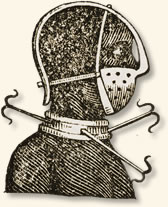
[TD="class: caption, align: center"]A device used to control
unruly slaves[/TD]
[/TR]
[/TABLE]
When the Negroes, whom the black traders have to dispose of, are shown to the European purchasers, they first examine them rela-tive to their age. They then minutely inspect their persons, and inquire into the state of their health, if they are afflicted with any infirmity, or are deformed, or have bad eyes or teeth; if they are lame, or weak in their joints, or distorted in the back, or of a slender make, or are narrow in the chest; in short, if they have been, or are afflicted in any manner, so as to render them incapable of much labor; if any of the foregoing defects are discovered in them, they are rejected. But if approved of, they are generally taken on board the ship the same evening. The purchaser has liberty to return on the following morning, but not afterwards, such as upon re-examination are found exceptionable.
The traders frequently beat those Negroes which are objected to by the captains, and use them with great severity. It matters not whether they are refused on account of age, illness, deformity, or for any other reason. At New Calabar, in particular . . . the traders, when any of their Negroes have been objected to, have dropped their canoes under the stern of the vessel, and instantly be headed them, in sight of the captain.
As soon as the wretched Africans, purchased at the fairs, fall into the hands of the black traders, they experience an earnest of those dreadful sufferings which they are doomed in future to undergo. . . . They are brought from the places where they are pur-chased to Bonny, etc. in canoes; at the bottom of which they lie, hav-ing their hands tied with a kind of willow twigs, and a strict watch is kept over them. Their usage in other respects, during the time of the passage, which generally lasts several days, is equally cruel. Their allowance of food is so scanty, that it is barely sufficient to support nature. They are, besides, much exposed to the violent rains which frequently fall here, being covered only with mats that afford but a slight defense; and as there is usually water at the bottom of the canoes, from their leaking, they are scarcely ever dry."
References:
This eyewitness account appears in Falconbridge, Alexander, An Account of the Slave Trade on the Coast of Africa (1788); Curtin, Phillip D. Atlantic Slave Trade (1969); Matheson, William Law, Great Britain and the Slave Trade, 1839-1865 (1967).
 
Ngoja nikamate compute ni attach picha za ushenzi za mabwana zako waarabu .wabelgiji wafanya biashara ya utumwa lini?sijawah kusikia labda madrasa ndio mnafundisha apart from comfu
[h=1]Blair's sorry apology for slavery[/h]

By Charles Moore

12:01AM GMT 02 Dec 2006
comments.gif
Comment


Why does Tony Blair say that he feels "deep sorrow" about the slave trade before the 200th anniversary of its abolition falls next year?

This form of words is very characteristic of how modern politicians deal with tricky situations. There is no reason for Mr Blair to say sorry. He is not responsible for the slave trade in any way, and by half-suggesting that he is, he surrenders to unreason and creates difficulties for his successors.

Take a comparison. Anti-semites have claimed for hundreds of years that the Jews inherit the guilt for the death of Jesus. Suppose the Chief Rabbi were to proclaim his "deep sorrow" for the Crucifixion. Such sorrow is a reasonable feeling for anyone to have, but the effect of the Chief Rabbi saying it would be to give legitimacy to the blood libel.

But the Prime Minister will have been advised that, if he did not put the word "sorrow" in somewhere, headlines would have said, "I'm not sorry for slave trade, says Blair". So he found a formula that involved a bit of a grovel, but nothing that would make him pay "reparations", as some pressure groups demand. It is ignominious, but perhaps, the blame-game being what it is, understandable.

Yet the bicentenary should be a cause for celebration (a point that Mr Blair did make, sotto voce). Apart from a brief abolition by the French First Republic, which was rescinded by Napoleon, Britain was the first country to abolish the slave trade. After Waterloo, it insisted on spreading that abolition to other European countries. The Royal Navy did a great deal to stamp out the trade. In 1833, Parliament made all slavery illegal. In law and in practice, Britain took the lead.

In his statement, Tony Blair also said: "It is hard to believe that what would now be a crime against humanity was legal at the time." One sees what he means, but it is only if you do try to understand how such things came about that you can see how versions of them might happen again.
When England joined the slave trade in the early 17th century, it was taking part in a practice that, in different forms, was as old as human history. The spur was competition with Spain, which had been slaving away for more than a century, in the Americas.
A triangular trade grew up. West African tribal leaders — and Arab traders — sold blacks from rival tribes to whites, who transported them to the West Indies and America. There they were set to work to produce sugar, cotton, rum and tobacco, which were then taken back to Bristol and Liverpool.
As so often with evils, the slave trade was not consciously chosen and promoted as morally right, though some later tried to defend it on moral grounds. It grew up because of the demand for labour in harsh conditions, and its cheap availability. This still happens today, if in a less extreme form. If the price of labour in a place is very low, you accept it. You cause havoc if you don't, so you tend to ignore your doubts.
And people should not imagine that such things were solely the result of prejudice against blacks (though blacks had by far the worst experience). In Scotland, there was a special rule that allowed employers to own colliers and salters for life, so special that colliers and salters were explicitly excluded from the introduction of habeas corpus in Scotland in 1701, and did not get full freedom until 1799. I am surprised Arthur Scargill isn't trying to get reparations for their descendants.
Moral change came about when people started to think about slavery, and to test it. A famous case was that of Somersett in 1772. He was a slave who escaped his master on a visit to England. The anti-slavers took up his cause and got him christened James (slaves often had no name but the surname of their master). From the emancipation of baptism came naturally, in their minds, his emancipation from slavery.
James was seized by his owner and chained on a boat, but the anti-slavers got a writ of habeas corpus, and his case came to court.
Lord Mansfield, the judge, declared that slavery had no legal meaning in England — "As soon as any slave sets foot upon English territory, he becomes free".
The Society for Effecting the Abolition of the Slave Trade struck a famous medallion of a black man in chains saying, "Am I not a man and a brother?" You only have to put that question for people to find it difficult to answer "No". But it took the operation of the Christian conscience to think of asking it.
The process of abolition, though painfully slow, does credit to the British system. It was part of a gradual and, on the whole, orderly opening up of British society. It tended to go with reforms such as extending the right to vote and letting non-Anglicans take a full part in society. As often with good causes, no one party led.
Anti-slavers were mostly radicals, but William Wilberforce was a Tory.
This tradition of improvement through argument and law is a very good one, and it is stronger in Anglo-Saxon countries than anywhere else. We should give thanks for it, even though the onward march of legislation is not the same as the onward march of liberty. It is rather shaming that the bicentenary next year will coincide with the ban on smoking in pubs and clubs.
What are the wrongs comparable to slavery today? If the defence of human vulnerability is considered one of our key values, why do we encourage abortion and euthanasia? If we think that nothing is more important than the loving upbringing of children, why do we so readily take children into "care" and why do we neglect them when they are in it?
We declare our commitment to the rights of women, but when it comes to the oppression involved in so many arranged marriages, we allow women's rights to be trumped by our belief in "multi-culturalism". There are probably more women forced into marriage in this country today than at any time since the early 19th century.
There are countries and belief systems still powerful in the modern world that do not have any deep-rooted objection to slavery. It surprises me how little attention is being paid, for example, to what China is currently doing in Africa. What are the terms and conditions of the work-forces it uses to extract oil and other natural resources? How many African governments, behaving like tribal chieftains 300 years ago, are taking Chinese money while their people suffer?
And how aware are we that many Muslims find in their faith a justification for slavery in certain circumstances? Mohammed, whose life is considered perfect by Muslims, slaughtered the Jewish tribe of Banu Qurayza, and enslaved their women and children. In his treaty with the Nubians, he insisted on a tribute of slaves.
These methods have not been repudiated by the faith. In the lands of Nubia and nearby today, the Islamist Arab government of Sudan is encouraging the dispossession, killing and, so it is reported, enslavement of Africans. I am told that, in the local Arabic usage, the word for black and for slave is the same. In Darfur, more than 200,000 black people have died.
What Mr Blair calls crimes against humanity are going strong. It is interesting that, as with slavery, people are slow to notice.
 
Kweli kabisa waarabu walishiriki ktk biashara ya Utumwa kama walanguzi walowauzia wazungu, lakini kwa nini masoko yote ya kuuza na kununua watumwa yalikuwa makanisa? http://upload.wikimedia.org/wikipedia/commons/b/b9/The_inspection_and_sale_of_a_slave.jpg
sijakuelewa Mkandara ina maana hujui Historia ya Utumwa walioipinga Biashara hii ya Utumwa ni kina nan?
Hao waliojenga Makanisa kutoka Anglican walishawahi kununua Watumwa
Huku Bara Ujiji Tabora Mpwapwa na kwingineko walikopita Watumwa, ni Biashara ilianza au Makanisa?

The_inspection_and_sale_of_a_slave.jpg
 
Hawa jamaa wa Oman siwezi kuwasahau maana umaskini wangu unatokana na biashara haramu ya watumwa walioifanya nchini Tanzania miaka ya 1700. Waliwachukua ndugu zangu wote na hivyo ukoo wetu ukaanza moja. Wakiongozwa na Mheshimiwa Tip Tip, walifika mpaka kwetu Ujiji na kuzoa ndugu zangu wote.

Nisaidieni kupata mwanasheria tuishikaki Oman ili itulipe fidia na kisha iombe radhi kwa unyama iliyotufanyia sisi Watanzania.

OCT 19, 2014 Update:

...............Usisahau Wazungu na Kanisa !........ndio walikuwa wateja. Ndio maana 'weusi' wamejaa bara Amerika (Kaskazini na Kusini na Ulaya)
Jipe muda wa 'kutwalii' kidogo kabla ya kukurupuka !
:cool2: shilanona
 
Last edited by a moderator:
Back
Top Bottom