The Man Who Invented the Aeroplane

The Man Who Invented the Aeroplane

X-PASTER

JF-Expert Member
Joined
Feb 12, 2007
Posts
11,604
Reaction score
1,848
The Man Who Invented the Aeroplane

0527625k6-Luftschiffahrt.jpg


Before the Wright Brothers achieved the first successful heavier-than-air controlled flight on December 17, 1903, hundreds of women and men attempted to fly, in airships, gliders and aeroplanes, and many did go aloft in gas and hot-air balloons.
 
Archytas (Born 428 BC), the Ancient Greek philosopher, mathematician, astronomer, statesman, and strategist, was reputed to have designed and built, around 400 BC, the first artificial, self-propelled flying device, a bird-shaped model propelled by a jet of what was probably steam, said to have actually flown some 200 metres. This machine, which its inventor called The Pigeon (Greek: Περιστέρα "Peristera"), may have been suspended on a wire or pivot for its flight.

flying-contraptions-2.jpg
 
The 9th century Berber inventor, Abbas Qasim Ibn Firnas, Abbas Ibn Firnas's glider is considered by John Harding to be the first attempt at heavier-than-air flight in aviation history. (an inventor, engineer, aviator, physician, Arabic poet, and Andalusian musician. Of Berber descent, he was born 810–887 A.D. in Izn-Rand Onda, Al-Andalus (today's Ronda, Spain), and lived in the Emirate of Córdoba. He is known for an early attempt at aviation)

Abbas%20Ibnu%20Firnas%202.jpg


Abbas%20Ibnu%20Firnas%202.jpg

 
In 1010 AD an English monk, Eilmer of Malmesbury (also known as Olive) purportedly piloted a primitive gliding craft from the tower of Malmesbury Abbey. Eilmer was said to have flown over 200 yards (180 m) before landing, breaking both his legs. He later remarked that the only reason he did not fly further was because he forgot to give it a tail, and he was about to add one when his concerned Abbot forbade him any further experiments.

goyafly.jpg
eilmer-de-malmesbury.jpg
 
Italian person named Leonardo da Vinci ca. 1485 (born April 15, 1452)

Da-Vinci-Airplane.jpeg
 
Bartolomeu de Gusmão, Brazil and Portugal, an experimenter with early airship designs. In 1709 demonstrated a small airship model before the Portuguese court, but never succeeded with a full-scale model.
passarola_2.jpg
 
Jean-François Pilâtre de Rozier, (Born 30 March 1754) Paris, France, first trip by a human in a free-flying balloon (the Montgolfière), built by Joseph-Michel and Jacques-Étienne Montgolfier,. 9 km covered in 25 minutes on October 15, 1783. (see Le Globe below for first unmanned flight, 2 months earlier)

pilatre_de_rozier6.jpg
 
Robert brothers, Professor Jacques Charles and Les Frères Robert, two French brothers, Anne-Jean and Nicolas-Louis, variously shared three milestones of pioneering flight:


  • Le Globe, the first unmanned hydrogen gas balloon flew on 26 August 1783.​
  • On 1 December 1783 La Charlière piloted by Jacques Charles and Nicolas-Louis Robert made the first manned hydrogen balloon flight.​
  • On 19 September 1784, La Caroline, an elongated craft that followed Jean Baptiste Meusnier's proposals for a dirigible balloon, completed the first flight over 100 km from Paris to Beuvry.​
charles-balloon.jpg
 
Hans Andreas Navrestad, Norway — 1825 Allegedly flew manned glider.

traian_vuia_aircraft.jpg
 
Richard William Pearse of New Zealand (Born 3 December 1877) Pearse made several attempts to fly in 1901
image343.jpg
 
British person named Percy Sinclair Pilcher born 16 January 1866 (died in the crash of another glider before he could make the attempt). On 30 September 1899.

pilcher_hawk_2_500.jpg
 
British person named Sir George Cayley, who was born in 1773 in Scarborough Yorkshire in 1853 (First well-documented Western human glide. Cayley also made the first scientific studies into the aerodynamic forces on a winged flying machine and produced designs incorporating a fuselage, wings, stabilizing tail and control surfaces. He discovered and identified the four aerodynamic forces of flight - weight, lift, drag, and thrust. Modern airplane design is based on those discoveries including cambered wings. He is sometimes called the "Father of aviation").

cayley-triple-wing.jpg

Cayley%20Glider%20Replica%20Flown.jpg


Matias Perez, Havana, flight in 1856, Matias Perez was a Portuguese pilot, canopy maker and Cuban resident who, carried away with the ever increasing popularity of aerostatic aircraft, disappeared while attempting an aerostatic flight from Havana's "Plaza de Marte" (currently Parque de la Fraternidad) on June, 1856.
LeBris1868.jpg
 
Jean-Marie Le Bris, France, flight in 1856, Jean-Marie Le Bris was the first to fly higher than his point of departure, by having his glider pulled by a horse on a beach, against the wind.

29concarneau_lebris.jpg
LeBrisFili36.jpg
 
Jan Wnek, Poland — controlled flights 1866 - 1869. Jan Wnek controlled his glider by twisting the wing's trailing edge via strings attached to stirrups at his feet. Church records only—Kraków Museum unwilling to allow verification.

255773598308512.jpg
 
Goodman Household, South Africa, 1871, Goodman built and flew his own glider over one hundred meters. The story is that he crashed breaking both glider and a leg. The event took place in the Kwazulu Natal Midlands near Curry's Post in 1871 and is recorded variously in legend and local literature.


Félix du Temple de la Croix, France, 1874, Félix du Temple's 1874 Monoplane.
First take-off of a manned and powered aircraft, from a downsloped ramp, resulting in a brief hop a few feet above the ground.

1874DuTemple.jpg
 
Victor Tatin, France, 1874, The Aeroplane of Victor Tatin, 1879. First airplane to lift itself under its own power, the Aeroplane was an unmanned plane powered by a compressed-air engine.

Tatin%20pic%201a.jpg
 
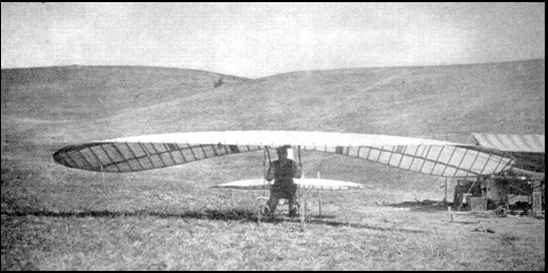
John Joseph Montgomery, United States of America 1883, First controlled glider flight in the United States, from a hillside near Otay, California.

300px-Montgomery1911.jpg

montgom1.jpg
 
Back
Top Bottom