Kuanguka kwa Marekani hakuepukiki

Kuanguka kwa Marekani hakuepukiki

Red Giant

JF-Expert Member
Joined
Mar 9, 2012
Posts
15,650
Reaction score
21,012
Marekani ni taifa la kibepari ambalo limefika kuwa na utajiri mkubwa kutokana na utengenezaji wa bidhaa (manufacturing). Walikuwa wakitengeneze nguo, magari, ndege, meli , electronics na vingine kedekede.

Kutokana na faida mabepari na ma CEO wakawa matajiri na kuanza kuishi maisha ya kifahari. Wafanyakazi wakaona mbona tunapunjwa, wakaunda workers unions na kuanza kudai pesa zaidi. Viwanda vikawapa. Baada ya ww2 japan, ujerumani na uchina wakaanza nao kutengeneza bidhaa. Wafanyakazi wa hizi nchi (hasa china) wakawa wanatengeneza badhaa kwa bei rahisi kuliko wamarekani wanaotaka mishahara mikubwa. Mwisho wa siku bidhaa za bei rahisi zikawa zinauza kuliko za US na mapato ya US kupungua kila siku.

Makampuni kuona gharama za uzalishji US zimeongezeka yakaanza kukimbia. Makampuni ya magari yakaanza kukimbilia mexico na nchi zingine, makampuni ya nguo yakakimbilia china na Bangladesh, electronics yakakimbilia china. Kwa hiyo marekani inapoteza mapato na employments. Ili wajiokoe inatakiwa wakubali kuishi kwa mishahara ya wamexico, wachina na wabagladeshi kitu ambacho hawawezi fanya. Kwa hiyo kwa mtindo huu marekani itazidi kuporomoka.

What is in for us? Wabongo inatakiwa tupunguze gharama za uzalishaji hasa umeme na kuongeza technicians ili tushindane kuchukua biashara ambazo US na wamagharibi wanaloose.
 
Your conclusion is far removed from your heading.

People are moving towards a knowledge economy now.Ndiyo maana hata hii internet unayotumia imeanzishwa na Wamarekani baada ya wao kuona habari za uzalishaji tuwaachie nyie dunia ya tatu huko huku tunatumia brains kwa sana.
 
Your conclusion is far removed from your heading.

People are moving towards a knowledge economy now.Ndiyo maana hata hii internet unayotumia imeanzishwa na Wamarekani baada ya wao kuona habari za uzalishaji tuwaachie nyie dunia ya tatu huko huku tunatumia brains kwa sana.
kama ndiyo hivyo miji kama detroit isingeporomoka. ni kweli tunaweza kuwa kwenye informatuion age lakini mahitaji makubwa ya watu ni tangible things.
 
kama ndiyo hivyo miji kama detroit isingeporomoka. ni kweli tunaweza kuwa kwenye informatuion age lakini mahitaji makubwa ya watu ni tangible things.

Detroit is expendable. And the global forces of demand and supply will make that city rise again. Already there is talk of Chinese investors gobbling up cheap properties in Detroit.

Sikatai kwamba matumizi makubwa ya watu ni tangible things. Lakini uchumi wa sasa unavyokwenda it is expensive to produce hivi vitu US kwa sababu US kuna labor laws na human rights,

Kwa hiyo hizo habari atapelekewa China ambaye hajali labor laws wala human rights huko, atengeneze vitu cheaply. Adam Smith stuff a la "comparative advantage" from "The Wealth of Nations".

Marekani watu wanachogundua leo kuelea kiuchumi mpaka ukija kukisikia huko ni miaka mitano mijayo mpaka kumi.

Kwanza dunia nzima inatumia hela ya Mmarekani kufanya biashara. Hilo tu linampa upper hand katika international trade.
 
Marekani haianguki leo wala kesho.
marekani inaanguka kwa kasi sana. saahizi makampuni makubwa ya technology yanaenda fanyia kazi india na china. marekani imebakiwa na biashara ya fedha tu ambayo nayoyo inaloose kwa kasi.
 
marekani inaanguka kwa kasi sana. saahizi makampuni makubwa ya technology yanaenda fanyia kazi india na china. marekani imebakiwa na biashara ya fedha tu ambayo nayoyo inaloose kwa kasi.

Hivi hayo makampuni makubwa yanamilikiwa na akina nani?
 
Detroit is expendable. And the global forces of demand and supply will make that city rise again. Already there is talk of Chinese investors gobbling up cheap properties in Detroit.

Sikatai kwamba matumizi makubwa ya watu ni tangible things. Lakini uchumi wa sasa unavyokwenda it is expensive to produce hivi vitu US kwa sababu US kuna labor laws na human rights,

Kwa hiyo hizo habari atapelekewa China ambaye hajali labor laws wala human rights huko, atengeneze vitu cheaply. Adam Smith stuff a la "comparative advantage" from "The Wealth of Nations".

Marekani watu wanachogundua leo kuelea kiuchumi mpaka ukija kukisikia huko ni miaka mitano mijayo mpaka kumi.

Kwanza dunia nzima inatumia hela ya Mmarekani kufanya biashara. Hilo tu linampa upper hand katika international trade.
7748
hicho kwenye red ndiyo wanajivunia lakini data zinaonyesha kila mwaka wanaloose vibaya sana kwa yuan na EURO.
 
Hivi hayo makampuni makubwa yanamilikiwa na akina nani?
yanamilikiwa na wamarekani na hata yangekuwa US yangekuwa yanamilikiwa na marekani na kutengeneza ajira kwa wamarekani. fikiria kampuni inaondoka na kuacha watu 2,000 bila ajira. hata kamabado linamilikiwa na mmarekani bado ni hasara kwa nchi.
 
7748
hicho kwenye red ndiyo wanajivunia lakini data zinaonyesha kila mwaka wanaloose vibaya sana kwa yuan na EURO.

If the Euro is the alternative, they have nothing much to fear.
 
Marekani haianguki leo wala kesho.

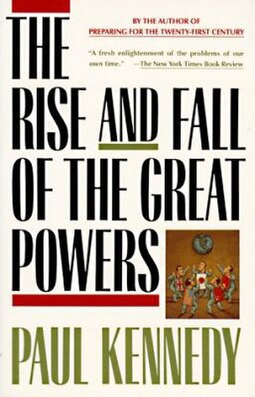
Ngumu kumeza, lakini historia hujirudia kwamba empire au super power zilizokua na kutukuka kwa kiwango cha juu hatimaye ziliporomoka (the rise and fall empires - Great powers).

255px-Greatpowers.jpg


The Rise and Fall of the Great Powers

Early modern era
The book starts at the dividing line between the Renaissance and early modern history-1500 (Chapter 1). It briefly discusses the Ming (page 4) and Muslim worlds (page 9) of the time and the rise of the western powers relative to them (page 16). The book then proceeds chronologically, looking at each of the power shifts over time and the effect on other Great Powers and the "Middle Powers".

Kennedy uses a number of measures to indicate real, relative and potential strength of nations throughout the book. He changes the metric of power based on the point in time. Chapter 2, "The Habsburg Bid for Mastery, 1519–1659" emphasizes the role of the "manpower revolution" in changing the way Europeans fought wars (see military revolution). This chapter also emphasizes the importance of Europe's political boundaries in shaping a political balance of power.


"The argument in this chapter is not, therefore, that the Habsburgs failed utterly to do what other powers achieved so brilliantly. There are no stunning contrasts in evidence here; success and failure are to be measured by very narrow differences. All states, even the United Provinces, were placed under severe strain by the constant drain of resources for military and naval campaigns... The victory of the anti-Habsburg forces was, then, a marginal and relative one. They had managed, but only just, to maintain the balance between their material base and their military power better than their Habsburg opponents." (page 72).

European imperialism
The Habsburg failure segues into the thesis of Chapter 3, that financial power reigned between 1660 and 1815, usingBritain, France, Prussia, Austria-Hungary, and Russia to contrast between powers that could finance their wars (Britain and France) and powers that needed financial patronage to mobilize and maintain a major military force on the field. Kennedy presents a table (page 81, Table 2) of "British Wartime Expenditures and Revenue"; between 1688 and 1815 is especially illustrative, showing that Britain was able to maintain loans at around one-third of British wartime expenditures throughout that period

  • Total Wartime Expenditures, 1688–1815: 2,293,483,437 Pounds,
  • Total Income: 1,622,924,377 Pounds,
  • Balance Raised by Loans: 670,559,060 Pounds, and
  • Loans as % of Expenditure: 33.3%

The chapter also argues that British financial strength was the single most decisive factor in its victories over France during the 18th century. This chapter ends on the Napoleonic Wars and the fusion of British financial strength with a newfound industrial strength.


Industrial Revolution
Kennedy's next two chapters depend greatly upon Bairoch's calculations of industrialization, measuring all nations by anindex, where 100 is the British per capita industrialization rate in 1900. The United Kingdom grows from 10 in 1750, to 16 in 1800, 25 in 1830, 64 in 1860, 87 in 1880, to 100 in 1900 (page 149). In contrast, France's per capita industrialization was 9 in 1750, 9 in 1800, 12 in 1830, 20 in 1860, 28 in 1880, and 39 in 1900. Relative shares of world manufacturing output (also first appearing on page 149) are used to estimate the peaks and troughs of power for major states. China, for example, begins with 32.8% of global manufacturing in 1750 and plummets after the First Opium War, Second Opium War andTaiping Rebellion to 19.7% of global manufacturing in 1860, and 12.5% in 1880 (compared to the UK's 1.9% in 1750, growing to 19.9% in 1860, and 22.9% in 1880).


20th century
Measures of strength in the 20th century (pages 199–203) use population size, urbanization rates, Bairoch's per capita levels of industrialization, iron and steel production, energy consumption (measured in millions of metric tons of coal equivalent), and total industrial output of the powers (measured vs. Britain's 1900 figure of 100), to gauge the strength of the various great powers.

Paul also gave emphasis on Productivity Increase based on systematic interventions which lead to Economic Growth & Prosperity to Great Powers in the 20th century.

He compares the Great Powers at the close of the 20th century and predicts the decline of the Soviet Union, the rise of China and Japan, the struggles and potential for the European Economic Community (EEC), and the relative decline of the United States. He highlights the precedence of the "four modernizations" in Deng Xiaoping's plans for China-agriculture, industry, science and military-deemphasizing military while the United States and the Soviet Union are emphasizing it. He predicts that continued deficit spending, especially on military build-up, will be the single most important reason for decline of any Great Power.


On the United States
  1. From the Civil War to the first half of the 20th century, the United States' economy benefited from high agricultural production, plentiful raw materials, technological advancements and financial inflows. During this time the U.S. did not have to contend with foreign dangers. From 1860 to 1914, U.S. exports increase sevenfold and result in huge trading surpluses.
  2. By 1945, the U.S.' economy enjoyed both high productivity and was the only major industrialized nation intact after World War II.
  3. From the 1960s onwards, the U.S. saw a relative decline in its share of world production and trade.
  4. By the 1980s, the U.S. experienced declining exports of agricultural and manufacturing goods.
  5. In the space of a few years, the U.S. went from being the largest creditor to the largest debtor nation.
  6. At the same time the federal debt was growing at an increasing pace. This situation is typical of declining hegemons.

The United States has the typical problems of a great power which include balancing guns and butter and investments for economic growth. The U.S.' growing military commitment to every continent (other than the Antarctica) and the growing cost of military hardware severely limits available options. The author compares the U.S.' situation to Great Britain's prior to World War I. He comments that the map of U.S. bases is similar to Great Britain's before World War I.

As the military expenses grow this reduces the investments in economic growth, which eventually "leads to the downward spiral of slower growth, heavier taxes, deepening domestic splits over spending priorities, and weakening capacity to bear the burdens of defense." Mr. Kennedy's advice is as follows.

The task facing American statesmen over the next decades, therefore, is to recognize that broad trends are under way, and that there is a need to "manage" affairs so that the relative erosion of the United States' position takes place slowly and smoothly, and is not accelerated by policies which bring merely short-term advantage but longer-term disadvantage.

CC;
Red Giant
 
yanamilikiwa na wamarekani na hata yangekuwa US yangekuwa yanamilikiwa na marekani na kutengeneza ajiea kwa wamarekani. fikiria kampuni inaondoka na kuacha watu 2,000 bila ajira. hata kamado linamilikiwa na mmarekani bado ni hasara kwa nchi.

Hivi unemployment rate ya China ni kiasi gani?
 
Ngumu kumeza, lakini historia hujirudia kwamba empire au super power zilizokua na kutukuka kwa kiwango cha juu hatimaye ziliporomoka (the rise and fall empires - Great powers).

Fact is, America is the world's only super power.

Ila najua hilo nalo kwako ni gumu kumeza.
 
Fact is, America is the world's only super power.

Ila najua hilo nalo kwako ni gumu kumeza.

United States of Amerika ya jana si hii tunayoiona leo.
On the United States

  1. From the Civil War to the first half of the 20th century, the United States' economy benefited from high agricultural production, plentiful raw materials, technological advancements and financial inflows. During this time the U.S. did not have to contend with foreign dangers. From 1860 to 1914, U.S. exports increase sevenfold and result in huge trading surpluses.
  2. By 1945, the U.S.' economy enjoyed both high productivity and was the only major industrialized nation intact after World War II.
  3. From the 1960s onwards, the U.S. saw a relative decline in its share of world production and trade.
  4. By the 1980s, the U.S. experienced declining exports of agricultural and manufacturing goods.
  5. In the space of a few years, the U.S. went from being the largest creditor to the largest debtor nation.
  6. At the same time the federal debt was growing at an increasing pace. This situation is typical of declininghegemons.

Wakati ilikuwa exporter mkubwa leo Marekani ni importer. Kumbuka impact kubwa inatokea uchumi wa nchi ambazo zilikuwa soko kwa bidhaa za marekani na sasa nchi hizo haziko tayari kusupply raw material bali products.

Hili linahitaji kwa wenye jicho la kuona mbali zaidi maana wengine wanapima kile ambacho kinaonekana kilichokwisha fanya wakati uchumi umetengamaa. Hali hili iliikubwa pia dola ya kirumi kwa ndugu zetu waitaliano kufikia hatua ukiwa na shilingi kumi za Tanzania utahitaji kiroba cha kubebea change utakazozipata za kiitaliano. Sasa angalia sarafu ya Marekani ni chini ya sarafu ya mwingireza na euro ya mataifa ya ulaya ambapo wakati mataifa hayo yalipokuwa yanaungana Marekani likuwa ikikejeli.
 
If the Euro is the alternative, they have nothing much to fear.
sijajua kwanini unasema kama ''Euro itakuwa ni alternative they have nothing much to fear''. ukweli ni kuwa huko tunakoenda hakutakuwa na pesa ya nchi moja kuwa dominant. kutakuwa na Euro, dollar na yuan. na kama unavyojua Euro ina maslahi ya nchi nyingi ni kazi kuwamanipulate.
 
United States of Amerika ya jana si hii tunayoiona leo.

Basi wewe na wenzako mnaoona hivyo nendeni mkapimwe hayo macho yenu.

Wakati ilikuwa exporter mkubwa leo Marekani ni importer.

Hii mbona wala si ishu kivile. Kuna nchi isiyo agiza vitu?

Kumbuka impact kubwa inatokea uchumi wa nchi ambazo zilikuwa soko kwa bidhaa za marekani na sasa nchi hizo haziko tayari kusupply raw material bali products.

Kwako wewe bidhaa za Marekani ni kama vitu gani hasa? Manake hata Hollywood movies ni bidhaa vile vile. Vinywaji vya Coca Cola ni bidhaa. Ndege za Boeing ni bidhaa. Elimu itolewayo Marekani ni bidhaa (kuna nchi yenye international students wengi kuizidi Marekani?), hizo VISA na MasterCard nazo ni bidhaa (au unadhani hayo ni makampuni ya Kichina?), hata currency ya dola nayo ni bidhaa, sayansi na teknolojia nayo ni bidhaa.....hata ligi ya NBA nayo ni bidhaa.....

Hili linahitaji kwa wenye jicho la kuona mbali zaidi maana wengine wanapima kile ambacho kinaonekana kilichokwisha fanya wakati uchumi umetengamaa.

Yeah yeah yeah...I guess wengine hatuna hilo jicho eeh?

Hali hili iliikubwa pia dola ya kirumi kwa ndugu zetu waitaliano kufikia hatua ukiwa na shilingi kumi za Tanzania utahitaji kiroba cha kubebea change utakazozipata za kiitaliano.

Warumi siyo Wamarekani. Unalijua hilo?

Sasa angalia sarafu ya Marekani ni chini ya sarafu ya mwingireza na euro ya mataifa ya ulaya ambapo wakati mataifa hayo yalipokuwa yanaungana Marekani likuwa ikikejeli.

Mbona sarafu ya Marekani imekuwa chini ya pauni kwa muda mrefu tu kabla hata ya EU kuja na EURO.

Kama unatumia jambo hilo kuwa ndo kigezo cha Marekani kuanguka basi unachekesha kuliko hata babu Bill Cosby!
 
sijajua kwanini unasema kama ''Euro itakuwa ni alternative they have nothing much to fear''. ukweli ni kuwa huko tunakoenda hakutakuwa na pesa ya nchi moja kuwa dominant. kutakuwa na Euro, dollar na yuan. na kama unavyojua Euro ina maslahi ya nchi nyingi ni kazi kuwamanipulate.

The Europeans can't get their act together. The Chinese won't even float their Yuan.

What else is there?

The Naira?

Frankly the US dollar has more to fear from some other disruptive forces, such as the Bitcoin and it's type, than these governmental currencies.

And even Bitcoin is disintegrating.
 
Na ya Marekani haipungui?

Na unajua hata unemployment rate ni nini wewe?
unemployment rate sio technical term kwamba mtu asijue. inawezekana unemployment rate ya marekani inapungua lakini si kwa kiwango ambacho ingepungua iwapo wangekuwa hawaloose biashara China, korea, Japan nk.
 
Back
Top Bottom