African Satellite World and Sat Gear

African Satellite World and Sat Gear

Hehehehe...wanted to see how people reason before I comment. Kenya is generally at around 36 degrees East, thus, satellites at around this position such as Paksat 1R and Eutelsat 36A/B will be directly overhead and can be nabbed with the dish pointing straight up (most noticeable with a primefocus dish). Satellites beyond 36E (from 37 and onwards towards 180E) will be to the east of 36 and thus can only be nabbed with the dish facing East e.g. Yahsat 1A, NSS12, Intelsat 20, Intelsat 906, etc. Satellites with location prior to 36E, i.e from 36E going backwards to zero and 180W will generally be nabbed with the dish facing western direction relative to your location e.g Amos 5, Intelsat 10-02, Nilesats, SES 4, SES 5, Eutelsat 7A/10A/16A/7 west A, etc. I rest my case.


Two beers on me Ranksat. Sometimes adult education can me very hard!

For those who want a pedestrian analogy, I always consider satellites to be like houses. Since they are all scuttled around 35,000 km above the equator, the only reference they have to each other is that they are either WEST or EAST of each other. The equator is zero (0) so we only use the Greenwhich Meridian to locate each other.

Therefor a satellite can be named X East, but still your dish will face West for you to nab it because your location might be further to the east of this satellite.


For instance, Kenya's longitudidal coordinate is just around 38E. BigBrother is on a satellite about 36E, so for you to nab this BB sat, you will point the dish skywards, almost overhead.

However, in Kenya, at 38E you can have a satellite at 17E in the name of Digiturk. Because Kenya is more Eastern than 17E, the dish will still face West but at an angle.


Then the question is: How can the dish point at the same general direction when tracking 7W and 17E?

The reason is simple: According to the Greenwich Meridian scale, which is 0-360 to the right and 0 to negative 360 to the laft, 7E and 17W are actually around the same area, considering that these satellites are over 35,000 km above, actually the angle that separates such birds (Azimuth) is quite minute. Have a happy hunting day, but know your location in this geospatial hobby and your ASAS will be less chronic!
 
Open question.Is there a difference btn a ku band and c band in name or make?
 
sa mux on nss 12 @11044v40000..anyone to confirm that


The channels are on Yamal 402 satellite.Watched live South african league game on Wednesday night on the feed channel on the same tp.


Good Morning Solom,

Thanks for the update.

Seems the channels you discovered are on Yamal 402 satellite, Southern Beam footprint covering part of Africa

11721590384_7b45814c38_b.jpg


Yamal 402 satellite is located @ [SIZE=+1]@ 54.9° East, [/SIZE]between Yahsat 1A and NSS 12.

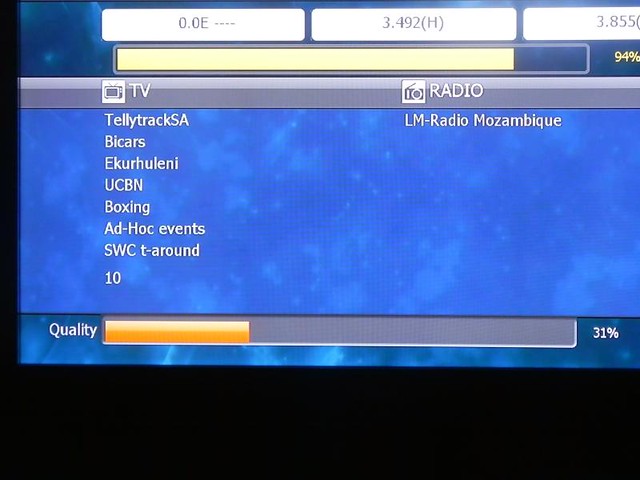
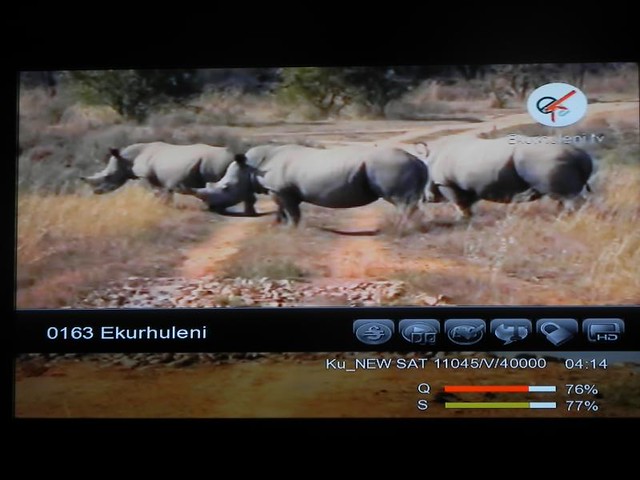
The channels on frequency 11045 V DVB-S SR 40000 are from South Africa.

9 Tv channels ( 3 encrypted 6 fta) and 1 Radio channel

Snap shot of some of the channels>>>

11721433246_3fffc9cafc_z.jpg


11721427346_22bf1b812c_z.jpg


11721018924_208974cbe3_z.jpg


11720926573_f689c15f14_z.jpg


11721019944_02cff6767d_z.jpg


11720650495_353051f45b_z.jpg


11720651275_cf58c7be34_z.jpg


and Boxing

11721269323_c672ffaebb_z.jpg
 
help please!
Which channel shows uefa champions league?

ETv hyde park at ses 5 tuesday match only
Oromia at 17e tuesday n Wednesday one match each day (requires more info to verify this)
Rodriguez (mbc3) at 7e wednesday match
Tv zimbo at 10e wednesday match
Both irib tv3 and verzesh beams tuesday and Wednesday different matches so u get an option to choose the selected games on these channels.
 
ETv hyde park at ses 5 tuesday match only
Oromia at 17e tuesday n Wednesday one match each day (requires more info to verify this)
Rodriguez (mbc3) at 7e wednesday match
Tv zimbo at 10e wednesday match
Both irib tv3 and verzesh beams tuesday and Wednesday different matches so u get an option to choose the selected games on these channels.

Thanks.I have a zuku dish and am planning to buy another receiver.which one should i choose?
 
more goodies coming our way @42°e.
.
.
ILS PROTON
SUCCESSFULLY
LAUNCHES TURKSAT-4A
FOR TURKSAT
FIRST PROTON LAUNCH
OF THE YEAR; 85TH ILS
PROTON LAUNCH
OVERALL
For Mission Control, please click
here
BAIKONUR COSMODROME,
Kazakhstan, February 15, 2014 –
International Launch Services (ILS), a
leader in providing mission
integration and launch services to
the global commercial satellite
industry, successfully launched the
TURKSAT-4A satellite into orbit today
on an ILS Proton vehicle. The
satellite was built by Mitsubishi
Electric Corporation for TURKSAT
Satellite Communication, Cable TV
and Operation Inc. Co. (TURKSAT
A.S.), one of the world’s leading
operators in the satellite
communication business. This was
the first ILS Proton launch for both
the satellite operator and the
manufacturer; it was also the first
Proton launch of the year.
The ILS Proton Breeze M vehicle
launched from Pad 24 at the
Baikonur Cosmodrome at 03:09 today
local time (14 February: 21:09 GMT
and 16:09 EST). The first three
stages of the Proton used a standard
ascent profile to place the orbital
unit (Breeze M upper stage and the
TURKSAT-4A satellite) into a sub-
orbital trajectory. From this point in
the mission, the Breeze M performed
planned mission maneuvers to
advance the orbital unit first to a
circular parking orbit, then to an
intermediate orbit, followed by a
transfer orbit, and finally to a
geostationary transfer orbit.
Separation of the TURKSAT-4A
satellite occurred approximately 9
hours and 13 minutes after liftoff.
TURKSAT-4A will provide
telecommunication and direct TV
broadcasting services over a wide
geographic region between west of
China and east of England, spanning
Turkey, as well as Europe, Central
Asia, the Middle East and Africa.
TURKSAT-4A is a multi-band
satellite with an expected on-orbit
maneuver lifespan of 30 years. The
satellite will provide high flexibility
of switchability and connectivity
among different service areas to its
customers.
The satellite weighed 4.8 metric tons
at liftoff and is the ninth satellite
built on Mitsubishi Electric’s DS2000
platform, a fully proven modular
platform with the flexibility to
handle a broad range of payload
applications.
ILS President Phil Slack stated, “This
is the first ILS Proton launch for our
partners, Mitsubishi Electric and
TURKSAT, and we are happy to have
such a strong foundation for our new
relationship. We are honored to be
entrusted to deliver our customers’
satellites to orbit. Thank you to all of
the teams at Mitsubishi Electric,
TURKSAT, Khrunichev, and ILS, who
have made this launch a success.”
Ozkan Dalbay, TURKSAT A.S. CEO
and Chairman of the Board, said,
“The TURKSAT-4A satellite will
increase coverage and enhance
customer services across Turkey as
well as through areas of Europe,
Central Asia, the Middle East and
Africa. Today's launch is a
significant milestone that
strengthens our ties with both ILS
and Khrunichev. Thank you to
everyone involved in the success of
this launch.”
Mitsubishi Electric General Manager
of Space Systems Division, Yasunori
Kamochi added, “We appreciate that
through ILS’ conscientious efforts,
they conducted a flawless mission
leading to the successful launch of
TURKSAT 4A, our first Proton
launch. We are certain that ILS’
assurance in quality and scheduling
will allow our customer to engage its
satellite mission in a timely manner.
We would like to thank everyone
involved with the TURKSAT-4A
launch for their diligence and
outstanding capabilities.”
This was the 85th ILS Proton Launch
and the 394th launch for Proton
overall since its maiden flight in
1965. The Proton Breeze M vehicle is
developed and built by Khrunichev
Research and Production Space
Center of Moscow, Russia’s premier
space industry manufacturer and
majority shareholder in ILS.
.
.
Türksat 4A - Wikipedia, the free encyclopedia
 
yesterday i tried to nab eutelsat 10A . i only got a glimpse of kenyan mux for few minutes before it started cracking and disappeared.
 
yesterday i tried to nab eutelsat 10A . i only got a glimpse of kenyan mux for few minutes before it started cracking and disappeared.

Hi...it comes on in evenings and disappears late at night.... very clear around 8-9pm.....
 
yesterday i tried to nab eutelsat 10A . i only got a glimpse of kenyan mux for few minutes before it started cracking and disappeared.

Hi with 8ft dish you can get the Kenyan channels from 2 PM to 8Am.
 
hi guys still mpya kwa hii forum. Mi naget KENYAMUX@10e bila was. De lyks of ktn, ntv, k24, sijui Qtv, mara utv, Gbs,sayre na mama yao kbc. Sahani 8ft (eurostar), lnbf supermax ile ya kawaida tu. Dcdr zuku HD costs 2K (wesee magudyz zenu za ma SRT ni expe kwa mwananchi wa kawaida jo. Au siyo). Signal intensity@90 signal Quality@70--74. Mi nawezawatch all day say 6am till 10pm jioni loud n clear bila ya kuniSCRATCH hata. Manze mi dont watch damn tv@ nite. Setup hs bin active 4 de lst two months. Locaton KERICHO Kenya. Thx men u guyz r great.
 
Hi with 8ft dish you can get the Kenyan channels from 2 PM to 8Am.

Hi Lagat chamge. Kenyan channels r loud n clear all day all night 24/7 kericho, kenya. Wd a quality of 70-74percent on a zuku HD decdr, Aaaah I am gud 2 go. Dish ni eurostar 240cm. @ REGIMENT do u read me? Thx great members. Snapshots taken sunday btwn 9am n 11am.
 

Attachments

  • 8ft 01.jpg
    8ft 01.jpg
    28.4 KB · Views: 125
  • 8ft.jpg
    8ft.jpg
    57.7 KB · Views: 144
  • Qtv.jpg
    Qtv.jpg
    32.3 KB · Views: 173
  • Signal level.jpg
    Signal level.jpg
    33.5 KB · Views: 135
  • Kbc 01.jpg
    Kbc 01.jpg
    22.1 KB · Views: 115
  • Ktn.jpg
    Ktn.jpg
    26.3 KB · Views: 109
  • Gbs.jpg
    Gbs.jpg
    29.9 KB · Views: 120
  • K24.jpg
    K24.jpg
    33.5 KB · Views: 113
  • Ntv.jpg
    Ntv.jpg
    24.3 KB · Views: 98
  • Zuku dcdr.jpg
    Zuku dcdr.jpg
    23.4 KB · Views: 151
Last edited by a moderator:
Russian Space Command is
monitoring the trajectory of
the Kosmos-1220 – a military
signal intelligence satellite –
whose fragments will soon come
crashing down somewhere on
Earth.
Earlier media reports said the
satellite remains surviving re-entry
were due to land on February 17. It
has now been determined that they
will likely make impact on Sunday.
The exact time and the location of
the crash “will depend on external
factors,” Colonel Aleksey Zolotukhin,
spokesman for the Russian Space
Forces, told RIA Novosti, adding
that that the latest estimate says
that the fragments would fall into
the Pacific.
Space Command is monitoring the
descent through electronic and
laser-optic observation, the military
official said.
The Kosmos-1220 is a Soviet signal
intelligence satellite launched into
orbit in November 1980 from the
Baikonur Cosmodrome in
Kazakhstan, then part of the Soviet
Union. Its mission ended in 1982.
The satellite was part of the Soviet
naval missile targeting system.
An understandable degree of
unease always accompanies falling
satellites, but the event is nothing
exotic. And though accidents
occasionally do happen, in which a
piece of space junk might crash into
Earth, consequences are hardly ever
severe. NASA’s statistics are
evidence of that. They say an
average of one such fragment
survives Earth’s atmosphere daily,
and hardly anyone notices, while
records of any property damage
throughout history have been
almost negligible.
Russian, American and German
satellite debris, as heavy as 160-400
kilograms, had previously fallen
within hundreds of kilometers of
populated areas in the Pacific with
very few serious incidents reported.
 
Back
Top Bottom