Mtanzania aliyemtikisa Isaac Newton

Mtanzania aliyemtikisa Isaac Newton

Mshana Jr

Platinum Member
Joined
Aug 19, 2012
Posts
360,127
Reaction score
829,015
Erasto mpemba alikuwa ni mzaliwa wa Lushoto mkoani Tanga, Alikuwa ni mwanafunzi ambae alikuwa na bidii katika masomo yake

Wakati yupo kidato cha tatu katika shule ya secondary Magamba ya mkoani Tanga walikuwa wakitengeneza aiskrimu za maziwa na kuweka kwenye friji ili zigande

Kawaida yao walikuwa wakichemsha maziwa ya moto kisha wanaweka sukari wanasubiri maziwa yapoe halafu ndio waweke kwenye friji

Lakini nafasi ilikuwaga ni ndogo katika friji kwahiyo kama ukichelewa itabidi usubiri wenzako aiskrimu zao zigande ndio uweke ya kwako

Siku moja Erasto Mpemba aliweka maziwa yakiwa bado ni ya moto akihofia kukosa nafasi kwenye friji, ila wakati anasubiri alijua kwamba haiwezekani maziwa yake yakaganda maana yalikuwa ni ya moto

Lakini jambo la kushangaza ni kwamba maziwa yake yaliwahi kuganda haraka kabla ya walioweka maziwa yaliyopoa, jambo lililomshangaza sana Erasto Mpemba na kutaka kujua kwanini iwe hivyo?

Alimfuata mwalimu wake wa physics ambaye alimkatalia akisema
IMG-20251013-WA0027.jpg
 
Ni mtu alieweza kuleta mchango katika ulimwengu wa sayansi lakini sio wa kumfananisha na Newton.

Newton ni habari nyingine, hakuishia kugundua tu kitu flani kinatokea ukifanya jambo flani.

Alichimba zaidi kwa kuweka misingi, sheria hadi formula za ku-proove kwa hesabu na physics. Vyuoni na mashuleni topics zake zinazipigiwa msuli wa kutosha.
  • First Law of Motion (Law of Inertia):
  • Second Law of Motion (Force and Acceleration):
  • Third Law of Motion (Action and Reaction):
  • Newton’s Law of Universal Gravitation
  • Newton's Work on Optics
  • Newton’s Binomial Theorem
  • Newton's Law of Cooling
  • Newtonian Fluid Mechanics
 
Huku Dsm hali ya hewa siyo shwari kidogo, hii chai ya Mshana ni ya moto inasadia kuleta joto angalau.
The Mpemba effect is the observation that hot liquids or colloids can freeze more quickly than colder ones, for similar volumes and surrounding conditions. Physicists remain divided on the effect's reproducibility, precise definition, and underlying mechanisms.
Source:
Wikipedia
 
Erasto mpemba alikuwa ni mzaliwa wa Lushoto mkoani Tanga, Alikuwa ni mwanafunzi ambae alikuwa na bidii katika masomo yake

Wakati yupo kidato cha tatu katika shule ya secondary Magamba ya mkoani Tanga walikuwa wakitengeneza aiskrimu za maziwa na kuweka kwenye friji ili zigande

Kawaida yao walikuwa wakichemsha maziwa ya moto kisha wanaweka sukari wanasubiri maziwa yapoe halafu ndio waweke kwenye friji

Lakini nafasi ilikuwaga ni ndogo katika friji kwahiyo kama ukichelewa itabidi usubiri wenzako aiskrimu zao zigande ndio uweke ya kwako

Siku moja Erasto Mpemba aliweka maziwa yakiwa bado ni ya moto akihofia kukosa nafasi kwenye friji, ila wakati anasubiri alijua kwamba haiwezekani maziwa yake yakaganda maana yalikuwa ni ya moto

Lakini jambo la kushangaza ni kwamba maziwa yake yaliwahi kuganda haraka kabla ya walioweka maziwa yaliyopoa, jambo lililomshangaza sana Erasto Mpemba na kutaka kujua kwanini iwe hivyo?

Alimfuata mwalimu wake wa physics ambaye alimkatalia akisemaView attachment 3488436
Kudos to him.

Lakini hiyo Mpemba effect ilishaandikwa na Artistotle miaka aliyoishi huko nyuma kabla ya Yesu kuzaliwa. Aristotle alifariki miaka 322 kabla ya common era /kuzaliwa na Yesu.

Ina maana Aristotle aliandika hili jambo miaka zaidi ya 2347 iliyopita.

Na zaidi, hiyo Mpemba effect yenyewe inakuwa questioned.

Soma hapa.

 
Kudos to him.

Lakini hiyo Mpemba effect ilishaandikwa na Artistotle miaka aliyoishi huko nyuma kabla ya Yesu kuzaliwa. Aristotle alifariki miaka 322 kabla ya common era /kuzaliwa na Yesu.

Ina maana Aristotle aliandika hili jambo miaka zaidi ya 2347 iliyopita.

Na zaidi, hiyo Mpemba effect yenyewe inakuwa questioned.

Soma hapa.

Hii niliona mahali
 
Kudos to him.

Lakini hiyo Mpemba effect ilishaandikwa na Artistotle miaka aliyoishi huko nyuma kabla ya Yesu kuzaliwa. Aristotle alifariki miaka 322 kabla ya common era /kuzaliwa na Yesu.

Ina maana Aristotle aliandika hili jambo miaka zaidi ya 2347 iliyopita.

Na zaidi, hiyo Mpemba effect yenyewe inakuwa questioned.

Soma hapa.

Nili taka nikuite, maana watu wana mchukulia poa isac newton kiasi cha kufanya comparison kirahisi.
 
Ni mtu alieweza kuleta mchango katika ulimwengu wa sayansi lakini sio wa kumfananisha na Newton.

Newton ni habari nyingine, hakuishia kugundua tu kitu flani kinatokea ukifanya jambo flani.

Alichimba zaidi kwa kuweka misingi, sheria hadi formula za ku-proove kwa hesabu na physics. Vyuoni na mashuleni topics zake zinazipigiwa msuli wa kutosha.
  • First Law of Motion (Law of Inertia):
  • Second Law of Motion (Force and Acceleration):
  • Third Law of Motion (Action and Reaction):
  • Newton’s Law of Universal Gravitation
  • Newton's Work on Optics
  • Newton’s Binomial Theorem
  • Newton's Law of Cooling
  • Newtonian Fluid Mechanics
Ongezea na Calculus.....


1760454105362.gif

ISAAC NEWTON: Math & Calculu

[td]
Newton
[/td]​
[td]
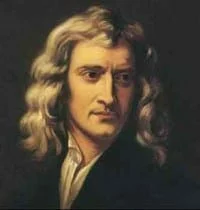
Sir Isaac Newton (1643-1727)
[/td]​
Principia” or “The Mathematical Principles of Natural Philosophy”,
In the heady atmosphere of 17th Century England, with the expansion of the British empire in full swing, grand old universities like Oxford and Cambridge were producing many great scientists and mathematicians. But the greatest of them all was undoubtedly Sir Isaac Newton.
Physicist, mathematician, astronomer, natural philosopher, alchemist and theologian, Newton is considered by many to be one of the most influential men in human history. His 1687 publication, the “Philosophiae Naturalis Principia Mathematica” (usually called simply the “Principia”), is considered to be among the most influential books in the history of science, and it dominated the scientific view of the physical universe for the next three centuries.
Although largely synonymous in the minds of the general public today with gravity and the story of the apple tree, Newton remains a giant in the minds of mathematicians, calculus allowed mathematicians and engineers to make sense of the motion and dynamic change in the changing world around us, such as the orbits of planets, the motion of fluids, etc.

The Average Slope of a Curve


[td]
Newton differentiation
[/td]​
[td]
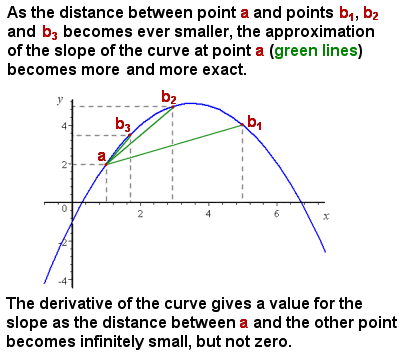
Differentiation (derivative) approximates the slope of a curve as the interval approaches zero
[/td]​

The initial problem Newton was confronting was that, although it was easy enough to represent and calculate the average slope of a curve (for example, the increasing speed of an object on a time-distance graph), the slope of a curve was constantly varying, and there was no method to give the exact slope at any one individual point on the curve i.e. effectively the slope of a tangent line to the curve at that point.
Intuitively, the slope at a particular point can be approximated by taking the average slope (“rise over run”) of ever smaller segments of the curve. As the segment of the curve being considered approaches zero in size (i.e. an infinitesimal change in x), then the calculation of the slope approaches closer and closer to the exact slope at a point (see image at right).

Without going into too much complicated detail, Newton (and his contemporary Gottfried Leibniz independently) calculated a derivative function f ‘(x) which gives the slope at any point of a function f(x). This process of calculating the slope or derivative of a curve or function is called differential calculus or differentiation (or, in Newton’s terminology, the “method of fluxions” – he called the instantaneous rate of change at a particular point on a curve the “fluxion”, and the changing values of x and y the “fluents”). For instance, the derivative of a straight line of the type f(x) = 4x is just 4; the derivative of a squared function f(x) = x2 is 2x; the derivative of cubic function f(x) = x3 is 3x2, etc. Generalizing, the derivative of any power function f(x) = xr is rxr-1. Other derivative functions can be stated, according to certain rules, for exponential and logarithmic functions, trigonometric functions such as sin(x), cos(x), etc, so that a derivative function can be stated for any curve without discontinuities. For example, the derivative of the curve f(x) = x4 – 5x3 + sin(x2) would be f ’(x) = 4x3 – 15x2 + 2xcos(x2).
Having established the derivative function for a particular curve, it is then an easy matter to calcuate the slope at any particular point on that curve, just by inserting a value for x. In the case of a time-distance graph, for example, this slope represents the speed of the object at a particular point.

Method of Fluents


[td]
Newton integration
[/td]​
[td]
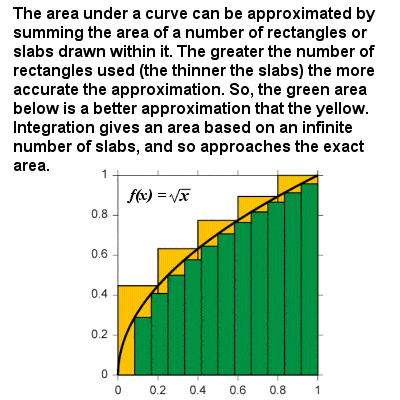
Integration approximates the area under a curve as the size of the samples approaches zero
[/td]​
The “opposite” of differentiation is integration or integral calculus (or, in Newton’s terminology, the “method of fluents”), and together differentiation and integration are the two main operations of calculus. Newton’s Fundamental Theorem of Calculus states that differentiation and integration are inverse operations, so that, if a function is first integrated and then differentiated (or vice versa), the original function is retrieved.
The integral of a curve can be thought of as the formula for calculating the area bounded by the curve and the x axis between two defined boundaries. For example, on a graph of velocity against time, the area “under the curve” would represent the distance travelled. Essentially, integration is based on a limiting procedure which approximates the area of a curvilinear region by breaking it into infinitesimally thin vertical slabs or columns. In the same way as for differentiation, an integral function can be stated in general terms: the integral of any power f(x) = xr is xr+1⁄r+1, and there are other integral functions for exponential and logarithmic functions, trigonometric functions, etc, so that the area under any continuous curve can be obtained between any two limits.

Newton chose not to publish his revolutionary mathematics straight away, worried about being ridiculed for his unconventional ideas, and contented himself with circulating his thoughts among friends. After all, he had many other interests such as philosophy, alchemy and his work at the Royal Mint. However, in 1684, the German Leibniz published his own independent version of the theory, whereas Newton published nothing on the subject until 1693. Although the Royal Society, after due deliberation, gave credit for the first discovery to Newton (and credit for the first publication to Leibniz), something of a scandal arose when it was made public that the Royal Society’s subsequent accusation of plagiarism against Leibniz was actually authored by none other Newton himself, causing an ongoing controversy which marred the careers of both men.

Generalized Binomial Theorem


[td]
Newtons method
[/td]​
[td]
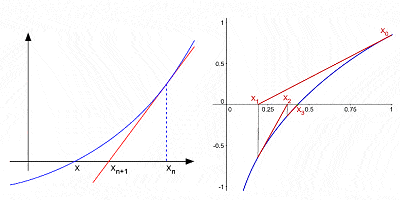
Newton’s Method for approximating the roots of a curve by successive integrations after an initial guess
[/td]​

Despite being by far his best known contribution to mathematics, calculus was by no means Newton’s only contribution. He is credited with the generalized binomial theorem, which describes the algebraic expansion of powers of a binomial (an algebraic expression with two terms, such as a2 – b2); he made substantial contributions to the theory of finite differences (mathematical expressions of the form f(x + b) – f(x + a)); he was one of the first to use fractional exponents and coordinate geometry to derive solutions to Diophantine equations (algebraic equations with integer-only variables); he developed the so-called “Newton’s method” for finding successively better approximations to the zeroes or roots of a function; he was the first to use infinite power series with any confidence; etc.

In 1687, Newton published his “Principia” or “The Mathematical Principles of Natural Philosophy”, generally recognized as the greatest scientific book ever written. In it, he presented his theories of motion, gravity and mechanics, explained the eccentric orbits of comets, the tides and their variations, the precession of the Earth’s axis and the motion of the Moon.
 
Back
Top Bottom