African Satellite World and Sat Gear

African Satellite World and Sat Gear

Anyone tried this ugandan mux? Its on eutelsat 3b @ 3.1E

K3bbT N791y9T rIKb5rc6s61 WcEToEq9MZxO UdCqxO8SQrJGsq88qXbpNRALiHNjHveiWeaCxyvD9yooooqqqiiiiqqzKOi4EYVVVRRRRVVVJlX5f8DQ18Poyybf90AAAAASUVORK5CYII=
attachment.php
 

Attachments

  • ug mux.jpg
    ug mux.jpg
    41.7 KB · Views: 634
Now smiles on the faces of srt4950h owners,enjoy while the channels last,happy viewing

peace
 
I remember those days Cheupec, when CNN was on Arabsat (analogue!!) and KTN was on atlantic bird and I thought I was the only ASAS! I can receive 16e here in the Rift. I checked the beam and looks like it is not covering MT Kenya and narok area!

Atlantic bird 3 it was. And it was my initiation into ASAShood. Armed with a protractor & a stone tied to a string for an inclinometer plus a crude magnetic compass i nailed the bird using values calculated with an online calculator. I got the coordinates of my location using an atlas and a bit of interpolation. It wasn't easy, no sat finder, no dishpointer apps (there was no android back then, It was 2006) and the dish was on a roof top where i had to climb a ladder with no assistant. Still through sheer determination and some divine intervention i nailed the bird in less than two hours. Atlantic bird 3.. Ooh the memories.
 
I have been having problems finding a good installer to help me nab eshail (am not ASAS really) in Nyeri. I have tried 2 so far and they don't seem to have a clue. I have a 135cm offset and inverto black ultra single. I need to know how the signal is using this dish before looking for a bigger dish, if need be. Any help from anybody near me will be greatly appreciated.
 
QUOTE=mungeks;14765598]I have been having problems finding a good installer to help me nab eshail (am not ASAS really) in Nyeri. I have tried 2 so far and they don't seem to have a clue. I have a 135cm offset and inverto black ultra single. I need to know how the signal is using this dish before looking for a bigger dish, if need be. Any help from anybody near me will be greatly appreciated.[/QUOTE]

Hello thea. In Nyeri you are closer to the equator than us guys in Nairobi... Still you need a bigger dish to nab 25?E...I would suggest a 150cm...b glad to give a helping hand
Good day
13447969254_7da8e7dbc8_m.jpg
 
any body who have received continental Tanzania or Ting Tanzania to share satellite name and position
 
QUOTE=mungeks;14765598]I have been having problems finding a good installer to help me nab eshail (am not ASAS really) in Nyeri. I have tried 2 so far and they don't seem to have a clue. I have a 135cm offset and inverto black ultra single. I need to know how the signal is using this dish before looking for a bigger dish, if need be. Any help from anybody near me will be greatly appreciated.

Hello thea. In Nyeri you are closer to the equator than us guys in Nairobi... Still you need a bigger dish to nab 25?E...I would suggest a 150cm...b glad to give a helping hand
Good day
13447969254_7da8e7dbc8_m.jpg
[/QUOTE]


Fringe sats are not for every Tom,Dick and Harry. Pm me we will see what we can arrange.
 
Thanks freddygaz. I also have my doubts about 135cm but wanted to be sure before investing in a bigger dish.
 
Hello thea. In Nyeri you are closer to the equator than us guys in Nairobi... Still you need a bigger dish to nab 25?E...I would suggest a 150cm...b glad to give a helping hand
Good day
13447969254_7da8e7dbc8_m.jpg


Fringe sats are not for every Tom,Dick and Harry. Pm me we will see what we can arrange.[/QUOTE]


Thanks Giden. see pm
 
Thanks freddygaz. I also have my doubts about 135cm but wanted to be sure before investing in a bigger dish.

You welkam....if you are receiving 11045H on 25E on your 130cm is a good start to increase your signal to nab the rest of the TPs
 
From impeccable sources......Continental package formally on Amos 5 to dock on Eutelsat 70b. Add more grease to your elbows.
 
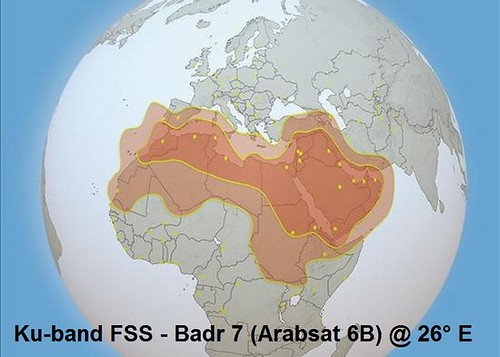
Cannes, November 10, 2015 - Arabsat 6B telecommunication satellite was successfully launched by Arianespace form Kourou, in French Guyana, with an Ariane 5 rocket.
This new satellite Arabsat 6B, the first in Arabsat?s 6[SUP]th[/SUP] generation of satellites, will be co-located with Arabsat satellites at the 26? East video hot spot known as BADR. It will extend in-orbit Arabsat?s capacity at this location for direct-to-home television broadcast and telecommunications services, and will provide broadband services in Ka-band with spot beam coverage. This new multi-mission satellite will deliver broadcast, broadband and telecommunications services over MENA, Africa and Central Asia. Arabsat 6B will be renamed BADR-7 as soon as reaching its operational orbit.

Arabsat 6B is able to operate up to 24 transponders in Ku-band as well as a powerfull capacity in Ka FSS band including 24 Ka spot-beams as well as Ka transponders for additional services. Four deployable antennas and three fixed antennas will address service regions over a large coverage that includes the whole of MENA, South and North-West Africa and Central Asia.
23384454191_896e978a95.jpg

The footprint resembles that one of Eutelsat 25B / Es'hail-1 @ 25.5? East...giving us a challenge when it starts beaming....so the BUDs have their work cut to be swung from 7E

Happy hunting
 
are just rumors but we expect it at ses5 or 7b

Guys I beg, lets all keep our fingers crossed. Kibet could be right afterall. Who knows? TING Media has been letting info in peice-meal all the while.

Actually they claim to be on air via terrestial at Daresalam now even as we speak.
 
Last edited by a moderator:
check footprint ya 70b with Tanzania in mind (continental ni ya tz)
 
Israel's Amos-5 satellite went dark on November 21st with its owner Spacecom confirming last week that it could not communicate with the spacecraft. Spacecom said that it had attempted to re-connect with the satellite, at its 17 degrees East orbital location. Ground observation, via powerful telescopes, confirmed that the satellite was still at its nominal position. The satellite was launched in December 2011, so was barely one-third into its operating life of some 15 years.
All satellites come – sooner or later – to an end-of-life. The normal situation is that the dying satellite maintains some on-board fuel so that ground engineers can use these final fuel supplies to boost it out of its normal geostationary orbit of 35,786 kms (22,236 miles) above the Equator. This final firing of the satellite's thrusters is designed to lift the craft at least another 300 kms higher, and thus well out of the way of its orbiting neighbours.
Indeed, since 2002 it has been a formal requirement that geostationary satellites are lifted into a so-called ‘graveyard' orbit.
But these rules cannot now be applied to Amos-5 which is slowly drifting as an uncontrollable "zombie" satellite. The problem is further compounded by the fact that the satellite will come extremely close to a number of near neighbours as its drifts away from 17 degrees East.
A similar situation occurred back in April 2010 when an Intelsat-owned craft (Galaxy-15) went wrong and would not listen to controls from its ground technicians. However, the Galaxy-15 was a true ‘zombie' in that it continued transmitting. As it drifted from its official home of 133 degrees West it collected signals uplinked from the Earth and powerfully beamed them back to the ground.
As the drift continued it moved perilously close to a number of other satellites, including SES-owned AMC-11, each of which were deliberately moved out of the way. At one point it was said that the Zombie had come within 5 kms of AMC-11, which is significantly too close.
However, this particular story had a happy ending. By December 2010 the Galaxy-11's on-board batteries had exhausted themselves and so the satellite – as they engineers had hoped – went into a safety mode, and had switched itself off, and in simple terms had re-booted its systems.
The technology worked, and the satellite again started ‘listening' to its ground bosses. It was the perfect Christmas present, not just for Intelsat's talented team but for the other worried and hard working engineers who could now start sleeping at night. Following in-orbit testing by October 2012 the errant satellite was back working at its proper home, of 133 degrees West.
Unfortunately, this solution is not likely for Amos-5. If, as it seems, the satellite is completely dead it will just continue to drift. And as it drifts through the Clarke Belt (named after Arthur C Clarke) the satellites in its path will just have to get out of its way – and use up precious fuel in the process.
 
Back
Top Bottom