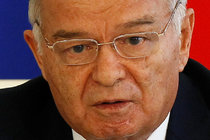
Huyu Rais Islam Karimov wa Uzbekistan alikuwa Dikteta wa ukweli maana alikuwa haamini mtu hata binti yake alimweka kizuizini :
Biography of the late President Islam Karimov
Mr. Karimov rose through the ranks of the local Communist Party until the Soviet leader Mikhail S. Gorbachev named him first secretary and effectively Uzbekistan’s chief in 1989. He won a presidential election after independence in 1991 and used Soviet methods to govern the country.
“He is the state and the state is him, and it has been that way for at least 25 years,” said Steve Swerdlow, the director of Central Asia research at Human Rights Watch.
Power in Uzbekistan was concentrated in the hands of the National Security Service, modeled on the old K.G.B. of the Soviet Union. Its longstanding but reportedly ailing director, Rustam Inoyatov, is expected to wield the greatest influence in
the selection of the next president. The president’s widow, Tatyana Karimova, an economist, also holds considerable sway. Neither is known to be seeking a public role.
“It is a police state where the power belongs completely to the security services,” said Daniil Kislov, the Moscow-based editor in chief of the website
Ferghana.ru. “The special services will not allow for any alternative on the succession.”
The immediate succession is expected to follow the Constitution, which mandates that the head of the Senate run the country for three months until new presidential elections can be organized. Mr. Karimov repeatedly manipulated elections or referendums to extend his rule well beyond the two terms mandated by the Constitution.
Such voting, which critics called fraudulent, always had a preordained conclusion. He won his
latest presidential term in March 2015 with over 90 percent of the vote.
Mr. Karimov jailed or exiled his political opponents and muzzled the news media. Political prisoners were estimated to number in the thousands. Torture was rife. He brushed aside any criticism that managed to bubble up despite the oppression.
An estimated one million Russians still live in Uzbekistan, though the population of more than 31 million is overwhelmingly Sunni Muslim. Mr. Karimov, who crushed an
Islamic insurgency after surviving an
assassination attempt by Islamic militants in 1999, was considered a bulwark against the spread of any jihadist threat in the region.
With him gone, there was some question whether the Islamic State or other groups might try to exploit the transition to re-emerge. “Whether or not the Islamic State sees a succession as an opportunity to create risks for the much-hated Russians remains an open question,” said Cliff Kupchan, an expert on Russia and chairman of the Eurasia Group, a risk advisory firm based in Washington.
In 1999, Mr. Karimov made his position toward radical Islam abundantly clear.
“I am prepared to rip off the heads of 200 people, to sacrifice their lives, in order to save peace and calm in the republic,” he told reporters. “If my child chose such a path, I myself would rip off his head.”
He went on to prove it,
massacring hundreds of antigovernment demonstrators in 2005 in the town of Andijon, a center of ethnic, social and economic tension in the fertile Fergana Valley. Both Europe and the United States imposed military sanctions.
Mr. Karimov responded by expelling American forces from Karshi-Khanabad Military Base, an important link in the supply chain for the forces propping up the government in Afghanistan against the Taliban.
Supply needs eventually trumped human rights issues, and the United States restored relations, even giving the Uzbekistan forces hundreds of surplus armored vehicles as American forces in Afghanistan were being drawn down.
If Mr. Karimov was a gray, reclusive figure, his older daughter and
once-presumed heir was anything but. Ms. Karimova, pursuing simultaneous careers in business, diplomacy, music and fashion design, partied with rock stars and fashion designers around the globe. Yet, from the outset her revealing clothes made her an unlikely leader in a conservative Muslim society.
Ms. Karimova fell from grace in spectacular manner when, around 2013, she was put under
house arrest and her business ventures were shuttered or confiscated. She was under investigation in Sweden, Switzerland, the United States and elsewhere on suspicion of pocketing bribes and participating in money-laundering schemes related to selling telecommunications licenses in Uzbekistan. She and the companies involved have denied wrongdoing.
Islam Karimov was born on Jan. 30, 1938, in Samarkand, Uzbekistan. His official biography said his father had been an office worker. Other accounts suggested that his parents, overwhelmed by a large family and meager resources, put him in an orphanage, at first temporarily, but eventually left him there.
He studied to become an engineer, worked at an airplane factory and joined the Communist Party in the early 1960s. He married in 1964, and he and his wife had a son, Petr, but soon divorced. The son is believed to have moved to Moscow decades ago and never returned.
Mr. Karimov joined Gosplan, the central Soviet economic planning agency, in 1966 and married for the second time in 1967. He rose to become the finance minister for the Soviet Socialist Republic of Uzbekistan in 1983.
By all accounts Mr. Karimov hated the political jockeying by different groups in the initial burst of freedom after independence in 1991 and worked to destroy all autonomous political, media and human rights organizations.
His antipathy toward Islamic groups is sometimes linked to an episode that same year. With Soviet authority crumbling, Islamic vigilante groups had established security and social services that were lacking in the Fergana Valley, and after one extremist group seized a building, Mr. Karimov went to negotiate with its representatives. He soon found himself humiliated when a young religious leader forced him to pray publicly. Later, he banned mosques from broadcasting the call to prayer.
Source:
http://www.nytimes.com/2016/09/03/world/asia/uzbekistan-islam-karimov-obituary.html?rref=collection/timestopic/Karimov, Islam&action=click&contentCollection=timestopics®ion=stream&module=stream_unit&version=latest&contentPlacement=1&pgtype=collection