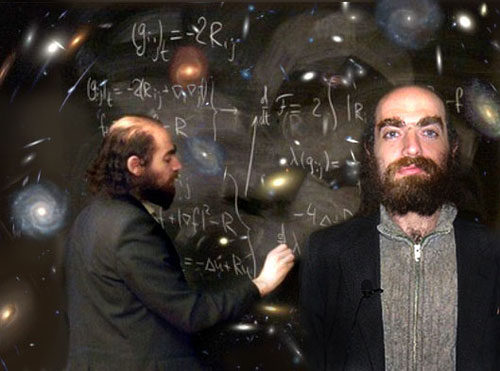
Mjue mtaalamu wa Hesabu!!

Mjue mtaalamu wa Hesabu!!

grish-perelman-math-genius.jpeg

Jamaa huyo hapo na kwa wale wenzangu wanaolitaka hilo fumbo ili labda waweze kulifumbua from another approach fumbo lenyewe hili hapa:
[h=3]Poincaré's question[/h] At the beginning of the 20th century, Henri Poincaré was working on the foundations of topology—what would later be called combinatorial topology and then algebraic topology. He was particularly interested in what topological properties characterized a sphere.
Poincaré claimed in 1900 that homology, a tool he had devised based on prior work by Enrico Betti, was sufficient to tell if a 3-manifold was a 3-sphere. However, in a 1904 paper he described a counterexample to this claim, a space now called the Poincaré homology sphere. The Poincaré sphere was the first example of a homology sphere, a manifold that had the same homology as a sphere, of which many others have since been constructed. To establish that the Poincaré sphere was different from the 3-sphere, Poincaré introduced a new topological invariant, the fundamental group, and showed that the Poincaré sphere had a fundamental group of order 120, while the 3-sphere had a trivial fundamental group. In this way he was able to conclude that these two spaces were, indeed, different.
In the same paper, Poincaré wondered whether a 3-manifold with the homology of a 3-sphere and also trivial fundamental group had to be a 3-sphere. Poincaré's new condition—i.e., "trivial fundamental group"—can be restated as "every loop can be shrunk to a point."
The original phrasing was as follows:

Consider a compact 3-dimensional manifold V without boundary. Is it possible that the fundamental group of V could be trivial, even though V is not homeomorphic to the 3-dimensional sphere?
​
Kwa wale ambao mnalalmika hamjaletewa haya maswali do not dispair kuna haya hapa chini bado: Yanaitwa
[h=1]Millennium Prize Problems[/h] [h=2]Contents[/h]


Atakaeshinda asinisahau hata ka 5% tu ka prize money.

kaka wewe n mtafit, hongera
 
Ha ha ha ha ha.Wote kimyaaaaaaa,fumbueni sasa akina Baba V,Godiani na Manyerere.
 
Duh na A zangu za namba za kutosha hii kitu ni noma,, hii haiwezi kuwa hisabati.. Duh sijawai kuona kwa kweli hata kwa kuhisi
 
Duh me umenifurahisha kulipost hlo fumbo,sasa waliosema liko wapi ndo walione sasa
 
Still we have many other controversies; for example, how universe came into existence, big bang theory, Superstring theory, Evolution theory, etc., Scientists are working tirelessly and sleeplessly to explore these theories, see for example LHC - world largest experiment which explores among other theories, the existence of Higgs Boson - Large Hadron Collider - Wikipedia, the free encyclopedia.
 
Unayataka hayo maswali? Yanaitwa Millennium Prize Problems.

Kama hapo aliposema mleta Thread, yalikuwa Saba na sasa yamebaki SITA. Kila moja lina $1,0million. Wahi haya hapa chini.

Watu wote! Hapana. Afrika lilishaletwa?
 
grish-perelman-math-genius.jpeg

Jamaa huyo hapo na kwa wale wenzangu wanaolitaka hilo fumbo ili labda waweze kulifumbua from another approach fumbo lenyewe hili hapa:
Poincaré's question

At the beginning of the 20th century, Henri Poincaré was working on the foundations of topology—what would later be called combinatorial topology and then algebraic topology. He was particularly interested in what topological properties characterized a sphere.
Poincaré claimed in 1900 that homology, a tool he had devised based on prior work by Enrico Betti, was sufficient to tell if a 3-manifold was a 3-sphere. However, in a 1904 paper he described a counterexample to this claim, a space now called the Poincaré homology sphere. The Poincaré sphere was the first example of a homology sphere, a manifold that had the same homology as a sphere, of which many others have since been constructed. To establish that the Poincaré sphere was different from the 3-sphere, Poincaré introduced a new topological invariant, the fundamental group, and showed that the Poincaré sphere had a fundamental group of order 120, while the 3-sphere had a trivial fundamental group. In this way he was able to conclude that these two spaces were, indeed, different.
In the same paper, Poincaré wondered whether a 3-manifold with the homology of a 3-sphere and also trivial fundamental group had to be a 3-sphere. Poincaré's new condition—i.e., "trivial fundamental group"—can be restated as "every loop can be shrunk to a point."
The original phrasing was as follows:

Consider a compact 3-dimensional manifold V without boundary. Is it possible that the fundamental group of V could be trivial, even though V is not homeomorphic to the 3-dimensional sphere?
​
Kwa wale ambao mnalalmika hamjaletewa haya maswali do not dispair kuna haya hapa chini bado: Yanaitwa
Millennium Prize Problems

Contents


Atakaeshinda asinisahau hata ka 5% tu ka prize money.

Kakitu kenyewe karahisi namna hii, watu tupo next level nyie bado mpo huku, poleni..
 
reminds me of a great scientist named Nikola Tesla, he practicaly invented the AC, invented the wireless communication and many vital inventions for the modern age but never wanted fame and died a very poor man.
 
Duh na A zangu za namba za kutosha hii kitu ni noma,, hii haiwezi kuwa hisabati.. Duh sijawai kuona kwa kweli hata kwa kuhisi

mkuu hapo kama hukusoma Bsc in mathematics au masters hapo ni chenga tu,mwenyewe naona mistari tu!!! embu tungoje hawa wataalam wetu wa hesabu waje!!!!
 
Kama differential, integration na differention nimeisona tuition zaidi ya mara mbili ukiachilia mbali pindi la class kweli nitasolve hata moja hapo?
Akina maclaurian, taylors, lagregas na wengineo wameshindwa kweli nitatoka? Ngoja nibakie kimya nisige konda bure na unrealistic concepts.
Mathematics is all about clarification of thought.
 
Back
Top Bottom