Miss Zomboko

JF-Expert Member
- May 18, 2014
- 4,618
- 9,611
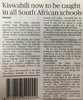
Waziri wa elimu ya msingi Angie Motshekga alitangaza Jumatatu kuwa Kiswahili kimekubaliwa kuwa lugha ya pili ambayo itatolewa na kufundishwa kwa wanafunzi katika shule za Afrika Kusini. Kitafundishwa katika shule za umma, za binafsi na za kujitegemea.
"Ilikubaliwa na Baraza la Mawaziri wa Elimu (CEM). Kwa sasa kuna lugha 15 ambazo sio rasmi zilizoorodheshwa kwenye mtaala wa taifa kama masomo ya hiari" alisema Motshekga. Lugha hizo ni pamoja na Kifaransa, Kijerumani na Mandarin. Kwa bahati mbaya hakuna lugha ya Kiafrika katika orodha hiyo ya lugha. Kiswahili ni lugha ya kibantu yenye ufanano kubwa wa kisarufi na lugha nyingi za Kiafrika zinazozungumzwa barani Afrika".
===================================
Basic education minister Angie Motshekga announced on Monday that Kiswahili has been approved as the second language that will be offered to learners in South African schools. It will be offered at public, private and independent schools.
“This was approved by the Council of Education Ministers (CEM). There are currently 15 nonofficial languages listed in the national curriculum statement as optional subjects," said Motshekga. These include French, German and Mandarin. There is unfortunately no African language in the list of languages. Kiswahili is a bantu language with lexical and linguistic similarities with many African languages spoken in the continent.”
She said Kiswahili is the third most spoken language in Africa after English and Arabic. “Kiswahili has the power to expand to countries that never spoke it and has the power to bring Africans together. It is also one of the officials languages of the African Union. We are confident that the teaching of Kiswahili is South African schools will help to promote social cohesion with our fellow Africans.
The implementation of languages will start in 2020.
Another curriculum addition is that of Marine Sciences which was also approved by CEM. The department has been working with the Two oceans Aquarium to develop a Maritime Sciences curriculum from 2017. The draft curriculum was submitted to Umalusi for evaluation in March.
"We are also working on introducing coding as a subject in our schools. Coding is unique in the way it brings all diverse skills together and this is one of the big advantages of teaching pupils to code,” Motshekga said.