Gen Norman Schwarzkopf has died!!!

Gen Norman Schwarzkopf has died!!!

Ab-Titchaz

JF-Expert Member
Joined
Jan 30, 2008
Posts
14,630
Reaction score
4,267
AP source: Retired Gen. Norman Schwarzkopf dies

By By LOLITA C. BALDOR | Associated Press – 22 mins ago


WASHINGTON (AP) - A U.S. official says retired Gen. H. Norman Schwarzkopf, who commanded the U.S.-led international coalition that drove Saddam Hussein's forces out of Kuwait in 1991, has died. He was 78.

The official tells The Associated Press that Schwarzkopf died Thursday in Tampa, Fla. The official wasn't authorized to release the information publicly and spoke on condition of anonymity.

A much-decorated combat soldier in Vietnam, Schwarzkopf was known popularly as "Stormin' Norman" for a notoriously explosive temper.

He lived in retirement in Tampa, where he had served in his last military assignment as commander-in-chief of U.S. Central Command. That is the headquarters responsible for U.S. military and security concerns in nearly 20 countries from the eastern Mediterranean and Africa to Pakistan.

http://news.yahoo.com/ap-source-retired-gen-norman-schwarzkopf-dies-002111413--politics.html
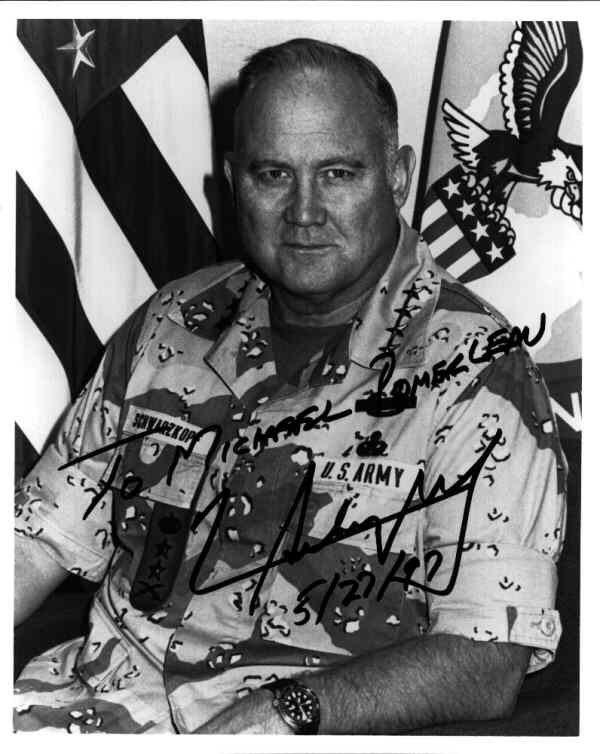
 

Norman_Schwartzkopf.JPG


Norman_Schwarzkopf.png
 
sch0-004a.gif


Herbert Norman Schwarzkopf
( August 22, 1934 – December 27, 2012) was a United States Army general who, while he served as Commander of U.S. Central Command, was commander of coalition forces in the Persian Gulf War.

Early life

Schwarzkopf was born in Trenton, New Jersey, the son of Ruth Alice (née Bowman) and Herbert Norman Schwarzkopf. His father served in the US Army before becoming the Superintendent of the New Jersey State Police, where he worked as a lead investigator on the infamous Lindbergh kidnapping before returning to an Army career and rising to the rank of Major General. In January 1952, Schwarzkopf's birth certificate was amended to make his name "H. Norman Schwarzkopf". This was done as an act of revenge against the upper class cadets at West Point because his father hated his own first name "Herbert" and when he attended West Point the upper class cadets yelled at him for signing his name "H. Norman Schwarzkopf".His connection with the Persian Gulf region began very early. In 1946, when he was 12, he and the rest of his family joined their father, stationed in Tehran, Iran, where his father went on to be instrumental in Operation Ajax, eventually forming the Shah's secret police SAVAK, as well. He attended the Community High School in Tehran, later the International School of Geneva at La Châtaigneraie, Frankfurt High School in Frankfurt, Germany and attended and graduated from Valley Forge Military Academy. He was also a member of Mensa.

Formal education

After attending Valley Forge Military Academy, Schwarzkopf, an army brat, attended the United States Military Academy, where he graduated 43rd in his class in 1956 with a Bachelor of Science degree.[SUP][6][/SUP] He also attended the University of Southern California, where he received a Master of Science in mechanical engineering in 1964. His special field of study was guided missile engineering, a program that USC developed with the Army, which incorporated both aeronautical and mechanical training. He later attended the U.S. Army War College as well.

Military career

Upon graduating from West Point he was commissioned a Second Lieutenant. He received advanced infantry and airborne training at Fort Benning, Georgia. He was a platoon leader and served as executive officer of the 2nd Airborne Battle Group, 187th Airborne Infantry Regiment at Fort Campbell, Kentucky. Next he was aide-de-camp to the Berlin Brigade in 1960 and 1961, a crucial time in the history of that divided city (the Berlin Wall was erected by East German and Soviet forces only a week after he left). In 1965, after completing his masters degree at USC, Schwarzkopf served at West Point as an instructor in the mechanical engineering department.

Service in Vietnam

More and more of his former classmates were heading to Vietnam as advisers to the South Vietnamese army and, in 1965, following Schwarzkopf's first year as a member of the faculty at West Point, he applied to join them. Schwarzkopf served as a task force adviser to the South Vietnamese Airborne Division; during that time he was promoted from Captain to Major. When his tour of duty in Vietnam was over, he returned to serve out the remaining two years of his obligated teaching service at West Point. In 1968, Major Schwarzkopf became a Lieutenant Colonel. In this same year, he married Brenda Holsinger.

In Vietnam in March 1970, Schwarzkopf was involved in rescuing men of his battalion from a minefield. He had received word that men under his command had encountered a minefield on the notorious Batangan Peninsula, he rushed to the scene in his helicopter, as was his custom while a battalion commander, in order to make his helicopter available. He found several soldiers still trapped in the minefield. Schwarzkopf urged them to retrace their steps slowly. Still, one man tripped a mine and was severely wounded but remained conscious. As the wounded man flailed in agony, the soldiers around him feared that he would set off another mine. Schwarzkopf, also wounded by the explosion, crawled across the minefield to the wounded man and held him down (using a "pinning" technique from his wrestling days at West Point) so another could splint his shattered leg. One soldier stepped away to break a branch from a nearby tree to make the splint. In doing so, he too hit a mine, which killed him and the two men closest to him, and blew an arm and a leg off Schwarzkopf's artillery liaison officer.

Eventually, Schwarzkopf led his surviving men to safety, by ordering the division engineers to mark the locations of the mines with shaving cream. (Some of the mines were of French manufacture and dated back to the Indochina conflict of the 1950s; others were brought by Japanese forces in World War II).

Schwarzkopf says in his autobiograpy It Doesn't Take a Hero that this incident firmly cemented his reputation as an officer who would risk his life for the soldiers under his command.


Schwarzkopf told his men that they might not like some of his strict rules, but it was for their own good. He told them "When you get on that plane to go home, if the last thing you think about me is 'I hate that son of a bitch', then that is fine because you're going home alive." Lt. General Hal Moore later wrote that it was during his time in Vietnam that Schwarzkopf acquired what later became his infamous temper, while arguing via radio for passing American Hueys to land and pick up his wounded men.

Rise to general

During the 1970s, Schwarzkopf's star continued to rise. He attended the U.S. Army War College at Carlisle Barracks, Pennsylvania (delayed for a year so that he could undergo back surgery for a congenital back condition that was aggravated by his combat services), served on the Army General Staff at The Pentagon, was deputy commander of U.S. Forces Alaska under Brigadier General Willard Latham, and served as commander of the 1st Brigade of the 9th Infantry Division at Fort Lewis, Washington. After promotion to Brigadier General, he was assigned as Plans & Policy Officer (Assistant J3) at U.S. Pacific Command for two years. He then served as Assistant Division Commander (Support) of the 8th Mechanized Division and as Community Commander of Mainz, West Germany, during which the city was visited by Pope John Paul II, thus putting Schwarzkopf in charge of the U.S. security forces during the pontiff's visit. He was promoted to Major General, and given command of the 24th Mechanized Infantry Division, at Fort Stewart, Georgia. A year into this assignment, a coup had taken place on the tiny Caribbean island of Grenada. With Cuban assistance, the Grenadian revolutionaries were building an airfield which U.S. intelligence suspected would be used to supply insurgents in Central America. It was also feared that Americans studying on the island might be taken hostage. Since an amphibious landing was called for, the entire operation was placed under the command of an admiral.

Schwarzkopf was sent by the Army as an advisor to the Navy to make sure the Army units attached to the task force were used correctly. He quickly won the confidence of his superior and was named Deputy Commander of the Joint Task Force. While the Grenada operation proved more difficult than its planners had anticipated, the coup was quickly thwarted. Order was restored, elections were scheduled, and the American students returned home unharmed.

In 1985, Schwarzkopf returned to the Pentagon to serve as an assistant to Lieutenant General Carl Vuono (who was then Deputy Chief of Staff for Operations). In 1986, Schwarzkopf was promoted to Lieutenant General, and was appointed as Commanding General of I Corps at Ft. Lewis. After only serving one year in command, he was called back to Washington to serve as Vuono's assistant (Vuono himself was promoted to General of the Army's Training and Doctrine Command, only later to become Army Chief of Staff), this time in operations Deputy Chief position.

Gulf War

In 1988, he was promoted to General and was appointed Commander-in-Chief of the U.S. Central Command. The U.S. Central Command, based at MacDill Air Force Base, in Tampa, Florida, was responsible at the time for operations in the Horn of Africa, the Middle East and South Asia.In his capacity as commander, Schwarzkopf prepared a detailed plan for the defense of the oil fields of the Persian Gulf against a hypothetical invasion by Iraq, among other plans.

The Iraq plan served as the basis of the wargame of 1990. Within the same month, Iraq invaded Kuwait, and Schwarzkopf's plan had an immediate practical application, which was as the basis for Operation Desert Shield, the defense of Saudi Arabia. As overall commander, Schwarzkopf initially was concerned that operational forces in the theater were inadequately supplied and equipped for large-scale combat in a desert environment. During preparations for Desert Storm, as the result of initiatives by General Schwarzkopf, the Desert camouflage combat uniform was produced in 100% cotton poplin without reinforcement panels in order to improve comfort for U.S. troops operating in the hot, dry desert conditions. A total of 500,000 improved cotton BDUs were ordered. However, cost concerns caused the cotton six-color Desert BDU to be discontinued shortly after the Gulf War. A few months later, General Schwarzkopf's offensive operational plan, called Operation Desert Storm (co-authored with his deputy commander, Lieutenant General Cal Waller and others on his staff), was the "left hook" strategy that went into Iraq behind the Iraqi forces occupying Kuwait and was widely credited with bringing the ground war to a close in just four days. He was personally very visible in the conduct of the war, giving frequent press conferences, and was dubbed "Stormin' Norman."

Retirement

After the war, Schwarzkopf was offered the position of Chief of Staff of the United States Army by Secretary of the Army Michael P.W. Stone, but he declined. He retired from active service in August 1991, and shortly thereafter wrote an autobiography, It Doesn't Take a Hero, published in 1992. There was some speculation in the aftermath of the Gulf War that he might run for political office, but he did not do so. In retirement, Schwarzkopf served as a military analyst for NBC, most recently for Operation Iraqi Freedom, along with promoting prostate cancer awareness, a disease with which he was diagnosed in 1993, and for which he was successfully treated. Recently, Schwarzkopf donated most of his time to multiple charities, and community activities. He sat on the board for Remington, and several other high-profile corporations. On May 4, 2008 Schwarzkopf was inducted into New Jersey's Hall of Fame. He was also an honorary board member of the Multiple Myeloma Research Foundation. Schwarzkopf lived in Tampa Florida until his death in 2012.

Political endorsements

Schwarzkopf supported President George W. Bush in his successful 2004 re-election bid against Democratic nominee John Kerry, stating "(President Bush) is the candidate who has demonstrated the conviction needed to defeat terrorism. In contrast to the President's steadfast determination to defeat our enemies, Senator Kerry has a record of weakness that gives me no confidence in his ability to fight and win the War on Terror." However, by December 2004, Schwarzkopf became critical of the Iraq War and Defense Secretary Donald Rumsfeld.Schwarzkopf endorsed Republican nominee John McCain in the 2008 presidential election.

Personal

Schwarzkopf was a cousin of actress Marianna Hill. He was married since 1968 and had three children. He was also a member of Mensa.

Norman Schwarzkopf, Jr. - Wikipedia, the free encyclopedia.
 
RIP Schwarzkorf.

He was the US top general.


WASHINGTON (AP) — Retired Gen. H. Norman Schwarzkopf, who topped an illustrious military career by commanding the U.S.-led international coalition that drove Saddam Hussein's forces out of Kuwait in 1991 but kept a low public profile in controversies over the second Gulf War against Iraq, died Thursday. He was 78.

Schwarzkopf died in Tampa, Fla., where he had lived in retirement, according to a U.S. official, who was not authorized to release the information publicly and spoke on condition of anonymity.

A much-decorated combat soldier in Vietnam, Schwarzkopf was known popularly as "Stormin' Norman" for a notoriously explosive temper.

He served in his last military assignment in Tampa as commander-in-chief of U.S. Central Command, the headquarters responsible for U.S. military and security concerns in nearly 20 countries from the eastern Mediterranean and Africa to Pakistan.

Schwarzkopf became "CINC-Centcom" in 1988 and when Saddam Hussein invaded Kuwait three years later to punish it for allegedly stealing Iraqi oil reserves, he commanded Operation Desert Storm, the coalition of some 30 countries organized by then-President George H.W. Bush that succeeded in driving the Iraqis out.

At the peak of his postwar national celebrity, Schwarzkopf — a self-proclaimed political independent — rejected suggestions that he run for office, and remained far more private than other generals, although he did serve briefly as a military commentator for NBC.

While focused primarily in his later years on charitable enterprises, he campaigned for President George W. Bush in 2000 but was ambivalent about the 2003 invasion of Iraq, saying he doubted victory would be as easy as the White House and Pentagon

predicted. In early 2003 he told the Washington Post the outcome was an unknown:
"What is postwar Iraq going to look like, with the Kurds and the Sunnis and the Shiites? That's a huge question, to my mind. It really should be part of the overall campaign plan," he said.

Initially Schwarzkopf had endorsed the invasion, saying he was convinced that former Secretary of State Colin Powell had given the United Nations powerful evidence of Iraqi weapons of mass destruction. After that proved false, he said decisions to go to war should depend on what U.N. weapons inspectors found.

He seldom spoke up during the conflict, but in late 2004, he sharply criticized then-Defense Secretary Donald Rumsfeld and the Pentagon for mistakes that included inadequate training for Army reservists sent to Iraq and for erroneous judgments about Iraq.

"In the final analysis I think we are behind schedule. ... I don't think we counted on it turning into jihad (holy war)," he said in an NBC interview.

Schwarzkopf was born Aug. 24, 1934, in Trenton, N.J., where his father, Col. H. Norman Schwarzkopf Jr., founder and commander of the New Jersey State Police, was then leading the investigation of the Lindbergh kidnap case, which ended with the arrest and 1936 execution of German-born carpenter Richard Hauptmann for stealing and murdering the famed aviator's infant son.

The elder Schwarzkopf was named Herbert, but when the son was asked what his "H'' stood for, he would reply, "H." Although reputed to be short-tempered with aides and subordinates, he was a friendly, talkative and even jovial figure who didn't like "Stormin' Norman" and preferred to be known as "the Bear," a sobriquet given him by troops.

He also was outspoken at times, including when he described Gen. William Westmoreland, the U.S. commander in Vietnam, as "a horse's ass" in an Associated Press interview.

As a teenager Norman accompanied his father to Iran, where the elder Schwarzkopf trained the country's national police force and was an adviser to Reza Pahlavi, the young Shah of Iran.

Young Norman studied there and in Switzerland, Germany and Italy, then followed in his father's footsteps to West Point, graduating in 1956 with an engineering degree. After stints in the U.S. and abroad, he earned a master's degree in engineering at

the University of Southern California and later taught missile engineering at West Point.
In 1966 he volunteered for Vietnam and served two tours, first as a U.S. adviser to South Vietnamese paratroops and later as a battalion commander in the U.S. Army's Americal Division. He earned three Silver Stars for valor — including one for saving

troops from a minefield — plus a Bronze Star, a Purple Heart and three Distinguished Service Medals.
While many career officers left military service embittered by Vietnam, Schwarzkopf was among those who opted to stay and

help rebuild the tattered Army into a potent, modernized all-volunteer force.
After Saddam invaded Kuwait in August 1990, Schwarzkopf played a key diplomatic role by helping to persuade Saudi Arabia's King Fahd to allow U.S. and other foreign troops to deploy on Saudi territory as a staging area for the war to come.

On Jan. 17, 1991, a five-month buildup called Desert Shield became Operation Desert Storm as allied aircraft attacked Iraqi bases and Baghdad government facilities. The six-week aerial campaign climaxed with a massive ground offensive on Feb. 24-28, routing the Iraqis from Kuwait in 100 hours before U.S. officials called a halt.

Schwarzkopf said afterward he agreed with Bush's decision to stop the war rather than drive to Baghdad to capture Saddam, as his mission had been only to oust the Iraqis from Kuwait.

But in a desert tent meeting with vanquished Iraqi generals, he allowed a key concession on Iraq's use of helicopters, which later backfired by enabling Saddam to crack down more easily on rebellious Shiites and Kurds.

While he later avoided the public second-guessing by academics and think tank experts over the ambiguous outcome of Gulf War I and its impact on Gulf War II, he told the Washington Post in 2003, "You can't help but... with 20/20 hindsight, go back

and say, 'Look, had we done something different, we probably wouldn't be facing what we are facing today.'"
After retiring from the Army in 1992, Schwarzkopf wrote a best-selling autobiography, "It Doesn't Take A Hero." Of his Gulf war

role, he said, "I like to say I'm not a hero. I was lucky enough to lead a very successful war." He was knighted by Queen Elizabeth II and honored with decorations from France, Britain, Belgium, Kuwait, Saudi Arabia, United Arab Emirates, Qatar and Bahrain.

Schwarzkopf was a national spokesman for prostate cancer awareness and for Recovery of the Grizzly Bear, served on the Nature Conservancy board of governors and was active in various charities for chronically ill children.

"I may have made my reputation as a general in the Army and I'm very proud of that," he once told the AP. "But I've always felt that I was more than one-dimensional. I'd like to think I'm a caring human being. ... It's nice to feel that you have a purpose."
Schwarzkopf and his wife, Brenda, had three children: Cynthia, Jessica and Christian.


AP source: Retired Gen. Norman Schwarzkopf dies - Yahoo! News
 
WASHINGTON (AP) - Retired Gen. H. Norman Schwarzkopf, who topped an illustrious military career by commanding the U.S.-led international coalition that drove Saddam Hussein's forces out of Kuwait in 1991 but kept a low public profile in controversies over the second Gulf War against Iraq, died Thursday. He was 78. Schwarzkopf died in Tampa, Fla., where he had lived in retirement, according to a U.S. official, who was not authorized to release the information publicly and spoke on condition of anonymity. A much-decorated combat soldier in Vietnam, Schwarzkopf was known popularly as "Stormin' Norman" for a notoriously explosive temper.
Retired Gen. H. Norman Schwarzkopf.jpg By By RICHARD PYLE and LOLITA C. BALDOR | Associated Press.
 
Naona picha inamuonyesha akiwa na soda iliyoandikwa kiarabu; nadhani hapa ni wakati yupo kule Kuwait wakati wa Operations Desert Storm!

Watakutana na Saddam! Hata ukiwa mmbabe namna gani lakini ardhi itakumeza tu.

Nasikia na mzee Bush (Amiri Jeshi Mkuu wake) naye yupo hoi Kitandani!
 
Naona picha inamuonyesha akiwa kavaa saa mikono yote miwili. Nadhani alikuwa bishoo sana.

Sent from my BlackBerry 9300 using JamiiForums
 
Naona picha inamuonyesha akiwa kavaa saa mikono yote miwili. Nadhani alikuwa bishoo sana.

Sent from my BlackBerry 9300 using JamiiForums

Hapana mkuu. Saa moja kwa ajili ya majira ya mashariki ya kati. Na saa nyingine kwa majira ya marekani.
 
Hapana mkuu. Saa moja kwa ajili ya majira ya mashariki ya kati. Na saa nyingine kwa majira ya marekani.

Ahsante kwa kunitoa tongotongo mkuu.

Sent from my BlackBerry 9300 using JamiiForums
 
Naona picha inamuonyesha akiwa na soda iliyoandikwa kiarabu; nadhani hapa ni wakati yupo kule Kuwait wakati wa Operations Desert Storm!

Watakutana na Saddam! Hata ukiwa mmbabe namna gani lakini ardhi itakumeza tu.

Nasikia na mzee Bush (Amiri Jeshi Mkuu wake) naye yupo hoi Kitandani!
Kama ardhi kummeza itammeza tu, lakini amekufa kifo kizuri tu ambacho kila binadamu atapenda afe, siyo kama kile cha mjomba Saddam au jomba Ghadaffi. Kun watu wameumbwa ili kuwa watawala, wengine watawaliwa tu, sasa ole wako ulazishe kama alivyofanya Saddam!
 
desert storm aliipiganisha kwa deception ya hali ya juu.., weeks leading to d-day ali-mobilize aircraft carriers na battleships upande ambao saddam akajua jamaa wataingilia kule kwa amphibious landing,, akakusanya nguvu kubwa upande ule alojua marekani wataingilia, wao wakapitia the other route kabisa ambayo ilikua na very minor resistance.., simply a war genius
 
Kama ardhi kummeza itammeza tu, lakini amekufa kifo kizuri tu ambacho kila binadamu atapenda afe, siyo kama kile cha mjomba Saddam au jomba Ghadaffi. Kun watu wameumbwa ili kuwa watawala, wengine watawaliwa tu, sasa ole wako ulazishe kama alivyofanya Saddam!

Kuna kifo kizuri na kifo kibaya !
Kizuri unakufa nusu nusu na kibaya una kufa moja kwa moja !
 
Back
Top Bottom