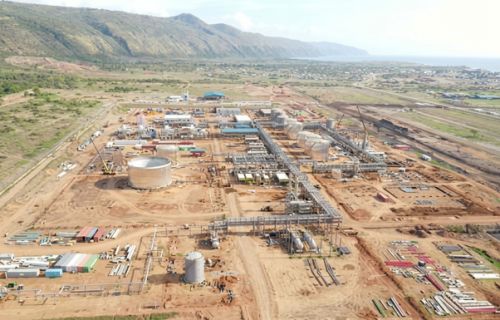
EACOP vs Lamu pipeline

EACOP vs Lamu pipeline

Uganda Delays $4 Billion Kabaale Refinery FID Until 2027​

Uganda Delays $4 Billion Kabaale Refinery FID Until 2027


icon-date.png
Thursday, 06 August 2026 16:28
  • Uganda has postponed the final investment decision (FID) for the $4 billion Kabaale refinery to February 2027, pushing the project beyond the start of commercial crude production.
  • The delay means Uganda will begin producing crude oil before it can refine it domestically, leaving the country dependent on imported petroleum products.
  • The East African Crude Oil Pipeline (EACOP) has also slipped behind schedule as logistics disruptions linked to the Middle East conflict affect the project.
Uganda is preparing to produce its first commercial barrel of crude oil, but it will not have a domestic refinery ready to process the output. On Aug. 5, the Petroleum Authority of Uganda (PAU) announced that the final investment decision (FID) for the $4 billion Kabaale refinery, planned in Hoima district, has been postponed until February 2027.


The revised timeline marks another seven-month delay after the FID was previously expected in July, according to data published by Africa Energy Portal in November 2025.

The PAU did not disclose the reasons for the latest postponement. However, AfricaOne News reported that the front-end engineering design (FEED) study conducted by UOP Honeywell was only halfway complete in October 2025, making a July investment decision unrealistic.

The regulator confirmed that the engineering study remains underway but did not provide an update on its current level of completion. The refinery is not the only Ugandan energy project experiencing schedule slippages.

The PAU also said that the East African Crude Oil Pipeline (EACOP), the 1,443-kilometer heated pipeline linking oil fields in western Uganda to Tanzania's port of Tanga, has fallen behind schedule.

The regulator attributed the delays to logistics disruptions caused by the conflict in the Middle East but did not announce a revised completion timeline.

Two-Decade Project Has Seen Multiple Setbacks

The Kabaale refinery project has experienced repeated delays over the past two decades. The project has changed investors three times since it was first proposed. Russia's RT Global Resources withdrew from the project first. The Albertine Graben Refinery Consortium later assumed the role before also exiting.

UAE-based Alpha MBM Investments eventually signed a memorandum of understanding in December 2023 and an implementation agreement in March 2025, as previously reported by Agence Ecofin.

The project's ownership structure now appears to have stabilized. Alpha MBM Investments will hold a 60% stake, while the state-owned Uganda National Oil Company (UNOC) will retain the remaining 40% in the refinery, which is designed to process 60,000 barrels of crude oil per day.

Meanwhile, Uganda still expects to begin commercial crude production in late 2026 or early 2027. As a result, the country will continue importing the petroleum products it needs until the refinery becomes operational.

According to Africa Energy Portal, Uganda currently spends more than $2 billion annually on petroleum product imports.

This article was initially published in French by Abdel-Latif Boureima

Adapted in English by Ange J. A de Berry Quenum


DRC oil exploration in protected areas draws environmental warnings​

Congolese authorities are set to auction off the rights to drill for fossil fuels in the rainforest © Volcanoes Safari
24 march 2023,
by Mike Mwenda
The Congolese government is allowing energy firms to bid for access to its vast oil and gas reserves, risking terrible ecological and climate effects.
The government of the Democratic Republic of Congo (DRC) has postponed the controversial auction of its 27 oil blocks and three gas blocks in the world’s second-largest protected rainforest, due to pressure from environmentalists. The oil blocks in question are spread over several parts of the country. Three are based in the coastal basin in the south of the country, nine in the Central Cuvette in the north-east of the DRC, eleven in the Tanganyika Graben in the east of the country, and four in the Albertine Graben, while the other three gas blocks are located in Lake Kivu in the west of the country.


Meanwhile, recent data has shown that the DRC has proven reserves of 180 million barrels, though estimates of total petroleum reserves are said to exceed 5 billion barrels. Currently, Congolese oil production is limited to the Coastal Basin, yielding 25,000 barrels per day of offshore production, all of which is exported.

Oil drilling plans

Initially, the Congolese government had planned to auction 16 oil blocks out of the 27 to oil firms, but it appears that with the Russian-Ukrainian conflict war sharpening Western demands, the DRC has been prompted to act quickly and cash in on the increased global interest in fossil fuels. Didier Budimbu, the Congolese Minister of Hydrocarbons, during the tender announcement in July last year said that “the sale of all these oil blocks will bring in nearly $2 billion US dollars to our treasury. And in a context of international economic crisis marked by the war in Ukraine, the DRC can really develop thanks to this oil discovery.”

se-didier-budimbu-portrait.jpg
Hydrocarbon minister Didier Budimbu Ntubuanga vowed to support oil companies interested in drilling in DRC© Didier Budimbu
Despite acknowledging environmental concerns raised by environmental activists, Mr Budimbu is adamant that his country has a right to exploit its natural resources. “The people of our country have the right to benefit from our natural wealth. People must understand that we are a free, sovereign nation, so we will exploit our natural resources.” He stressed.

DRC Environment Minister Eve Bazaiba has also defended the fossil fuel bonanza. “Nobody can put pressure on us. No convention in the world, not even the Paris Agreement, forbids a country from emitting CO2 for development purposes. Those who think the oil blocks pose a problem should come and re-assess,” said Bazaiba. She further assured critics that an environmental impact assessment of oil drilling would be carried out prior to the auctioning of all oil blocks. “If we think it could destroy the environment, we will leave it in the ground.”


Read more

Giant coal mine in South Africa leaves trail of evictions and death


Pressure to delay DRC oil fields auction

Initially, the DRC government had planned to unveil the list of multinational companies bidding for oil drilling in January this year. However, just before the deadline, minister Didier Budimbu tweeted that the cut-off points had been rolled back with immediate effect to various dates between April and October 2023.

ilustrations-congo-oil.png
Map of the concessions up for sale in DRC’s tropical rainforest @ SimonLLewis
Although the auctioning of 27 oil blocks has been postponed, new information has emerged that the Congolese government secretly auctioned off three gas blocks to the US and Canadian companies in the rainforest. Meanwhile, Mr Budimbu has declined to comment on the alleged auction, but he was quick to indicate that the “exploration there” would follow environmental guidelines.

Keep fossil fuels in the ground

Environmentalists and climate change activists have condemned the auction and looming oil drilling. Benard Kioko Ndaka, the CEO of Global Green Economy, said in an interview with LifeGate that “the planned auctioning of oil fields in the protected areas in DRC is a terrible embarrassment to the DRC’s efforts to position itself as a solutions country for the climate crisis. We’re urging the Congolese government to abandon current and future oil explorations in the protected areas. We believe that fossil fuels are a dead end.”

benard kioko ndaka
Bernard Kioko Ndaka (centre) has urged the Congolese government to move away from fossil fuels © Mike Mwenda
“The Congolese government must not only focus on financial or economic interests, but the lives of millions of people in Congolese communities and around the world that will be at stake,” Ndaka continued. “Let me end by saying this: there is no figure in terms of dollars that could compensate for the climate consequences. It’s not too late for the DRC to control the situation.”

Oil giants dump DRC

Following backlash from environmentalists, a series of multinational oil giants have reportedly ruled themselves out of the controversial oil projects in the DRC. France’s TotalEnergies, one of the corporations at the tender event, said that it was not participating in the bidding and said other major players will likely stay away. So far, eleven companies have indicated they are not interested in bidding for the 27 oil blocks in the protected areas. Unfortunately, other multinationals such as Chevron, Tullow Oil, and Perenco have not publicly commented on whether they will bid or not.

Read more

Mining giant and Kabwe locals square off in class-action lawsuit over lead mine

Meanwhile, independent environmental campaigning organisation Greenpeace Africa, says it has kept records of public statements made by giant oil companies. It is clear that fossil fuels have built the modern world and brought us conveniences that we now take for granted, but in the 21st century, science now tells us that we need to move away from fossil fuels to prevent the worst effects of climate change.


South Sudan ranked 5th among Africa’s top 10 oil-rich nations, New report reveals

Koang Chang · February 9, 2026

eyeradio.org/south-sudan-ranked-5th-among-africas-top-10-oil-rich-nations-new-report-reveals

---

GxGfWX6WcAEZeU1-678x565.png


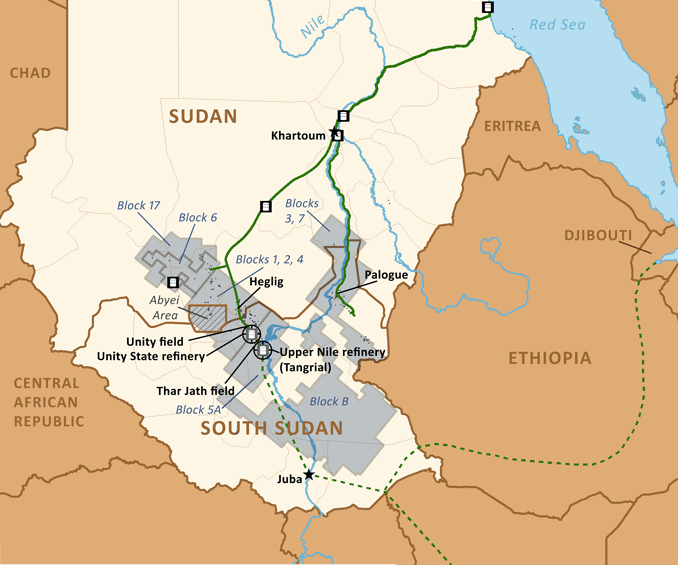
Map of oil fields in Sudan and South Sudan. Source: Courtesy

JUBA, South Sudan (Eye Radio) – South Sudan is ranked 5th among the top 10 African nations with the largest proven oil reserves in 2026, a status that continues to anchor the country’s budget and development path, according to a report by Business Insider Africa.

In a report published by Business Insider Africa, oil has long been one of Africa’s most powerful economic assets. In Africa, Libya holds the largest proven oil reserves, estimated at 48.4 billion barrels, ranking ninth globally, according to the latest Global Firepower report.

Oil has long been one of Africa’s most powerful economic assets — shaping government budgets, foreign policy, and development paths across the continent, according to Business Inside Africa report.

From North Africa’s vast desert fields to offshore platforms along the Atlantic coast, crude oil has funded infrastructure, created global trade links, and, in many cases, exposed economies to boom-and-bust cycles.

Even as the world talks up energy transition, oil remains essential to Africa’s growth story, providing revenue, jobs, and geopolitical leverage.

Below are the African countries with the largest proven oil reserves:

1\. Libya

  • Government Job
  • Map
  • Videos
  • Youtube Videos
  • 46 Minutes
  • Africas
  • Anchors

  • Backbone
  • Broadcaster
  • Calls
  • Government Job
  • Map
  • Videos

Libya holds Africa’s largest proven oil reserves, estimated at 48.4 billion barrels, ranking ninth globally. Oil is the backbone of its economy, accounting for more than 90% of government revenue. Production has been repeatedly disrupted by political instability and security challenges since 2011, preventing the country from fully realising its resource potential.

2\. Nigeria

Nigeria has Africa’s second-largest oil reserves at roughly 36.9 billion barrels, ranking 11th globally. Oil has long been central to the economy, although the country is increasingly seeking diversification. Production has been hampered by pipeline vandalism, oil theft and underinvestment, but recent reforms, including the Petroleum Industry Act, aim to attract capital and stabilise output. Nigeria remains a major supplier to global markets and a key player in OPEC. Alongside oil, its growing gas reserves are expected to play a larger role in future energy and export strategies.

3\. Algeria

G4qktkpTURBXy9lZTAyYjkzZGRiMDI1MzUzNWY1ZjRjNmQ1NjRiM2QyYy5qcGeRlQLNAxbNAiDCww


Algeria

Algeria’s proven oil reserves stand at about 12.2 billion barrels, placing it 15th globally. The country is a major energy supplier to Europe, exporting both oil and natural gas. State-owned Sonatrach dominates the sector, and hydrocarbons account for the bulk of export earnings. While Algeria’s oil production is mature, it continues to invest in exploration and enhanced recovery techniques.

4\. Angola

Angola holds approximately 7.8 billion barrels of proven oil reserves, ranking 18th globally. It is one of sub-Saharan Africa’s largest oil producers, with offshore fields accounting for most output. Oil contributes the majority of government revenue and export earnings, making the economy highly sensitive to price swings.

5\. South Sudan

South Sudan has an estimated 3.75 billion barrels of proven oil reserves, ranking 24th globally. Oil dominates the economy, providing nearly all government revenue. However, landlocked geography means exports rely on pipelines through Sudan, creating political and logistical vulnerabilities.

6\. Egypt

hndktkqTURBXy9hNjY1Njg3ZmQ0YzYwMTQxZDE5MzQzMTJlZGYxNGUxZC5qcGVnkZUCzQLdzQGiwsM


The Republic of Congo holds about 2.9 billion barrels of proven oil reserves, ranking 28th globally. Oil accounts for the vast majority of export earnings and government revenue. Most production originates from offshore fields, which are operated by international energy companies.

8\. Uganda

Uganda has an estimated 2.5 billion barrels of proven oil reserves, ranking 30th globally. Unlike many producers, Uganda has yet to become a major exporter, with its oil sector still under development. Projects such as the Tilenga and Kingfisher fields and the East African Crude Oil Pipeline (EACOP) are expected to unlock production later this decade.

9\. Gabon

ZGmktkpTURBXy85YmZhMWM1NWMzYTJhOTY3M2JmNzM2ODFjZjI4NzE5OC5qcGeRlQLNAxbNAg_Cww


Gabon

Gabon holds roughly 2 billion barrels of proven oil reserves, ranking 36th globally. Oil has historically underpinned the economy, though production has steadily declined as mature fields age. The government is encouraging new exploration and improved recovery methods to slow the decline. Gabon is also pushing to diversify into mining, forestry and services to reduce reliance on hydrocarbons. Despite its smaller reserve base compared with regional peers, oil remains a critical source of revenue.

10\. Chad

Chad’s proven oil reserves are estimated at 1.5 billion barrels, ranking 37th globally. As a landlocked country, Chad depends on export pipelines through Cameroon, increasing costs and vulnerability to disruptions. Oil is the country’s main export and a key source of government revenue, though benefits have been unevenly distributed.
 
Back
Top Bottom