Big quake in Haiti 7.0 magnitude

Big quake in Haiti 7.0 magnitude

Nadhani hii ni habari nzuri. Nchi iwekwe chini ya UN kwa miaka 20-25 (nasikia kuna wakubwa huwa wanazuia kwenye UN maazimio ya kusaidia maendeleo). Wamarekani hawana nia ya kuiinua nchi ile, kama Aristide msemo wake, wakubwa wanataka watoke tu kwenye misery wawe tu na 'dignified poverty', they should aim higher than that. Wajapani wamejenga majengo ya kuhimili matetemeko ya ardhi, kila kitu kinawezekana.


Jean-Bertrand Aristide: Exiled President Wants To Return To Haiti After Earthquake

JOHANNESBURG - A weeping former Haitian President Jean-Bertrand Aristide, living in exile in Africa since he was ousted in a rebellion five years ago, said Friday he wants to return to his quake-devastated country and is prepared to leave immediately, but did not indicate any concrete plans to do so.

In a rare public appearance, Aristide told reporters at a hotel next to Johannesburg's airport that he and his family are ready to fly to Haiti to help with the catastrophe. He said friends, whom he did not name, are willing to provide a plane to fly him to Haiti with medical supplies and other emergency equipment.

"As far as we are concerned, we are ready to leave today, tomorrow, at any time to join the people of Haiti, share in their suffering, help rebuild the country, moving from misery to poverty with dignity," said Aristide, his wife Mildred next to him, eyes downcast, twisting a handkerchief.

Aristide spoke in a hotel meeting room reserved by the South African foreign affairs ministry. A ministry official told reporters Aristide would make the statement and not answer questions, and the former president didn't.

Aristide, a former slum preacher, was beloved by many of Haiti's majority poor but opposition to his rule grew during his second presidential term after he was accused of masterminding assaults on opponents, allowing drug-fueled corruption and breaking promises to help the poor. Still, was a deafening clamor for Aristide's return during food riots in Haiti in 2008, showing he remains hugely popular.

Speaking briefly in Creole, Aristide told Haitians: "If one suffers we all suffer. Togetherness is strength. Courage. Hold on, hold on."

If Aristide does return, political instability in an impoverished nation struggling to dig itself out from the massive 7.0-magnitude earthquake could result. Aristide has previously hinted at returning, saying he merely wants to be a teacher. But his enduring popularity and ability to galvanize Haitians would likely propel him into the political spotlight.

"We feel deeply and profoundly that we should be there, in Haiti, with them, trying our best to prevent death," Aristide told reporters.

He wiped away tears that rolled from underneath his glasses as he spoke of Haitians' indomitable spirit.

Saul Kgomotso Molobi, a South African foreign affairs ministry official with Aristide, said he knows of no plans for Aristide to return to Haiti.

Aristide was first elected president in 1990 but was ousted in a military coup the following year. U.S. troops sent by then President Bill Clinton, currently a United Nations special envoy to Haiti, restored Aristide to power in 1994. After stepping down, Aristide was re-elected in 2000 but was ousted again in the bloody 2004 rebellion.

Aristide and his wife live with their two daughters in a government villa in Pretoria, South Africa's capital, just north of Johannesburg. The couple has embraced an academic life, with Aristide writing on the linguistics of Zulu and Haitian Creole, as well as on the theology of love.

http://www.huffingtonpost.com/2010/01/15/jean-bertrand-aristide-haiti-earthquake_n_424329.html

..................................................

Kuna video hapa najaribu kuiweka lakini link inakataa, unaweza kuipata hapa chini. Huyu Randall Robinson ndiyo alinifumbua na siasa za Haiti kama miaka 4 hivi iliyopita.

http://www.democracynow.org/2010/1/15/bush_was_responsible_for_destroying_haitian
 
Kuna kitu kuhusu watu weusi. Nimefikiria: Louisianna (New Orleans), Haiti, the endless tragedies in Africa etc. Mbona sehemu/ nchi za wazungu hakutokei mambo major kama haya?

Sidhani ya kwamba ni kweli unachodokeza. Angalia hii orodha ya maafa mabaya zaidi yaliyoorodheshwa katika jedwali:

Rank Event Location Date Death Toll (Estimate)
1. China floods China Nov. 1931 1,000,000–4,000,000
2. Yellow River flood China Oct. 1887 900,000–2,000,000
3. Shaanxi earthquake China Jan. 23, 1556 830,000
4. Bhola cyclone Bangladesh Nov.13, 1970 500,000
5. Indian Ocean tsunami (Ind. Ocean) Dec.26, 2004 230,000+
6. earthquake Antioch, Byzantine Empire 526 250,000
7. Tangshan earthquake China 1976 242,000
8. Haiyuan earthquake China 1920 240,000
9. India Cyclone India 1839 -300,000
10. Banqiao Dam China 1975 90,000 - 230,000
[ame]http://en.wikipedia.org/wiki/List_of_natural_disasters_by_death_toll[/ame])

Hakuna "kitu juu ya watu weusi". Maafa asilia yanapiga vibaya:
a) nchi za kitropiki penye dhoruba kali zaidi kuliko nchi za kaskazini na kusini duniani (kwa sababu maji ya moto ya bahari inalisha nguvu dhoruba)
b) nchi karibu na mipaka ya mabamba gandunia (tectonic plates) ambako kwa lazima matetemeko ya ardhi yanatokea kila baada ya miaka kadhaa.
c) tusubiri tu mlipuko wa volkeno karibu na mji mkubwa. Mahali pa hatari hasa: Mlima Vesuvio na mji wa Napoli (Italia)! Pia: Indonesia...

Wala dhoruba wala tetemeko zinajali rangi au imani ya watu wala kama ni watu wema au wabaya.
(linganisha Lk 13,4 kwa mtazamo wa kikristo katika maswala haya!)
Ila tu umaskini, elimu na hali ya serikali inafanya tofauti!
Elimu: Watu wasipoteze muda na hofu ya sheitani bali wajifunze kujenga majengo yanayodumu pia wasijenge mahali pa hatari panapojulikana
Umaskini: unawanyima watu elimu na uwezo wa kujenga bora na kuwasukuma wajenge pale pasipofaa
Serikali: tofauti kubwa kama inajali na kuhakikisha watu wafuate utaratibu uanopunguza vifo.Au kama inafanya mipago kwa dharura na kujenga huduma ipasavyo au la!

Mfano: Japani ina matetemeko ya ardhi makali lakini wana sheria kali kuhusu majengo wanafuata. China: vifo vingi tetemeko lililopita kwa sababu serikali ilikula rushwa haikufuatilia sheria ze ujenzi. Nairobi: hata kama ni mfano mdogo kila mwaka wa pili watu hufa mafuriko baada ya mvua mkali kwa sababu maskini wanajenga katika mabonde ya mto karibu na maji.
 
“As part of the Department’s ongoing efforts to assist Haiti following Tuesday’s devastating earthquake, I am announcing the designation of Temporary Protected Status (TPS) for Haitian nationals who were in the United States as of January 12, 2010. This is a disaster of historic proportions and this designation will allow eligible Haitian nationals in the United States to continue living and working in our country for the next 18 months. Providing a temporary refuge for Haitian nationals who are currently in the United States and whose personal safety would be endangered by returning to Haiti is part of this Administration’s continuing efforts to support Haiti’s recovery.

“At this moment of tragedy in Haiti it is tempting for people suffering in the aftermath of the earthquake to seek refuge elsewhere. But attempting to leave Haiti now will only bring more hardship to the Haitian people and nation. The international community has rallied to deliver relief to Haiti. Much has already arrived and much more is on its way. The Haitians are resilient and determined and their role in addressing this crisis in their homeland will be essential to Haiti’s future.

“It is important to note that TPS will apply only to those individuals who were in the United States as of January 12, 2010. Those who attempt to travel to the United States after January 12, 2010 will not be eligible for TPS and will be repatriated.

“The Department of Homeland Security continues to extend sympathy to our Haitian neighbors and support the worldwide relief effort underway in every way we can. Four Coast Guard cutters have arrived in Haiti, in addition to a variety of Coast Guard assets that were already in the area to support military air traffic control, conduct damage assessments and rescue people in need of assistance. The Federal Emergency Management Agency (FEMA) continues to work closely with the U.S. Agency for International Development (USAID) and the State Department—the lead U.S. federal agencies in the response—while coordinating the deployment of state and local Urban Search and Rescue Teams from across the country to Haiti and standing by to provide food, water and other resources as requested. U.S. Customs and Border Protection (CBP) has provided aircraft to support response efforts.

Haitians in the U.S. who are eligible to apply for TPS should call USCIS toll-free at (800) 375-5283.”
 
http://www.cnn.com/interactive/2010/01/world/gallery.large.haiti-1/?hpt=T1

Haiti_photo7.jpg
 
10.jpg

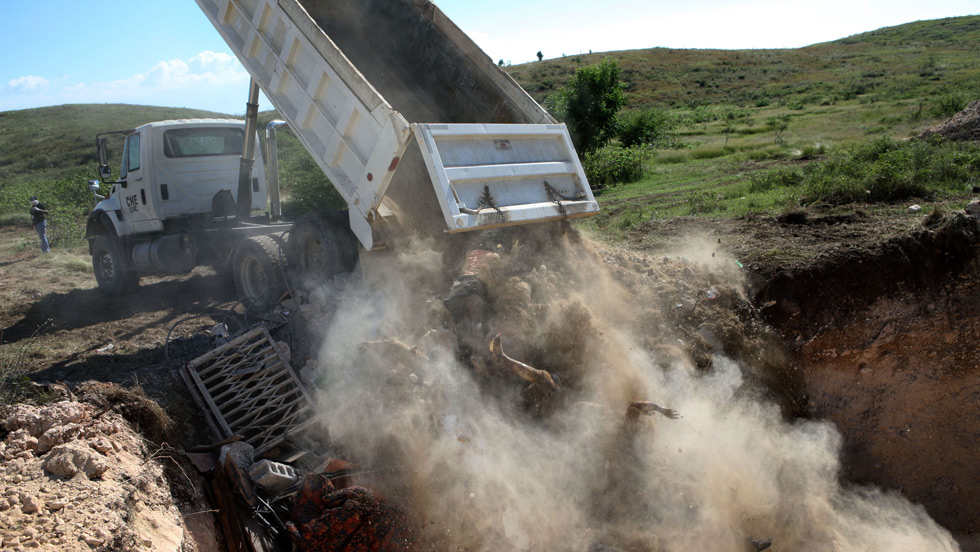
Bodies are dumped into mass graves Friday, January 15, in Titanyen, Haiti


14.jpg
 
Senegal offers land to Haitians

Senegal's president says he will offer free land and "repatriation" to people affected by the earthquake in Haiti.
President Abdoulaye Wade said Haitians were sons and daughters of Africa since Haiti was founded by slaves, including some thought to be from Senegal.
"The president is offering voluntary repatriation to any Haitian that wants to return to their origin," said Mr Wade's spokesman, Mamadou Bemba Ndiaye.
Tuesday's earthquake killed tens of thousands and left many more homeless.
Buildings have been reduced to rubble, the distribution of aid is slow, and people have been flooding out of the devastated capital, Port-au-Prince.
"Senegal is ready to offer them parcels of land - even an entire region. It all depends on how many Haitians come," Mr Bemba Ndiaye said.
"If it's just a few individuals, then we will likely offer them housing or small pieces of land. If they come en masse we are ready to give them a region." The spokesman emphasised that if a region was given, it would be in a fertile part of the country rather than in its parched deserts, the Associated Press news agency reported.

Story from BBC NEWS:
http://news.bbc.co.uk/go/pr/fr/-/1/hi/world/africa/8463921.stm
 
Nimejaribu kufikiria hatua hii ya Senegal, hivi ingefanywa Tanzania je? Maneno yangezuka ardhi inauzwa nk. Nadhani ipo sababu nyingine ya kugawa ardhi than originality,
 
Nimejaribu kufikiria hatua hii ya Senegal, hivi ingefanywa Tanzania je? Maneno yangezuka ardhi inauzwa nk. Nadhani ipo sababu nyingine ya kugawa ardhi than originality,
Huh...!
Too suspicious!

Nadhani hawa wa-Senegal wana sera ya ardhi kama ya Tanzania.

Ardhi yote ya nchi iko chini ya Rais, and At any time, the prezidaa can decide anything concerning the use of land!..

Na ameamua hivyo baada ya kuona na kutazama kwa nature ya huruma tu, na pia hiyo fact ya u-nasaba wa wa-Haiti!..Bravo Wade!
 
Sometimes i wonder is this GOD for all or for others. why such a thing didnt happens in Europe instead of poverished Haiti?
 
Ngoja awasaidie,hao jamaa wameumizwa sana hilo tetemeko, hali ni mbaya kuliko maelezo wajameni!Isipokuwa sidhani kama wataikubali ofa hiyo!
 
Scientists: Haiti must prepare for more massive quakes

ht_haiti_ba_9_100115_ssh.jpg


CHICAGO (AFP) – Haiti and its neighbors must prepare themselves for more massive quakes after the devastating tremors this week increased pressure along a lengthy fault line, scientists warned Friday.

Paul Mann, a senior research scientist at the Institute for Geophysics at the University of Texas at Austin, warned that just because the rebuilding process had started people shouldn't assume the risk was over.

"This relief of stress along this area near Port-au-Prince may have actually increased stress in the adjacent segments on the fault," he told AFP.

Researchers have already begun to work on models to try to predict how the stress changes resulting from the 7.0-magnitude quake which struck Tuesday is affecting the adjacent segments of the fault.

"This fault system is hundreds of kilometers long and the segment that ruptured to form this ear quake is only 80 kilometers long," Mann said in a telephone interview.

"There are many more segments which are building up strain where there haven't been earthquakes for hundreds of years.
"Potentially any one of these segments could cause an earthquake similar to that which happened in Haiti."

There are, thankfully, only two major population centers along the fault: Port-au-Prince and Kingston, Jamaica.

But as demonstrated in the chaos which followed Tuesday's tremor, the impact of a quake of that magnitude can be "paralyzing," Mann said.

Adding to the danger is the fact that the segment which broke was not among those closest to Port-au-Prince.

And there is a second fault system in the north of Haiti which extends to the Dominican Republic which has not ruptured in 800 years and has built up sufficient pressure for a 7.5 magnitude quake.

"The question is when are those going to rupture," Mann said, adding that it is very difficult to predict "whether or not that's going to happen next week or 100 years."

Eric Calais, a French geophysicist who works at Purdue University in Indiana, is among those trying to assess the danger.

He had warned Haitian officials years ago of dangerous pressure in the fault which caused this week's devastating quake, but little could be done to reinforce the desperately poor nation's weak buildings.

"The Haitian government is not to blame in this," Calais told AFP.
"They listened to us carefully and they knew what the hazard was. They were very concerned about it and they were taking steps. But it just happened too early."

Calais began researching the fault line in 2003 and soon took his initial findings to the Haitian government, even meeting with the prime minister.

In March 2008 he and Mann presented a paper showing that the fault had built up sufficient pressure to cause a 7.2 magnitude quake.

But they could not pinpoint when the quake might strike and the government was occupied with recovering from a series of four hurricanes which struck that year.

While the government had begun work on an emergency response plan, little could be done to retrofit and strengthen key buildings such as hospitals, schools and government buildings from which rescue operations could be organized.

"It's a poor country," Calais said. "Strengthening a building to resist a large earthquake can be as costly as replacing the building."

The devastation will allow Haiti to rebuild stronger than before, Calais said, noting that there are relatively cheap engineering solutions that can be applied to ensure that new buildings will not collapse in the next quake.

"It's very important for Port-au-Prince to rebuild properly," he added. "There are other segments of that fault that could rupture in the future."


Wazo zuri. Naamini kuna wengi tu watakaokwenda. Siku ya kwanza walikuwa wanaongelea kuwapeleka Guantanamo Bay, sijui hilo wazo limeishia wapi.
 
ni wazo zuri ila inabidi raisi afikirie miaka 20 au 50 mbele. Kizazi cha hao wahamiaji hawatakuwa na matatizo miaka ya mbele? Wajukuu wao hawatachukiwa na waSenegal "halisi" na kuzua vita au vurugu za ndani? Kumbuka Liberia, au nchi nyingine zenye one major immigrant community. Tanzania tu kuna kinyonge cha chini chini na wahindi ambao walikuja kwa nia njema kujenga reli enzi za ukoloni. Ujerumani kuna kinyonge cha chinichini kwa waturuki walioenda kusaidia kujenga nchi upya baada ya vita kuu. Kiufupi, sera za immigration zinabidi ziangalie mbele! Hasahasa socially
 
ina maana haiti hapafai kuishi tena??

HAITI DISASTERS
1770 - Earthquake devastates Port-au-Prince
1842 - Quake destroys Cap-Haitien, other cities
1935 - Storm kills 2,000
1946 - Tsunami kills 1,790
1954 - Hurricane Hazel kills hundreds
1963 - Hurricane Flora kills 6,000 in Haiti and Cuba
1994 - Hurricane Gordon kills hundreds
1998 - Hurricane Georges destroys 80% of crops
2004 - Floods kill 2,600
2004 - Tropical Storm Jeanne kills 1,900
2007 - Tropical Storm Noel triggers mudslides, floods
2008 - Three hurricanes and tropical storm kill 800
2010 - Quake hits Port-Au-Prince, killing thousands

Sources: AP, US Geological Survey
 
Je na sisi wa huku Morogoro kwenye mafuriko mbona tunaletewa Muhamar Gadafi peke yake?
 
HAITI DISASTERS
1770 - Earthquake devastates Port-au-Prince
1842 - Quake destroys Cap-Haitien, other cities
1935 - Storm kills 2,000
1946 - Tsunami kills 1,790
1954 - Hurricane Hazel kills hundreds
1963 - Hurricane Flora kills 6,000 in Haiti and Cuba
1994 - Hurricane Gordon kills hundreds
1998 - Hurricane Georges destroys 80% of crops
2004 - Floods kill 2,600
2004 - Tropical Storm Jeanne kills 1,900
2007 - Tropical Storm Noel triggers mudslides, floods
2008 - Three hurricanes and tropical storm kill 800
2010 - Quake hits Port-Au-Prince, killing thousands

Sources: AP, US Geological Survey

Jamani!!!!...Hapa hapafai kuishi.Utani kando aisee.
 
Back
Top Bottom