It is too late to try to stop North Korea now!
It will back fire! They are having nukes already!
A flurry of
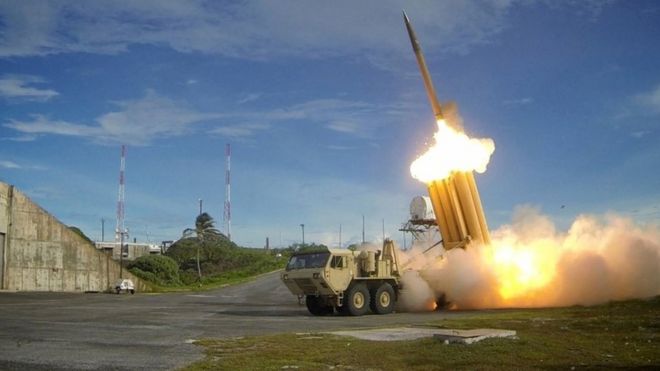
recent missile tests by North Korea has set nerves on edge and stirred fresh concern about whether U.S. defenses could protect Americans against a sneak attack. North Korea has detonated nuclear devices and is trying to develop long-range missiles capable of reaching the United States.
The Pentagon has spent more than $40 billion on the
Ground-based Midcourse Defense system — GMD for short. It’s designed specifically to thwart a nuclear strike by North Korea or Iran. Yet there are grave doubts about whether it’s up to the task.
Here is a look at the system’s origins, how it’s supposed to work and the technical problems that have bedeviled it.
What exactly is GMD supposed to do?
It’s designed to defend the United States against a “limited” nuclear attack. That means a strike with a handful of missiles, as opposed to a massive assault of the kind that Russia or China could launch. The United States relies on deterrence — the threat of overwhelming retaliation — to prevent Russia or China from ever unleashing missiles against us. In the case of North Korea or Iran, we would rely on GMD to knock incoming warheads out of the sky.
How would GMD do that?
By intercepting incoming warheads in space, just as they’re about to begin their reentry into the atmosphere. That’s the approximate “midcourse” point in a warhead’s journey from launch pad to target.
What’s an interceptor, and how does it work?
The GMD interceptors are 60-foot-tall, three-stage rockets. Each has a five-foot, 150-pound “kill vehicle” at its tip. In the event of an attack, interceptors would be launched from their underground silos. Once in space, the kill vehicles would separate from their boost rockets and fly independently toward their targets, at speeds up to 4 miles per second.
A kill vehicle on display at Ft. Greely, Alaska, with its silver thrusters protruding. (Al Grillo / Associated Press)
How many interceptors are there, and where are they based?
There are 37 operational interceptors — four at Vandenberg Air Force Base in Santa Barbara County, Calif., and 33 at Ft. Greely, Alaska.
Map shows approximate locations of Ft. Greely, Alaska, and Vandenberg AFB in California. (Los Angeles Times)
How would the kill vehicle destroy an incoming warhead? By blowing it up?
The kill vehicles carry no explosives. They’re designed to destroy enemy warheads with kinetic energy, or energy of motion — in other words, by crashing into them.
How would the kill vehicle find the incoming warhead?
Satellites and powerful radars, stationed on land and at sea, track airborne objects. The GMD system receives data from these and other sources and would use it to guide the interceptors. The kill vehicle also has an on-board navigation system to help it zero in on its target.