Cost comparison SGR Kenya vs SGR Tanzania

Cost comparison SGR Kenya vs SGR Tanzania

SOURCE / ECONOMY
China, Tanzania, Zambia agree to jointly build TAZARA Railway prosperity belt: Chinese FM
By Global Times
Published: Nov 21, 2025 11:38 PM

Signing ceremony for revitalization of Tanzania-Zambia Railway Photo: courtesy of China Railway Construction Corporation


To catalyze sustainable development of the project after its revitalization, the governments of China, Tanzania and Zambia agreed to jointly build the TAZARA Railway prosperity belt, advance the comprehensive development of regions along the railway in a systematic manner, and unleash the potential of regional development in Tanzania and Zambia, Mao Ning, spokesperson for China's Foreign Ministry, told a press conference on Friday.

Mao made the remarks as Chinese Premier Li Qiang, Zambian President Hakainde Hichilema and Tanzanian Vice President Emmanuel John Nchimbi attended the ground-breaking ceremony of the TAZARA revitalization project on Thursday.

Under the personal guidance and effort of the heads of state of the three countries, the TAZARA Railway, a milestone project of China-Africa friendship, will gain new vitality and dynamism in the new era, Mao said.

Under the vision of China and Africa jointly advancing modernization that is just and equitable, open and win-win and eco-friendly, puts the people first, features diversity and inclusiveness, and is underpinned by peace and security, the three countries agreed to forge the railway into a path to freedom, development, friendship, happiness, green development and harmony. The three sides will stay committed to the principles of mutual respect, equal-footed consultation and joint contribution for shared benefit, advance the building of the TAZARA Railway prosperity belt, inject new impetus to socioeconomic development of Tanzania, Zambia and surrounding countries, and deliver more benefits to the local people, the spokesperson noted.

According to a statement China Railway Construction Corporation (CRCC) sent to the Global Times on Friday, CRCC and its subsidiary China Civil Engineering Construction Corporation (CCECC) will take the revitalization project as an opportunity to deliver high-quality construction, operation, and services. CRCC said it will actively align with the development strategies of Zambia and Tanzania, promote coordinated development of industries along the corridor such as mining, modern logistics and agricultural processing, and explore deeper cooperation in areas including new energy, water resources development, and green and low-carbon initiatives.

CRCC said in the statement that the revitalization project will follow the guiding principle of "revitalize first, develop later" and carry out a comprehensive, systematic upgrade.

According to the company, it will replace all the sleepers along the entire line, lay 390 kilometers of new rail, repair bridges with hidden defects and strengthen power supply and communication systems, in order to fully restore the railway's freight and logistics capacity.

The company will also retain and optimize existing passenger services and improve production and living facilities along the corridor. Moreover, it will establish a dedicated training center, and the project is expected to create more than 20,000 jobs, the statement said.

Song Wei, a professor at the School of International Relations and Diplomacy at Beijing Foreign Studies University, told the Global Times on Friday that the TAZARA Railway is an iconic project embodying the deep friendship between China and Africa.

"The launch of the revitalization project will inject fresh vitality into regional connectivity and economic cooperation across Africa, which will not only facilitate local transportation but also generate multiple effects from driving growth in imports and exports to promoting tourism exchanges, and beyond," Song noted.

Once revitalized, TAZARA Railway's annual freight capacity is expected to surge from around 200,000 tons to 2.4 million tons, while transit times along the corridor will be reduced by two-thirds. This will ensure the dividends of development reach thousands of households, driving the clustering of commerce, logistics, processing, agriculture, tourism, and other industries, while injecting vigorous new momentum into China-Africa cooperation, said the company in the statement.

Song noted that the project mirrors the close economic and trade ties between China and Africa.

According to the Xinhua News Agency, trade with China continues to act as a stable anchor in Africa's trade structure. In 2024, bilateral trade reached $295.6 billion, setting a new record for the fourth consecutive year.

China also decided earlier this year to extend zero-tariff treatment to 100 percent of tariff lines for 53 African countries with which it has diplomatic relations, Xinhua reported.

Song said that China's support for Africa has always adhered to the principle of mutual benefit and win-win cooperation, while actively sharing the dividends of China's development with the continent.

"China - through mechanisms such as the Forum on China-Africa Cooperation — has continued to increase its support for Africa and has encouraged more Chinese enterprises to invest and do business there, which will help African countries address infrastructure shortcomings, enhance industrial capabilities, better integrate into the global value chain, and achieve common development and shared prosperity," Song noted.


BIG STORY: Kenya to Launch SGR Extension to Malaba in January 2026, says Ruto​

The 262-kilometre SGR extension to Malaba will close a critical gap in the region’s Northern Corridor, linking the Port of Mombasa to Uganda’s upcoming SGR line and onward to Rwanda, South Sudan, and eastern DR Congo​

George Asiimwe November 21, 2025
2 minutes read


The project has long been viewed as a linchpin in unlocking seamless rail connectivity from the Indian Ocean to Uganda’s interior and the Great Lakes region
Nairobi: Kenya will commence construction of the Standard Gauge Railway (SGR) extension from Naivasha to Malaba in January 2026, President William Ruto announced Thursday, in a strategic move expected to accelerate regional integration and transform trade logistics across East Africa.

The announcement came during President Ruto’s annual State of the Nation Address at Parliament in Nairobi, where he framed the project as a “national imperative” and reaffirmed Kenya’s commitment to positioning itself as a regional infrastructure and logistics hub.

“This infrastructure drive will also include extending the Standard Gauge Railway from Naivasha to Kisumu and eventually to Malaba beginning in January 2026,” Ruto told lawmakers, citing the project as central to Kenya’s long-term transport modernization agenda.
The 262-kilometre SGR extension to Malaba will close a critical gap in the region’s Northern Corridor, linking the Port of Mombasa to Uganda’s upcoming SGR line and onward to Rwanda, South Sudan, and eastern DR Congo.
The project has long been viewed as a linchpin in unlocking seamless rail connectivity from the Indian Ocean to Uganda’s interior and the Great Lakes region.
Uganda signed a $2.2 billion contract in early 2025 with Turkish firm Yapi Merkezi to construct the Malaba–Kampala section of its SGR network.

Kenya’s announcement now places both countries on a coordinated path to operationalize the high-speed cargo corridor by the end of the decade.

The SGR routes


Economic Stakes
If completed as planned, the railway will reduce cargo transit time between Mombasa and Kampala from five days to under 24 hours and cut transport costs by up to 30%, according to regional logistics analysts.

The improved efficiency is expected to spur trade volumes, ease pressure on roads, and attract foreign direct investment in export processing, manufacturing, and warehousing.

“This is a transformational step not just for Kenya, but for the regional economy,” said Pauline Mboya, a transport economist based in Nairobi.

“We’re looking at a logistics spine that could define East African trade for the next 50 years.”

Kenya’s Port of Mombasa remains the dominant maritime gateway for the region, handling over 70% of Uganda-bound cargo.

However, limitations in infrastructure west of Naivasha have forced exporters and freight forwarders to rely on inefficient road transport or the older meter-gauge railway.

To finance the project sustainably, Ruto announced the creation of a National Infrastructure Fund, to be underpinned by the new Government-Owned Enterprises Bill.

He said the fund would leverage proceeds from privatization and attract institutional investors, including sovereign wealth funds, pension managers, and private equity.

“We cannot continue funding essential infrastructure through unsustainable borrowing or burdening taxpayers,” Ruto said.

“We aim to attract ten shillings from long-term investors for every one shilling invested from privatization proceeds.”

“This financing architecture will leverage capital markets, diversify ownership, and channel private capital into public priorities,” he added.

The fund is modeled on global precedents such as Australia’s Future Fund and Singapore’s Temasek Holdings.

Regional Coordination

Kenya’s announcement comes amid renewed East African efforts to strengthen regional infrastructure under the East African Community (EAC) and the African Continental Free Trade Area (AfCFTA).

The SGR extension is also aligned with the Northern Corridor Integration Projects (NCIP), a framework championed by Kenya, Uganda, and Rwanda.

President Ruto framed the project as a generational challenge.

“These four projects are our national imperatives… This is the assignment of our generation,” he said. “This is the moment we must rise up to.”

Construction of the Naivasha–Malaba line will require coordination across government agencies, land compensation processes, public-private partnerships, and collaboration with Uganda’s Ministry of Works and Transport to ensure border interoperability.

The January 2026 launch date sets the tone for what could be one of the most ambitious transport infrastructure undertakings in East Africa’s recent history.


TAIFA LEO Logo

Ruto, Museveni waahidi kupeleka SGR hadi DRC​

Na CECIL ODONGONovember 24th, 2025
ruto-museveni-samia-1320x792.jpg

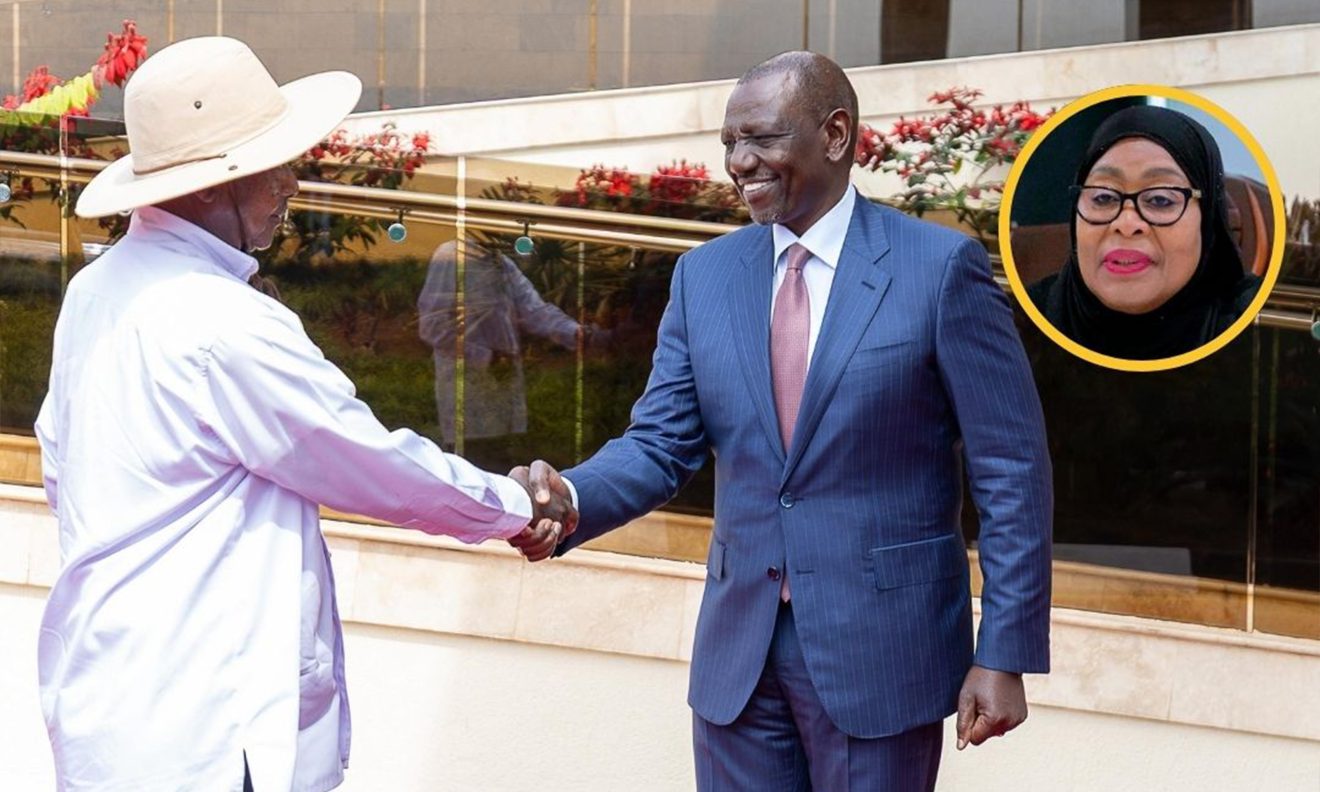
Rais Yoweri Museveni (kushoto) alipolakiwa na mwenyeji wake Rais William Ruto Nairobi. Picha ndogo ni Rais wa Tanzania Samia Suluhu. Picha|PCS

RAIS William Ruto ametangaza kuwa reli ya kisasa ya SGR sasa itajengwa kutoka Naivasha-Kampala hadi Rwanda na kwenye mpaka wa Jamhuri ya Demokrasia ya Congo (DRC) kuanzia mapema mwaka ujao.

Dkt Ruto alisema hatua hiyo itasaidia kuimarisha biashara za ukanda huu hasa Uganda na Kenya na Jumuiya nzima ya Afrika Mashariki.

“Januari tutazindua ujenzi wa SGR kutoka Naivasha hadi Kampala na itaungana na ile ya Malaba-Kampala na baadaye DRC,” akasema Rais.


Alikuwa akiongea katika eneo la Osukuru, Wilaya ya Tororo Uganda ambapo pamoja na Rais Yoweri Museveni walizindua mradi wa Kiwanda cha utengenezaji wa chuma, Devki.

Rais Ruto alisema SGR itakuwa mradi wa pamoja na utazinduliwa Januari 2026.
Wakati huo huo, Rais alisema kuwa Kenya na Uganda zitaongeza mfumo wa usafirishaji wa mafuta kupitia mabomba hadi DRC.

Rais Ruto pia alisema uhusiano wa Kenya na Uganda ni imara na nchi hizo zilibuni mbinu mpya ya kuimarisha uchumi wao katika kikao cha mawaziri wao Nairobi hivi majuzi.


Rais Museveni naye alisema miradi ya kiviwanda itakuwa na manufaa tu wakati ambapo jamii zitapata nafasi za ajira.

Mwenyekiti was Devki Nerendra Ravel alihakikishia marais hao kuwa kiwanda hicho kitawategemea na kuwatumia wafanyakazi kutoka Uganda.

Aliahidi kuwa mradi huo utabuni nafasi 15,000 za ajira kwa raia wa Uganda.
“Naihakikishia jamii ya hapa kuwa asilimia 90 ya kazi itafanywa na watu wa hapa,” akasema Dkt Raval.

 
Back
Top Bottom