FRANCIS DA DON
JF-Expert Member
- Sep 4, 2013
- 40,613
- 46,713
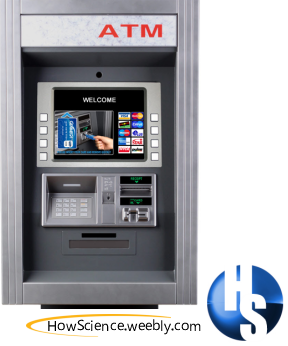
As of recent times, individuals do not carry money for shopping. Instead, they carry an automated teller machine card, commonly known as ATM Card. When cash is needed they go to the nearby ATM machine, insert their ATM card, and take the necessary amount. As these ATM machines are found in most of the supermarkets, towns, and even hotels. Do you have any idea how your bank money is received from any part of the country? In this article we shall describe briefly on how the ATM is networked with the bank and the operations of an ATM machine.
Difference between ATM card and Debit card
- --Although both these cards serve the same purposes, most of the banks prefer the issueing of credit cards. When you buy something with a debit card, the money is automatically reduced from your savings account. This is different from the way a credit card works. For a credit card, you get a monthly bill for the amount you have spent. You can take money directly with the help of an ATM card. But, with a debit card, you can only purchase things. You can use ATM cards for some direct purchase as well, but it is limited.
- Debit cards can be used in different fields like grocery stores, hotels, booking tickets, pharmacies and so on.
- There is also a difference in appearance between an ATM card and a debit card. A debit card has the users name, the companys logo, the banks logo and also written Check card in front of it. An ATM card, on the other hand has the account number and also the bank logo. Both the cards have a common strip on the back of the card, so that the user can sign on it.
How does an ATM Work?
There are mainly two types of ATMs which differ according to the way they operate. They can be called as
1. Leased-line ATM
2. Dial-up ATM machines
Any ATM machine needs a data terminal with two inputs and four output devices. Of course, for this to happen there should also be the availability of a host processor. The host processor is necessary so that the ATM can connect and also communicate with the person requesting the cash. The Internet Service Provider (ISP) also plays an important role in this action. They act as the gateway to the intermediate networks and also the bank computer.
A leased-line ATM machine has a 4-wire, point to point exclusive telephone line which assists in connecting it with the host processor. These types of machines are preferred in places where the user volume is high. They are considered high end and the operating costs of this type of a machine is very high.
The dial-up ATM machines has only a normal phone line with a modem and a toll free number. As these are common connections, their initial installation cost is far less and their operating cost is only a fraction of that of a leased-line ATM.
The host is mainly owned by the bank. It can also be owned by an ISP. If the host is owned by the bank only machines that work for that particular bank will be supported.
Parts of ATM machine
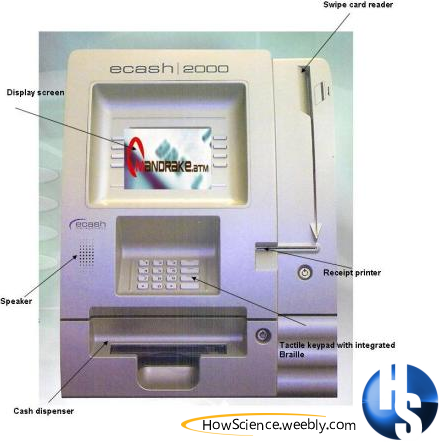
As told earlier, there are mainly two input devices and four output devices for an ATM. The input devices are
- Card Reader This is a part of the identification of your particular account number. For this the magnetic stripe on the back of the ATM card is either swiped or pressed on the card reader so that it captures your account information. To understand the account information of the user, the data from the card is passed on to the host processor. The host processor thus uses this data to get the information from the card holders bank.
- Keypad After the card is recognized, the machine asks further details like the type of withdrawal you prefer, your balance enquiry, and your personal identification number (PIN) and so on. Since each card has a unique PIN number, it is highly unlikely for someone else to withdraw money from your account. There are also separate laws to protect the PIN code while sending it to the host processor. So, the PIN number is mostly sent in encrypted form.