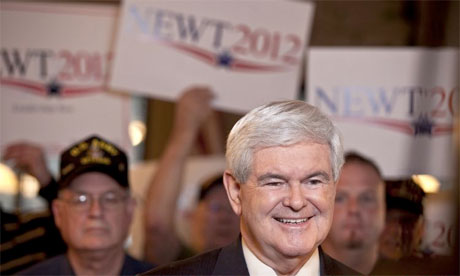
US Presidential Primaries

US Presidential Primaries

[h=1] [/h]

[h=1]Sarah Palin anoints Newt Gingrich[/h] Well, there's a sort of logic: it takes a grandstanding prima donna to know one


Sarah-Palin-007.jpg
Sarah Palin speaking to Tea Party supporters at a rally in Manchester, New Hampshire. Photograph: Michael Seamans / Demotix/Demotix/Corbis

The American people figured out Palin's irrelevance before the media did; it was only last October that we stopped doing the polls that gave them the chance to tell us that.
Now, Palin's endorsement of Newt Gingrich ahead of the South Carolina primary may say more about Gingrich than it does about Palin – which is what endorsements are supposed to do, though in the upside-down world of modern politics, this is not how we usually talk about them. Nor is it how Palin probably wishes we'd talk about them.
Let's take as given that Palin's true intent, for whatever cynical and/or misguided reason, is to maximize the length of the GOP nomination cycle and thus wants to throw weight behind one of the guys not already winning. It's not going to be Paul – she is a Fox News commentator, after all – and it's not going to be Perry, because, well, Perry. Between Rick Santorum and Gingrich, she doesn't go for the guy whose actual lived experience is as a political and social conservative; she goes for the arrogant historian-lobbyist who at least can cohere words in an order that she can't.
Either Newt has successfully shed his years-long association with Washington culture, or Palin – like many Newt supporters – is so angry with the Obama administration that she doesn't care if Gingrich's values genuinely match up with hers; she just wants fireworks. Preferably M80s. Thrown in the White House commodes.
There's an element of what-the-frak-ness to the GOP campaigns at this point, and Newt embodies this (you could say he approached marriage the same way). Robbed of the chance to have a real nomination fight, voters will settle for theatrics. Palin is no stranger to drama over content, after all.
One thing's for certain: they both have animal pelts for hair.
 
[h=4]Series: Campaign ad watch 2012[/h] Previous | Index

[h=1]Newt Gingrich's ugly moment[/h] Gingrich shamelessly parlays a controversial debate statement into a racial-charged dogwhistle to South Carolina conservatives


Newt Gingrich's ad 'The Moment'. Video: Newt2012 [h=2]Who[/h]It is Newt Gingrich, the former House speaker and official Mr Angry of the current race for the Republican nomination. Newt is angry about many things (Barack Obama, taxes, jobless poor people, the "war on religion", evil liberals, Iran), but mostly, what he is angry about is Mitt Romney trouncing everyone in the race so far. Now, the final showdown looms in South Carolina for a non-Romney conservative alternative to emerge. Newt thinks it should be him and he does indeed have the best – albeit small – chance of providing an upset.
[h=2]What[/h]It is a TV spot called "The Moment". It features Gingrich going off on a brief rampage during a recent debate about Obama being the "food stamp president", and then ranting about how poor people need to stop being poor and just get a job. In the fevered atmosphere of a South Carolina Republican debate, in a room stuffed with white conservatives, this piece of wonderful oratory got a standing ovation.
[h=2]When[/h]It is up now on the South Carolina airwaves. Voting begins on Saturday and every moment is precious – if someone is going to finally emerge as a conservative alternative to Romney rather than various candidates performing a dizzying series of ups and downs. (If Newt does rise again in the South it will be his third go-around.)
[h=2]Why[/h]Newt needs to appeal to South Carolina conservatives: the people who are most distrustful of Romney's record of flip-flops on social issues and – maybe – a little dubious about his Mormon faith. But this is the South, not Iowa or New Hampshire. Race and America's painful history of oppressing its black minority is never too far from the surface.
One way to get those conservative voters on board is to "dogwhistle" the issue of race. That is what many people – including this correspondent – would say Gingrich is doing with this ad. When he says Obama is the food stamp president, he is not really talking about the food stamp programme. He is playing up to a prejudice among some white conservatives that black people (represented by Obama) are "welfare kings and queens" living high on the hog off the backs of hardworking decent white folks with jobs.
For some elements of the South Carolina Republican electorate, such dogwhistling is a powerful way of saying: I am one of you. Of course, Gingrich would deny it in yet another hiss of outrage at the sheer gall of liberal commentators who seek to silence their critics by falsely calling them racists. But just listen to Gingrich's speech and watch the raucous cheer of the overwhelmingly white crowd of GOPers, and make up your own mind.
[h=2]How[/h]Simple things speak loudest in politics. This ad is very simple and shouts its message: I am proud of taking this stand, it says. It is absolute unashamed red meat to its intended audience. "Who can beat Barack Obama?" the ad asks, before cutting straight to Gingrich, whose main stump speech in recent days has been about how the Obama machine will chew up a "Massachusetts moderate" like Mitt. Newt kicks straight in.
"More people have been put on food stamps by Barack Obama than any president in history," Gingrich says to a gladiatorial cheer from the crowd. Of course, this might just be because Obama has been dealing with a crippled economy, high unemployment, spiralling poverty and the worse economic slowdown since the Great Depression. But that's not what Newt means. He means Obama is black and he is helping other black Americans freeload off decent white people. Then, Newt really hits his stride.
"I believe every American of every background has been endowed by their creator with the right to pursue happiness," he says. "If that makes liberals unhappy, I'm going to continue to find ways to help poor people learn how to get a job … learn how to get a better job … and learn some day to own the job," he concludes, as the crowd rises to its feet.
Newt's vision here seems to rest on the idea that there are lots of great jobs out there if only those feckless poor people would go learn how to get them. But instead, these idle souls are just happy to keep milking the (evil liberal) government for free, rather than take the opportunities that America's free market so readily offers them. To say this is a parallel vision of reality is to greatly understate the situation. America's welfare state is already in tatters. Anyone who thinks it's fun being poor and on food stamps with no work in the US should really try living that life for a while. It is not easy to break out of it.
Indeed, recent studies showed that social mobility in the US is now below that of Canada and many European countries. There are also few jobs in a country where the unemployment rate is more than 8% (and that's only the headline figure that ignores the long-term jobless). But again, Newt is not concerned with nuance. He's blowing on that dogwhistle so hard that stray mutts up in Alaska (perhaps pulling Sarah Palin's sled) are now howling at the moon.
The ad concludes with "I am New Gingrich and I approve this message." Rarely has that piece of legal boilerplate seemed more sinister. The sad thing is that so many of the audience approved it, too.
 

[h=1]Barack Obama's presidency, three years on – is it time to give up hope?[/h] He promised radical change, a new kind of politics. Many one-time believers now say he has no stomach for a fight


Barack-Obama-with-his-wif-007.jpg
Barack Obama with his wife, Michelle, at the White House in December 2011. Photograph: Jewel Samad/AFP/Getty Images

Three years ago to the day, Barack Hussein Obama stood before a crowd shivering in the frigid January air and took the oath of office that made him the 44th president of the United States. By some estimates, there were two million people thronging the National Mall in Washington that day, a human carpet stretching to the steps of the Capitol, to witness a moment many – perhaps most – never believed they would see: the inauguration of America's first black president. When Aretha Franklin, in a splendid hat, sang My Country, 'tis of Thee, the air filled with hope that this would be a moment of healing – of the immediate, bruising past of the Bush years, but also of the long history of racial division in America. Hopes, in other words, that were almost impossibly high.
And these vaulted ambitions did not only apply to the vexed matter of race. Time magazine's cover featured a photo-montaged image merging Obama and Franklin Roosevelt, hailing "the New New Deal". There was a breathless expectation that Obama was poised to solve an economic crisis with a programme of investment and government activism that would not only put Americans back to work but rebuild the country, preparing it for a cleaner, greener future. And of course Obama would put aside the reckless, swaggering foreign policy of his predecessor, would reach out to the Muslim world and would doubtless replace discord with harmony across the globe. It was not just those who were there on that bright January morning who got caught up in the excitement of all this promise. Less than nine months later, the Nobel committee gave Obama its peace prize.
Now all that seems a long time ago. Conservative Americans, especially those who live in the Foxosphere, never believed the hype anyway. But since then, many of the one-time true believers, Democrats and liberals, have lost their faith in Obama. They believe his presidency has been a terrible, historic letdown; that he has not delivered on his promises; that instead of bringing radical change, he has provided more of the same; that he has been a weak, querulous presence in the White House, unwilling to make enemies, unwilling even to define himself or make clear what he stands for.
The specific charge sheet against Obama could run for several pages and then several more. On the economy, the president is blamed for a lack of ambition, for passing a stimulus package of $787bn that, say the critics, should have been nearly twice the size. Obama erred, too, by allowing Democrats in Congress to write the stimulus bill, packing it with pet schemes and pork that would do little to get the economy moving. In an attempt to win Republican support – which never came – he also weighed down the bill with too many tax cuts. The result was action that was simply incomplete, leaving unemployment hovering around the 9% mark for most of Obama's presidency.
Former admirers say he was too weak on the banks, failing to declare war on those who had caused the 2008 crash. The clues were there in his senior appointments. While some liberals had fantasised about a dream ticket of Nobel laureate Paul Krugman and former labour secretary Robert Reich, Obama filled his two key economic posts with Larry Summers and Timothy Geithner, both schooled by Robert Rubin, former co-chair of Goldman Sachs. Obama did legislate on financial reform, but the bill did not go far enough, with no restoration of the Depression-era Glass-Steagall act, which had previously separated casino and retail banking. Nor was there any action to cap the pay of top executives, even in companies majority-owned by the US government. It's not that Obama fought and lost on these issues. In most cases, he did not even fight.
His signature achievement, the passage of healthcare reform, also dismayed as many liberals as it delighted, chiefly because Obama surrendered on the so-called public option which, while not exactly establishing an American NHS, would have at least offered a government-run insurance programme as an alternative to the private sector. That made Obama's bill no more radical than one proposed decades earlier by Richard Nixon, or the one passed by a certain Mitt Romney when he was governor of Massachusetts.
In his inaugural address Obama spoke often and poetically on climate change. He vowed to "harness the sun and the winds and the soil to fuel our cars and run our factories". But there has been no action and not even any serious advocacy. Aware that Republicans do not even believe there is an energy problem, he has shied away from offering a solution.
Those of us watching from afar have felt versions of this disappointment. Plenty of Guardian readers would have cheered when Obama used his first day in office to sign an order for the closure of the detention camp at Guantánamo Bay – and chose to make his first presidential phone call to the Palestinian president, Mahmoud Abbas. But, thwarted by a Republican refusal to allow any ex-Guantánamo detainees to set foot on US soil, Obama has been unable to make good on that day one order: Camp X-Ray remains open. As for Israel-Palestine, on which he had promised to work from his first day in office, the US role has been ineffective or even, by some lights, counter-productive.
"He has allowed himself to be an American president poked in the eye by Bibi," says one former European foreign minister who worked on the Middle East peace process, referring to the Israeli prime minister, Binyamin Netanyahu. Many diplomats and others agree that Obama's insistence on a freeze on Israeli settlement building, however well-intentioned, proved to be a tactical error, allowing any chance of progress to become entangled in one single aspect of what is a much larger problem – and that in the staring contest between Obama and Netanyahu, Obama blinked first. What explains these multiple failings? Are they the fault of Obama the man or of the system? On the domestic front, some are forgiving of the president, saying that he has faced impossible odds. Among the obstacles is an intransigent Republican party in Congress that does not hide its desire to deny Obama anything that looks like an achievement, even if such paralysis damages the national interest. "The single most important thing we want to achieve is for President Obama to be a one-term president," said the Republicans' senate leader, Mitch McConnell.
Add to that a senate rulebook that allows the Republican minority to filibuster and frustrate every Democratic initiative; a Democratic party as divided and factional as the Republicans are united and disciplined; a Fox News echo chamber that daily demonises the president as a Muslim Marxist foreigner eager to impose totalitarianism on the American republic; and corporate money ready to flood the airwaves and put pressure on the congressmen it funds to ensure its interests are protected. Viewed like this, Obama was only ever a mere mortal taking on an invincible machine – and so was always bound to fail.
Others are less charitable. They point first to Obama's tactical errors. He should never have let Congress write the healthcare bill, thereby delaying and diluting it, but should have taken the initiative himself. He should have focused on jobs before healthcare reform anyway. Above all, he tried to accommodate the Republicans for too long. He believed his own rhetoric, which promised an end to Washington partisanship – "he drank his own Kool-Aid," says one observer – when he should have rapidly realised that Republicans did not want to sit around the campfire with him singing Kumbaya. They wanted to destroy him. He should have drawn a clear dividing line between him and them, defining himself as the defender of the national interest and of the hard-pressed, and casting the Republicans as the enemy. He should have channelled the spirit of FDR, who did not hesitate to say of his political adversaries: "I welcome their hatred." Instead, he remained cool, calm and hyper-rational to a fault, often described as too chilly to connect emotionally with the nation he leads.
Which brings us closer to the core critique of Obama. That he avoids a fight, that he folds too early, that in his desire to unite and heal he too often surrenders his own position – to the point where no one is clear what his own position is. He blinked yet again when he faced down congressional Republicans who refused to raise America's debt ceiling last August, even though polls showed the US public backed him. "Every time the Republicans played chicken with him, he caved," laments Nation columnist Eric Alterman, who adds: "This is really painful for me. I loved the guy."
So the liberal disappointment with Obama is real. And yet it may not endure forever. Despite everything, the president has amassed quite a record. The healthcare reform he passed had eluded every president since Teddy Roosevelt; it had been a Democratic goal since Truman. But only Obama did it. The stimulus package has created an estimated 2.4m jobs and prevented the recession turning into a second Depression. While other advanced economies are caught in a downward spiral of deficit fetishism, the US is seeing unemployment come down. And recently, Obama successfully fought for and defended the payroll tax cut, one tax cut that benefits low-income Americans.
Abroad, Obama secured what George W Bush only blustered about: the removal of Osama bin Laden. Under Obama, al-Qaida's capacity and strength have diminished sharply. He made good on his promise to bring troops home from Iraq and is doing the same in Afghanistan (even if he is not so much ending the war there as simply pulling out). Yes, the US played a crucial back-up role in Libya, but there has been no repeat of Bush's warmongering.
It is not a bad record and there is every chance that it will represent merely the first half of a long game. If, as looks likely, Obama is re-elected in November, the FDR precedent might be invoked once again: it was in his second term that Roosevelt notched up some of his greatest achievements. This president, too, may have learned from his mistakes and got the true measure of his enemies. After three long, hard years, there are still grounds for hope.
 

[h=1] [/h]

[h=2]US elections 2012[/h] [h=1]South Carolina Republican debate – live[/h] After Rick Perry drops out, it's effectively down to a two-horse race between the frontrunners, Newt Gingrich and Mitt Romney, in tonight's Republican debate in South Carolina


This page will update automatically every minute: On | Off
Newt-Gingrich-Mitt-Romney-007.jpg
Newt Gingrich and Mitt Romney get set for low blows in tonight's Republican debate in Charleston, South Carolina. Photograph: Matt Rourke/AP/Matt Reynolds/EPA

9.32pm: Now its an "amnesty of the illegal aliens" question from the audience.
Newt Gingrich runs through his greatest hits on the subject, incuding the "Mastercard and Visa to run immigration" nonsense, because they will avoid fraud. Good luck with that.
And here's the "World War Two-style draft board" nonsense from Gingrich. What did they call those in the South in 1960s? Citizens' Committees?
9.30pm: My colleague Brian Braiker has put together this Storify of reaction to Newt Gingrich's opening tirade against the media over the question about his second wife.
9.28pm: Now we have a rather lame question about what the candidates would have done differently in their campaigns. Who cares? Inside baseball!
"I'd have worked to get 25 more votes in Iowa, that's for sure," says Mitt Romney. A brief moment of levity, but Romney quickly shifts onto calling Barack Obama a European socialist. Yawn.
"I wouldn't change a thing," says Rick Santorum, "to have made it to the final four..." "It's like the X Factor!" says my colleague Matt Wells: "You've made it through to the final four!"
Ron Paul says he should spoken more slowly. That it? Apparently.
tumblr_lubgglxDWo1r5gmoeo1_500_normal.jpg
Ana Marie Cox
  • ✔
@anamariecox
Perry is answering the "if you could do one thing over" question in the mirror, holding a bottle of Jim Beam and playing Merle Haggard.

20 Jan 12


9.17pm: Sopa question! It appears that all the candidates don't like it, although Newt Gingrich decides to adopt his "Wanker Newt" persona for a bit when complaining about nasty libearls in Hollywood.
Rick Santorum thinks there is something to be done about online piracy. And he's not too happy about the internet in general: "The idea that anything goes on the internet, where does that come from?" Ah now why would Santorum be unhappy about internet content, one wonders?
9.14pm: There are some tricky questions about overseas investment, that I've lost the thread of. Something to do with iPads made in China.
9.14pm: Ewen MacAskill likes the Santorum v Gingrich smackdown:
ewen_macaskill_60x60.jpg
That was a great riff from Rick Santorum on Gingrich's failings. Obviously he spent a lot of time practising that in his hotel room, and it would make a good campaign ad.
Santorum desperately needs to slow Gingrich down but even this riff, good as it was, is probably not enough.
It has been a good debate so far, benefiting from the smaller field of candidates.
9.09pm: John King then throws a quote from Romney's father in his face, who was the first candidate to publish his tax returns – and published 12 years worth at once, saying that one year could be a fluke. So Mitt Romney, will you publish 12 years worth of tax returns?
"Maybe," says Romney – andt hen there are some boos from the audience.
Romney shifts the ground quickly, saying "I know I've been successful," and somehow making wanting to see his tax returns an attack on America's free market.
Nice try but really, as they once said of Richard Nixon, he sounds so crooked that he needs to screw on his pants every morning.
9.08pm: Our reporter Matt Williams has been speaking to Republican pollster Dan Judy, who is watching the debate despite seeing his man Jon Huntsman drop out earlier this week. Here's what he had to say:
There haven't been any game changing moments so far. The big story in the first 45 minutes has been Newt's angry answers over his divorce. The crowd loved it – there is a lot of Gingrich people in the audience.
I still think that issue is a negative for him but he handled it as well as he could. There weren't a lot of punches thrown in the early part of the debate. It started to heat up, and then they went to a break.
9.06pm: Asked when the candidates should release their tax returns, Newt Gingrich quips "an hour ago" (he has just released his). Ron Paul says he hasn't because he earns so little he's embarrassed. And somehow Mitt Romney blames Obama for insisting on it – which is weird.
"I want to make sure I beat President Obama and everytime we release things we get drip, drip drip … my taxes are carefully managed," says Romney.
Gingrich comes back at Romney, saying:
If there's anything in there that's going to help us lose us the election, we should know it before the election. And if there's nothing in there, why not release it?
Mitt-Romney-and-Newt-Ging-001.jpg
Mitt Romney and Newt Gingrich at the South Carolina Republican debate. Photograph: Jason Reed/Reuters 9.01pm: Mitt Romney jumps with his "this is all insider Washington nonsense" line. But then Romney dries up, strangely, saying "You asked me a different question...." and tails off. Silence. Romney is fumbling around here, unusually. Eventually he gets around to making a point about how in Ronald Reagan diaries and how Newt is only mentioned there once.
That was easily the strangest moment for Romney in any of these debates. Although it may not do him any harm, it was just a bit odd, rather than damaging in an "oops" sort of way.
8.57pm: Ooooooooh now it's getting nasty: Rick Santorum is off on a huge tear against Gingrich, accusing him of being gutless. I'm not up on the details of what Santorum is talking about exactly.
But Gingrich says "Long before Rick came into Congress, I was busy being a rebel."
He reels off his track record in Congress: "Those are facts, even if they are inconvenient from Rick's point of view."
8.55pm: Asked what he thinks about Newt Gingrich saying he should get out of the race because he's rubbish, Rick Santorum points out that he won in Iowa, and gives it the old "Newt Gingrich is great, he's a friend of mine, I love him, but he's a dangerous maniac" line.
Newt Gingrich says: "I started working with Governor Reagan in 1974..." I think that's as far back in the calendar as Gingrich has pushed the "me and Ronald Reagan were mates way back" thing so far.
Now Santorum is having a go at Gingrich for having "grandiose ideas" but says he can't execute them.
8.47pm: After all that, moderator John King goes to Ron Paul. "I was wondering if you had something against doctors who practised medicine," quips Ron, but somehow manages to step back and complain about US troops in Japan. Not quite sure of the connection.
8.45pm: If you had Newt Gingrich saying "Lincoln-Douglas debate" in the debate drinking game, then drink up!
Sanorum reminds everyone that Newt supported an individual mandate. "I can say, I figured it out and [Obama] didn't," says Gingrich. "But you believed in it for 10 years," rebuts Santorum.
Top stuff here. Fighting like cats in a sack. A sack made out of barbed wire.
Rick Santorum is lashing Romney over his Massachusetts healthcre reforms, saying that Romney is unelectable because he can't debate Obama over healthcare because he offered exactly the same thing.
This is top stuff from Santorum because finally it hits Romney at his very weakest point, as well as accusing Romney and Gingrich of "playing footsie with the left" over healthcare.
Romney responds, but compared to Santorum's main charge, he sounds weak. Romney says it means he knows what he's talking about. Oh yeah.
Santorum is right back at him. Mitt puts his hands in his pockets and looks at the floor, grinning. Now he's leans back and gives a fake laugh. Romney's response is: "Get the federal government out of Medicaid."
Perry Bacon Jr. @perrybaconjr
Santorum's facts about private/public insurance in Massachusetts are correct, and show how similar MA law and "Obamacare" are

20 Jan 12


CNN-Republican-debate-in--001.jpg
CNN Republican debate in Charleston, South Carolina. Photograph: ERIK S. LESSER/EPA 8.37pm: Now it's a question about what happens after we all abolish Obamacare. This gives everyone the chance to blather on about the awfulness of Obamacare and so forth.
Romney then says he will make health insurance "more like the free market". Yes, an always popular position.
Newt Gingrich pokes one of Obama's more popular healthcare positions: allowing children to remain on their parents healthcare until the age of 26. This is very popular. But Gingrich takes it head on: "Parents of America, elect me president and your children will get a job and leave home." (I paraphrase, but not much.)
8.33pm: Our correspondent Ewen MacAskill is at the debate venue here in Charleston and gives his thoughts on Newt Gingrich's beat-up of CNN's super-dumb questioning about his second wife:
ewen_macaskill_60x60.jpg
It was a good tactic for Gingrich to shift the onus onto the media, criticising John King for starting the presidential debate with it. Media-bashing proved popular with this Republican audience and probably goes down well nationwide. It has worked for Gingrich in earlier debates.
But maybe he made too much of it, going on just a bit too long. Many millions watching would have been unaware of the Marianne Gingrich interview: the former House speaker has just provide great advertising for the ABC interview. He has just ensured many of them will be tuning in to hear it.
And, even if it is unfair, such personal comments about Gingrich from his ex-wife can have a negative impact. People decry negative stories but they still watch and read them, and they do have an impact.
8.30pm: As usual, Ana Marie Cox nails it.
tumblr_lubgglxDWo1r5gmoeo1_500_normal.jpg
Ana Marie Cox
  • ✔
@anamariecox
"Do the math," also the phrase uttered by Marianne Gingrich at one point. #scdebate

20 Jan 12


8.27pm: On the role of govenment, Ron Paul harks back to world war two, saying that the US economy recovered despite the government cutting its budget by 60%. Ah, well, it had just finished fighting a world war, which might have had something to do with it.
And then was the whole GI Bill thing too, that was a government programme. Ahem.
8.26pm: Rick Santorum makes a veiled attack on Romney by saying the Republican party shouldn't be all about high finance. He quickly segues into some local pandering by saying that South Carolina can compete with anyone in the world. Yes they'll be quaking in their shoes in Jiangsu province when President Santorum takes over.
8.23pm: Offered the chance to smack Mittila the Hun over Bain Capital, Newt Gingrich takes it with a grin. Offered the chance to respond, Mitt Romney blows it off and returns to hating on Barack Obama's "crony capitalism".
John King comes back to how many jobs Bain Capital actually produced, and asks him "to do the math".
Romney repeats his usual line of four companies that have created 120,000 jobs, minus 10,000 jobs lost in others place. This is kind of nonsense, since Bain for example only gave Staples (one of the four) about 10% of its start-up capital. So shouldn't it only take credit for 10% of the jobs?
But no, Romney goes off onto how he believes in capitalism and how he's going to "stuff it down [Barack Obama's] throat". How charming.
8.19pm: Complaining about the slowness of the government, Newt Gingrich says: "We won the entire second world war in three years and eight months." Did "we" now, Newt? Because of course the second world war only started in December 1941, as everyone knows.
Meanwhile, here's a picture of a woman in a hat.
Romney-Visits-South-Carol-004.jpg
Belinda Roberts listens to Mitt Romney speak to supporters at his campaign headquarters in Charleston, South Carolina. Photograph: Joe Raedle/Getty Images 8.18pm: Rick Santorum isn't having it, and says it's an issue of character, although he's having it both ways.
Mitt Romney: "John, let's get on to the real issues, that's all I've got to say." Cheers.
Ron Paul deplores it but manages a quick mention of "my wife of 53 years".
CNN, what were you thinking of? You've lost the news. Why didn't they have the question asked by a "real voter"? That way, the candidates couldn't just blame the media. Schoolboy error.
8.13pm: Ok so that's the debate over, basically. Newt's won, with a bravura display of wounded dignity. That must be some sort of record.
8.12pm: First question is to Newt Gingrich, asked about Marianne Gingrich's comments that Newt asked her for an "open marriage". "Would you like to discuss that, Mr Speaker," asks John King. "No, but I will," replies Newt.
It is as close as despicable as anything I can imagine. I'm frankly astounded than CNN would take trash like that and se it to open a presidential debate.
He's won this already.
8.09pm: The candidates are now doing their intros. "I've been married for 42 years," mentions Mitt Romney, entirely by coincidence. It has nothing to do with anything, such as for example Newt Gingrich being married three times.
Rick Santorum manages to get in a sly mention that he actually won the Iowa caucuses. Ha.
8.08pm: There are of course only four white guys on stage now. And now it's the national anthem sung by cadets from The Citadel. Coincientally, I'm blogging this from the site of the original Citadel, now a mid-priced hotel, after the earlier version was, ah, undone somewhat post-1865. It was cadets from The Citadel that fired the first shots of the Civil War at Fort Sumter.
Who will fire the first shots tonight, tortured Civil War metaphor here?
Actually the cadets sounded a little "barbershop" there.
8.05pm: The Guardian's Stuart Millar is live at the debate venue in Charleston and pings in this brief piece of colour from the pre-debate warm-up:
Nikki Haley, governor of South Carolina, tells the audience here that voters should have to show photo ID. Then the audience all had to stand for the oath of allegiance and an honour guard in traditional uniform marched in with the stars and stripes.
8.03pm: CNN is doing a debate preamble now complete with voiceover guy with deep scary voice. "Ron Paul. The insurgent. A powerful force with an army of voters," and so on. "Welcome to Charleston and the fight for the South," says Voice. Hmm, we remember the last time there was a fight for the South in South Carolina.
John King is up now.
7.53pm: After all that drama, this debate will be a damp squib, right? Wrong, my friends. Everyone has something to look forward to:
CNN-Republican-debate-in--001.jpg
CNN Republican debate in Charleston, South Carolina. Photograph: ERIK S. LESSER/EPA Mitt Romney: few days ago he was smoking cigars and looking pretty sweet: Iowa, New Hampshire and according to the polls, South Carolina. Game, set and match. Now though Iowa has been plucked from his jaws of victory, everyone suddenly realises that he has a swimming pool filled with money in the Cayman Islands, and Newt Gingrich has overtaken him in the polls.
Mitt needs to change the rules and get rough. Expect him to take some shots – cheap and otherwise – at Gingrich.
Newt Gingrich: his rise in the polls followed his stinkingly awesome (so they say) debate performance last Monday, which was perfectly timed. Since then the momentum has been with him – although the spectre of his second wife going rogue on national television hangs over this debate.
Ron Paul: might want to extricate himself from his "I love Iran" remarks of Monday, which caused even some of his more staunch supporters to blanch. He will want to get back to the sensible, pragmatic policies that he is best known for: arresting members of the Federal Reserve for high treason, for example, putting gold on school lunch menus, and letting uninsured people rot to death in a ditch
Rick Santorum: could take this an opportunity to launch an entire menswear smart casual line of clothing. But instead will want to get back in the game. Does he do that by bashing Newt or Mitt? Or both?
7.46pm: While we're waiting for the excitement to start here on the Guardian live blog sofa in Charleston (yes, we are actually here, live and on location), you should read my colleague Ewen MacAskill's debate preview, in which he characterises it as "a two-man affair, a duel between Mitt Romney and Newt Ginrgrich, with the South Carolina primary at stake"
7.30pm: The South Carolina primary has unearthed more surprises today than some primaries produce in an entire election cycle – will tonight's GOP debate in CHarleston continue the trend of the day they are calling "Thunder Thursday"?
In fact no one is calling it "Thunder Thursday" but memes have to start somewhere.
For those of you who haven't been paying attention today, the following has occurred within the last 12 hours:
1. Rick Perry dropped out
2. Rick Perry endorsed Newt Gingrich
3. Newt Gingrich's second wife (of three) gave an interview about kinky Newt's three-in-a-bed love triangle (that's a slight exaggeration but only a slight one)
4. Two opinion polls showed Gingrich overtaking Mitt Romney among South Carolina voters
5. The Iowa GOP revoked Mitt Romney's victory in the Iowa caucuses after a cockup
6. Herman Cain popped up and endorsed … the people. No, really, that happened.
7. Mitt Romney blurted out at a press conference "I love the Cayman Islands!" Actually that last one isn't true.
Yes all that has happened. And the day isn't even anywhere near over yet. First, at 8pm ET, there's a debate on CNN. Then shortly after that finishes, ABC News's Nightline shows its interview with the lucky second Mrs Gingrich, Marianne, in what a British tabloid would call "kiss and tell shocker!" when it wasn't too busy photoshopping Newt's head onto a promiscuous lizard.
So after all that, we're going to live-blog the debate hosted by CNN live (literally) from Charleston, South Carolina. So stay right here – and leave your comments below. Tonight's hot topic is: would you have a three-in-a-bed romp with Newt Gingrich? Or would you rather bite your own arm off like James Franco in that movie?
We'll also be taking the thoughts of the Guardian's team of journalists and commentators, including Ana Marie Cox, and from the Guardian team at the debate venue.
 
[h=1]Rick Perry quits Republican race and endorses Newt Gingrich[/h] Texas governor praises Gingrich as 'visionary who can transform our country' – but former House speaker has his own problems


Perry's endorsement of Newt Gingrich could throw the Republican race wide open Link to this video The Republican presidential field dramatically narrowed on Thursday when Texas governor Rick Perry dropped out of the race and endorsed Newt Gingrich, in a move that throws the South Carolina primary wide open.
Although Perry only commanded between 4% and 5% support in the polls, these voters could prove decisive in a tight race if they shift to Gingrich.
But Gingrich is suffering problems of his own, after his second wife Marianne went on TV to say that he had asked her for an "open marriage". She alleged that Gingrich wanted to stay married to her but continue an affair with an aide, Callista Bisek, whom he went on to marry.
The exit of Perry, two days before the primary, adds to the pressure on the frontrunner, Mitt Romney, who seemed to be coasting to the Republican nomination. Romeny spent the afternoon preparing for the final pre-vote TV debate, due to take place in Charleston on Thursday evening.
Romney's campaign became unstuck this week after a strong debate performance by Gingrich on Monday. Another debate Thursday night in Charleston, the last before the primary, could decide the race, with Romney and Gingrich badly needing to score points.
On the campaign trail on Wednesday, Romney looked tired and under pressure. He was not helped by the release of official voting figures in Iowa on Thursday morning that showed he did not, in fact, win the caucuses. Rick Santorum, the socially conserative former Pennsylvania senator, ended up with the most votes – 34 more than Perry.
But the Iowa Republican party said it could not say officially who won, because votes in eight precincts were missing.
If Gingrich were to win South Carolina, it would mean the Republican race would be blown wide open. Instead of winning all three of the first states, Romney would only be able to claim New Hampshire, his adopted home and a state he was always bound to win.
Perry's departure from the race, after fighting one of the most inept campaigns in recent US history, leaves just four remaining candidates: Romney, Gingrich, Santorum and Texas congressman Ron Paul.
Perry, speaking at a hastily-organised press conference in Charleston, said: "As I have contemplated the future of this campaign, I have come to the conclusion that there is no viable path to victory for my candidacy in 2012. Therefore, today I am suspending my campaign and endorsing Newt Gingrich for president."
He praised Gingrich as a "conservative visionary who can transform our country". Perry added: "Newt is not perfect, but who among us is? The fact is, there is forgiveness for those who seek God and I believe in the power of redemption, for it is a central tenet of my own Christian faith."
When Perry joined the race in August, he had on paper all the credentials to jump to the top of the polls. He was photogenic, had experience of government as governor of Texas, and a record – albeit a dubious one – of job creation based on company transfers from elsewhere round America.
But a series of awful debate performances resulted in his poll numbers falling. In one debate, he could not remember the three departments of state which he had promised to abolish. "Oops," he said, in a phrase from which he never recovered.
He improved on the campaign trail but it was too late. Republicans were scathing. One Republican in South Carolina, Katherine Ellstrom, 65, was adamant in ruling out Perry, describing him on the basis of his debate performances as "one fry short of a Happy Meal".
Perry did not help his cause by suggesting after Iowa he might quit, only to change his mind the next day.
Romney was magnanimous, issuing a statement claiming that Perry had "earned a place of prominence as a leader in our party".
Rick Santorum, the main rival to Gingrich for the conservative vote, said he "respects" Rick Perry's decision to endorse the former House speaker, saying it was "his decision to make".
Gingrich is scheduled to make life more difficult for Romney with the release of tax returns on Thursday showing the former Massachusetts governor paying a 31% rate. Romney has so far refused to release his tax returns, but admitted he pays a rate of about 15%, low for man with an estimated wealth of $200 million.
But the former House speaker was not getting it all his own way. His second wife, Marianne Gingrich, told ABC on Thursday that he asked her for an "open marriage" to enable him to see his mistress, Callista, whom he went on to marry.
"He was asking to have an open marriage, and I refused," Marianne Gingrich said. He asked "that I accept the fact that he has somebody else in his life."
Some Republicans, particularly Christian evangelicals, have been unhappy about voting for Gingrich because of his love life.
Marianne Gingrich said she was shocked that his affair with Callista had taken place "in my bedroom in our apartment in Washington"
 
[h=1]Newt Gingrich launches tirade over marriage at South Carolina debate[/h] Republican hopeful embarks on a risky offensive, objecting to 'despicable' media questions, while Romney is booed over tax


Newt Gingrich in fiery exchange over marriage. Link to this video The Republican presidential hopeful Newt Gingrich clashed with CNN for bringing up allegations by his former wife about one of his affairs during a televised debate on Thursday that was the last before the crucial South Carolina primary.
Looking stern and angry, Gingrich dismissed the allegations as "false" and said he was appalled that CNN, which was hosting the debate, would open with a question about the claims. He repeatedly described CNN's behaviour as "despicable".
Gingrich's former wife, Marianne, in an interview with ABC, claimed he had asked her for an "open marriage": staying married while conducting his affair with Callista, who went on to become his third wife. She also claimed the lovers had sex in the family home in Washington.
Gingrich is surging in the polls in South Carolina and is neck-and-neck with Mitt Romney after dominating the previous debate, on Monday in Myrtle Beach, South Carolina. He was unable to replicate that performance on Thursday night.
His outburst against the media will play well with Republican voters but is double-edged: it gives greater prominence to the allegations, which may lose him votes among Christian evangelicals.
The governor of South Carolina, Nikki Haley, who is campaigning for Romney and who was the victim of sex smears during her own campaign in 2010, speaking in the spin room after the debate, described Gingrich's response as "emotional".
Another Romney surrogate, the former New Hampshire governor John Sununu, took a much tougher line on the open marriage question, describing it as a "strange outburst that may come back to bite him when reality sets in in the morning".
Sununu added: "Gingrich can't just blame all his problems on the media."
Although the debate ranged over personal tax, healthcare, piracy laws, immigration and other issues, the most explosive element was the confrontation between Gingrich and the CNN moderator John King at the start of the debate.
King mentioned allegations by Marianne, to gasps from the mainly Republican audience, then said: "Would you like to take some time to respond to that?"
Gingrich, looking angry, said: "No … but I will. I think the destructive, vicious, negative nature of much of the news media makes it harder to govern this country, harder to attract decent people to run for public office. And I am appalled that you would begin a presidential debate on a topic like that."
Gingrich's press spokesman, RC Hammond, speaking in the spin room afterwards, challenged the media to explain why they had raised Marianne's allegations. "He has answered all these questions. It has been reported ad nauseum for decades."
Romney, though concerned about Gingrich's surge in South Carolina, opted against directly targeting him during the debate, worried that this might turn off voters. Romney had a steady but unspectacular night, fumbling only once, when asked again about releasing his tax returns.
He promised to produce the returns in April but only one year's worth, leaving him again looking defensive. "When they're completed this year in April, I'll release my returns in April and probably for other years as well," he said.
Gingrich, who released his tax returns for last year to the press during the debate, pressed Romney to release his tax returns now. "If there's anything in there that is going to help us lose the election, we should know it before the nomination. And if there's nothing in there – if there's nothing in there, why not release it?"
Romney's spin doctors noted that Gingrich had only released one year, while Paul and Santorum were not releasing theirs.
The debate belonged to the former senator Rick Santorum, who needs to pull back Gingrich and went after him hard, delivering a long monologue listing his failings.
"Newt's a friend. I love him," Santorum said. "But at times you've just got, you know, sort of that, you know, worrisome moment that something's going to pop. And we can't afford that in a nominee."
Ron Paul largely watched from the sidelines, frequently left out of the discussion by King.
 
[h=1]Rick Perry: how series of gaffes derailed Texan hope who once rode high[/h] Once a frontrunner, Perry was undone by a series of mistakes and a conservative base unsure of his electability


Texas-Governor-Perry-007.jpg
Rick Perry announced on Thursday he is dropping his run for the Republican presidential nomination. Photograph: Chris Keane/REUTERS

Myron Chorbatian couldn't make his mind up.
"I love everything Rick Perry stands for. I think he's a real man of God and he wants to take this country back to its roots," he said.
But then Chorbatian, a financial adviser who had just attended a prayer meeting with Perry, hesitated.
"The trouble is electability across the country. I don't know if Perry has it. Newt Gingrich says what Perry says on big government, and I like that, but says it more succinctly. Debating skills will be important against Obama," he said.
Perry made a last-ditch attempt this week to rescue his bid for the Republican presidential nomination by meeting anti-abortion activists and evangelical Christians, and by popping in to every other shop on the city of Greer's main street in the deeply conservative north-west of South Carolina, which holds its primary election on Saturday.
If the Texas governor didn't know before he completed the campaign blitz on Wednesday evening that his bid to be president was going nowhere, he certainly understood by the time the tour was over.
While some ardent backers were on hand, Perry repeatedly ran into sympathy, but not support, among voters who saw him as a loser and were willing to compromise some of their beliefs in order to chose a candidate with a shot at winning – despite a lack of agreement on what victory means.
Some voters, such as Chorbatian, have their eye firmly on choosing the man with the best chance of getting Barack Obama out of the White House.
Others, such as Peter Griffin, a car mechanic, are more immediately determined to prevent Mitt Romney – a politician regarded with suspicion by many in upstate South Carolina because of his previous support for abortion rights and compulsory health insurance, and among others because he is a Mormon – from getting the Republican nomination. Griffin planned to throw his vote behind Gingrich, another social conservative.
Not many voters in South Carolina considered Perry capable of beating Romney or Obama, leaving him last in every poll. On Thursday the Texas governor finally faced up to the fact that a campaign that had begun with such promise – as he was widely declared the clear favourite for the Republican nomination – was dead in the water.
As he pulled out of the race, saying that he knows "when it's time to make a strategic retreat", Perry recognised that the battleground had shifted. He planted his flag firmly in the camp seeking to keep Romney from winning the nomination by endorsing Gingrich.
"That objective is not only to defeat President Obama but to replace him with a conservative leader who will bring about real change," said Perry. "We need bold conservative leadership that will take on the entrenched interests and give the American people their country back."
Few would have predicted such an end when Perry launched his campaign in August to a flurry of excitement. The religious right loved that he was a Christian evangelical who had used his power to close abortion clinics and block gay marriage.
Other conservatives thought they were on to a winner backing a governor who could claim to have overseen an economy in Texas that had weathered the great recession and created half of all the new jobs in the US in recent years. On top of that, Perry had a track record of winning elections he was widely predicted to lose. His Democratic opponents in Texas called him the luckiest politician alive.
Early on, Perry lived up to the hopes of supporters. He regarded it as an asset for a White House contender to be called unpresidential. Perry called the head of the US central bank a traitor, said that evolution is "just a theory" and again questioned the existence of global warming. But his main target was big government, which he characterised as an anti-American conspiracy and promised to make it mostly "inconsequential" to people's lives.
The Republican right lapped it up, not least Tea Party supporters.
But within weeks he dropped the first of a series of gaffes that wrecked his run for president. He alienated many in the conservative heartland by calling critics of more liberal aspects of his immigration policy heartless for opposing education funding for the children of illegal immigrants. Opponents of big government were also disturbed by what they saw as his misuse of the governor's powers to require young girls to be vaccinated against a sexually transmitted virus that causes cervical cancer.
Then came the debate in November where Perry could not remember the three government agencies he would close as president. His hesitation was bad enough. His response at the gaffe – to say "Oops" – was devastating. What followed was not so much a slide as a collapse in funding and support.
It wasn't that Perry wasn't seen as sincere. Many on the Republican right think of him as more honest and consistent in their values than Gingrich, who is three times married, had several affairs and took millions in payments from institutions he was criticising. But Perry was no longer seen as a winner by those determined to find a candidate to get Obama out of the White House or to keep Romney from grabbing the nomination.
By the time the Texas governor was making his last-ditch attempt to rescue his bid in Greenville and Greer this week, he must have known it was all over.
Even national Christian evangelical leaders overlooked Perry at a meeting in his home state and threw their weight behind a surging Rick Santorum.
Earlier this week, Gingrich appealed for Perry and Santorum to drop out of the race so he can pick up their support and defeat Romney.
A big problem for Perry was the memory of 2008, when many conservative voters were lukewarm on the Republican candidate, John McCain, and stayed away from the polls. Looking back, they believe that let Obama in to the White House. They are determined that it will not happen again.
Chorbatian was one of those who didn't vote four years ago.
"I've seen a statistic that 30 million evangelicals stayed away last time and Obama won by 10m votes. A lot of us see that we made a big mistake. They're saying that in pulpits all across America, that we have to have a candidate who has a chance of winning and we have to vote for him whoever he is," he said. "If the candidate is Romney, we'll vote Romney. He's not my first choice. I have some problems with him but the important thing is to get Obama out."
That view is not universal. Some on the Christian right say they cannot get past Romney's adherence to the Church of Jesus Christ of Latter-day Saints.
Don Brown, a retired car salesman, said he thought Perry was a better person than Romney and a true Christian.
"I'm not for Mormons," he said.
The determination of some voters to block Romney was reflected in a Rasmussen opinion poll released on Thursday that showed Gingrich surging to two points ahead of his main rival, and that was before Perry dropped out and offered his endorsement.
Conservative voters who are not so religious have a different take.
Mike Wood, an engineer who Perry spoke to in a cafe as he made his way along Greer's main street, said his first concern was to get rid of Obama.
"I'll vote for a Republican every time. Electability is the most important thing whoever is the nominee," he said. He said he likes Perry but did not think he could win and so was probably leaning toward Romney.
"I'm not a very religious person and that wouldn't change my thinking at all. I think it's just financial policies of Obama we can't afford. The debt is off the scale," he said.
Bill Roughton, head of the local chamber of commerce, was non-committal after meeting Perry.
"I haven't made my mind up. It depends on what they're going to do for small businesses. Obama's going to be hard to defeat. Whoever we put there against him has got to stand his ground," he said.
As Perry pounded the streets of Greer, signing autographs for children and posing for pictures, it was clear he still had a few fans. Fans such as Marlene Whitmire.
"He's down to earth and a Christian fella. He has high moral standards. He just seems honest," she said.
But, unfortunately for Perry's shortlived shot at the presidency, most voters wanted more than that.
 
[h=1]Romney calls on Gingrich to release ethics violation report[/h] Race becomes increasingly bitter as Romney attempts to deflect attention from his refusal to divulge tax returns by calling on Gingrich to release congressional ethics report


Newt-Gingrich-in-Charlest-007.jpg
Newt Gingrich departs after a tour of the University of South Carolina Children's Hospital in Charleston, South Carolina. Photograph: John Moore/Getty Images

Mitt Romney has moved to fend off a late surge in support for Newt Gingrich in South Carolina's Republican primary election by calling on him to release a secret congressional report that saw Gingrich become the first speaker of the House of Representatives convicted of ethics violations.
Romney's call comes as he attempts to deflect attention from his own refusal, repeated on Friday, to immediately make public tax returns on a fortune of more than $200m.
A series of opinion polls put Saturday's race too close to call following a sharp rise in voter backing for Gingrich as social conservatives coalesced around him in an attempt to block Romney, who is suspect for his previous support of abortion rights, gay marriage and government intervention in health care, from winning the nomination.
All the candidates made a last ditch effort to win over the large number of undecided voters with swings across the largely religious and conservative state and a blitz of television advertising and phone calls.
In a fresh wave of adverts, Romney pressed home his claim that he is best positioned to beat President Barack Obama – an assertion backed by nationwide opinion polls. But he has been on the defensive over his tax returns with Gingrich implying during Thursday's televised debate that Romney may have something to hide. Gingrich said he saw no reason why Romney should not release last year's returns if there was nothing in them to embarrass him, and if there is then he should let the Republican party know before he becomes the nominee and Obama can use them against him.
Gingrich added to the pressure by releasing his own returns which show that he earned $3.1m in 2010 and paid tax of 31.5%.
On Friday, Romney sought to throw that back at Gingrich by suggesting that a report from a 1997 Congressional ethics investigation into the then-speaker of the House of Representatives' conduct, which resulted in him being fined $300,000, is a time bomb that the Democrats will release when it suits them. Romney called on Gingrich to make the report public now.
"[Former Democratic speaker of the House] Pelosi has a full record of that ethics investigation … it's going to get out," he said during a campaign stop in Gilbert.
Romney's backers had spent the morning in conference calls attacking Gingrich's congressional record. In Gilbert, South Carolina governor Nikki Haley, who has endorsed Romney and was at his side, told reporters who had asked about his tax returns: "The people of South Carolina are not talking about tax returns. They're not. They're talking about jobs, spending and the economy.
"In all honesty, I've heard more people wondering why you guys aren't asking about ethics reports and ethics problems with the Gingrich campaign."
Gingrich was fined over the financing for two projects he supported and for giving the ethics committee false information, but the full report on the affair has never been made public.
Romney's attempts to put Gingrich's ethics on trial follow the dramatic showdown at Thursday's debate over the opening question about allegations by one of Gingrich's former wives, Marianne, that he asked for an open marriage so he could continue an affair with the woman who is now his wife, Callista.
Gingrich's theatrical and blistering attack on the media over the question will have endeared him to many Republicans looking for someone to take the battle to Obama. But opinion among pundits was divided on what impact the allegations will have on the large numbers of deeply Christian voters in South Carolina as they remind evangelicals of past infidelities that have already caused some to say Gingrich is an unfit candidate. Polling suggests women voters are particularly wary of Gingrich.
The latest opinion polls offer an array of outcomes from a Politico poll that put Romney seven points ahead to a Public Policy Polling survey that gave Gingrich a six-point lead. Other polls put the race much closer. The other candidates, Rick Santorum and Ron Paul, were far back in the field.
A win for Romney in South Carolina would see him remain favourite to take the Republican nomination. But a loss to Gingrich would probably result in a protracted and bloody political battle, as the fight moves on to Florida, that would delay the Republican campaign to unseat Barack Obama.
One key Romney supporter, former New Hampshire governor John Sununu, predicted the nomination race will be a long one. Asked what Romney will do if he loses South Carolina, Sununu said: "He has never suggested one or two or three primaries and caucuses would make a difference. It has been designed for a long slog."
He compared the race to the Ford-Reagan one in 1976, which went all the way to the party convention in the summer.
Sununu dismissed the tax issue, asking journalists what they expected to find in his tax returns.
"Are you going to be surprised when it turns out he is rich?" he said. Sununu said the surprise will be how generous Romney is in giving to charity.
National polls continue to show that Romney maintains a clear lead among Republican voters. A Pew Forum poll released on Thursday gave Romney 31% support, nearly double that received by Gingrich. Republican voters overwhelmingly said they believe Romney has the best chance of beating Obama.
Among the undecided South Carolina voters is Kristen Stoudenmire, a hairdresser in the conservative northwest of the state who said her principal concern is the economy because she and her husband do not earn enough to afford health insurance and they are about to have a baby and face thousands of dollars in doctors bills.
"It's jobs and the economy. I'm leaning to Romney. I'm looking at who can improve the economy. We need the better jobs. I think Romney is better on that," she said. "We're struggling, really struggling. We have to come up with $4,000 for the doctor and that's even before the delivery."
Dave Crook, a salesman, thought differently.
"Romney is like Bush. Nothing will change. He'll be for big government. We need someone radical. I favoured Perry but it's Newt who can win and so that's who I'll vote for," he said.
South Carolina holds an open primary which means any resident of the state can vote whether they support the Republican party or not. But while African Americans make up more than a quarter of South Carolinians, only a tiny proportion are expected to vote in an election tinged with racism, including Gingrich's implication that black people are reluctant to work and are the principal beneficiaries of government food stamps.
However, the open primary has also opened the way for popular satirist Stephen Colbert, to call for voters to back his bid to be "president of the United States of South Carolina" by voting for Herman Cain, who dropped out of the race but whose name is still on the ballot.
Colbert led a rally in Charleston where Cain took to singing and Colbert attacked Romney's much derided flip flops on abortion, gay marriage and health care.
"The only difference between Mitt Romney and a statue of Mitt Romney is that a statue never changes its position," he said.
 
[h=2]Republican primaries polling analysis[/h] [h=1]Newt Gingrich's surge in South Carolina affirmed by polls[/h] Helped by a flagging Santorum rather than a collapsing Romney, Gingrich's strong debating has put him ahead in South Carolina


Newt-Gingrich-in-Charlest-007.jpg
Newt Gingrich at the University of South Carolina Children's Hospital in Charleston. Harry Enten's polling analysis has the former House speaker leading frontrunner Mitt Romney by more than three percentage points. Photograph: John Moore/Getty Images

The South Carolina Republican primary has been a kingmaker in years past. Since 1980, the winner of either the Iowa caucuses or the New Hampshire primary has gone on to win South Carolina – and then the nomination. 2012 looks to prove that the only permanent tradition in politics is the breaking of tradition.
A surging Newt Gingrich, who finished fourth in both Iowa and New Hampshire, has lead Mitt Romney in every single poll taken Wednesday night or later. This marks a dramatic change from earlier in the week when Romney held a 5-15 point lead in the Palmetto State.
Gingrich's strong Monday night debate performance is responsible for this turnaround. NBC/Marist found Romney leading by 15 points on Monday night, but by Tuesday night that lead had dropped to five points. The decline continued on Wednesday, and the only question now is whether Gingrich can maintain that momentum through Saturday's primary.
All three of the major polling averages (538, HuffPollster, and Real Clear Politics) indicate that he probably will.
southcarolinapolls_460.jpg
Aggregation of the leading polling averages. Table: Harry J Enten/guardiannews.com Gingrich leads Romney by anywhere from 2.3 points, in the Real Clear Politics average, to 5.2 points, in the HuffPollster aggregate, with Ron Paul in third and Rick Santorum in fourth. The lead across all three averages is important because, although they are produced with mostly the same polling data, the aggregates do differ mathematically in how they handle the data.
If the averages differed greatly, it would mean greater uncertainty in the outcome. In Iowa, for instance, 538's Iowa-specific model placed Rick Santorum ahead of Mitt Romney by 4.4 points, while the other averages had Romney up by about five points. The ultimate result split the difference, with Rick Santorum winning by less than 100 votes.
There is still much reason to be cautious, though. Primary polling is good, but not perfect (especially in southern primaries). This year alone, the aggregate of the aggregates erred by an average of 2.1 points in Iowa, and 1.6 points in New Hampshire per candidate. If Gingrich's predicted percentage was too high by either 2.1 points or 1.6 points, and Romney's was too low by either, then Romney could win or be close to winning South Carolina.
Likewise, the greatest candidate error for a candidate was 5.2 points in Iowa and 3.9 points in New Hampshire. If Romney exceeded his projected percentage by either of these, or if Gingrich fell short by either, then, again, Romney would win.
We also don't yet know how Thursday night's debate will affect the primary voting. Many pundits believe Gingrich was strong with his rebuke of John King's Marianne Gingrich questions, and Mitt Romney was weak with his rambling answer on tax releases. The problem with this line of analysis is that it ignores Rick Santorum's best debating performance of the cycle.
Gingrich's recent rise can be attributed more to a decline in Santorum's support than a collapse of Romney's. If only 10% of Gingrich voters (many of whom are evangelical Christians) switch to Santorum because of the Marianne Gingrich saga, Romney would win.
A Romney victory in South Carolina would presage an almost certain win in Florida at the end of the month and a quick wrap-up of the nomination. If, however, Gingrich maintains his lead in the polls (and I expect he will), we enter unchartered territory.
The frontrunner Romney has already lost Iowa, albeit retrospectively, to a former senator last seen losing re-election by an almost unheard of 18 points (in Pennsylvania) and who was languishing in last place no more than a week before the Iowa caucuses. Now, Romney appears on the verge of blowing another lead to a man who was run out of the House of Representatives by his own party.
These collapses are surprising. Mitt Romney should by every historical standard win the Republican nomination. I still believe he will: Romney has more money, organization and support from influential party leaders than any of the remaining viable candidates.
The polling, though, says Romney will not be crowned in South Carolina. Newt Gingrich is the candidate most likely to win the state, by a small margin, and carry momentum as the GOP race heads toward the Sunshine State.
 
[h=1]Stephen Colbert and Herman Cain, together at last[/h] Comedian appears in Charleston to urge Republicans to vote for Herman Cain – the only man in town who didn't get the joke


Stephen-Colbert-and-Herma-007.jpg
Stephen Colbert: 'I want you to vote for Herman Cain because he possesses the one thing I'll never have: a place on the ballot'. Photograph: Jason Reed/Reuters

The comedian and satirist Stephen Colbert arrived in Charleston aboard Herman Cain's 999 bus to ask Republican voters to choose the former candidate in Saturday's South Carolina primary.
Of course, that was barely the point. To marching bands, cheerleaders and a crowd of over 3,000 on the College of Charleston's manicured campus, Colbert took to the stage and led a stirring version of This Little Light of Mine, with a gospel choir. A close harmony of The Star Spangled Banner followed.
The crowd of mostly students, holding banners proclaiming "I skipped work for Stephen" or "My mom still thinks I'm in college" rather than their thoughts about taxation, cheered and whooped in genuine glee, polar opposite to the dutiful applause that so often characterises campaign events.
"Do not sit down!" Colbert instructed. "There are no chairs. Partly for budgetary reasons, but mostly because I'll take a standing ovation any way I can get it."
Noting the similarity between the gathering and other assemblies of young people in parkland, he said: "I just hope this doesn't turn into an Occupation. But you know that if it did, you'd be pepper-sprayed in the politest way possible. This is Charleston, after all."
"Folks, I'm not here to pander, because I don't need to pander to the most beautiful people in the world".
The Charlestonians hanging out of their painted shutters chortled and bathed in the spotlight of the TV cameras, the print journalists, the "ham radio enthusiasts" and the bloggers, all thanked by Colbert. "We've got to thank the bloggers," he shouted. "Just for coming outside. Wear some sunscreen, fellas!"
His ironic thanks to South Carolina governor Nikki Haley for her non-attendance were booed vociferously at the mention of her name. Twitter user Clifton (@silt66), conversely, was cheered loudly for a tweet on Thursday: "I'm skipping class tomorrow to see Stephen Colbert live. Oh yeah totally worth it". Clifton's sentiments were clearly not strange to the largely under-30 crowd.
Both speakers ran through some of their greatest hits. Colbert's one-liners on the GOP race and his super pac were cheered as the well-known hits they are: "Do you know that if you guess Ron Paul's name, he has to teach to you to spin hay into gold?"; "The only difference between Mitt Romney and a statue of Mitt Romney is that the statue never changes in position"; "Imagine my super pac is my baby, but a baby made of MONEY – and imagine how hard it was to give that up."
He then moved swiftly on to introducing the man whose bus he had arrived on. "A Her Man is not the same as a She Male – I don't want to frighten any Santorum supporters … I have believed in the message of Herman Cain for several days now … I want you to vote for Herman Cain because Herman Cain is me and he posseses the one thing I don't think I will ever have: a place on the South Carolina ballot".
All was going swimmingly until the former candidate took the stage.
Apparently the only person who missed the joke, Cain segued into a version of his stump speech, itself rehashed on Thursday for the South Carolina Republican leadership convention. The crowd shuffled awkwardly and wondered if it would be OK to leave before the encore. Satire threatened to fall apart in the face of grim reality as a candidate not famed for self-awareness appeared to be under the impression the crowd was there to hear about cainconnections.com
Thankfully, Cain remembered to make a point, perhaps the most genuine of the event, given the audience of the young and largely apolitical. Urging the collected to disobey Colbert and NOT to vote for him, he said, "I am going to ask you NOT to vote for Herman Cain because I don't want you to waste your vote. Your vote matters."
It was left to Colbert to swiftly retake the stage and, in the words of his Washington, DC rally, Restore the Sanity.
With a swipe at Mitt Romney, he turned to this main theme. "If corporations are people then I'm a people person. So it's a civil rights issue. I don't like it when people compare me to Martin Luther King. I like it when I do it myself… I'm the Martin Luther King of corporate civil rights. I'm the Lockheed Martin Luther Burger King, you might say."
Though the event itself sometimes conspired to miss the point, Colbert came good at the end. "The pundits have asked, is this all some joke? If they are saying this is a joke, then they are saying the whole system of campaign financing is a joke."
Perhaps the ludicrous pinnacle was Cain, to popular demand, again quoting his favourite Pokemon anthem, The Power of One, before warbling his way through Believe In Yourself, from The Wiz. To which a sanguine Colbert responded: "All I can add to Herman's eloquent quotation of Pokemon is: 'Gotta Catch Them All'."
 
[h=1]The GOP race and the media: stuffing the 'newshole'[/h] Unfortunately for all the reporters, editors and anchors following the Republican primaries, it's official: the public could care less


Mitt-Romney-with-reporter-007.jpg
Republican presidential hopeful Mitt Romney surrounded by media staff in Rochester, New Hampshire. Photograph: Emmanuel Dunand/AFP/Getty Images

Journalism has, and always has had, an election fetish.
As the last guarantors of democracy and so forth, we mediators dutifully – which is to say, self-righteously – embrace our role of apprising the electorate of the choices arrayed before them. Whether the electorate cares or not – which, by the way, the electorate frequently does not in the least.
The (nominal) nomination race in the Republican party is a sublime and ridiculous example. It is being covered like a very bad earthquake or a very good war, despite a cast of extremely dubious characters and an absolutely foregone conclusion. Why? Because it's fun. It's perversely, deliciously fun.
Don't take my word for it. There is a whole branch of academic research devoted to understanding the role of journalism in shaping public policy, and vice versa. Those researchers have found that the US press has devoted attention to the Republican primaries out of proportion to the public's interest.
On Thursday, the Pew Research Center's Project for Excellence in Journalism quantified that conclusion, tracing the trend to allegations of sexual misconduct against erstwhile presidential hopeful Herman Cain. At that time, 20% of (what we ink-stained wretches call) "the newshole" was commanded by the presidential race.
"Coverage of the campaign has only gained steam since," Thursday's Pew report observes. "Thus far in 2012, the campaign has accounted for nearly half, 46%, of the newshole."
Yep, a year before the general election, right on schedule , the boys and girls on the bus got busy reporting poll results, donations, scandals, gaffes, candidates' personal histories, ad claims, lies and mischaracterizations, campaign-staff defections and many, many local menu items. All this, though the pundits among them duly explained the Mitt Romney would eventually win, and though the public – as documented in the Pew report – expressed little enthusiasm. Cable news and every front page made it all sound soooo dramatic … but the body politic wasn't buying.
If you can imagine the improbable circumstance that a complacent, civically illiterate public, substantially in economic extremis, and with a new Kardashian to gape at practically every week, can't hang onto every word of every story of every newspaper they have long since stopped subscribing to in order to follow a nomination process whose outcome has, from the very outset, been obvious.
As if public indifference makes a difference. The news media simply lurve political campaigns, no matter how irrelevant. No matter how many stories of deep and abiding relevance, and profoundly uncertain outcomes, must go begging. No matter how empty the desks are, because the political reporters are chasing from Iowa to New Hampshire, to South Carolina, to Florida – and everybody else in the newsroom has been laid off or bought out.
Mind you, I'm not asserting that elections are unimportant in a democracy, or that the press shouldn't perform due diligence on the candidates. But due diligence is one thing and compulsive trivia mongering is another. Our sober responsibility to promote civic health does not include hyping non-events – especially when in so doing, we also trivialize the underlying policy issues and, worse still, ignore the alarming larger story.
In this case, the alarming larger story is that three of the four remaining candidates have a long history of espousing political views that were deemed the province of the lunatic fringe even when Goldwaters roamed the earth.
I must equally point out that the public's lack of interest should be no measure of what is journalistically worthwhile, to news organizations or Pew. In the physician-patient relationship, the doctor is presumed to know better. Because, in fact, she or he does know better. Doctors are trained. They are experts. Nobody complains that they're an elite, because nobody wants Joe the Plumber doing colonoscopies.
By the same token, however, nobody wants the doctor to perform procedures just because they're easy, or remunerative, or impressive-sounding, or fun. There is no such thing as a recreational colonoscopy. So why must the poor body politic endure recreational journalism? It's just murder on the newshole.
 
[h=2]US elections 2012[/h] [h=1]South Carolina GOP primary results – live[/h] • Newt Gingrich projected to win big in South Carolina
• Mitt Romney pledges to fight for nomination in 'long race'
• Rick Santorum expected to come in third
• Follow the results live


This page will update automatically every minute: On | Off
newtgingrichSC_460x276.jpg
Newt Gingrich in Spartanburg, South Carolina, as voting began in the Republican primary where Mitt Romney was previously the frontrunner. Photograph: John W Adkisson/Getty Images

9.29pm: To chants of "Newt can win!", finally Gingrich appears on stage here in Columbia, flanked by his grandchildren, whom Newt labels his "debate coaches".

9.28pm: On Fox News, Karl Rove is talking down the scale and meaning of Gingrich's victory.
There is something to be said for the end of the "South Carolina always backs the eventual winner" line that we've had repeated forever. It is based, as a statistician would say, on a very small data set: 1980, 1988, 1996, 2000 and 2008. That's not exactly the Oracle of Delphi.
9.13pm: Two-thirds of the precincts are in, and Gingrich has 41% with Romney trailing at 26%. On Fox News, campaign correspondent Carl Cameron says even the Gingrich campaign has been surprised by the size of his victory.
Gingrich, according to the exit polls, won every category, including married women, which is quite something, considering the Marianne Gingrich interview on Thursday.
It looks like Gingrich is having trouble getting into his own victory party, it's so crowded.
Stuart Millar @stuartmillar159
Stage and room so packed Newt and Callista can't get in #newtjam

22 Jan 12


8.57pm: The Guardian's Chris McGreal tries to feel for the feeble pulse of Mitt Romney's supporters here in Columbia tonight:
chris_mcgreal_60x60.jpg
Ryan Boland, the chair of a Romney campaign county office, said he wasn't surprised that Gingrich did well: "This is South Carolina and he threw a lot of red meat. Unfortunately there are a lot of people who like to gnaw on that. Mitt is so much more solid."
Boland said the loss in South Carolina is a setback but Romney remains the favourite. "I'm still optimistic. Florida will be Mitt's. Then there's Michigan and those next states. They'll go with Mitt," he said.
But Boland added that he thought Romney may have to follow Gingrich's lead and throw a bit more red meat out there: "He's been cautious, playing it safe. I don't want him to go over the top but I would like him to be a bit more aggressive."
Scott Barker is a Romney voter who turned up expecting a victory party: "I'm a little disappointed. It's really a shock to me that Newt Gingrich did so well. I really thought that Romney would squeak it out.
"I honestly don't think Newt Gingrich can win a general election. Gingrich is a problem for the Republican party."
Larry Harsey said he thinks Romney, a Mormon, was defeated by his religion, although that was not a common view among others around him: "This man is a great man. Some people don't like his religion. That shouldn't matter but it does."
8.54pm: Now it's Rick Santorum up on stage.
"Well, three states, three winners. What a great country," says Santorum. And unlike churlish Mr Lemonface Romney, Santorum congratulates Gingrich full-throatedly rather than talking about "a hard-fought campaign".
For some reason Santorum goes off on a strange tangent about how he wrote a book in response to Hillary Clinton. Why? Who knows, only Rick Santorum's brain.
tumblr_lubgglxDWo1r5gmoeo1_500_normal.jpg
Ana Marie Cox
  • ✔
@anamariecox
Okay not really getting where Santorum is going with this but he seems to be working really hard to get there.

22 Jan 12


Anyway he quickly gets back to "radical Jihadists" and "the working class values that my grandfather taught to me," so we're back on course there. Although Rick appears to be running for governor of Pennsylvania tonight.
There are some particularly attractive young women are behind Santorum on stage – presumably they are decoys placed there to distract Newt Gingrich.
Adam Gabbatt @AdamGabbatt
Santorum: "Three states, three winners, what a great country." pic.twitter.com/6UJVx5cu


22 Jan 12


8.49pm: Talk about faint praise:
Romney-2012-TwitterAvatar_normal.jpg
Mitt Romney
  • ✔
@MittRomney
Tonight, I congratulate Speaker Gingrich on a hard-fought campaign here in South Carolina.

22 Jan 12


Congratulating someone for a "hard-fought campaign" is usually the domain of the winner. Not a lost-by-a-landslide loser.
8.33pm: Ron Paul is still going – I think Newt Gingrich's bus must still be stuck outside Columbia. Paul promises:
We will be going to the caucus states, and we will be promoting the whole idea of getting more delegates, because that's the name of the game and we will pursue it.
Looks like tonight we will get four to five times more votes than we did four years ago.
Ron-Paul-007.jpg
Ron Paul and family. Photograph: Pablo Martinez Monsivais/AP 8.31pm: The Guardian's Jonathan Freedland thinks Newt Gingrich's hard line on Israel-Palestine will help him with Jewish Republicans in Florida.
Jonathan Freedland @j_freedland
I suspect Newt's "invented people" line about the Palestinians is not exactly going to hurt him in Florida

22 Jan 12


8.24pm: Ron Paul is resplendent in a lovely blue sweater with a nice striped tie. The words coming out of his mouth include "fiat money", "gold standard" and so on.
"We are the next generation," says 76-year-old Ron Paul.
8.21pm: Sarah Palin is on Fox News! "It's still early in the process..." but Megyn Kelly cuts her off because Ron Paul is now speaking.
How the mighty have fallen: Sarah Palin cut short for Ron Paul. Fancy.
Meanwhile, along the same lines, here's Jim Newell of Gawker.
Jim Newell @jim_newell
At least Mitt's dad lost to a dignified person like Richard Nixon

22 Jan 12


8.18pm: The Gingrich train is leaving the station: with 24% of the precincts counted, Newt Gingrich has 41% of the votes while Mitt Romney has just 26% – a 14 percentage point margin. Rick Santorum has 17% and Ron Paul has 13%.
Gingrich is on course for a huge win here, a blowout. This could be a vast black eye for Romney.
8.13pm: Romney is laying down the gauntlet to Gingrich here on the attack on free enterprise line, although he is making it sound like an MBA class tutorial.
"My campaign will be about the businesses I helped start," says Mitt. Gosh, that will be such fun.
The crowd chants: "We need Mitt!"
"Why thank you," says Mitt, who appears to be swallowing some of the lemons he's trying to make lemonade out of. "Anne agrees with you." What?
Romney's back on his stump speech. This is like the opposite of the "Dean Scream". The "Mitt Snit" perhaps?
Mitt-Romney-in-South-Caro-007.jpg
Mitt Romney speaking in South Carolina tonight. Photograph: Charles Dharapak/AP 8.12pm: Meanwhile, Rick Santorum is speaking, over on CNN. Speaking of Gingrich, Santorum says: "He kicked butt. I'm proud of him."
8.08pm: Mitt Romney is speaking to his supporters at his non-celebration party in Columbia. Let's listen in shall we?
Arriving on stage to cheers, Romney opens with "You should hear them when we win." Ah, right. But you didn't win.
Romney continues to do his lemons-being-made-into-lemonade act. "This is such an interesting race!" declares Mitt, who is at pains to stress "We've now had three contests …. This is a long race and we've got a long way to go."
He congratulates Gingrich briefly … aaaaand we're back into the Romney stump speech on the awfulness of Barack Obama. Sigh.
For some reason the crowd doesn't want to hear Romney's tired soundbites – which we've all heard a zillion times on his TV ads, which is what he's repeating here.
"In recent weeks the choice within our own party has also been stark … our party cannot been lead by someone who has never run a business or run a state." So now the definition of president is, say a former businessman and governor.
Romney is making an attack on the Gingrich/Santorum assault on Romney's Bain Capital career, and he's making it all into "an attack on free enterprise".
8.01pm: The Guardian's Stuart Millar reports from the Gingrich victory party here in Columbia, South Carolina. It seems there's a real sense that their man's victory tonight is significant beyond this state.
At the packed Gingrich victory party in Columbia's Hilton hotel, the soundtrack is 80s rock and the mood pure joy. "I'm ecstatic," said Raymond Moore, from Lexington, SC. "I never doubted he would do it. Newt's a heavy hitter and we need heavy hitter right now."
As somebody who toyed with the idea of backing Rick Santorum but decided against because he didnt believe he could win the nomination, Moore said he had no doubt that Gingrich would win the race. "I'm sure he'll go all the way. I'll be hitting the phone banks for him in Florida to make sure he does it.
"Romney has shown here that he's not ready. He struggled in the debates with questions he should have been prepared for. Obama is going to throw $1bn at us and we need a candidate who can deal with that."
Stuart Millar @stuartmillar159
Gingrich supporter Raymond Moore: "I'm ecstatic. Newt is a heavy hitter and we need a heavy hitter right now." #fits pic.twitter.com/KzRZbnyr


22 Jan 12


7.58pm: Our correspondent Ewen MacAskill has this analysis, saying that Mitt Romney's campaign risks being derailed by the South Carolina result.
ewen_macaskill_60x60.jpg
Gingrich's win highlights the fractured nature of the Republican party. For the first time since 1980 a different candidate has won the first three contests in the nominating race. Santorum Iowa, Romney New Hampshire, Gingrich South Carolina.
This is bad news for Romney. Although he has vast piles of money and the most staff and campaign offices in the next contest, Florida, and the states that follow, that counts for little if a candidate cannot connect with voters as seems to be the problem with Romney.
Instead of being wrapped up by the end of January, as Romney had a reasonable hope of achieving at the start of the week, the Republican race is now set to go on month after month. The prospect of it not being decided until the party convention in August is no longer as fanciful as it seems.
Gingrich goes into Florida with little cash and staff but money and the staff it buys follows winners. John McCain in 2007 almost went bust, having to slim down his campaign, but after winning New Hampshire and South Carolina the money began to flow in and he took Florida too.
Florida is a huge state, geographically and in terms of population, and requires vast sums spent on advertising. Romney has the money to do this and Gingrich may be able to find the backers to match him. Gingrich, though, has an advantage: two more debates, in Tampa on Monday and in Jacksonville on Thursday. Given his performances in debates this week, Gingrich will be relishing this and Romney dreading it. One of the most significant findings in the exit polls is that two-thirds admitted they had been influenced by the debates.
Romney has a double-digit poll lead in Florida, but he had a double-digit poll lead in South Carolina too. None of that seems to matter in this crazy race. Florida is now a toss-up state.
And beyond that, the states up next, such as Nevada and Maine are more favourable to Romney. The next big test will be in March, Super Tuesday, when 10 states are up for grabs.
Gingrich starts from a disadvantage in that he failed to qualify in time for one of them, Virginia, but he will do well in the southern states and maybe some of the others. This race is set for the long haul.
7.57pm: The Guardian is also in Charleston at the party for the projected third-place candidate, Rick Santorum. Adam Gabbat reports from there.
Adam-Gabbatt-byline-pic-001.jpg
There's about 30 or 40 people stood around at Santorum's results event – a number bolstered by reality TV star Jim "Bob" Duggar and the many fruits of his loins – with most of the crowd seemingly wondering why they're here.
"I was hoping for better," said a rather downbeat-looking Haley Cochran. "But Gingrich still has some good things."
Why not vote for him then? "I find Santorum has stronger values, and I support that. Gingrich has had some let downs."
What does she mean by values? "His stances on abortion, and religion."
Nick Hearn, who has been volunteering for the Santorum campaign "for
the last few weeks" was a little more bullish. "You know, when I played sports, I never thought about what would happen if we lose."
And now Santorum has lost? "Well one out of three isn't a bad place to be right now. Going into Florida, he still has a great opportunity."
7.52pm: Pundit Charles Krauthammer on Fox News is trying to explain Newt Gingrich's resurrection:
You've got Lazarus. But Lazarus only had to rise once. Gingrich has risen twice, and maybe there's something going on here.
7.47pm: Fox News is projecting that Rick Santorum will finish third, and Ron Paul will be fourth. That means Santorum will most likely stick around for Florida.
Meanwhile the Guardian's Janine Gibson, at the Gingrich event, reports a carnival atmosphere – and a decidedly MOR music playlist.
janinegibson @janinegibson
Now they're playing the Eye of the Tiger and the music from Rocky.... What will be next, twitter? #newtaoke pic.twitter.com/NlUZCwR7


22 Jan 12


7.45pm: At the Romney campaign event, supporters are being directed to sign the national anthem – which suggests Romney may appear shortly.
Chris McGreal reports:
A young campaign aide is directing the crowd to chant: "President Romney". But it can't be said their hearts are in it.
When the latest results pop up on a TV screen, putting Romney ahead with 40%. But that's just with 2% of the vote counted. The crowd goes wild – and then realises.
7.33pm: Here's a fascinating fact from the exit poll in South Carolina. On the "best candidate to beat Barack Obama" question – the category that Mitt Romney has lead throughout this campaign – Newt Gingrich is now blowing him away.
According to the jointly-funded poll, Gingrich got 48% and Romney got 39% on the electability issue. That kicks away Romney's biggest prop: that he's the guy who can beat Obama.
There are candidates such as Romney who try and run on "electability". But the "electability" question is so nebulous that it can slip through a candidate's fingers, as many others including Hillary Clinton have discovered.
7.32pm: The Associated Press has now called it for Newt Gingrich. This is significant – the AP has the highest bar of all the US news organisations when it comes to calling these things, and have the most sophisticated psephologists.
7.27pm: Here's a fascinating fact from the exit poll in South Carolina. On the "best candidate to beat Barack Obama" question – the category that Mitt Romney has lead throughout this campaign – Newt Gingrich is now blowing him away.
According to the broadcasters' joint exit poll, Gingrich got 48% and Romney got 39% on the electability issue. That kicks away Romney's biggest prop: that he's the guy who can beat Obama.
There are candidates such as Romney who try and run on "electability". But the "electability" question is so nebulous that it can slip through a candidate's fingers, as many others including Hillary Clinton have discovered.
7.19pm: The Guardian's Chris McGreal reports from the Mitt Romney non-victory uncelebrations in Columbia, at what sounds like a total downer:
chris_mcgreal_60x60.jpg
Romney's staff are hinting that he may concede quickly athough they didn't seem certain. Romney supporters have drifted in to the hall at the state fair grounds. The mood is glum.
What seemed certain victory a week ago now looks like it might be a humiliating loss. Some of Romney's supporters are telling themselves that way back when he was never expected to win South Carolina anyway. And that the road ahead still favours him. But they're clearly feeling the loss.
7.14pm: Well, that was quick. Obviously, Mitt Romney is in second place. Based on the live shots from Fox News, the Romney "victory party" looks like a wake for a mildly disliked distant relative.
We still don't know how the Ron Paul versus Rick Santorum race for the bottom – so to speak – has played out, and that has some implications. If Santorum is spanked here then there's a chance he'll pull out (none of these puns are intended, honest) and that can only help Gingrich, even if Santorum has been a useful idiot for Gingrich in the debates in the Romney-beat-up-athon.
7.08pm: ABC News and CBS are also calling it for Gingrich. That must be a heck of an exit poll lead.
Meanwhile, according to the embedded reporter for NBC News, the Gingrich campaign bus is stuck in traffic an hour out of Columbia, which is rather amusing.
7.04pm: BREAKING: Polls have just closed, and both Fox News and NBC News are calling South Carolina for Newt Gingrich. What that means is that Gingrich has a huge lead in the exit polls, when a TV network feels confident enough to call a result right off the bat.
CNN's exit poll puts Gingrich well in the lead, but the network is holding off a projection for the time being.
6.46pm: You may somehow have missed this awesome piece of Newt-justification by Dr Keith Ablow – "a psychiatrist and member of the Fox News Medical A-Team" – of Newt Gingrich's three marriages? It's obviously a joke but you've got to love that last line:
So, as far as I can tell, judging from the psychological data, we have only one real risk to America from his marital history if Newt Gingrich were to become president: We would need to worry that another nation, perhaps a little younger than ours, would be so taken by Mr. Gingrich that it would seduce him into marrying it and becoming its president.
Isn't that an Onion piece right there?
6.40pm: Rick Perry only left the race two days ago but it already feels like a lifetime.
Meanwhile, it's recrimination time in Texas.
Joshua Treviño @jstrevino
At drinks with ex-Perry staff last night, the loathing of the DC-based campaign consultants was set to eleven.

21 Jan 12


6.21pm: Our correspondent Ewen MacAskill is in downtown Columbia at the venue for Newt Gingrich's results party.
ewen_macaskill_60x60.jpg
I've just bumped into the chairmwoman of the Democratic National Committee, Debbie Wasserman Schultz, at the Newt party room. There are no Newt supporters here yet, just loads of media. It's an extremely small room for a party.
Schultz has been going round the Republican caucus/primary scene to take advantage of the massed ranks of journalists. She seems, like most Democrats, to expect Romney to the eventual nominee regardless of whether Gingrich wins tonight and targeted Romney rather than Gingrich.
She said: "I think if Newt Gingrich wins tonight it is demonstrative of the fact that the more people get to know Mitt Romney they do not like him. Why won't he come clean on his economic record at Bain and about his tax returns? Something as simple as showing his tax returns? When he announced on Tuesday he was paying 15%, most middle-class Americans pay more than that."
Who would Obama rather meet? "Let the Republicans decide their nominee. They have all embraced extremism."
6.03pm: In the comments, reader Damien asks a couple of good questions.
What would happen if Gingrich wins here but then, as expected, loses in the February primaries? Will he still have much of a chance for the rest of the campaign or will the momentum have returned to Romney?
Good question, Damien. The short answer is: woah. Let me speculate wildly here and say, the first point is what happens in Florida. Obviously, a win in South Carolina will give Newt the "big mo" going into the Sunshine State in 10 days time. But given Romney's head start and deep pockets, it's a tough one for Gingrich. So before getting into anything else, the result in Florida makes a big difference.
After Florida, there are a string of caucus states, and Romney probably has the edge there. As we saw with the Clinton-Obama to-do in 2008, winning a string of even relatively minor states gives your candidates a winning narrative.
Also, what are the advantages/disadvantages of a prolonged fight to the nomination? Presumably it would risk disunity in amongst the Republicans and more money will be spent in the primaries at the expense of the general?
It depends. It certainly helped Obama in 2008. It probably helped Gerald Ford in 1976 after defeating one R Reagan. The battle against Ted Kennedy hurt Jimmy Carter in 1980. It's not the prolonged battle that does the damage: it's whether or not the one-time rivals kiss and make up after the nomination has been decided.
Reagan graciously conceded to Ford, Hillary Clinton gave herself wholeheartedly to the Obama campaign, while Ted Kennedy was a moody old grump that poor Jimmy Carter had to chase around the stage at the DNC to get a congratulatory handshake. It was humiliating.
So in conclusion: a prolonged primary battle helps the eventually winner, because they take up more airtime, so long as the eventual loser doesn't go and sulk in his/her tent like Achilles (who lost to Agamemnon in the crucial Achaean caucus).
Mitt-Romney-in-Greenville-007.jpg
Mitt Romney in Greenville, South Carolina. Photograph: Emmanuel Dunand/AFP/Getty Images 5.39pm: Fox News is playing clips of John McCain's victory speech back in 2008. Which remind me that in 2008 nobody really cared about the GOP race so much, because the Democratic primary between Barack Obama and Hillary Romney – I mean Clinton – was the huge event that night.
If Mitt Romney really wants to win the Republican nomination what he really needs is for Bill Clinton to pop up and dismiss Newt Gingrich winning South Carolina. Because that worked.
5.29pm: How unlike the home life of our plutocratic presidential candidate. Here is a totally realistic photo of Mitt Romney doing some washing. But of course Mitt Romney is used to laundering … usually money laundering.* But it's the same basic principle, right?

*Mitt Romney's lawyers, it was a joke, please do not sue us.
5.18pm: I know elections are tough and dirty in South Carolina but this is ridiculous.

5.07pm: There was almost an embarassing double booking today. Mitt Romney and Newt Gingrich were both due to make a voting-day campaign stop at Tommy's Country Ham House, a popular Saturday morning breakfast spot in Greenville, which serves traditional southern foods and is a regular stop on the election trail.
For reasons that remain unclear, both campaigns were booked at the same time. And in the battle of Ham House, in a move that may well have set the tone for the day, Romney lost.
Chris McGreal, our correspondent in Greenville, has the full story.
Newt-Gingrich-at-Tommys-C-007.jpg
Newt Gingrich at Tommy's Country Ham House. Photograph: Benjamin Myers/Reuters 4.32pm: Don't forget to take part in our exciting predict-the-result competition. We have surpassed ourselves with the prizes, this time. We have a a genuine Ron Paul rally sign – signed by Ron Paul himself. And a "Ron Paul 2012" beanie hat (not signed by Ron Paul).
Who says the media is ignoring him?
3.53pm: Our reporter Adam Gabbatt has stayed in Charleston, and he has been visiting polling stations today.
Adam-Gabbatt-byline-pic-001.jpg
By lunchtime, 255 people had cast their vote here at Mason preparatory school, nestled by Charleston harbour in the west of the city.
There's no danger of repeat of the Iowa caucus counting chaos, with voters electronically selecting their candidates in the school gym.
An unscientific Guardian sample of six voters at around 12.30pm showed Mitt Romney surging into an unassailable lead with 100% of the vote, although there's plenty of time left until the polls close.
"He is a businessman and people have to understand that running the United States is a business, rather than scratching each others backs," said Judith S Hendrick, a 58-year-old entrepreneur.
"We're gonna be owned by China if someone doesn't understand that running this country is a business."
John Scott, who lived in Hampstead, London before moving to Charleston, had also plumped for Romney, although said he was an independent and had voted for Obama in 2008.
He said he was undecided if Romney could win his vote in a presidential election, but said Obama "hasn't carried out a lot of the promises he made."
"We haven't seen a lot of change."
One young woman said Romney had swayed her because: "I like the fact he didn't come from money. His dad worked in a car factory."
George Romney was CEO of American Motors Corporation until 1962, entering politics thereafter.
The voter asked not to be named.
3.40pm: We have moved the Guardian's live blog HQ from a mid-price hotel in Charleston, to a mid-price hotel in Columbia, the state capital, in the middle of the state. The weather is appalling: there's a tornado warning in force, there's torrential rain, thunder and lightning. Which won't do much for voter turnout.
3.30pm: Voting is well under way in the South Carolina primary, where the two front-runners, Newt Gingrich and Mitt Romney, are in a close fight to the finish line. The former House speaker has bounced from a strong debate performance on Monday to usurp Mitt Romney as front runner. All the indications are that he could pull off a famous victory here.
But despite posting a pretty consistent lead over the past few days, the pollsters appear relucant to call it for Gingrich. The large number of undecided voters make it far more volatile, as well as absentee ballots thought likely to favour Romney
Team Romney have been desparately playing down expectations in the past few days but there is no doubt that the former Massachusetts governor's position is looking rocky. From a confident prediction that he would sweep the first three states, Romney has retrospecively lost Iowa and may have let South Carolina slip out of his hands despite a furious campaign and a fortune spent on advertising.
Polls close at 7pm ET (12 midnight GMT), and the Guardian's team of reporters are out and about, taking the pulse of South Carolina and attending the competing victory parties.
But there can be only one winner: so until the polls close why not try your hand at the prediction game and enter our South Carolina forecasting competition.


Posted by Richard Adams and Matt Wells in Columbia, South Carolina
Sunday 22 January 2012 02.31 GMT guardian.co.uk Article history


[h=4]World news[/h]
[h=4]Series[/h]
More from Richard Adams's blog on
[h=4]World news[/h]
[h=4]Series[/h]
More blogposts
More minute by minutes


Related


[h=1]Obama holds three fundraisers a night as Democrats ready for $1bn campaign[/h] President on course to generate millions of dollars in funds for 2012 re-election battle


U.S.-President-Barack-Oba-007.jpg
President Obama delivers remarks at a fundraising dinner of the kind that is generating millions of dollars for his campaign. Photograph: Jim Young /REUTERS

While Republican candidates are scrapping it out in South Carolina, the powerful re-election machine behind President Barack Obama has already set a pace of fundraising almost certain to shatter records for the sheer amount of money flowing into American politics.
Obama's campaign, called Obama for America, and the Democratic National Committee, the governing body of the Democratic party, together brought in a staggering $220m (£141m) in 2011. Though no definitive Republican challenger has yet emerged, that influx of cash should easily put Obama's team on course to beat the $750m they brought in during 2008's history-making election.
"The Obama campaign has shown a remarkable ability to raise an enormous amount of money," said Professor Arthur Sanders, a political scientist at Drake University in Iowa. Obama himself has been at the front of the effort, with frequent trips across the country to attend fundraising events. Last week, he went to New York where he indulged in two dinners on the same night at the same Manhattan restaurant. One cost $5,000 a head for a place and the other $15,000. But Obama's efforts, and eating, did not stop there. A third dinner followed – at the home of movie director Spike Lee – at which people coughed up $35,800 a plate. Then a final date saw the president pitch up at a Harlem concert for a last round of moneyraising.
The Democrats' fundraising approach has been multi-pronged, including jaunts such as those last week in New York. Often such trips target key battle-ground states, generating useful free publicity in areas of the country where Obama's strategists believe the election will be most fiercely fought. But the Democrats will also try to emulate their 2008 success by mobilising an army of small donors, often using social media networks to raise money quickly. In 2011, more than 1.3 million Americans gave money to the Obama campaign, with 98% giving $250 or less. More wealthy donors – those willing to donate the $5,000 legal maximum – are going to be wooed by being offered access to special campaign events in return for their generosity. It is widely believed, by both Democrat and Republican observers, that Obama's team could eventually top $1bn in election spending.
Such vast amounts of cash will give the Democrats a powerful, and necessary, weapon to fight what is expected to be a closely contested election, given the still uncertain health of the American economy. After all, propelled by an activist base energised by the Tea Party, the Republicans are expected to raise similar amounts of money.
The Democrats' cash is already being put to use. Last week, Obama's campaign launched its first TV ad of the election, giving an early kick-off to the contest as Republicans still battle fiercely over who will be their nominee. The ad, which focused on energy policy, is on air in key states like Ohio, Wisconsin, Michigan, Virginia and South Carolina, all of which Obama won in 2008 and may have to hold to emerge victorious again.
In other states, the campaign is already spending the cash to set up ground operations and lay the basis for an effective "get out the vote" operation on election day. In Iowa, even though Obama faced no rival in the state's caucus in early January, his team used its resources to open several field offices and signed up thousands of volunteers.
But it is not just campaign cash that is flooding in at ever greater levels to US politics. A court ruling that recently loosened America's campaign finance laws has seen the emergence of organisations called SuperPACS, which are legally forbidden from co-ordinating with a candidate but can spend unlimited sums of money in their cause. Individual donors can give millions of dollars to such groups, which can then be used to run highly effective attack ads against opponents. In the Republican primary, each candidate has had a SuperPAC on their side, often proving brutally effective in taking down rivals. In the 2012 presidential election, Republican and Democrat supporters are likely to make widespread use of multiple SuperPACS.
One Republican SuperPAC, called American Crossroads and linked to well-known strategist Karl Rove, is expected to raise at least $200m in the 2012 election. "The SuperPACs will ratchet up the spending even higher. It will also increase the pressure on candidates to have as much money as they can at their own disposal to combat the other side's SuperPACs," said Sanders.
That has led many critics to voice concerns about the sheer levels of campaign spending likely to be seen in 2012. Proponents of campaign finance restrictions have long argued that big money – whether from wealthy individuals, labour organisations or corporations – has a baleful influence on the political system. But instead of seeing restrictions tightened, they have been weakened. "It is potentially corrosive. People feel they don't matter if they don't have a lot of money," Sanders said.
 
[h=1]Obama holds three fundraisers a night as Democrats ready for $1bn campaign[/h] President on course to generate millions of dollars in funds for 2012 re-election battle


U.S.-President-Barack-Oba-007.jpg
President Obama delivers remarks at a fundraising dinner of the kind that is generating millions of dollars for his campaign. Photograph: Jim Young /REUTERS

While Republican candidates are scrapping it out in South Carolina, the powerful re-election machine behind President Barack Obama has already set a pace of fundraising almost certain to shatter records for the sheer amount of money flowing into American politics.
Obama's campaign, called Obama for America, and the Democratic National Committee, the governing body of the Democratic party, together brought in a staggering $220m (£141m) in 2011. Though no definitive Republican challenger has yet emerged, that influx of cash should easily put Obama's team on course to beat the $750m they brought in during 2008's history-making election.
"The Obama campaign has shown a remarkable ability to raise an enormous amount of money," said Professor Arthur Sanders, a political scientist at Drake University in Iowa. Obama himself has been at the front of the effort, with frequent trips across the country to attend fundraising events. Last week, he went to New York where he indulged in two dinners on the same night at the same Manhattan restaurant. One cost $5,000 a head for a place and the other $15,000. But Obama's efforts, and eating, did not stop there. A third dinner followed – at the home of movie director Spike Lee – at which people coughed up $35,800 a plate. Then a final date saw the president pitch up at a Harlem concert for a last round of moneyraising.
The Democrats' fundraising approach has been multi-pronged, including jaunts such as those last week in New York. Often such trips target key battle-ground states, generating useful free publicity in areas of the country where Obama's strategists believe the election will be most fiercely fought. But the Democrats will also try to emulate their 2008 success by mobilising an army of small donors, often using social media networks to raise money quickly. In 2011, more than 1.3 million Americans gave money to the Obama campaign, with 98% giving $250 or less. More wealthy donors – those willing to donate the $5,000 legal maximum – are going to be wooed by being offered access to special campaign events in return for their generosity. It is widely believed, by both Democrat and Republican observers, that Obama's team could eventually top $1bn in election spending.
Such vast amounts of cash will give the Democrats a powerful, and necessary, weapon to fight what is expected to be a closely contested election, given the still uncertain health of the American economy. After all, propelled by an activist base energised by the Tea Party, the Republicans are expected to raise similar amounts of money.
The Democrats' cash is already being put to use. Last week, Obama's campaign launched its first TV ad of the election, giving an early kick-off to the contest as Republicans still battle fiercely over who will be their nominee. The ad, which focused on energy policy, is on air in key states like Ohio, Wisconsin, Michigan, Virginia and South Carolina, all of which Obama won in 2008 and may have to hold to emerge victorious again.
In other states, the campaign is already spending the cash to set up ground operations and lay the basis for an effective "get out the vote" operation on election day. In Iowa, even though Obama faced no rival in the state's caucus in early January, his team used its resources to open several field offices and signed up thousands of volunteers.
But it is not just campaign cash that is flooding in at ever greater levels to US politics. A court ruling that recently loosened America's campaign finance laws has seen the emergence of organisations called SuperPACS, which are legally forbidden from co-ordinating with a candidate but can spend unlimited sums of money in their cause. Individual donors can give millions of dollars to such groups, which can then be used to run highly effective attack ads against opponents. In the Republican primary, each candidate has had a SuperPAC on their side, often proving brutally effective in taking down rivals. In the 2012 presidential election, Republican and Democrat supporters are likely to make widespread use of multiple SuperPACS.
One Republican SuperPAC, called American Crossroads and linked to well-known strategist Karl Rove, is expected to raise at least $200m in the 2012 election. "The SuperPACs will ratchet up the spending even higher. It will also increase the pressure on candidates to have as much money as they can at their own disposal to combat the other side's SuperPACs," said Sanders.
That has led many critics to voice concerns about the sheer levels of campaign spending likely to be seen in 2012. Proponents of campaign finance restrictions have long argued that big money – whether from wealthy individuals, labour organisations or corporations – has a baleful influence on the political system. But instead of seeing restrictions tightened, they have been weakened. "It is potentially corrosive. People feel they don't matter if they don't have a lot of money," Sanders said.
 
[h=1]Mitt Romney blinks first in the battle of Tommy's Ham House[/h] Former governor of Massachusetts avoids showdown with Newt Gingrich at regular stop on the election trail


Tommys-Ham-House-007.jpg
Supporters of GOP candidates Mitt Romney and New Gingrich hold signs at Tommy's Ham House in Greenville, South Carolina. Photograph: John W Adkisson/Getty

The battle of Tommy's Ham House looked to set the tone for voting day.
Mitt Romney lost.
The man who a week ago was regarded as the inevitable winner of the South Carolina primary decided to make one last push in the deeply conservative north-west of the state as opinion polls suggested a rout at the hands of Newt Gingrich.
Tommy's Ham House – a popular Saturday morning breakfast spot in Greenville, serving traditional southern foods – has been a regular stop on the election trail for years.
Romney's staff added it to the schedule at the last minute in the hope of connecting with more of the undecided voters who looked to be going Gingrich's way. He'd meet them over their grits shortly before eleven.
But it turned out Gingrich had had the same thought and was booked in at the same time. His staff said they would not budge.
Perhaps the breakfast crowd would get an unscheduled debate between the Republican frontrunners to help them make up their minds.
"I'm here to check them both out," said John Lorentz, an insurance consultant, supping coffee as the cafe filled. "You know, upstate here is about 60% evangelical Christian and with them all four candidates have got their bad points. Rick Santorum is a strict Catholic and this place has a history of anti-Catholicism. Mitt Romney is a Mormon. The undercurrent here is that Mormons aren't Christians. Conservative minded people are upset about the allegations Newt Gingrich wanted an open marriage, particularly women. Then you've got the libertarianism of Ron Paul, the stuff about staying out of the bedroom. Paul says abortions, gay marriage, homosexuality are none of your business."
Lorentz wasn't sure any of that mattered as he decided between Romney and Gingrich, and he wanted to see what the men had to say up close.
While the crowd in the cafe grew, a savvy political pin salesman worked his way between the tables with two large boards – one filled with an array of Gingrich buttons, the other declaring loyalty to Romney.
"Newt is outselling Romney easily," he said. "People seem fired up for Newt."
An exasperated waitress, trying to fight her way through with two jugs of steaming coffee, suddenly declared to no one in particular: "What they say is: here at the Ham House you get the White House."
But the face to face showdown is not to be.
Romney blinked and gave way. He'll come an hour earlier than originally planned. It was the first victory of the day for Gingrich.
The cafe is overflowing by the time Romney pitches up. His opponent's staff are better organised and colonise the plum sites for big "Gingrich 2012" signs outside the cafe and along the street leading to it - after the police have moved on the African American homeless men sitting around the neighbouring car park.
Romney has to pass the his rival's signs as he pushes his way in to the cafe. The crowd roars with approval, but that proves to be all anyone but a few people around him can hear. Romney's standing next to a loudspeaker and microphone but he says he can't use it because it belongs to Gingrich.
There are groans of complaint. A single question is passed person to person: "What did he say?"
Some catch snippets.
"Something about an exciting time," said one woman.
Romney clambers over tables and chairs to shake hands but ignores one side of the cafe completely despite the shouts of his supporters who have mounted table tops for a glimpse. But time is ticking by and Gingrich is coming. Suddenly the former frontrunner is out the door and gone.
A few minutes later, Gingrich's bus pulls in to the car park. A chant goes up: "Newt, Newt."
He grabs the microphone Romney couldn't touch and chides his rival.
"I've got a question. Where's Mitt? I thought he was going to stay and maybe have a little debate," he digs.
Romney supporters wave their signs. Gingrich says he hopes they will listen to him and "see the light".
Gingrich reels off what is now a well worn spiel about this presidential election being the most important of their lifetimes. He drops in his regular claim – "I know as a historian" – as he seeks to assure the voters he's brilliant enough to carry through the promised conservative revolution.
His supporters didn't seem to be so worried about that. They liked it a lot more when he got belligerent and turned on Romney, the former governor of Massachusetts.
"I am the only conservative who can stop the Massachusetts moderate," he declared. "I'm the only genuine conservative who can debate, who can take it to Barack Obama, who can define the future America by standing up for American exceptionalism."
Lacey Ellis, a part time kindergarten teacher, says Gingrich is the only Republican candidate who can match Obama in a debate. Waving a large "Newt 2012" sign, she said she wasn't worried about his marital history or ethical issues.
"I went to see him at a real small gathering the other day and he was excellent. I think he's the smartest of them. He's what the country needs. I'm not worried about his three wives," she said.
There is also something that bothers her about Romney.
"That Romney's a Mormon is a big factor. We were talking about that last night. We feel that's important. He's not a Christian. Newt is," she said.
But Gingrich's attempts to portray himself as a radical outsider ready to turn the system on its head haven't convinced Sheri Quattlebaum. She's sporting a Romney badge.
"Gingrich reminds me too much of [former Republican presidential candidate, Senator John] McCain. Same old politician. I don't think he stands a chance against Obama. He can debate well but he won't beat him in an election," she said.
Quattlebaum's husband, Glyne, says he's voting for Romney for one reason: "He understands business. I definitely want Obama out. He's screwing up America."
Lorentz also admires Gingrich's verbal dexterity but he too has lots of doubts.
"I like Newt's intellectual agility but he's got a lot of issues. When he was speaker [of the House of Representatives] there were ethical issues. He's a Washington insider. Newt is a great ideas man but he's not so good at implementing them," he said.
As the time ticks buy, Lorentz comes closer to a decision. In the end it comes down to something no one has mentions.
"For people carrying around the button of nuclear weapons, I want it to be Romney. I don't want a volatile Newt in there," he said. "I'm going with Romney but it looks as if Gingrich will win today."
 
[h=1]Exit Poll Tells Story Behind Gingrich Win[/h]
22scene4-articleLarge.jpg
Luke Sharrett for The New York Times
A dog accompanied a voter in Charleston. More than half of the voters did not decide until the last few days, one survey said. More Photos »

[h=6]By MARJORIE CONNELLY[/h] [h=6]Published: January 21, 2012[/h]


CHARLESTON, S.C. — Concerns about the economy, the desire to defeat President Obama and Newt Gingrich’s performance in the recent debates helped voters in the South Carolina Republican primary make their decisions.

[h=5]How the Poll Was Conducted[/h] The South Carolina exit poll was based on questionnaires completed by voters on Saturday as they left primary election locations across the state.
The poll was conducted by Edison Research of Somerville, N.J., for the National Election Pool, which consists of ABC News, The Associated Press, CBS News, CNN, Fox News, and NBC News.
The results are based on 2,381 Republican primary voters at 35 randomly selected polling places, interviewed as they were exiting each site.
In theory, in 19 cases out of 20, the results from such polls should differ by no more than plus or minus 3 percentage points from what would have been obtained by seeking to interview all voters who participated in South Carolina’s Republican primary. Results based on smaller subgroups, like specific demographic groups or supporters of a particular candidate, have a larger potential sampling error.
In addition to sampling error, the practical difficulties of conducting any survey of voter opinion on an election day, like the reluctance of some voters to take time to fill out the questionnaire, may introduce other sources of error into the poll.
Prof. Monika L. McDermott of Fordham University and Michael R. Kagay of Princeton, N.J., assisted The New York Times in its polling analysis.


[h=6]Multimedia[/h]
Slide Show
[h=6] Jubilance for Gingrich Team in South Carolina[/h] [h=6][/h]

Graphic
[h=6] South Carolina Primary Results[/h] [h=6][/h]

Video
[h=6] Video of Candidates’ Speeches From South Carolina[/h] [h=6][/h]

Slide Show
[h=6] The South Carolina Primary[/h] [h=6][/h]


[h=3]Related[/h]


[h=3]Election 2012 iPhone App[/h] A one-stop destination for the latest political news — from The Times and other top sources. Plus opinion, polls, campaign data and video.


The contest was fluid until the bitter end — more than half chose their candidate within the last few days, according to a survey of voters.
Mr. Gingrich was supported by men and women alike, evangelical Christians and Roman Catholics, those who support the Tea Party and those who are neutral about it.
Mitt Romney, who until earlier last week was considered the front-runner in South Carolina, did best among moderates, the very affluent and those who oppose the Tea Party.
Voters in the South Carolina primary were more concerned about the economy than they had been four years ago. Nearly two-thirds of them said the economy was the most important issue determining their vote. Four years ago, the economy was the top issue, selected by 40 percent of voters in the Republican primary.
In 2008, fewer voters were feeling the economic pinch. Eleven percent said then that they were falling behind financially; now a fifth said they were, at a time when the state’s unemployment is above the national average, at 9.9 percent. Three in 10 voters in Saturday’s primary said someone in their household had lost a job or had been laid off in the last three years. Three-quarters were very worried about the direction of the nation’s economy in the next few years.
Even more than in Iowa and New Hampshire, the top priority for the Republicans in South Carolina was defeating President Obama, and Mr. Gingrich did best with those voters. He also fared well with the voters who were looking for a candidate with the “right experience.”
The Republican primary in South Carolina is open; voters do not have to be registered as a Republican to vote. So with no Democratic primary this year, there were more independents voting in the Republican primary than in 2008. A quarter described themselves as “independent” or “other”; only 18 percent had done so in 2008.
Independents divided their support among Mr. Gingrich, who received about 3 in 10 of their votes, and Ron Paul and Mr. Romney, who each got about a quarter of their votes.
Nearly two-thirds of the voters described themselves as evangelical or born-again Christian. In 2008, 60 percent had indicated they were evangelical or born-again Christians. Mr. Gingrich was backed by about 40 percent of these voters; about a fifth of them voted for Mr. Romney. Although Rick Santorum was endorsed by a group of evangelical leaders in Texas, he received only a fifth of the votes from evangelical Christians.
Six in 10 voters said it was important that a candidate shared their religious beliefs, and nearly half of them backed Mr. Gingrich, who has converted to Catholicism; about a fifth went for Mr. Romney, a Mormon; and nearly the same for Mr. Santorum, also a Catholic. In 2008, Mr. Romney came in third in the Republican primary, when Senator John McCain placed first and Mike Huckabee came in second.
For nearly two-thirds of voters, the recent debates were an important factor in their decision; for about 1 in 8 they were the most important factor. Mr. Gingrich was considered by many to have done particularly well in the debates; he received the votes of about half of those for whom the debates were important.
The exit poll, conducted by Edison Research for a consortium of the television networks and The Associated Press, surveyed voters as they were leaving polling places.
 
[h=1]Gingrich Wins South Carolina Primary, Upending G.O.P. Race[/h]
gringrich-articleLarge.jpg
Travis Dove for The New York Times
Newt Gingrich, with his wife, Callista, in Greenville, S.C., on Saturday. He drew support from a wide swath of voting blocs. More Photos »

[h=6]By JIM RUTENBERG[/h] [h=6]Published: January 21, 2012[/h]


CHARLESTON, S.C. - Surprising his rivals and scrambling the Republican race for the presidency, Newt Gingrich won the pivotal South Carolina primary Saturday, just 10 days after a distant finish in New Hampshire left the impression that his candidacy was all but dead.


[h=6]Multimedia[/h]
video-caucus-012112-sc-thumbWide.jpg

[h=6]The Caucus | A Race Upended[/h]


Slide Show
[h=6] Jubilance for Gingrich Team in South Carolina[/h] [h=6][/h]

Graphic
[h=6] South Carolina Primary Results[/h] [h=6][/h]

Video
[h=6] Video of Candidates' Speeches From South Carolina[/h] [h=6][/h]

Slide Show
[h=6] The South Carolina Primary[/h] [h=6][/h]


[h=3]Related[/h]

[h=3]Related in Opinion[/h]


[h=3]Election 2012 iPhone App[/h] A one-stop destination for the latest political news - from The Times and other top sources. Plus opinion, polls, campaign data and video.


Enlarge This Image
22elect-articleInline.jpg

[h=6]James Estrin/The New York Times[/h] Just after the polls closed on Saturday, Romney supporters at the South Carolina State Fairgrounds in Columbia reacted to the news that Newt Gingrich was projected the winner of the primary. More Photos »


It was a striking development in a months-long Republican nominating contest that has seen the restive base of conservative voters ping-pong among the alternatives to the party establishment's favorite, Mitt Romney.
With late-night tallies showing Mr. Gingrich beating Mr. Romney by 12 percentage points, it was no small win. Exit polls showed Mr. Gingrich had done it with a formidable coalition of groups that have resisted Mr. Romney's candidacy all election season long: evangelical Christians, Tea Party supporters and those who call themselves "very conservative."
Mr. Gingrich now heads to Florida, where he faces a daunting test in seeking to capitalize on his new status as the candidate who poses a singular, insurgent threat to Mr. Romney. He used his victory speech to cast himself as the champion of the party's anti-establishment wing, reprising his popular castigation of the news media and other "elites" while keeping his focus on the defeat of President Obama.
Standing beside his wife, Callista, as he addressed an exuberant crowd in Columbia, Mr. Gingrich attributed his victory to "something very fundamental that I wish the powers that be in the news media will take seriously: The American people feel that they have elites who have been trying for a half-century to force us to quit being American and become some kind of other system."
Complimenting the other candidates, he repeated his criticism of Mr. Obama as the best "food stamp president" in history, saying he, by contrast, would be the "best paycheck president."
The crowd greeted Mr. Gingrich with chants of "Newt can win," their answer to the party establishment's doubts about his ability to ultimately defeat Mr. Romney.
But for a night, at least, there was no arguing with the results.
Just 10 days before, Mr. Romney left New Hampshire as the presumed front-runner. He now moves on to the next fight claiming just one of the first three nominating contests, having been stripped last week of his incorrectly declared victory in the Iowa caucuses. That win was instead given to Rick Santorum, who placed third in South Carolina on Saturday.
"This race is getting to be even more interesting," Mr. Romney, with circles under his eyes and an unfamiliar pallor after days of hard campaigning here, told his supporters in Columbia. "This is a hard fight because there is so much worth fighting for. We've still got a long way to go and a lot of work to do."
But Mr. Romney still has a considerable advantage over Mr. Gingrich when it comes to money and organization, both of which will be vital in the expensive campaign state of Florida, which has its primary on Jan. 31. And Florida is different political terrain from South Carolina, where Mr. Gingrich had cultivated the Tea Party movement's leaders since its start.
Mr. Romney and the "super PAC" supporting him have been advertising heavily in Florida for weeks, including on Spanish-language television. An analysis by Kantar Media/CMAG shows that Mr. Romney has spent at least $4 million on advertising there.
Mr. Romney's team was expected to come into the state trumpeting major endorsements and reasserting his status as a favorite of the biggest names in Republican politics. But his hopes of landing the coveted endorsement of former Gov. Jeb Bush of Florida were dashed when Mr. Bush said he would not make an endorsement. He told Bloomberg News that Mr. Romney, Mr. Gingrich and Mr. Santorum had all sought his support.
He called on the candidates to leave the "circular firing squad" of their rivalry and make sure that the tone of their debate did not alienate independent voters, especially on immigration. And Mr. Romney should release his tax returns while competing in Florida, Mr. Bush said.
Mr. Gingrich and his supportive super PAC - which pounded Mr. Romney here relentlessly - have not advertised in Florida yet, though Mr. Gingrich has visited the state often. On one visit last week, he told Floridians that his plan was to win in South Carolina and then compete strongly there. It seemed unlikely then.
Mr. Gingrich seized on his South Carolina victory less than an hour after the polls closed.
"Thank you South Carolina! Help me deliver the knockout punch in Florida. Join our Moneybomb and donate now," he wrote on his Twitter feed. His campaign placed a large ad on the Web site the Drudge Report, popular among conservatives, seeking donations as well.

  • 1
  • 2
Next Page »
Marjorie Connelly and Katharine Q. Seelye contributed reporting from Charleston, and Allison Kopicki from New York.
 
[h=1]Obama to Draw an Economic Line in State of the Union[/h]
22obama-articleLarge.jpg
Stephen Crowley/The New York Times
A signer interpreted President Obama's campaign speech on Thursday at the Apollo Theater in New York. His third State of the Union address, before a joint session of Congress, is set for Tuesday.

[h=6]By JACKIE CALMES[/h] [h=6]Published: January 21, 2012[/h]


WASHINGTON - President Obama will use his election-year State of the Union address on Tuesday to argue that it is government's role to promote a prosperous and equitable society, drawing a stark contrast between the parties in a time of deep economic uncertainty.


[h=6]Multimedia[/h]
Video
[h=6] President Obama's State of the Union Preview (YouTube)[/h] [h=6][/h]

Interactive Feature
[h=6] The Republican Presidential Field[/h] [h=6][/h]

[h=3]Related[/h]


[h=3]Election 2012 iPhone App[/h] A one-stop destination for the latest political news - from The Times and other top sources. Plus opinion, polls, campaign data and video.


In a video preview e-mailed to millions of supporters on Saturday, as South Carolina Republicans went to the polls to help pick an alternative to him, Mr. Obama promised a populist "blueprint for an American economy that's built to last," with the government assisting the private sector and individuals to ensure "an America where everybody gets a fair shot, everyone does their fair share and everybody plays by the same set of rules."
Mr. Obama has honed that message for months as he has attacked Republicans in Congress and on the presidential campaign trail, contrasting it with what he has described as Republicans' "go it alone" free-market views.
Last week at fund-raisers in New York, he told supporters that his push for a government hand had a precedent dating to the construction of canals and interstate highways, and the creation of land-grant colleges and the G.I. Bill. He said that Republicans had moved so far to the right that 2012 will be a "hugely consequential election."
Notably, Mr. Obama will again propose changes to the tax code so the wealthy pay more, despite Republicans' consistent opposition. Americans overwhelmingly support the idea, polls show, and the White House hopes that it gains traction with voters, given last week's acknowledgment by the Republican presidential candidate Mitt Romney that he pays taxes at a lower rate than many middle-class Americans because most of his income comes from investments.
With most Americans registering disapproval of the president's economic record after three years, it is all the more imperative for Mr. Obama to define the election not as a referendum on him but as a choice between his vision and that of his eventual Republican rival.
Mr. Obama's third State of the Union address is widely seen in parallel with the one delivered in 1996 by President Bill Clinton. Mr. Clinton likewise was seeking re-election, after voters in the midterm elections had put Republicans in power in Congress as a rebuke to his perceived big-government liberalism.
But Mr. Clinton sought to co-opt Republicans' small-government message; his State of the Union line "the era of big government is over" is among the most memorable of his presidency. Mr. Obama is confronting them instead, and framing the election-year debate in a way that aides say will challenge Republicans' support for unfettered American markets and "you're-on-your-own economics," as he put it in December in Osawatomie, Kan., in a speech that was a prelude for Tuesday's address.
Advisers and other people familiar with the speech say Mr. Obama will expand again on the administration's effort to resolve the housing crisis with both carrots and sticks to lenders dealing with homeowners behind on their mortgage payments - after yet another debate between his economic and political advisers.
The political team has long argued that most Americans oppose bold government action to stem home foreclosures, like forcing lenders to reduce borrowers' principal, seeing it as rewarding those who had bought houses they could not afford. The economic team holds that until the housing market recovers, the broader economy cannot - and that all Americans suffer.
On Tuesday, Mr. Obama will flesh out his populist message with new proposals to spur manufacturing, including tax breaks for companies that "insource" jobs back to the United States; to double-down on clean-energy incentives; and to improve education and job training initiatives, especially for the millions of long-term unemployed, the officials familiar with the speech said.

  • 1
  • 2
Next Page »


[h=6]A version of this article appeared in print on January 22, 2012, on page A1 of the New York edition with the headline: In Speech, Obama to Draw Line on the Economy.[/h]
 
[h=6]News Analysis[/h] [h=1]Fresh Doubts About Republican Contest[/h]
22assess-articleLarge.jpg
James Estrin/The New York Times
Mitt Romney amid supporters in Greenville, S.C., on Saturday. More Photos »

[h=6]By JEFF ZELENY[/h] [h=6]Published: January 21, 2012[/h]


CHARLESTON, S.C. - For Mitt Romney, the South Carolina primary was not just a defeat, though it was most emphatically that. It was also where his campaign confronted the prospect it had most hoped to avoid: a dominant, surging and energized rival.


[h=6]Multimedia[/h]
video-caucus-012112-sc-thumbWide.jpg

[h=6]The Caucus | A Race Upended[/h]


Slide Show
[h=6] Jubilance for Gingrich Team in South Carolina[/h] [h=6][/h]

Graphic
[h=6] South Carolina Primary Results[/h] [h=6][/h]

Video
[h=6] Video of Candidates' Speeches From South Carolina[/h] [h=6][/h]

Slide Show
[h=6] The South Carolina Primary[/h] [h=6][/h]


[h=3]Related[/h]


[h=3]Election 2012 iPhone App[/h] A one-stop destination for the latest political news - from The Times and other top sources. Plus opinion, polls, campaign data and video.


The rebirth of Newt Gingrich, a notion that seemed far-fetched only weeks ago, has upended a litany of assumptions about this turbulent race. It wounds Mr. Romney, particularly given his stinging double-digit defeat here on Saturday, and raises the likelihood that the Republican contest could stretch into the springtime.
For now the race goes on, with Mr. Gingrich and Mr. Romney joined by Rick Santorum and Ron Paul. But Mr. Gingrich's showing here suggests that Mr. Romney may no longer be able to count on his rivals splitting the opposing vote into harmless parcels, or on the support he is getting from the party establishment to carry him past a volatile conservative grass-roots movement.
At a minimum, it is clear that Republican voters, after delivering three different winners in the first three stops in the nominating contest, are in no rush to settle on their nominee.
Mr. Romney, whose message has been built around the proposition that he can create jobs, lost badly among voters who said they were very worried about the economy, according to exit polls.
He had trouble with evangelicals and voters searching for a candidate who shared their faith. He did not win over people who support the Tea Party movement. And he struggled with questions about his wealth over the past week and could not match Mr. Gingrich in exciting the passions of conservatives.
His arguments of electability - the spine of his candidacy - fell flat to a wide portion of the party's base here.
For all that, by most traditional measures, Mr. Romney retains a firm upper hand in the Republican race as it moves into a protracted battle to win 1,144 delegates.
He is on the ballot in all states, while Mr. Gingrich is not. Even as he was steadily falling in South Carolina last week, he was racking up tens of thousands of early votes for the Florida primary on Jan. 31. He has a well-financed "super PAC" ready to carry out attacks on his behalf. And he faces far friendlier terrain in February as Nevada and Michigan, the only states he won four years ago, weigh in.
But despite the advantages of his campaign organization, which quite literally is the best that money can build, Mr. Romney leaves South Carolina with fresh questions about his unsteady performance as a candidate. He was repeatedly outshone by Mr. Gingrich, whose candidacy has flourished in debate after debate. And with two more debates in the next five days in Florida, the amount of media attention awaiting Mr. Gingrich is sure to be immense.
A big fear for Mr. Romney is that this race may not be dictated by traditional measures. Republicans seem to want someone they are confident can shred Mr. Obama in a head-to-head matchup. The Tea Party movement, if less prominent than a year ago, continues to impose pressure against political compromise and for ideological purity. Mr. Romney's Mormon religion remains an issue to some evangelical voters.
If Mr. Romney and his team had allowed themselves to dream of a smooth walk to the nomination, they are now wide awake to the challenges ahead and how hard they will have to fight.
The Romney campaign, which had let its collective boot off of Mr. Gingrich's throat after his candidacy fell in Iowa, is poised to open the most aggressive attack yet against him. Advisers to Mr. Romney said that they were happy to have Mr. Gingrich take his turn in the front-runner's spotlight.
"We like the way the race looks going forward," Stuart Stevens, a top strategist to Mr. Romney, said Saturday evening. "A lot of politics is about patience and picking your opponent."
While advisers to Mr. Romney believe that he will ultimately fare well in a head-to-head matchup, the 10 days leading up to the Florida primary present an interesting test for how a traditional campaign organization can stack up against the wave of momentum that Mr. Gingrich will carry from his muscular victory in South Carolina.

  • 1
  • 2
Next Page »


[h=6]A version of this news analysis appeared in print on January 22, 2012, on page A1 of the New York edition with the headline: Certainty Fades as Romney Falters.[/h]
 
Back
Top Bottom