Tanzania refuses to sign environment protocol

Tanzania refuses to sign environment protocol

Koborer

JF-Expert Member
Joined
Apr 6, 2012
Posts
1,020
Reaction score
272
Environmentalists in particular but basically a broad cross-section of the East African business community and civil society promptly condemned Tanzania when news emerged that the country refused to sign the East African Community's environmental and natural resource management protocol.

The move was seen to weasel out of handing the community a say in environmental issues, particularly along trans-boundary ecosystems like the Masai Mara – Serengeti protected areas, where Tanzania seems hell bent to construct a highway across the most sensitive parts of the migration routes of the great herds.

A recently launched appeal against a ruling by the East African Court of Justice, preventing Tanzania from constructing a highway, already at the time made observers conclude that worse was yet to come, and the refusal to sign on to the protocol now affirms those fears as entirely correct.

The decision by Tanzania also puts in doubt the formal, coordinated cooperation over the much needed cleanup of Lake Victoria, which was to be dealt with under this very protocol too.

Demands by Tanzania to remove tourism from the protocol was in particular in Kenyan circles seen as yet another slap in the face, underscoring long pending sentiments across the East African Community that protectionist backward thinking in Tanzania's leading political circles was holding back regional developments and again cast doubts over the country's true commitment of remaining in the trade bloc, especially after repeated threats in the more recent past that the country could ditch the EAC in favor of SADC.

Tanzania tried hard to feign surprise last year and turned into the proverbial cry baby when fellow EAC members Uganda, Kenya and Rwanda decided that enough was enough and closed ranks to fast track a number of infrastructure projects, earning themselves the title ‘Coalition of the Willing'.

A joint standard gauge railway, linking the port of Mombasa with the hinterland via Kampala and Kigali was one of the key elements of the new deal, then quickly expanded into a common customs administration's area where the main clearance of goods destined for the hinterland countries was done at the port, cutting down on red tape and saving on time it took to deliver cargo to Uganda and Rwanda.

The idea of a common tourist Visa, dismissed by Tanzanian government mouthpieces as a ‘security risk' has since been implemented by Uganda, Rwanda and Kenya, again leaving Tanzania out of a concerted effort to promote wider travel by international visitors across the entire region.

Tanzania, though invited, declined to be part of the group and initially even succeeded to keep Burundi out of the meetings, though of late has that changed as Burundi has now after all decided to send regular observers to the summits of the three with plans to decide on joining hands with them as early as the first quarter of 2015.

Environmentalists and NGO's which supported the legal case before the East African Court of Justice about the Serengeti Highway are presently engaged in a renewed major fundraising exercise to collect enough money for the upcoming appeals process and this latest decision by Tanzania, not to be part of the environmental protocol the EAC has developed, will only strengthen the existing sentiments and distrust that the Serengeti Highway was still very much on the drawing board.

Tanzania's recent record over wildlife conservation and environmental protection has come under sustained criticism as numerous projects promoted and sanctioned by the current government are in direct collision with best green practices and may irreversibly destroy fragile habitats, with the plans to build a port in the very centre of the Coelacanth's habitat at Mwambani being a prime case in point.

But there is much more, from the withdrawal of the request to recognize the Eastern Arc Mountains as a UNESCO World Heritage Site, when the organization put its foot down about the early stages of plans of a highway across the Serengeti, to the ongoing plans to destroy the only breeding grounds of East Africa's flamingos in favour of soda ash mining, to carving out 200 square kilometres from the Selous for Uranium mining besides plans to flood much of the core tourism area of the Selous by putting up a hydroelectric plant and dam at Stiegler's Gorge.

All this and more was touched upon in the past here, and the links for the relevant articles are once again shown for the benefit of readers. Quo Vadis Tanzania is the question now, in regard of environmental protection as well as wildlife conservation, where the present day government has presided over the largest elephant slaughter in the recent history.

Given these connections, it is of little wonder for the more informed observers that the Tanzanian government was determined not to hand the region a tool like the protocol on the environment and management of natural resources, which could have impacted in any way or form on their own plans to, by hook or crook, go ahead and do as the present leadership pleases.


Source:eturbonews


http://www.eturbonews.com/50831/tanzania-refuses-sign-environment-protocol
 
Koborer
HA HA HA! When will that fallacy called STANDARD GAUGE RAILWAY reach Kampala? For your information Tanzanians are very smart they knew something somewhere a rotten rat was hiding.Uganda has smelt a stinking rat in the Standard Gauge Railway.

You coalition of the willing can`t you continue doing whatever you are doing without mentioning Tanzania in your press or meetings? HA HA HA!
 
Last edited by a moderator:
East African Eagle
Uganda to seek $8 bln China loan to fund railway construction

Thu Sep 18, 2014 12:37pm GMT

[-] Text [+]


By Elias Biryabarema

KAMPALA (Reuters) - Uganda is hoping to secure an $8 billion loan from China to build a railway network to revamp the country's transport infrastructure as it prepares to start oil production.

As in other areas of Sub-Saharan Africa, China has become a major investor in Uganda. It has mostly channelled funds into roads, hydro power dams, fibre optic cable networks and other infrastructure, usually offering cheap loans.
"This is a huge project and we'll need cheap money and I don't think we can get it from anywhere else," Keith Muhakanizi, permanent secretary, ministry of finance, told Reuters on Thursday.
"We hope China will agree to fund the railway project ... negotiations will start soon."
Uganda signed a memorandum of understanding with China Harbour Engineering Corporation (CHEC) in late August to start a feasibility study on the new project.
East African leaders and China formally signed agreements in May related to the construction of a new multi-billion dollar, standard gauge railway to run from the Kenyan port of Mombasa to Nairobi and on to neighbouring states, including Uganda.
Uganda hopes China can fund the portion of the railway line from its border with Kenya to its capital Kampala, and north to the border with South Sudan as well as the oil-rich West Nile region that borders Democratic Republic of Congo.
Uganda plans to start pumping its crude, estimated at 6.5 billion barrels in reserves in 2017, and requires railways to transport heavy drilling equipment.
 
Last edited by a moderator:
East African Eagle

Tanzania confirms TAZARA split, Zambia not aware

Time Posted: July 17, 2014 6:12 am

6,451 views | 24 Comments | Email This Post | Print This Post |
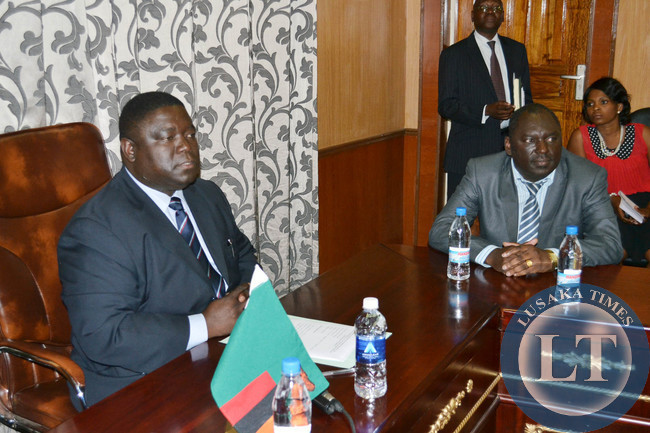
Transport, Works, Supply and Communications Minister Yamfwa Mukanga
(left) addresses new Zambia Railways Board members at his office as
the new Board Chairperson Davies Chama looks on in Lusaka

GOVERNMENT has refuted reports that the Tanzania-Zambia Railway Authority (TAZARA) – the joint venture between Tanzania and Zambia – will end on August 1 this year to allow the two countries operate separate railway firms.
Minister of Transport, Works, Supply and Communications Yamfwa Mukanga said the reported pronouncement by Tanzania is not what was discussed at a recent TAZARA Council of Ministers meeting in Lusaka.
Mr Mukanga, however, said if that is what Tanzania wants, Zambia is able to operate an independent entity.
 
Last edited by a moderator:
East African Eagle

This article was authored by one Dr. Wolfgang. It was not written by COW so you need to direct your energies to the author. As for the standard gauge railway, that is a different matter which we could debate in another thread. Avoid going off topic.
 
Last edited by a moderator:
Tanzania confirms TAZARA split, Zambia not aware

Tanzania wants TAZARA operations to be decentralized not centralized in Zambia to make the Railway profitable in both sides. Decision will be made soon officially.
 
Nimesoma kidogo ntarudi baadae...lakini wanaweza kuwa na reason ya kukataa...haya ya 'leave coal in the hole and oil in the soil' ukiyafuata kichwa kichwa nchi itadumaa... wao huko kwao waliharibu mazingira mpaka wakatajirika ndio wakaanza fikiria protection..

Wana mazingira ni watu wa kuwasikiliza with caution...hata developed countries wanawajua propaganda zao hao so called environmentalists...and they don't take them seriously ...

ndio ,mambo ya ku protect tembo kwa kuua binadamu...yani uhai wa tembo ni muhimu kuliko wa binadamu...
 
This article was authored by one Dr. Wolfgang. It was not written by COW so you need to direct your energies to the author. As for the standard gauge railway, that is a different matter which we could debate in another thread. Avoid going off topic.

There are writers out their who write on behalf of others for a fee.When you read between the lines you can know that he wrote sitting on whose chair even if his name is DR.Wolfgang or whoever.
 
this is all about arusha - musoma highway through the ngorongoro!!!
 
This article was authored by one Dr. Wolfgang. It was not written by COW so you need to direct your energies to the author. As for the standard gauge railway, that is a different matter which we could debate in another thread. Avoid going off topic.

Don't split Tazara, China warns Dar

ico_plus.png
Share
ico_bookmark.png
Bookmark
ico_print.png
Print
ico_email.png
Email Rating

tazara.jpg
A Tazara train during a stopover while travelling between Dar es Salaam and Kapiri Mposhi, Zambia. PHOTO | FILE
By Songa wa Songa, The Citizen Reporter

Posted Monday, August 4 2014 at 08:43
In Summary

  • He said China was ready to provide financial and technical support, but on condition that the two countries come up with a comprehensive rehabilitation and management proposal that would see the railway effectively run jointly by Tanzania and Zambia, and not separately as was recently decided.


Dar es Salaam. The government of China has expressed readiness to finance reconstruction of the struggling Tanzania and Zambia Railway Authority (Tazara) if the firm is to be managed jointly as originally envisaged.

Speaking to The Citizen in an exclusive interview in Dar es Salaam on Friday, the Chinese ambassador to Tanzania, Mr Lu Youqing, said Tazara is not only a symbol of friendship between his country and Tanzania and Zambia; it is also an important economic infrastructure that should not be allowed to disintegrate.

He said China was ready to provide financial and technical support, but on condition that the two countries come up with a comprehensive rehabilitation and management proposal that would see the railway effectively run jointly by Tanzania and Zambia, and not separately as was recently decided.

Money is not a problem so far; the problem is rather, the apparent lack of a joint sustainable and achievable plan, which China would be happy to support.

"Today we are in a much better position to support Tazara; in 1965 when we agreed to finance its construction, our per capita GDP was just $100 but now it is $6,000," he said.

The 1,860km long railway from Dar es Salaam to the town of Kapiri Mposhi in Zambia was built from 1970 to 1975 with financial and technical support from the People's Republic of China and has since been managed jointly by Tanzania and Zambia.

But due to dwindling business and management woes, early July this year, the partner governments reportedly agreed that each country would take care of its side of the railway network.


The minister for Transport, Dr Harrison Mwakyembe, announced in Dar es Salam that Tanzania would oversee the operations between Dar es Salaam and Tunduma while Zambia would administer operations between Tunduma and Kapiri-Mposhi, a strategy aimed at improving Tazara performance within the next three months.


Regional managers for both sides would be in charge of the new system and their performance would be evaluated at the end of this period, he said.

The Zambian government promptly responded by distancing itself from Dr Mwakyembe's statement and insisted that the partner governments had not reached such an agreement and if anything, that was Tanzania's desire, not Zambia's.

Zambian minister for Transport, Works, Supply and Communications Yamfwa Mukanga, was quoted by Lusaka newspapers as saying the reported pronouncement by Tanzania was not what was discussed at a recent Tazara Council of Ministers meeting in Lusaka.

Mr Mukanga, however, said if that was what Tanzania wanted, the Zambian part of the railway was also ready to operate as an independent entity.

1 | 2 Next Page»
 
Tanzania wants TAZARA operations to be decentralized not centralized in Zambia to make the Railway profitable in both sides. Decision will be made soon officially.

Don't split Tazara, China warns Dar

ico_plus.png
Share
ico_bookmark.png
Bookmark
ico_print.png
Print
ico_email.png
Email Rating

tazara.jpg
A Tazara train during a stopover while travelling between Dar es Salaam and Kapiri Mposhi, Zambia. PHOTO | FILE
By Songa wa Songa, The Citizen Reporter

Posted Monday, August 4 2014 at 08:43
In Summary


  • He said China was ready to provide financial and technical support, but on condition that the two countries come up with a comprehensive rehabilitation and management proposal that would see the railway effectively run jointly by Tanzania and Zambia, and not separately as was recently decided.


Dar es Salaam. The government of China has expressed readiness to finance reconstruction of the struggling Tanzania and Zambia Railway Authority (Tazara) if the firm is to be managed jointly as originally envisaged.

Speaking to The Citizen in an exclusive interview in Dar es Salaam on Friday, the Chinese ambassador to Tanzania, Mr Lu Youqing, said Tazara is not only a symbol of friendship between his country and Tanzania and Zambia; it is also an important economic infrastructure that should not be allowed to disintegrate.

He said China was ready to provide financial and technical support, but on condition that the two countries come up with a comprehensive rehabilitation and management proposal that would see the railway effectively run jointly by Tanzania and Zambia, and not separately as was recently decided.

Money is not a problem so far; the problem is rather, the apparent lack of a joint sustainable and achievable plan, which China would be happy to support.

"Today we are in a much better position to support Tazara; in 1965 when we agreed to finance its construction, our per capita GDP was just $100 but now it is $6,000," he said.

The 1,860km long railway from Dar es Salaam to the town of Kapiri Mposhi in Zambia was built from 1970 to 1975 with financial and technical support from the People's Republic of China and has since been managed jointly by Tanzania and Zambia.

But due to dwindling business and management woes, early July this year, the partner governments reportedly agreed that each country would take care of its side of the railway network.


The minister for Transport, Dr Harrison Mwakyembe, announced in Dar es Salam that Tanzania would oversee the operations between Dar es Salaam and Tunduma while Zambia would administer operations between Tunduma and Kapiri-Mposhi, a strategy aimed at improving Tazara performance within the next three months.


Regional managers for both sides would be in charge of the new system and their performance would be evaluated at the end of this period, he said.

The Zambian government promptly responded by distancing itself from Dr Mwakyembe's statement and insisted that the partner governments had not reached such an agreement and if anything, that was Tanzania's desire, not Zambia's.

Zambian minister for Transport, Works, Supply and Communications Yamfwa Mukanga, was quoted by Lusaka newspapers as saying the reported pronouncement by Tanzania was not what was discussed at a recent Tazara Council of Ministers meeting in Lusaka.

Mr Mukanga, however, said if that was what Tanzania wanted, the Zambian part of the railway was also ready to operate as an independent entity.

1 | 2 Next Page»

meanwhile the COW

[h=2]18[/h]
[h=5]Sep[/h]

[h=1]RVR commended on turnaround as it launches fleet of American built locomotives[/h]

Facebook
Twitter
Google+
Linkedin
Pinterest
Delicious


  • "Bright days ahead for railway sector": Cabinet Secretary Kamau
  • First major investment in locomotives on the Uganda-Kenya railway in 20 years
  • Governments reiterate commitment to support the concessionaire
Kenya's Cabinet Secretary for Transport, Eng. Michael Kamau with flag and Ugandan Minister of State for Transport Dr Stephen Chebrot (standing to his left) commission the first three of 20 American built General Electric locomotives acquired by RVR, today in Mombasa. The Locomotives are the first phase of a programme that will see the company more than double locomotive capacity by acquiring 34 new locos.


Barabara ya Arusha-Mwanza lazima ipite! Nyie wakenya mbona hamtukomi! Kama hatutaki kitu hatukutaki! Nyie kifanyeni kivyenu under CoW....! Mbona barabara ya Nairobi-Mombasa na Arusha-Voi zote zinapita katikati ya mbuga za wanyama lakini kwa vile zinawafaidi hampayuki! Koborer waltham
Capture1.JPG
 
Last edited by a moderator:
Quote: There ain't really much I hear that's poppin' off without us-DRAKE. Sounds about right.
 
ralphtz

ruhusa ya kupayuka ipo, indelea kaka.
 
Last edited by a moderator:

Why Tanzania said No to EAC protocol on the environment


By ADAM IHUCHA, TEA Special Correspondent

N SUMMARY


  • Tanzania says the protocol — which has already been ratified by Kenya and Uganda — contradicted the one on a Common Market as it seeks to regulate trading in minerals.
  • It also wants tourism removed from the protocol, saying this would be better articulated under another accord the partner states are negotiating on tourism and wildlife management.
  • Tanzania’s position has left the EAC in a quandary since there are no clear procedures for addressing reservations on protocols that some partner states have ratified but are yet to come into force.

Tanzania has scuttled the East African Community’s bid for a binding agreement on handling shared resources, such as Lake Victoria and wildlife reserves, after it refused to sign a protocol on environment and natural resources management.

This leaves the region without a framework to address long-standing conflicts over use of cross-border resources such as Lake Victoria and the Mara-Serengeti tourism haven or scarce water and pasture.

In a letter to the EAC Secretariat, dated September 4, Tanzania said the protocol — which has already been ratified by Kenya and Uganda — contradicted the one on a Common Market as it seeks to regulate trading in minerals.

“The Protocol contradicts the protocol on establishment of the EAC Common Market. In particular access to and use of land and premises should be governed by national policies and laws,” Tanzania stated in the letter to EAC Secretary General Dr Richard Sezibera.

Tanzania also said the protocol included provisions on marketing and trading in minerals while it should have restricted itself to protection of the environment in mining activities.

It also wants tourism removed from the protocol, saying this would be better articulated under another accord the partner states are negotiating on tourism and wildlife management.

“The protocol includes development and transmission of electric power, development of integration policy on rural electrification and inter-connection of partner states electric grids, which is beyond environment and natural resources management,” stated the letter presented during last week’s Council of Ministers meeting in Arusha.

The meeting, chaired by Kenya’s Cabinet Secretary for EAC Affairs Phyllis Kandie, resolved that the council would revisit its previous decision on the matter in order to address Tanzania’s concerns. The council directed the Secretariat to study the issues raised and submit proposals at the next meeting.

During its meeting in May, the council had ordered Tanzania to ratify the protocol, signed in 2005, by the end of this year. The protocol was negotiated before Burundi and Rwanda joined the community.

Tanzania’s position has left the EAC in a quandary since there are no clear procedures for addressing reservations on protocols that some partner states have ratified but are yet to come into force.

“In my view, the best way is to redraft the protocol and confine it to trans-boundary aspects of the environment in particular the shared water body and ecosystems while leaving state members to take care of other matters. This is in line with the principle of permanent sovereignty over natural resources,” Environmental and Natural Resource laws lecturer at Tumaini-Makumira University Elifuraha Laltaika told The EastAfrican.

He added that the protocol was a bit stretched, given the level of integration where land issues are highly contentious.

Although council decisions are binding on partner states, revisiting the previous decision was meant to enable partner states to renegotiate the contentious provisions. Kenya and Uganda were asked to submit any issues they may have with the protocol to the Secretariat.

“The Council directed the Secretariat to convene a meeting of the Sectoral Council on Environment and Natural Resources to study the issues raised by Tanzania and other partner states and submit proposals to the 30th meeting of the council for consideration,” a communiqué from the Secretariat said. The meeting is scheduled for November.

The other option would have been for Tanzania to ratify the protocol and seek amendments later, a course flatly dismissed by Tanzania’s EAC Affairs Deputy Minister Dr Abdallah Saadala.

“The parallel is telling someone to go to hell first and then be shifted to heaven,” Dr Saadala.

The protocol would provide directions on how to administer trans-boundary environment and natural resources for mutual benefits and address conflicts arising from their use.

Previously, some countries in the region have quarrelled over shared resources.

For example, Tanzania and Malawi have been involved in border dispute in Lake Malawi that started in 2012.

Again, since 2008, Kenya and Uganda have been involved in ownership dispute over Migingo Island on Lake Victoria.

Recently, on August 28, Somalia filed a case against Kenya at the International Court of Justice for violation of its territorial waters by entering into agreement with foreign oil companies to explore oil and gas in the Somalia waters in the Indian Ocean.

source: Why Tanzania said No to EAC protocol on the environment - News - www.theeastafrican.co.ke

cc Koborer, jMali, ralphtz, waltham, bona

 
JokaKuu

mambo ya tanzania haitaji mjadala, tumewazoea. wapewe nafasi wakizinduka watarudi kufuata mkondo wa maji, kila siku wanaomba kubebelezwa, nafasi wapewe
 
Last edited by a moderator:
mambo ya tanzania haitaji mjadala, tumewazoea. wapewe nafasi wakizinduka watarudi kufuata mkondo wa maji, kila siku wanaomba kubebelezwa, nafasi wapewe!!!!!!

Watanzania wa sasa wabembelezwe? Nyerere alipowaambia tuungane East Africa akiwa tayari hata kuachia uraisi mkamwona mjinga pamoja na kuwabembeleza kote.Mkaendekeza dharau kwa Tanzania na wanasiasa wa tanzania na watanzania kwa ujumla.Kosa lile lile mlilofanya mnaendelea nalo hadi leo.
.
Wakati ule ilikuwa rahisi sana wakenya na waganda na wanyarwanda na warundi kuwadanganya watanzania na wakadanganyika sababu kiwango cha elimu cha watu kilikuwa chini mno.Ile ilikuwa oppotunity nzuri mno kwa watu toka nchi hizo kuitumia kukubali shirikisho la kisiasa na kuhamia kila kona ya tanzania.OPPORTUNITY HAS A TIME LIMIT.Nchi hizo wakamdharau nyerere wakakataa political federation wakati ule ambalo lingetatua matatizo yote ya ajira na ardhi na makazi kwa watu wa nchi hizo ambayo wanahangaika nayo sasa hivi.

Sasa hivi sio rahisi kizazi kilichopo ni cha wale wasiomjua kenyata,obote wala nyerere .Ni kizazi cha watanzania wengi wasomi na vichaa.Kuwaburuza sio rahisi na hata ukiwabembeleza sio rahisi.Ni kizazi chenye misimamo yao mikali na ndio kizazi cha wengi wenye Tanzania.Hivyo kwenye majadiliano yoyote ndani ya EAC nchi nyingine zitarajie changamoto kali kutoka kwa watanzania.Watanzania wa sasa sio wale wa miaka ya nyerere!!!!

Na ushauri wa bure mtanzania ukimdharau siku moja yeye atakudharau milele.Hata uje uombe samahani ulie kama paka hawana tabia ya kusamehe.Hivyo wale mnaodharau watanzania mnazidi ku-complicate mambo kwenye uhusiano wa Tanzania na nchi zenu na watu wenu.
 
mambo ya tanzania haitaji mjadala, tumewazoea. wapewe nafasi wakizinduka watarudi kufuata mkondo wa maji, kila siku wanaomba kubebelezwa, nafasi wapewe!!!!!!

Acha uwongo, ni nyinyi ndio ambao kila siku mnabembeleza Tanzania sio kinyume chake, we don't need you. Why can't you people go ahead without whining about us?
 
Back
Top Bottom