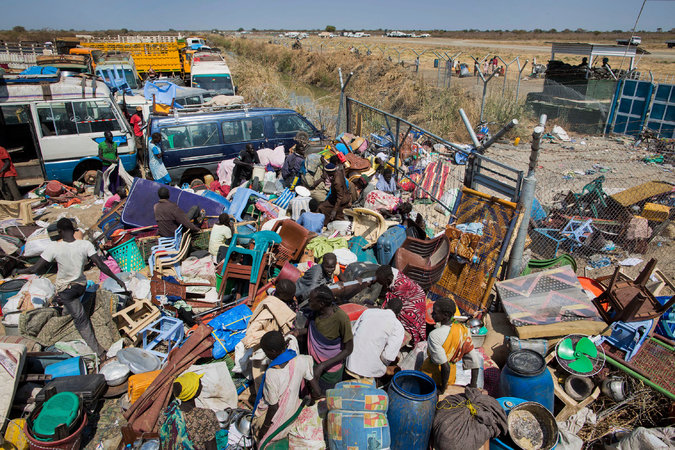
South Sudan burns as the whole world watches!

South Sudan burns as the whole world watches!

Ab-Titchaz

JF-Expert Member
Joined
Jan 30, 2008
Posts
14,630
Reaction score
4,267
South Sudan burns as world watches

_73899010_south_sudan_conflict_displ_464map_290314_v5.gif


Wednesday, April 23, 2014 - 00:00 -- BY AFP

JUBA: South Sudan's army yesterday said it was battling rebels in three key states, as insurgents blamed for massacring hundreds of civilians in attacks last week continued an offensive targeting oil fields.

The rebels seized the town of Bentiu last week, unleashing two days of ethnic slaughter as they hunted down civilians sheltering in mosques, churches and a hospital, according to the UN. A week after the fall of the capital of the key oil-producing state of Unity, government forces said they had been forced to pull out of another major settlement nearby amid furious rebel attacks.

"The battles have been very heavy in Unity state," army spokesman Philip Aguer told AFP, adding that troops made a "tactical withdrawal" from the town of Mayom, a strategic local centre made up of dusty roads and thatch huts, some 50 kilometres (30 miles) west of Bentiu.

South Sudan's army has been fighting rebels loyal to sacked vice president Riek Machar since the unrest broke out more than four months ago. The conflict has an ethnic dimension, pitting President Salva Kiir's Dinka tribe against militia forces from Machar's Nuer people.

"The fighting is ongoing, we are close by and will not let the rebels advance further," Aguer added, insisting that the army remained in control of major oil fields and the country's refinery, also in Unity state.
5.png


Bodies of South Sudanese killed at Bentiu being collected for burial. About 1,200 were killed by SPLM soldiers. ​

In Bentiu, the United Nations reported Monday one of the worst atrocities in the war-torn nation. Toby Lanzer, the top UN aid official in the country, told AFP after visiting Bentiu he had witnessed the "most terrible sight".

"There are piles of bodies lining the streets where they had been executed, in the market, outside and inside places of worship... the majority wearing civilian clothes," Lanzer said Monday.

Heavy fighting was also reported in the eastern state of Jonglei, and in Upper Nile in the northeast, with Aguer boasting the army had repulsed the attacks and killed scores of rebels.

"In Upper Nile... the number of rebels killed was 48," he said, claims that were not possible to independently verify.

"In Jonglei... the fighting was heavy but the rebels were fought back," he added. The conflict in South Sudan, which only won independence from Sudan in 2011 and is the world's youngest nation, has left thousands dead and forced around a million people to flee their homes.
5_0.png


Bodies of South Sudanese killed at Bentiu being collected for burial ​


The fighting has been marked by reports and allegations of atrocities by both sides, with ethnic massacres, child soldier recruitment and patients raped and murdered in hospitals by attacking forces. But the rebels rejected the accusations, turning the blame instead on the government.

"The government forces and their allies committed these heinous crimes while retreating," rebel spokesman Lul Ruai Koang said in a statement, while praising the "gallant forces" of the rebels.

"Claims that our forces are responsible is unfounded, cheap propaganda," he added. -


South Sudan burns as world watches | The Star
 

_74392517_74392513.jpg


More than a million people have since been forced from their homes since the conflict began.


_74380020_74380013.jpg


There has been recent fighting in Upper Nile, Unity and Jonglei states.


_74408423_021967491-1.jpg


The town of Bentiu has changed hands several times during the fighting.
​
 
S Sudan conflict: President Salva Kiir sacks army chief

_74408421_022012439-1.jpg


No official reason was given for the removal of Gen James Hoth Mai.

South Sudan's President Salva Kiir has sacked the head of the army.
A decree read out on state television announced that Gen James Hoth Mai would be removed with immediate effect. No reason was given.

The country has been in turmoil since December. Last week rebels seized the oil hub of Bentiu.

Meanwhile the UN has accused the government of providing "erroneous information" regarding a massacre of hundreds of civilians in the town.

South Sudan Minister of Information Michael Lueth was wrong to tell reporters that residents seeking protection had been barred from entering a UN base, the UN mission said in a statement.

After rebel forces captured Bentiu on 15 and 16 April, they targeted hundreds of people who had taken refuge inside a mosque, a church and a hospital, and killed them because of their ethnicity, the UN Mission in South Sudan (Unmiss) said.

"At no point did the mission ever turn away any civilians who came to its camp to seek protection and instead opened its gates to all unarmed civilians," it added.

Setbacks
Correspondents say last week's killings are among the most shocking since the conflict began.

BBC News - S Sudan conflict: President Salva Kiir sacks army chief
 
South Sudan conflict: UN denies turning away massacre victims

south-sudan-violence.jpg


UN human rights investigators say hundreds of civilians were killed last week when rebel forces seized the South Sudanese city of Bentiu. Observers say the killings were ethnically motivated, highlighting divisions between supporters of the president, a Dinka, and those favouring the former vice-president, a Nuer. (Mackenzie Knowles-Coursin/Associated Press)

Peacekeepers say number of people sheltering inside peacekeeprs' base rose from 8,000 to 22,500 in a day

The Associated Press
Posted: Apr 23, 2014 6:51 PM ET
Last Updated: Apr 23, 2014 7:10 PM ET


The United Nations mission in South Sudan accused the government Wednesday of spreading false claims that the UN camp near the scene of a massacre refused to shelter victims.

In a statement, the United Nations said South Sudan Minister of Information Michael Lueth was wrong to tell a news conference earlier Wednesday that residents seeking protection were barred from entering a UN base in the contested city of Bentiu. Many instead ended up in houses of worship, where hundreds were slain on April 15 and 16.


The UN mission denied it turned away any civilians at its camp in Bentiu. It said the numbers of people sheltering inside the base rose from 8,000 on April 15, when the killings started, to about 22,500 by Wednesday.

It added that UN peacekeepers helped rescue more than 500 civilians from the city hospital, where rebel soldiers on a killing spree had cornered them.

The UN also said that the minister, Lueth, was wrong to suggest that refugees were rebel fighters or sympathizers, and these remarks could encourage attacks on refugees inside UN camps.

Human Rights Watch called on the UN Security Council to investigate the killings in Bentiu and other deaths earlier in the month in Bor. The rights watchdog said the violence shows that ethnically motivated brutality against civilians is spiraling out of control.

The Security Council is scheduled to discuss the South Sudan bloodshed Wednesday.

Violence has been raging in South Sudan since mid-December. Much of the fighting has been along ethnic lines, with supporters of the president, a Dinka, pitted against supporters of the former vice-president, a Nuer.

The violence is only one part of a dual crisis in South Sudan, a landlocked country that gained its independence from Sudan in 2011.

Because of the fighting, more than one million people have fled their homes, and few residents are tending crops. UN officials say the country faces a severe risk of famine in the months ahead.


South Sudan conflict: UN denies turning away massacre victims - World - CBC News
 

952f1337-0398-42a1-a9f0-dd6565895d6e-620x413.jpeg


A boy sits in a truck carrying South Sudanese civilians from the country's border to Nyumanzi camp in northern Uganda. More than 81,000 refugees have arrived in Adjumani, Arua and Kiryandongo districts since the influx to Uganda began in December


4b488e9b-2e50-4d6e-8954-d2297c22f45d-620x413.jpeg


A woman and her children head to Dzaipi refugee camp by truck. A Red Cross volunteer from South Sudan, David Aliar, says he arrived the same way only a few weeks ago. "When you entered the truck you could step on another person. All you could think of was just to get to where you needed to be. It didn't matter that you had no air to breathe or couldn't sit, that's not the problem, so long as they bring you to where your life could be better," he explains.


3da30f82-358b-4419-91b7-b239e37dbfd2-620x413.jpeg


Girls carry their belongings from the South Sudanese border to the refugee reception centre. There are 65,500 refugees in Adjumani district, according to the UN refugee agency, UNHCR. Every day approximately 600 people arrive at the site.


bf31a488-4a8b-4450-8a93-d723365a73f1-620x413.jpeg


Children search for the names of relatives on the wall of the reception centre. Many youngsters are separated from their parents while escaping the war. "With no facilities available to house these children, younger ones are placed in the care of foster families while their parents are traced," says Akasa Adiges, who helps reunite families at the Adjumani branch of the Red Cross. "We are sometimes successful in our attempts to reunite families, but in some cases not."
​
 
567a23fa-d639-4b31-8ca6-9e9e6efc2608-620x413.jpeg


Refugees wait to be relocated from the transit centre to settlement camps. Facilities at the Nyumanzi camp are inadequate for the growing number of people being housed there. Water shortages and poor sanitation place refugee families at greater risk of disease.


1fade478-1c64-4651-a509-0641c241e169-620x413.jpeg


A volunteer with the Uganda Red Cross Society calls out the names of refugees waiting to board the truck. Relocation is on a first-come, first-served basis, and it can take up to a week for refugees to be allocated a settlement space


d7162f3d-d955-4b2f-8003-5e250c80186b-320x480.jpeg


A boy arrives alone at the transit camp. Children tend to suffer the most during conflict because they are often unable protect themselves from the effects of violence. The unlucky ones are separated from their parents and have no one to turn to for help. Many South Sudanese children have suffered this fate and are forced to endure the long journey to a place of refuge alone.
​
 
7a40b058-1cfc-4219-924e-d96179d37dc8-620x413.jpeg


Aliar helps refugees to contact family members by telephone. "Registering our people was not that easy, so I went to the base manager of the Ugandan Red Cross and volunteered to help the registration team," he says. "As a person from South Sudan it is easy for me to speed up the registration process by translating." .


0b41e433-5a3c-4281-b3e6-eadcb986f808-620x413.jpeg


Sarah Yach, 17, from Juba in South Sudan has recently entered Uganda with her family. Water is delivered to the camps in trucks and poured into tanks in strategic positions. There are a limited number of tanks and it takes Sarah more than an hour to collect enough water for cooking and cleaning.


9316b9dc-c31e-46d0-b753-79d31f1e9434-620x413.jpeg


Refugees wait for food rations to be handed out by the World Food Programme, which has resorted to emergency measures amid the escalating humanitarian crisis..


fc6c761c-59c0-43d8-a5cc-ce39ae4cce56-620x413.jpeg


Most refugees survive on just two bowls of porridge a day. '"Life here is not easy," admits Aliar. "The food is not enough."
​
 
cee90bfe-187a-45ec-a919-8138fa2d7bd3-620x413.jpeg


Approximately half the refugees are aged between three and 17. Schools have been set up in the camp, but not all children get the opportunity to study. Plan and similar humanitarian organisations are constructing child-safe areas for youngsters to play. .


696338e1-3979-4852-a561-927ea9dce6bd-620x413.jpeg


Hairdressers, grocery shops and solar-powered mobile-phone charging points have been set up in the camps by Ugandan and South Sudanese entrepreneurs. These sites foster a sense of normality and community at the site..


a29bd25d-f47f-4ae9-aa7c-a99969dffc05-620x413.jpeg


Nyiel Kuch, 16, came to the refugee camp with her mother and five siblings in December. "The place here is good, but the food is not enough for us," she says. "But we cannot complain; we don't have a choice. Even when it is cold, we don't have warm clothes to cover our backs, but we must keep quiet – we cannot complain."


3e668e6d-2f75-4b0a-8ee6-602d42bf0646-620x413.jpeg


Thon Garang digs a latrine for his family. Sanitation is one of the biggest challenges at the refugee camp, and there are growing fears the onset of the rainy season will exacerbate the problem. The lower part of Nyumanzi is in a flood plain and experts say the refugees may be forced to leave. "The area usually gets flooded and, in the worst case, it could mean the outbreak of serious waterborne diseases such as cholera," says the field manager for Plan in Uganda, Davies Okoko..
​
 
Bentiu massacre is game-changer in South Sudan conflict, says UN official

south-sudan-slaughter.jpg


David Smith
, Africa correspondent


theguardian.com, Tuesday 22 April 2014 13.03 EDT

UN says rebels slaughtered hundreds of people when they seized capital of Unity state, urged on by hate speech on radio

The UN's top humanitarian official said on Tuesday that a massacre in South Sudan fuelled by hate speech on a public radio station was a "game-changer" in the country's four-month conflict.

Toby Lanzer said he saw "piles and piles" of bodies on a visit to the oil hub of Bentiu after rebels wiped out civilians based on their ethnicity and nationality. TV pictures showed corpses lying outside a mosque and piled up on a mechanical digger.

It is probably the worst single atrocity since fighting broke out in the world's newest country last December, and raises the prospect of a full-blown civil war along ethnic lines, intensifying pressure on the international community to intervene.

According to the UN, rebels slaughtered hundreds of people when they seized Bentiu, the capital of Unity state, hunting down men, women and children who had sought refuge in a hospital, a mosque and a Catholic church. The victims included Sudanese traders, especially from the Darfur region.

The rebels issued a statement boasting of "mopping- and cleaning-up operations", the UN alleged, and fighters took to the radio to broadcast hate speech, urging men to rape women of specific ethnicities and demanding that rival groups be expelled from the town.

"Use of hate speech via a public radio station to incite violence is a game-changer," said Lanzer, who was in Bentiu on Sunday and Monday.

He said thousands of civilians were now streaming to the UN base in Bentiu fearing that more violence was imminent. The cramped base holds 25,000 people and has very little water and only one latrine per 350 people.
A rebel spokesman, Lul Ruai Koang, dismissed the UN accusations as "unfounded, cheap propaganda" and put the blame on government forces.

What began as a political power struggle in South Sudan quickly assumed an ethnic dimension, pitting President Salva Kiir's Dinka tribe against militia forces from the former vice-president Riek Machar's Nuer people.

Peace talks have failed to stem the flow of atrocities on both sides.

Donatella Rovera, a senior crisis response adviser at Amnesty International, who has just returned from the country, said: "Whatever the reasons this conflict broke out on 15 December – and there were obviously political grievances – from the first day it has taken on markedly an ethnic dimension. We saw this very clearly with the attack by opposition forces on Bentiu."

She said there was worse to come in terms of food shortages. "We're seeing two big killers in South Sudan. One is people being killed along ethnic lines. The other, that will kill even more people, is the unfolding humanitarian catastrophe. It's the planting season and no one is able to plant. This is going to be a larger catastrophe still and it is entirely down to the conflict."

The fighting has left thousands dead and forced around a million people to flee their homes. The government says its forces are currently battling rebels in three key states as Machar's fighters continue an offensive targeting oil fields. Peace talks are due to restart in neighbouring Ethiopia this month.

Oxfam International called for a ceasefire and a "massive injection" of emergency aid. Winnie Byanyima, its executive director, said: "How many lives have to be lost before the parties to the conflict silence their guns and donors responds with more resources? We either act now or face an even larger human catastrophe in the weeks and months to come."

The United States has threatened sanctions against those responsible for fuelling the conflict. Samantha Power, the US ambassador to the UN, said: "All responsible for South Sudan horrors and deliberately targeting civilians must be held accountable."

Bentiu massacre is game-changer in South Sudan conflict, says UN official | World news | theguardian.com
 
Haya ndo mambo waryoba anataka kutuletea hapa Tz.
 
South Sudan: World must act before it's too late


GADOAPR24.jpg


By Editorial


[h=3]In Summary[/h]
  • African leaders, therefore, must drop the reflex defence of their counterparts and accept that in the absence of local solutions, there is no option but international criminal jurisdiction in dealing with genocide and crimes against humanity.

It is just over a fortnight ago that leaders from across the region were joined by representatives from the global community in Kigali for the commemoration of the 20th Anniversary of the Rwanda genocide.

As chair of the East African Community, President Kenyatta used the occasion to apologise to the people of Rwanda for the abject failure of countries in the region to halt the genocide.

Similar messages of regret and contrition have been delivered by many other countries in Africa and beyond, as well as global organisations, including the United Nations, which admits it failed Rwanda.

As the world sat with folded arms, nearly one million Rwandans were slaughtered in a 100-day rampage. The apologies now may be heartfelt, but they will never undo the horror that a whole nation was subjected to.

Expressions of regret will only be meaningful if the message, "Never Again" carries real meaning, and is not just mouthed for television cameras.

It must mean that leaders from across the globe will act swiftly and decisively at the first signs of crimes against humanity anywhere.

Hence the urgency with which we must look at the disaster unfolding in South Sudan.

Africa's newest country has been in the throes of a cataclysmic breakdown since last December when fighting broke out between troops loyal to President Salva Kiir and rebels commanded by dismissed Vice-President Riek Machar.

With the threat of a new civil war in the offing, the regional development organisation bringing together countries in eastern Africa and the Horn, the Inter-Governmental Authority on Development (Igad), moved fast to call peace talks in Addis Ababa, the seat of the African Union.

A ceasefire deal was, indeed, signed in January, but continuing fighting means it has been treated with contempt by both sides. A plan to beef up the existing UN peace-keeping mission in South Sudan with the addition of more troops from neighbouring countries and further afield in Africa has not seen much progress.

INEFFECTIVE PLEAS

Meanwhile, things are going from bad to worse. The latest ethnic massacre in Unity State must spur Igad, the East African Community, the AU and the UN to move beyond making ineffective pleas. The people of South Sudan face mass murder, and require help now rather than apologies later.

This is the time for the regional blocs and the continental organisation to move speedily and send troops into South Sudan to protect civilians and separate the combatants.

Such a response will, of course, need the support of the wider international community through the United Nations.

President Kiir and Mr Machar must also be told in no uncertain terms that they will be held directly and personally accountable for any crimes committed by their forces.

African leaders, therefore, must drop the reflex defence of their counterparts and accept that in the absence of local solutions, there is no option but international criminal jurisdiction in dealing with genocide and crimes against humanity.

South Sudan: World must act before it’s too late - Editorials - nation.co.ke
 
We need to go and protect the civilians.
I want to .....
 
Haya ndo mambo waryoba anataka kutuletea hapa Tz.

Pumba hizi zaitwakiwsiha lini? Muundoa wa serikali ya Muungano wa Tanzania una uhusiano gani na ukabila wa Sudani, au ndiyo namna ya kutisha watu kama ambavyo CCM imezowea kutisha wanacahi kwa kisingizio cha Am,ani. After all tranzania leo siyo ya amani tena kwa sababu ya matabaka makubwa sana ya watu. Nyerere alifanikiwa kuunganisha watanzania wakati huo kwa kupiga vita matabaka ambayo yamkua kwa haraka sana tangu alipoondoka madarakani.


Tatizo kubwa la Sudani, kama ilivyo kwa nchi nyingi za kiafarika, ni kukosekana kwa uongozi unaojua kuheshimu makabila yote katika jamiihiyo. Tanzania tulibahatika sana kuwa na Nyerere. Majirani zetu wote wamekuwa na matatizo hayo hayop ya Sudani ingawa kwa viwango tofauti.
 
Back
Top Bottom