Ndege ya Malaysia A/line yapoteza mawasiliano

Ndege ya Malaysia A/line yapoteza mawasiliano

Australian Air Chief Marshal Angus Houston: "On the information I have available to me, there has been no major breakthrough in the search for MH370. I will provide a further update if, and when, further information becomes available' - ABC
 
Last edited by a moderator:
Australian Prime Minister Tony Abbott says authorities are 'confident' signals heard in search for missing jet are from black box - ABCnews
 
Last edited by a moderator:
Some experts are now suggesting that robots could be used to help find missing Flight MH370.

Prof Ian Wright, director of science and technology at the National Oceanography Centre, told the Guardian that the sea bed could be mapped using sonar from ships.

This could then provide a map to allow underwater robots to search for the wreckage.
 
A Royal Australian Air Force (RAAF) AP-3C Orion conducts a low level fly-by before dropping supplies to Australian Navy ship HMAS Toowoomba
 

Attachments

  • 1397278199285.jpg
    1397278199285.jpg
    53.9 KB · Views: 151
Mkuu jana PM katoa hotuba kwa confidence akiwa Beijing kuwa 'we are confident that we receive signals from the black box' leo story imekua tofauti. No more any signal aaah hii drama ama vip, leo siku ya 35
 
Mkuu jana PM katoa hotuba kwa confidence akiwa Beijing kuwa 'we are confident that we receive signals from the black box' leo story imekua tofauti. No more any signal aaah hii drama ama vip, leo siku ya 35

hiyo nina wasiwasi huenda isionekane tena maana mwezi tayari umeshakatika na jitihada zote za kuitafuta zimegonga mwamba
 
Malaysia jet search area proves too deep for robotic submarine; mission cut short - @AP
 
Joint Agency Coordination Center: Bluefin-21 last night completed a 6-hour mission looking for MH370. It exceeded its operating depth limit of 4,500 meters - @KJBar
 
Mini-sub prepares to start 2nd mission after first attempt to find for MH370 aborted - @AFP
 
10:49PM
Royal Navy ship HMS Echo is also involved in the search.

Speaking today, its commander told how the crew were working flat out in a bid to find missing Flight MH370.

As reported by the BBC, Cdr Phillip Newell said the search was "challenging".
 
9:11PM
The use of the drone will mark a new phase in the search for the plane.

It should be noted, however, that there is no guarantee of success and progress will be slow.

The drone travels at about walking speed, which will require search teams to be extremely patient.
 
7:07PM
One of the main reasons why the drone will now be used is because the black box batteries are way past their 30-day expected life.

They should have stopped working two weeks ago, however a number of pings have been heard in that time.

Rescuers will be reliant on- the drone's sonar and cameras in an attempt to finally find missing Flight MH370.
 
4:45PM
newsIcon
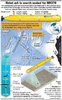
The infographic below takes a look at the Bluefin-21 and how it will go about scouring the seabed in the search area.

At an expected depth of 4,500m the sea floor in the area is deeper than where the Titanic now rests and where Air France flight 447, which crashed back in 2009, was eventually found.
 

Attachments

  • 1397538901460.jpg
    1397538901460.jpg
    92 KB · Views: 90
Missing Malaysian Airlines flight: How will the underwater Bluefin-21 search submarine work?

14 April 2014 03:47 PM By Ben-Burrows

With the search for MH370 now well into its second month, authorities are delving below the waves of the southern Indian Ocean for the first time
The search for the missing Malaysian Airlines plane is into its 38th day.

With a location now narrowed down to a relatively small area of the southern Indian Ocean, focus is turning to activity to below the waves.

After no sign of any further electronic pings for six days, the decision has been made to launch a remote submarine to scan the sea floor, some 4,500m below the surface, for debris.

But just how does an automated underwater vehicle, as it's known, work - and what likelihood is it that it will find the stricken MH370?

How does a sonar submarine work?

Bluefin-21 is a probe equipped with side-scan sonar.

Such technology uses acoustic sounds to create a picture of the sea floor.

After emitting a sound the submarine then waits to receive a response, before calculating the distance from those results. The submarine will cover about an area of around 40sqkm.

Each mission will last 24 hours, but only 16 of which will be spent on the ocean floor.

It will take two hours for it to descend to the depths and two more to return to the surface after scanning.
 

Attachments

  • 1397539097465.jpg
    1397539097465.jpg
    78.3 KB · Views: 86
How long will it take to process the information found?
Equipped with a 4GB flash drive the sub will create a 3D map of the sea floor in the hope of locating any debris.

It will reportedly take as many as four hours to download and analyse any data making it a full day from the moment Bluefin-21 enters the water to the time where it can be exactly established what is, or isn't, in the search area.
 
What is the terrain at the bottom of the sea like?
The bottom of the search area now being combed, while extremely deep - some 4,500m - is not especially mountainous.

That said, despite the area being generally flat experts have warned that the search will almost certainly be a long and painstaking process.
 
What happens if it finds the plane?

If Bluefin-21 detects any wreckage the vehicle will be fitted with a camera and sent back down again to within approximately 20 feet from the sea floor.

It will then attempt to capture photographs of the debris.

Should those photos then be verified as confirming the presence of wreckage of MH370, a remotely-controlled vehicle will be sent down in an attempt to recover it.

Remotely operated vehicles would be called in to assist but would need to be powered via cable from the surface.

These types of specialised pieces of equipment, capable of working at such incredible depths, are apparently few and far between.
 
Could a manned submarine go down and get the black box?

There are very few submarines in circulation that would be capable of descending to, and working at, a depth of as much as 4,500m.

Only a handful of countries own such craft too such as the US, China, Japan and Russi
 
What do we know about the mysterious oil slick

Mystery: We won't know anything regarding the oil slick until the sample is analysed
-
Australian ship Ocean Field spotted an oil slick only 5km from where the electronic pings were detected earlier this week.

A sample, around 2 litres, was collected for analysis but it could be days before it goes under the microscope and any more information can be gleaned from it.
 

Attachments

  • 1397539369628.jpg
    1397539369628.jpg
    77.1 KB · Views: 223
Back
Top Bottom