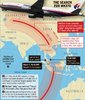
Ndege ya Malaysia A/line yapoteza mawasiliano

Ndege ya Malaysia A/line yapoteza mawasiliano

Utataji umegeukia kisiwa cha andaman inakohofiwa huenda maharamia waliosokomeza huko

Concerns:

There are now fears the plane was flown towards the Andaman Nicobar island

Mmh how comes? Andaman ni watu wasio na connection na dunia kbs iweje wateke ndege?
 
Mmh how comes? Andaman ni watu wasio na connection na dunia kbs iweje wateke ndege?

The issue with this island is that the Experts fear air pirates with flying knowledge hijacked the Kuala Lumpur to Beijing flight and diverted it towards the Andaman Islands in the Bay of Bengal.

One senior Malaysian police official said: “What we can say is we are looking at sabotage, with hijack still on the cards.”
 
Mmh how comes? Andaman ni watu wasio na connection na dunia kbs iweje wateke ndege?[/QUOTE

Geography and History Andaman and Nicobar Islands

The geography and history of Andaman and Nicobar Islands states that Andaman and Nicobar is one of the seven union territories of India, which was infamous as the 'Kalapani' during the British rule in India. The geography and history of Andaman and Nicobar Islands is a rich source of information on the the location, demography and the rich past of the Island.


The geography, constituting the first element of geography and history in Andaman and Nicobar Islands, maintains that Andaman and Nicobar is a conglomeration of about 570 islands, with Port Blair as their capital.

A brief estimate of the geography of Andaman and Nicobar Islands is as follows:
Area - 8249 square kilometers.
Area of Andaman district - 6498 square kilometers.
Area of Nicobar district - 1841 square kilometers.
Latitude - 6° to 14° North.
Longitude - 92° to 94° East.
Height - Sea level to 732 meters.
Highest point - Saddle peak (732 meters) and Mount Thullier (642 meters).
Districts - 2.
Climate - Tropical.
Temperature - 31° C (maximum) and 23° C (minimum).
Forest area - 92%
Demography - 280,661 (1991 census).
Ethnic races - Onge, Sentinelese, Jarawa and Andamanes of the Negroid origin, and Shompen and Nicobarese of Mongoloid descent.
Languages - Nicobarese, Malayalam, Telegu, Tamil, Hindi, Bengali, etc.

The history of Andaman and Nicobar Islands suggests that the island was a covered with a tribal population until 1789. In 1789, the East India Company established a settlement in Andaman and Nicobar Islands, but was soon vacated in 1796.

It was in 1857, during the first war of Indian Independence that the island was used as a penal colony, which was known as 'Kalapani'. The convicts charged against some criminal offense against the East India Company was sent to Andaman and Nicobar Islands.

Moreover, during the Second World War, the island was recaptured by the Britishers who continued their administration in the islands till 1947, the year when India got its independence.

In fact, the Andaman and Nicobar Islands' geography and history is a rich store house that enfolds the topography and rich past of the Island.

Topography


Andaman and Nicobar Island topography shows a typical character, with the presence of a number of islands in a long and broken chain. The topography of Andaman and Nicobar Islands appears to be a north-south arc, situated between the 16° and 14° latitude, and 92° and 94° East longitude.

The topography of Andaman and Nicobar Islands is, geologically, a part of land mass of South-east Asia, including Malaysia, North-east India, Burma, Thailand and Indonesia.

Andaman and Nicobar Islands contains a group of 3000 islands, which includes both islands and islets in the archipelago. Ritchie Archipelago and Labyrinth Islands are the two important islets in Andaman and Nicobar Islands. The topography in Andaman and Nicobar Islands comprises of a long range of hills with evergreen forests. The islands holds a series of ridges and mountains, with moderate elevation and slopes: flat lands are sparse in Andaman and Nicobar Islands.

A snap-shot at the Andaman and Nicobar Islands topography is as follows:
Altitude:
Saddle Peak (Andaman Islands)-732 meters.
Mount Thullier (Nicobar Islands)-642 meters.
Length and Breadth of the Andaman Islands:
Length-467 kilometers.
Width-52 kilometers.
Length and Breath of the Nicobar Islands:
Length-259 kilometers.
Width-58 kilometers.
Biggest Island:
Middle Andaman Islands (Andaman group)-1536 square kilometers.
Great Nicobar Islands (Nicobar group)-1045 square kilometers.
Smallest Island:
Ross Island (Andaman)-0.8 square kilometers.
Pilomillow Island (Nicobar)-1.3 square kilometers.
The topography at Andaman and Nicobar Islands maintains that the Islands comprises of North Andaman, Middle Andaman, South Andaman and Little Andaman in the Andaman group of islands, and Great Nicobar, Car Nicobar, Nancowry, Katchal and Chowra in the Nicobar group of islands.

Area

Andaman and Nicobar Islands area is 8249 square kilometers. The area of Andaman and Nicobar Islands comprises of the islands such as North Andaman, Middle Andaman, South Andaman, Baratang, Little Andaman and Car Nicobar.


The area at Andaman and Nicobar Islands houses two distinct groups of islands, viz. Andaman and Nicobar. The area in Andaman and Nicobar contains about 3000 islands, including islets and rocks in the archipelago. The area of Andaman and Nicobar Islands includes Landfall islands in the north; whereas in the south, the area extends up to Great Nicobar.

A short estimate on the area of Andaman and Nicobar Islands is as follows:
Total area - 8249 square kilometers
Area of Nicobar district - 1841 square kilometers
Area of Andaman district - 6408 square kilometers
Area of the rural regions - 8232.36
Area of the urban regions - 16.64

Moreover, the area of Andaman and Nicobar Islands comprises of a variety of beaches, picnic spots, monument, islands, museums, etc :

1. Beaches:

Harminder Bay Beach,
Ramnagar Beach,
Radhanagar Beach,
Corbyn's Cove abd Chirya Tapu,
Karmatang Beach, etc.

2.Islands:

Red Skin Island,
Cinque Island,
Havelock Island,
Ross Island,
Jolly Buoy,
Barren Island, etc.

3.Picnic Spots:

Corbyn's Cove Tourism Complex,
Mount Harriet,
Chidiya Tapu, etc.
Monument:
Cellular Jail.

4.Museums:

Anthropological Museum,
National Memorial,
Fisheries Museum, etc.

Thus, the Andaman and Nicobar Islands area comprises the entire domain that falls under the jurisdiction of the Andaman and Nicobar Islands.


Soil and Vegetation


Andaman and Nicobar Islands soil and vegetation is favorable for tropical evergreen forest and semi-evergreen forests; in some regions, the soil and vegetation of Andaman and Nicobar Islands also supports tropical monsoon

Andaman and Nicobar Islands experiences a tropical climate, without any extremes except for the rains and thunder storms. Rainfall is common in the Islands, and is generally divided into two phases: May to mid September and November to mid December. Thus, the climate of Andaman and Nicobar Islands is highly favorable for the evergreen forest.

Moreover, it can be said that the soil and vegetation of any place is connect to each other. Therefore, the soil and vegetation in Andaman and Nicobar Islands is complementary to each other. The soil and vegetation at Andaman and Nicobar Islands supports the growth of epiphytic vegetation (plants that grow on other plants). In fact, the vegetation of Andaman and Nicobar Islands mostly comprise of ferns and orchids. The soil and vegetation of South Andaman is favorable for growing epiphytic plants.

The vegetation of Middle Andaman mostly includes moist deciduous forests. The monsoon rains of Andaman and Nicobar Islands largely supports the deciduous type of vegetation in the Andaman and Nicobar Islands. Further, the vegetation of North Andaman is characterized by wood climbers: the type of vegetation found here is moist evergreen type. In Nicobar islands, the vegetation is devoid of evergreen forests. In fact, the Nicobar islands are characterized by grasslands. The vegetation of Nicobar islands is, further, marked the absence of deciduous forests.

Another aspect of vegetation in Andaman and Nicobar Islands is that throughout the length and breadth of the islands, the coastline is dotted with coconut trees. The entire fringe of the island is outlined with coconut trees.

Therefore, Andaman and Nicobar Islands soil and vegetation shows a distinct pattern with the prevalence of evergreen and deciduous forests in some areas, and grassland in some others.


British Regime


The British regime in Andaman and Nicobar Islands had a great impact during the 19th century. It was in the 19th century that the East India Company established a Cellular Jail in Andaman and Nicobar Island.

The British regime of Andaman and Nicobar Islands falls under the modern history of the Andaman and Nicobar Islands, which began in 1788. In 1788, Lord Cornwallis, the governor-general of India, sent Lieutenant Archibald Blair and Lieutenant R. H. Colebrook to find the suitability of the island for housing the British Colony. On the recommendation of these two officers of the British regime in Andaman and Nicobar Islands that the first settlements were established on Chattam Islands, a small island near Port Cornwallis.

But after 1857, the British regime at Andaman and Nicobar Islands founded a penal settlement in Andaman and Nicobar Islands. The prison, which came to be known as Cellular Jail or 'Kalapani', was established with an intension to house the criminals, especially the rebels, charges against disloyalty towards the British Regime. In Andaman and Nicobar Islands, the British regime founded the first prison at Viper island, housing nearly 200 prisoners.

During this time, thousands of people were brought to the Andaman and Nicobar Islands, who led to live of exile. The prisoner brought in the Cellular Jail were kept under successive Superintendents, who tortured them gruesomely. The prisoners were made to suffer dire consequences for their revolt against the British Government.


Japanese Regime


The Second World War introduced the Japanese regime in Andaman and Nicobar Islands. On March 21, 1942, the Andaman and Nicobar Islands went under the Japanese regime.

In Andaman and Nicobar Islands, the Japanese regime remained in power from March, 1942 till October, 1945. The Japanese regime in the Andaman and Nicobar Islands maintained an amicable relationship with the aborigines at the initial level. In the years, succeeding their supremacy over the Islands, the Japanese regime at Andaman and Nicobar Islands had sympathy for the natives of the Andaman and Nicobar Islands; but, the scenario changed shortly.

With the passage of time, the Japanese regime of Andaman and Nicobar Islands became harsh and lost sympathy for them. This gave rise to series of revolt in the island territory. Situation was rendered worse when the Japanese regime became suspicious of the natives: the aborigines took this as a form of insult towards them, and so started rebellion against the erstwhile government.

The Japanese suspected the natives to have relation with the British, and so they tried to nip the problem in the bud. As a result, a fierce combat took place between the Japanese regime in Andaman and Nicobar Islands. Many innocent people of the Andaman and Nicobar Islands were killed in the combat: the Humfreygunj massacre is one such combat, which saw the death of many people.

But, the Japanese regime has also played a great role in making the natives of Andaman and Nicobar Islands self-sufficient. It was the Japanese regime that taught the aborigines of the Islands to grow crops and to use more and more land for cultivation. Moreover, the Japanese regime also constructed roads in Andaman and Nicobar Islands.

Thus, it can be said that the Japanese regime in Andaman and Nicobar Islands, played a great role in paving the way for a bright future.


The post independence period in Andaman and Nicobar Islands


The post independence period in Andaman and Nicobar Islands started with the end of the British Rule in India. It was on the 15th August, 1947 that India got its Independence and it is after this period that the post Independence period started in the Andaman and Nicobar Islands. In Andaman and Nicobar Islands, the post independence period marks the settlement of the Bengali community in the Islands. After the Independence, the Bengalis came to the Andaman and Nicobar Islands on the rehabilitation scheme of the Government of India. The rehabilitation program initiated by the Indian Government in 1949 continued till 1970s. During the post independence period of Andaman and Nicobar Islands, a number of Bengalis settled in the Andaman and Nicobar Islands.

However, it is noteworthy that most of the Bengalis who came to the Andaman and Nicobar Islands hailed from East Pakistan (now Bangladesh). The post Independence period was a period of social turmoil in East Pakistan; therefore, many Bengalis belonging to East Pakistan headed towards Andaman and Nicobar Islands.

The post independence period at Andaman and Nicobar Islands saw the rehabilitation of the Bengali community being distributed in the different parts of the Andaman Islands, viz. Middle, north and south. In the Nicobar Islands, settlers include ex-service who rehabilitated in the Islands according to the rules and regulations of the District Soldier, Sailor, Airmen Board.

These ex-servicemen settled in the Andaman and Nicobar Islands in 1969. Besides the Bengalis, many other communities of India also settled in the Andaman and Nicobar Islands: these communities include Tamilians, Marathis, Malayalis and Punjabis.

The post independence period in Andaman and Nicobar islands witnessed the enactment of a new legislation under a Chief Commissioner, who is nominated by the President of India. Further, on 12th November, 1982, the post of the Chief Commissioner was raised to the rank of Lieutenant Governor
 

Attachments

  • 1395008021077.jpg
    1395008021077.jpg
    49.6 KB · Views: 169
  • 1395008035719.jpg
    1395008035719.jpg
    47.7 KB · Views: 151
  • 1395008054817.jpg
    1395008054817.jpg
    104 KB · Views: 159
  • 1395008072514.jpg
    1395008072514.jpg
    49.3 KB · Views: 150
More updates:

WORLD NEWS
Search for Flight 370 Enters Daunting New Phase

Search Moves to Two Huge New Areas Spanning Bay of Bengal

KUALA LUMPUR, Malaysia—The search for Malaysia Airlines 3786.KU 0.00% Flight 370 expanded by thousands of miles in an operation of unprecedented scale, marked by a series of twists that have made the least likely scenarios the most credible.

The number of countries searching for the flight, which fell off radar March 8 en route to Beijing from Kuala Lumpur, doubled to roughly two dozen over the weekend. Searchers are now looking for debris more than 3,200 miles away from the point at which they believe the plane's transponders and another signaling system were deliberately turned off about an hour into the flight.

Malaysian authorities now say they believe foul play was behind the plane's vanishing, and police are investigating all crew and passengers on the flight as well as engineers who may have had contact with the aircraft before takeoff. Police searched the pilots' homes over the weekend, but Malaysia's transport ministry said there was no evidence so far linking the pilots to the plane's disappearance.

The search zone for Malaysia Airlines MH370 is expanding. How do planes and helicopters go about finding the missing flight. WSJ's Jason Bellini has #TheShortAnswer .

Satellite tracking suggests the plane likely traveled for hours and ended up along one of two possible corridors: one that stretches from northern Thailand to the border of Kazakhstan and Turkmenistan, and the other from Indonesia to the southern Indian Ocean.

"At this stage, both the northern and southern corridors are being treated with equal importance," Malaysian Defense Minister and Acting Transportation Minister Hishammuddin Hussein said.

Air-safety experts said there has never been a search for remnants of an aircraft spanning such a vast area.

"The enormous size of the air and sea fleet searching, and the number of countries involved—I haven't seen anything like it," said Harro Ranter, president of the Aviation Safety Network, a service that tracks air accidents.

Depending on how long the effort lasts and how extensive a region leaders of the search eventually want to cover, some early estimates are that it could end up encompassing nearly 300,000 square miles.

Air-safety investigators rely heavily on precedent to solve mysteries that surround air accidents. But in Flight 370's case normal procedures and investigative practices aren't applicable, several air-safety experts said, because the probe is focused on apparent deliberate acts by someone or a group whose motives remain unknown. And at this point, investigators have no clear-cut clues from any wreckage or debris.

"I've never heard of anything as wild as some of the data" coming out of this investigation, said Jim Hall, a former chairman of the National Transportation Safety Board.

According to Mr. Hall, "the only consistent thing is that every expert has changed his mind at least once" during the course of the investigation.

Malaysian and Japanese personnel take part in search operations. Reuters

In a development that could help narrow the search, five Asian nations over the weekend said their radar systems hadn't detected any sign of the Malaysia Airlines aircraft that has been missing for nine days. Indonesia, Myanmar, Thailand, India and Pakistan—which all might have been on the flight path of the wayward Boeing 777—said there was no sign the plane had flown over their territories.

"Such a large object could not have gone undetected," said one Indian military official in Port Blair in the Andaman Islands.

Still, investigators weren't willing to rule out the possibility that the plane and its 239 passengers and crew traveled over or near those countries.

The twin possible paths of the errant jetliner were derived from calculations using the jet's last known position, speed and likely fuel consumption allowing investigators to determine where Flight 370 was last seen and where it might have later exhausted its fuel.

The only aviation search that even approached the scope of the current effort, according to government safety officials and independent experts, was the hunt for debris after the 2003 breakup of the space shuttle Columbia as it re-entered the atmosphere over Texas. Debris collected from the Columbia disaster, which killed seven astronauts, amounted to 84,000 separate pieces. Remnants of one liquid oxygen tank weren't found until eight years later.

Malaysian officials called together representatives of 22 countries Sunday and asked for assistance in tracking the plane's movements, including the countries along the two corridors where the search is now under way.

The nature of the search has changed," Mr. Hishammuddin said. "From focusing mainly on shallow seas, we are now looking at large tracts of land, crossing 11 countries, as well as deep and remote oceans."

The U.S. Navy over the weekend added more-advanced aerial surveillance assets and intensified the round-the-clock work from a Navy destroyer involved in the effort. Cmdr. William Marks, the spokesman for the U.S. Seventh Fleet, said an American P-8 Poseidon jet did a reconnaissance mission Sunday into the Andaman Sea and the Bay of Bengal. The P-8, which can fly 575 miles an hour, flew about 1,200 miles out into the search area and then began looking for about four hours, Cmdr. Marks said.

Australia's Chief Defense Force chief General David Hurley said Malaysian authorities coordinating the search had diverted an Australian AP-3C Orion maritime patrol aircraft to begin searching for the plane to the north and west of the Cocos Islands, an atoll midway between Australia's west coast and Sri Lanka.

Malaysia's leader says communications systems on Flight 370 were cut off by "deliberate action." U.S. officials are investigating whether a third system, on the plane's lower deck, was also compromised. WSJ's Jason Bellini explains. Image: AP

Establishing definitive information about what transpired on the plane may not end even if the so-called black box is recovered. The plane's digital cockpit-voice recorder saves only the last two hours of conversation and sounds inside the cockpit, so there won't be any data going back to the instant the transponder was turned off and the plane deviated from off its original flight plan.

Since the 1970s, the only other instance of someone in the cockpit shutting off an onboard signaling system related to a crash was the 1997 disaster involving a SilkAir Boeing 737 in Indonesia, which killed all 104 people on the plane. NTSB investigators concluded the most likely cause was that the captain pulled a circuit breaker that disabled the flight-data recorder and cockpit-voice recorder, before deliberately sending the plane into its fatal dive from 35,000 feet. Indonesian investigators concluded the probable cause was some type of mechanical failure.

Investigators have entered uncharted territory in trying to piece together what happened on Flight 370, melding information from satellite data and military data to figure out where the plane went. As that analysis began to illustrate the jet's sharp turn to the west, search teams expanded the search to into the Strait of Malacca toward the Andaman Sea, more than doubling the search area within days of the disappearance.

A week after the jet vanished, investigators had concluded the plane flew for more than six and a half hours from its last verified location.
 
Updates

Newspaper report: Missing jet flew as low as 1,500 meters to avoid detection ! - @tm_insider
 
BREAKING:

No trace of the plane has been found more than a week after it vanished but investigators believe it was diverted by someone with deep knowledge of the plane and commercial navigation.

End of alert
 
12:34AM
BREAKING NEWS: Israel last night tightened security in its airspace amid fears Malaysian Airlines flight MH370 could have been hijacked by terrorists.

Airliners heading towards the country will now be required to identify themselves much earlier in a sign Israel is taking the possibility of a terror attack using the missing plane seriously.
 
11:43PM
BREAKING NEWS: One of the pilots of the missing Malaysia Airways plane Fariq Abdul Hamid was planning to marry a fellow pilot from another airline, it had been claimed.

A report in the Sabah-based Daily Express said he was due to tie the knot with a Captain Nadira Ramli, 26, who is attached with AirAsia.

She is reported to be a daughter of a senior Malaysia Airlines pilot.
 
Members of the international press attempt to to get someone to speak to them in front of the house of Fariq Abdul Hamid, the missing Malaysian airliner's co-pilot.
 

Attachments

  • 1395037280487.jpg
    1395037280487.jpg
    112 KB · Views: 136
Hii ndege kama haijafanyiwa hujuma na wataalamu kwa faida yao, basi itakuwa imepotea kama kama zilivyowahi potea ndege zingine katika mazingira ya kutatanisha.
Mpaka leo imebaki historia tu, all in all ni kuendelea kuwaombea wawe salama na ndugu,jamaa na marafiki wapate nguvu katika kipindi hiki kigumu kwao.
 
It was confirmed Malaysian air force radar picked up traces of the plane turning back westwards, crossing over Peninsular Malaysia into the northern stretches of the Strait of Malacca. Another chilling theory suggested the plane could have been hijacked using a mobile phone or USB stick.Anti-terror expert Dr Sally Leivesley, a former Home Office official, believes the speed, altitude and direction of the aircraft could have been changed by sending radio signals from a device. She said: “It might well be the world’s first cyber hijack. There appears to be an element of planning from someone with a very sophisticated systems -engineering understanding.”

Malaysian Police inspector general Khalid Abu Bakar added: “The four areas of focus on the investigation are hijacking, sabotage, personal problem and -psychological problem. That includes ground staff.”

Investigators said there was no -suggestion Mr Shah and co-pilot Mr Hamid – who had allowed passengers on to the flight deck on previous trips – had specifically asked to fly together.

Officials are now certain the plane’s Aircraft and Communications Addressing and Reporting System was partially -disabled before it reached the east coast of Malaysia.

Soon afterwards, someone turned off its transponder, which communicates with civilian air traffic controllers. Aviation experts said it was -relatively easy to switch off most of the systems that track an aircraft. Traditional radar would still pick up a plane.

But pilots may still not know about every system that link with satellites.

This would explain how Flight MH 370 was still sending out “pings” despite everything else being off.
 

Attachments

  • 1395037734984.jpg
    1395037734984.jpg
    170 KB · Views: 172
The Note
Rep. Peter King: 'No Terrorist Chatter' on Missing Malaysian Flight

Mar 16, 2014, 8:48 PM
by
BENJAMIN BELL benjaminbell

This morning on "This Week," House Intelligence Committee member Rep. Peter King, R-N.Y., told ABC's George Stephanopoulos that there has been no "terrorist chatter" picked up by the United States relating to missing Malaysia Airlines Flight 370, which vanished nine days ago after leaving Kuala Lumpur headed toward Beijing.

"There's nothing out there indicating it's terrorists. Doesn't mean it's not, but so far nothing has been picked up by the intelligence community from day one," said King, who chairs the House Homeland Security Subcommittee on Counterintelligence & Terrorism.

During the interview, King expressed dismay at the way the investigation has been handled by authorities in Malaysia, stressing the focus should have been on the pilot and co-pilot from the beginning.

"The fact is the FBI was not asked in. And you know these pilots they should have been - the pilot and co-pilot - should have been the focus from the start," King told Stephanopoulos. "That would be ordinary law enforcement investigatory procedures. The FBI could have been called to help that, Interpol could have been called in, our intelligence agencies."

"But my understanding is that Malaysia is not really cooperating at all, are very reluctant to lay what they have out on the table," King added.

When asked by Stephanopoulos what the next steps would be for U.S. authorities, King said the FBI and other U.S. and international investigators should be more involved.

"We have to use all our intelligence," King said. "I wish there was more FAA, NTSB, FBI involvement. I wish the FBI were over there."

"If this is going to be a criminal investigation as far as those, the pilot and the co-pilot, we should use as much international law enforcement as possible," King added. "The FBI is the best at that… again Interpol, a basic unit should be used. Malaysia, for whatever reason, has been resisting. There's obviously something with the pilot and the co-pilot and that has to be drilled down on."

King also expressed reservations on how quickly the two Iranians who boarded the flight with stolen passports were cleared of suspicion.

"Just the fact that they were there and written off so quickly as having any threat," King said. "I mean, why did they have to get on that plane to seek asylum? The fact that it was so easy for them to get on with stolen passports. It just creates a terrorist atmosphere. Having said that, there's nothing showing it. I just wouldn't rule it out now is all."
 

Attachments

  • 1395038882003.jpg
    1395038882003.jpg
    52.1 KB · Views: 133
Last edited by a moderator:
Hii ndege kama haijafanyiwa hujuma na wataalamu kwa faida yao, basi itakuwa imepotea kama kama zilivyowahi potea ndege zingine katika mazingira ya kutatanisha.
Mpaka leo imebaki historia tu, all in all ni kuendelea kuwaombea wawe salama na ndugu,jamaa na marafiki wapate nguvu katika kipindi hiki kigumu kwao.

No one thought a big Boeing B777 jet could vanish into thin air in this day of highly computerised flight decks, advanced satellite communications and 21st century tracking systems. The fact that it did has raised an endless array of questions that will have to be answered.
 
Malaysia Airlines: Blame game has yet to begin
Tom Ballantyne
Last updated: 4 hours ago
The autopsy into the mystery of Flight 370 will go down as a landmark period in the history of aviation safety.


Whatever the ultimate outcome of the investigation into the bizarre disappearance of Malaysia Airlines Flight MH370 with its 239 passengers and crew, the autopsy into the mystery will go down as a landmark period in the history of aviation safety. While the aircraft has not yet been located and with the probability it is now lying deep on the floor of the Indian Ocean, there has been no let-up in the flow of speculation and theories on what occurred as the flight made its way from Kuala Lumpur to Beijing. Pilot suicide,-Hijacking,--a mid-air catastrophic break-up of the plane at 35,000 ft. All of those have happened before.

A poliitical fanatic

What now seems certain, however, is that MH 370 did turn away from its course, fly back over peninsular Malaysia and head west or northwest, flying for up to seven hours before contact was finally lost. What also appears to be confirmed is that none of this happened by accident. Human hands, and ones familiar with the operation of the aircraft, were involved. Whether this was the pilot or pilots, or the crew operating under duress, remains to be seen. But there is mounting evidence that the flight Captain, a man with years of experience, was a political fanatic, a supporter of Malaysian Opposition leader Anwar Ibrahim. He had become increasingly angry about the Malaysian government's treatment of Ibrahim, including his jailing on what many believed were "trumped up" charges.

The reasons for his anger are unimportant. That he might take 238 souls with him if suicide was indeed the aim is difficult to comprehend. The question is: Why was this not discovered until nearly a week after the disappearance? Why had no-one rung alarm bells earlier and what regular psychological screening does Malaysia Airlines conduct on flight crew who hold in their hands the lives of thousands of people annually?


If indeed the pilot was involved, and this still remains a matter of speculation, another issue is raised. The aircraft transponder, which identifies it to air traffic control and provides such information as altitude and location, was turned off. So were the flights two normal communications systems, apparently 14 minutes apart. All of this essentially made the plane invisible, except to primary radar which would see it merely as a "blip" on the screen without any identification. The insistence of pilots in having final manual command of aircraft systems is well known. They don't want to be told "don't touch". But should they have the ability to turn off a vital location and information device such as a transponder? Should they have the ability to turn off communication systems?

Unidentified aircraft approaching

This aspect of the flight raises other questions. Even without its transponder the plane was clearly seen, though not identified, by Malaysian military radar. Yet nothing was done about it. No aircraft was scrambled to see what this mystery object was. In its long hours of flight to the west of Malaysia, was it seen by other military radar, such as India's, or if it flew north-west, by Thailand or even China. It is difficult to believe any of these countries, seeing an unidentified aircraft approaching or entering their airspace, would not have done something to find out what it was.

Another issue which will have to be reviewed by the industry is how data from the aircraft was transmitted to the ground during its flight. Details of engine performance are transmitted at regular intervals from modern aircraft to the engine manufacturer so they can keep track of what is happening and thus inform the airline if they had any issues to deal with.

With today’s satellite networks, data on all aspects of the aircrafts systems could similarly be transmitted. With thousands of aircraft flying daily, this obviously involves a huge amount of data but the industry and regulators will have to look into how it can be done in a manageable way so that aircraft can't simply vanish into thin air. In the same way the current "black box" and cockpit voice recorder systems are outdated. Why should investigators spend millions of dollars recovering these items, particularly if they ended up under hundreds of metres of seawater. In today’s world it is feasible for the information they collect to be transmitted in real time to ground stations.

If chatter in the cockpit was being beamed to earth and collected in real time, we might now have a better idea of what happened on the flight deck of MH 370.

When the mud clears and the Malaysia Airlines aircraft is finally found - and most experts believe that is a matter of when, not if - from what will certainly go down as one of the greatest mysteries in aviation history, there will undoubtedly be a number of official inquiries, both within Malaysia and the airline industry, looking into not only the how but the why of what happened.

The blame game has yet to begin but hopefully the outcome will lead to an incredibly safe mode of transport becoming even safer. In the meantime, the long search of the remains of MH370, if that is indeed what the hunters are looking for, goes on.

With the aircraft's last position being some 2,200 nautical miles from its last known position and much of the search area being little more than guesswork, finding the plane remains the number one priority. The inquisition will begin later.

Tom Ballantyne is Chief Correspondent of the Hong Kong-published Orient Aviation magazine. He has 40 years experience in international journalism. He is a regular commentator on aviation issues on television and radio in Australia, Asia, the Middle East and the United Kingdom. He is also a speaker at numerous aviation conferences and seminars and the author of several travel books.
 
Ee Mungu wasidie ndg zetu hawa wapatikane wakiwa wazima hata kama wamechoka na kuchanganyikiwa kiasi gani, wape oyo mkuu. Watanzania tuwaombee wenzetu
 
Kisiwa hicho kinakaliwa na watu na kuna shughuli za kiuchumi km sehemu zingine

Mkuu wakazi wengi wa Andaman island ni indeginous andamans ila kuna wahamiaji wa kutoka South India huenda kwa karibuni ndio wamendelea but kulikuwa ni isolated world kabisa miaka kadhaa ilopita
 
MPENZI msomaji ungana nami katika simulizi hii mpya ya kweli inayohusu viumbe wa ajabu waishio angani. Hawa wanasadikiwa kuimeza ndege ya malaysia. Ikiwa unafuatilia kuwa awali nliezea kuhusu theory ya Bermuda Triangle katika upotevu wa ndege hii, hapa basi utawasikia hawa viumbe wa ajabu kama vile biblia inavyosema kuna vile viumbe visivyoonekana kwa macho yetu lakini vipo. Haya twende pamoja. Kama ni msomaji wa vitabu vitakatifu, Mungu aliumba vitu vinavyoonekana na visivyoonekana. Inahisiwa kuwa visivyoonekana ni vingi kuliko vinavyoonekana.

Viumbe hao wa ajabu waishio angani wanaitwa Aliens. Wana muonekano kama binadamu isipokuwa hawafanani moja kwa moja na binadamu. Viumbe hao waliogundulika karne kadhaa zilizizopita wameshatengenezewa filamu nyingi na wasanii mbalimbali duniani (tutazichambua huko mbele). Aliens wapo wa rangi tofauti kama kijani, weupe, weusi, njano, zambarau na kila aina ya rangi. Inaaminika kuwa Aliens wanaoishi angani wana akili nyingi kuliko binadamu. Wana mfumo wa kompyuta uitwao Alien Software na wapo juu kiteknolojia kuliko binadamu, tatizo tu hawavai nguo! Ngoma nzito hapo mkuu ndo maana rubani wa MH370 flight alipampana vilivyo wale jamaa wakazima switchi za mawasiliano kama upepo vile upulizavyo mshumaa.

Tofauti na binadamu ambaye anafanya kazi kwa hatua moja kwenda nyingine, Aliens wao hufanya mambo kinyume kabisa. Kwa mfano wakitaka kusema ‘naomba maji’ husema ‘maji naomba’ yaani cha nyuma kinakwenda mbele na cha mbele kinarudi nyuma. Kama tunavyowashangaa, nao pia wanatushangaa na kutuona viumbe wa ajabu.

Wachambuzi wa mambo ya anga walishaandika ripoti nyingi kuhusu viumbe hao ambao huja duniani na kurudi angani. Swali ni je, viumbe hao wanaishi katika sayari gani? Wataalam hao wanalijibu swali hilo kwa kusema haijulikani moja kwa moja wanaishi sayari gani lakini kwa uhakika siyo kwenye mwezi (kumbuka mwezi siyo sayari). Inawezekana bado hujaelewa simulizi hii. Bermuda Triangle ni eneo la pembetatu la bahari lililopo kati ya nchi tatu katika Bahari ya Atlantiki. Miaka kadhaa huko nyuma viumbe hao waliwahi kutua eneo hilo na kuweka historia (nitaisimulia huko mbele). Eneo hili limeshapoteza ndege sita sasa na hazijawahi onekana tena ikiwamo ya juzi Boeing 777 Malaysian Airliness Flight.

Pia waliwahi kuonekana Kisiwa cha Bermuda pwani ya Mashariki mwa Marekani, Kisiwa cha Puerto Rico kilichopo Kaskazini mwa Carrebian na Fort Lauderdale huko Florida, Marekani. Umewahi kusikia vitu mbalimbali duniani vikisemekana vimepotea katika mazingira ya kutatanisha? Aliens wanahusishwa na upoteaji wa meli baharini hasa za mizigo huku watu wakiamini huwa zinazama lakini uchunguzi ukifanyika meli hizo huwa hazionekani hata ndani ya maji baharini. Msiba wa Boeing 777

Aliens wanatajwa kuhusika na upotevu wa watu duniani ikiaminika kuwa labda watu hao walikufa lakini ukweli ni kwamba huchukuliwa na viumbe hao. Ndege za kijeshi zimeripotiwa mara nyingi kupotea au kutokuonekana milele katika eneo la Bermuda Triangle ikieleza kuwa Aliens ndiyo wahusika wa upotevu huo.Ujio wa Aliens katika eneo la Bermuda Triangle ulisababisha kisiwa hicho kupata umaarufu duniani na kupewa jina la Devil’s Sea (Bahari ya Shetani) ambapo binadamu wamekuwa wakiamini au kujenga imani potofu kuwa shetani amekuwa na makazi katika eneo hilo na kuwapoteza wasafiri wa majini. Wengine huhisi ni ushirikina.

Wapo binadamu wanaoamini kuwa Aliens walikuwepo duniani tangu enzi hizo kabla ya binadamu na hawajaondoka.Si sehemu hizo pekee lakini wamekuwa wakitua maeneo mbalimbali duniani na kuna baadhi ya serikali duniani zinawajua. Wataalam wa anga wanadai Aliens wako mbali kimaendeleo na wanafanya wanavyotaka. Hivyo basi kuhusu hiyo ndege wao ndo wajua wataifanyaje na hao walokuwemo.
 
Back
Top Bottom