Dr. Kwame Nkurumah
You are using an out of date browser. It may not display this or other websites correctly.
You should upgrade or use an alternative browser.
You should upgrade or use an alternative browser.
Dr. Kwame Nkurumah
- Thread starter MaxShimba
- Start date


MaxShimba
Platinum Member
- Apr 11, 2008
- 36,008
- 4,093
- Thread starter
- #2


<st1😛lace w:st="on" style="color: rgb(204, 204, 204); font-family: Arial, Tahoma, Helvetica, FreeSans, sans-serif; font-size: 15px; line-height: 20px; text-align: justify;"><st1😛lacename w:st="on"> Lincoln</st1😛lacename><st1😛lacetype w:st="on">University</st1😛lacetype></st1😛lace> Football Squad of 1939 -1941. Sitting: 2nd from Left Dr. Ebenezer Ako Adjei Standing: 1st from left Dr. Kwame Nkrumah

President of Ghana Kwame Nkrumah (1909 - 1972) with his wife Fathia Nkrumah (nee Rizk, 1932 - 2007), circa 1963


.jpg)

Fidel Castro and Ghanaian Pan-Africanist, Kwame Nkrumah

Mrs. Ruth Botsio (nee Whittaker, the beautiful and hard politician wife of Kojo botsio;Kwame Nkrumah;Mrs. Komla Agbeli Gbedemah. Caption: Premier of Ghana Kwame Nikrumah (C) walking with Mrs. Komla Gbedemah (L) and Mrs. Kojo Botsio (R) at the Ghana Liberation Ceremony. 01 Dec 1959
MaxShimba
Platinum Member
- Apr 11, 2008
- 36,008
- 4,093
- Thread starter
- #3

Note the PG symbol on the cap those three guys are wearing. The PG stand for Prison Graduates. It was a popular title for these freedom fighters.


MaxShimba
Platinum Member
- Apr 11, 2008
- 36,008
- 4,093
- Thread starter
- #4

7th March 1957: First Prime Minister of Ghana Dr Kwame Nkrumah (1909 - 1972) at the rally celebrating Ghanaian independence in Accra stadium in front of 50,000 Africans. He is joined by Governor General Charles Arden-Clarke and HRH Duchess of Kent. (Photo by Central Press/Getty Images)


MaxShimba
Platinum Member
- Apr 11, 2008
- 36,008
- 4,093
- Thread starter
- #8

In 1960, Ghana became a republic and Nkrumah, its president. Following a course of international neutrality and political cautiousness, he sought economic and technical aid from the U.S. and the Soviet Union. He visited New York to address the United Nations General Assembly. While there, he renewed old acquaintances and was welcomed by an enthusiastic audience that included Minister Malcolm X, Congressman Adam Clayton Powell, and Chuck Stone of the American Committee on Africa. (Africa was becoming an area of interest to Black Americans). At the UN, Nkrumah was very explicit in his remarks concerning the colonizers and the wretched conditions they created (and left) in Africa. He said in part, "....The flowing tide of African nationalism sweeps everything before it and constitutes a challenge to the colonial powers to make a just restitution for the years of injustice and crimes committed against our continent..... For years Africa has been the footstool of colonialism and imperialism, exploitation and degradation.... But Africa does not seek vengeance. Africa wants her freedom! It is a simple call, but it is also a signal lighting a red warning to those who would tend to ignore it."


MaxShimba
Platinum Member
- Apr 11, 2008
- 36,008
- 4,093
- Thread starter
- #13


The Duchess of Kent dancing with President Nkrumah


President Nkrumah and first lady Fathia

01 Jul 1958Prime Minister of Ghana, Kwame Nkrumah (C) with Amb. Daniel Chapman (2L) and Kojo Botsio who is the nation`s third chief director of ministry of Agriculture (2R) at Mt. Vernon
MaxShimba
Platinum Member
- Apr 11, 2008
- 36,008
- 4,093
- Thread starter
- #14

Date created: 01 Jul 1958
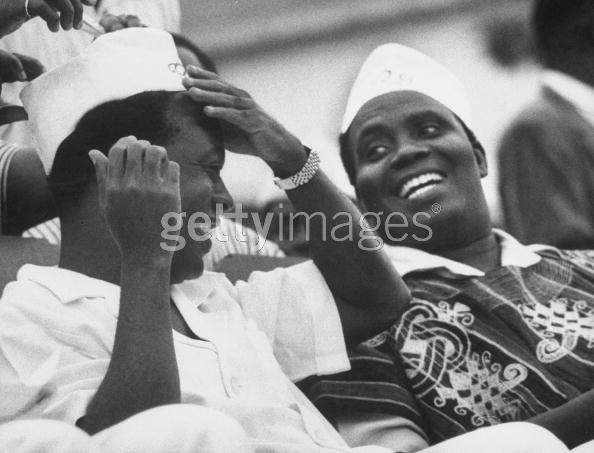

Prime Minister of Ghana, Nkrumah Kwame (C) with Komla Agbeli Gbedemah (2L) and Kojo Botsio (L) greeting embassy people.

Prime Minister of Ghana, Kwame Nkrumah (2R) with Amb. Daniel Chapman (R) and Kojo Botsio, (L, rear) at White House reception.
MaxShimba
Platinum Member
- Apr 11, 2008
- 36,008
- 4,093
- Thread starter
- #15

Emotions time at independence; 01 Mar 1957 (L-R) Ghana Politicians A. Caseley Hayford, Komla Agbeli Gbedemah, Kwame Nkrumah, Kojo Botsio, and Krobo Edusei at the Ghana independence ceremonies.


and Botsio were!!


MaxShimba
Platinum Member
- Apr 11, 2008
- 36,008
- 4,093
- Thread starter
- #16


12th November 1961: Kwame Nkrumah (1909 - 1972), the Prime Minister of Ghana with Queen Elizabeth II at a state banquet at the Ambassador's Hotel in Accra. Ghana in honour of the royal visit on the second day of the Queen's tour of the country. (Photo by Keystone/Getty Images)

Son of Alaska
JF-Expert Member
- Jun 2, 2008
- 2,812
- 1,070
History tells us,NKRUMAH was ahead of his time,and without doubt he puts all other african presidents,past and present in the shade.Africa is proud of this great son
MaxShimba
Platinum Member
- Apr 11, 2008
- 36,008
- 4,093
- Thread starter
- #18
As Tanzania celebrates the 50th anniversary of its independence, LSE's Dr Elliott Green looks at why the East African country has not achieved economic success in tandem with political stability.
Fifty years ago this month the country of Tanganyika became independent from the UK under the leadership of Prime Minister Julius Nyerere, who would become its first President a year later when it became a republic. The republic was later subsumed into the state of Tanzania when it merged with Zanzibar in 1964.
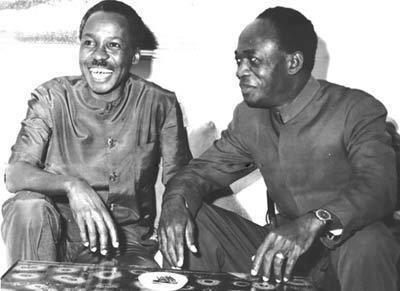
 Nyerere (left) with another independence leader, Kwame Nkrumah
Along with similar commemorations elsewhere in Africa, the 50th anniversary celebrations in Dar es Salaam and elsewhere have been met by mixed responses. An article in The Citizen, Tanzania's biggest English-language daily newspaper, was typical in asking why the country remains so poor and ordinary citizens' ‘dreams and hopes were shattered to smithereens.'
Indeed, poverty reduction and general human development in Tanzania has been slow since the late 1970s, even relative to other African countries. For example, its Human Development Index ranking has dropped from the 74th percentile (96th out of 130 states) in 1990 to the 81st percentile today (152nd out of 187 states), allowing such countries as Bangladesh, Ghana and Namibia to surpass Tanzania.
Tanzania's lack of economic success has not, however, overshadowed the country's political successes, namely its remarkable ability to avoid any of the violent political strife that has affected most of its neighbours. Tanzania went from a multi-party democracy to a one-party state and then back again with very little controversy, in part because its citizens kept electing leaders from the ruling TANU (now CCM) political party.
Despite continuing problems with corruption, Tanzania has nonetheless also avoided the tumultuous ethnic politics of most African states (except in Zanzibar). The strong nature of Tanzanian national identity is in fact legendary within Africa: when asked by the Afrobarometer survey whether they identified more with their national or ethnic identity, 88% of Tanzanian respondents chose the former, compared to a continent average of 42% and only 17% in Nigeria .
So why has the country been such an economic failure but a political success? Many commentators have attributed both outcomes to Nyerere's leadership. On the one hand, his efforts at ‘African socialism' led him to force peasants into ujamaa (Swahili for ‘familyhood') villages in the 1970s, which subsequently led to a decline in agricultural production as the state failed to ‘capture' the peasantry in Goran Hyden's famous phrase. (This period is covered well in Chapter 7 of James Scott's famous book, Seeing Like a State.)
On the other hand, however, Nyerere was adept at creating a sense of national identity by making Swahili the official language of government, moving the capital from Dar es Salaam to the more central location of Dodoma, and ending the policy of collecting data on ethnic identity in state censuses. In particular, education policy focussed on teaching nationalism to the youth: in a 1973 form 6 exam which I viewed in the National Library in Dar es Salaam, one typical question was, "discipline is a prerequisite of nation building. Comment on this with respect to Tanzania at present."
Personally I believe that Nyerere receives more blame and praise than he deserves for Tanzania's current state. (Read more of my thoughts on the subject) As regards economics, Nyerere's villagisation policies were in large part a response to the dispersion of citizens in rural Tanzania, often far away from transportation centres and ports. It is thus not an accident that other African governments in Ethiopia, Mozambique and Rwanda adopted similar rural policies more recently.
Similarly, none of Nyerere's nation-building policies were unique – those who praise his focus on Swahili as a national language tend to neglect similar efforts in Ethiopia, where Emperor Hailie Selassie declared Amharic as the national language, or in Somalia, where Siad Barre's government standardised the Somali script and made it the sole national language. Needless to say, a single national language did not prevent political fragmentation and civil wars in Ethiopia and Somalia.
In the end, Tanzania's post-colonial successes and failures, as with many other examples in Africa, are less the legacy of one leader than they are of deeper structural issues. Arguably the reason why Tanzanian nation-building was more successful was due to a lack of inter-regional inequalities.
More controversially, it is possible that the lack of industrialisation and economic development more generally is in part responsible for low levels of regional inequality. In other words, Tanzania's economic failures and political successes are tightly linked to each other, in many ways just like economic success and political failure have long been linked in Côte d'Ivoire.
Thus any attempt to summarise the past 50 years of Tanzanian development must come to terms with both its economic and political developments, and commemorations should focus less on the influence of Nyerere or any other one particular leader and more on the broader issues confronted by Nyerere and others in their efforts at promoting development.
Fifty years ago this month the country of Tanganyika became independent from the UK under the leadership of Prime Minister Julius Nyerere, who would become its first President a year later when it became a republic. The republic was later subsumed into the state of Tanzania when it merged with Zanzibar in 1964.
 Nyerere (left) with another independence leader, Kwame Nkrumah
Indeed, poverty reduction and general human development in Tanzania has been slow since the late 1970s, even relative to other African countries. For example, its Human Development Index ranking has dropped from the 74th percentile (96th out of 130 states) in 1990 to the 81st percentile today (152nd out of 187 states), allowing such countries as Bangladesh, Ghana and Namibia to surpass Tanzania.
Tanzania's lack of economic success has not, however, overshadowed the country's political successes, namely its remarkable ability to avoid any of the violent political strife that has affected most of its neighbours. Tanzania went from a multi-party democracy to a one-party state and then back again with very little controversy, in part because its citizens kept electing leaders from the ruling TANU (now CCM) political party.
Despite continuing problems with corruption, Tanzania has nonetheless also avoided the tumultuous ethnic politics of most African states (except in Zanzibar). The strong nature of Tanzanian national identity is in fact legendary within Africa: when asked by the Afrobarometer survey whether they identified more with their national or ethnic identity, 88% of Tanzanian respondents chose the former, compared to a continent average of 42% and only 17% in Nigeria .
So why has the country been such an economic failure but a political success? Many commentators have attributed both outcomes to Nyerere's leadership. On the one hand, his efforts at ‘African socialism' led him to force peasants into ujamaa (Swahili for ‘familyhood') villages in the 1970s, which subsequently led to a decline in agricultural production as the state failed to ‘capture' the peasantry in Goran Hyden's famous phrase. (This period is covered well in Chapter 7 of James Scott's famous book, Seeing Like a State.)
On the other hand, however, Nyerere was adept at creating a sense of national identity by making Swahili the official language of government, moving the capital from Dar es Salaam to the more central location of Dodoma, and ending the policy of collecting data on ethnic identity in state censuses. In particular, education policy focussed on teaching nationalism to the youth: in a 1973 form 6 exam which I viewed in the National Library in Dar es Salaam, one typical question was, "discipline is a prerequisite of nation building. Comment on this with respect to Tanzania at present."
Personally I believe that Nyerere receives more blame and praise than he deserves for Tanzania's current state. (Read more of my thoughts on the subject) As regards economics, Nyerere's villagisation policies were in large part a response to the dispersion of citizens in rural Tanzania, often far away from transportation centres and ports. It is thus not an accident that other African governments in Ethiopia, Mozambique and Rwanda adopted similar rural policies more recently.
Similarly, none of Nyerere's nation-building policies were unique – those who praise his focus on Swahili as a national language tend to neglect similar efforts in Ethiopia, where Emperor Hailie Selassie declared Amharic as the national language, or in Somalia, where Siad Barre's government standardised the Somali script and made it the sole national language. Needless to say, a single national language did not prevent political fragmentation and civil wars in Ethiopia and Somalia.
In the end, Tanzania's post-colonial successes and failures, as with many other examples in Africa, are less the legacy of one leader than they are of deeper structural issues. Arguably the reason why Tanzanian nation-building was more successful was due to a lack of inter-regional inequalities.
More controversially, it is possible that the lack of industrialisation and economic development more generally is in part responsible for low levels of regional inequality. In other words, Tanzania's economic failures and political successes are tightly linked to each other, in many ways just like economic success and political failure have long been linked in Côte d'Ivoire.
Thus any attempt to summarise the past 50 years of Tanzanian development must come to terms with both its economic and political developments, and commemorations should focus less on the influence of Nyerere or any other one particular leader and more on the broader issues confronted by Nyerere and others in their efforts at promoting development.


Similar Discussions
-

-

-
Ibyo wamenya kuri Dr Momar Dieng wagizwe Umuyobozi Mukuru wa RICA
- Started by Twin_Kids
- Replies: 0

