Hebu wewe kabla ya kukosoa jaribu kupitia uzi huu hizo source zimewekwa hadi missions walizofanya. Usijione unajua kumbe ni mtupu, waliyoweka rank ya intelligence agency hawakuwa wajinga hadi wawape nafasi ya kwanza. Hao CIA wenyewe walishawahi kuchezewa mchezo mchafu na ISI si mara moja
Wataalazmu wa mambo ya intelijensia naomba msaada wenu, uzoefu wangu ni wakusoma vitabu vya espionage ziwe za kitechnolojia, uchumi , kijeshi au za kisiasa zinazohusisha mataifa makubwa ulimwenguni zikiwemo nchi za Marekani, Ulaya ya Magharibi kama Uingereza, Ujerumani Ufaransa na hata zilizokua nchi za kisoshalist za Ulaya ya Mashariki ikiwemo Urusi na Mashariki ya kati Israel ikiwa kinara
Katika usomaji wangu nakuta mara nyingi Urusi inafanya mambo ambayo kiakili unaona hayawezekani. Utakuta Shirika la Ujasusi la Urusi wakati huo linaitwa KGB(sijui sasa linaitwaje) linaendesha (lina run) ma agent wa CIA na kuwafanya kua double agents, yaani CIA agents wanakua informers kwa faida ya Urusi! Tena sio ofisa mmoja wa CIA au wawili ni kwa makumi kama ambavyo Marekani nao wanakua na watu wao ambao wana wa run ma agent wa Kirusi!
Kwa upeo mdogo wa mambo haya niliyokua nao naona ajabu sana Marekani kufanyiwa kitu hiki na Urusi mpaka najiuliza au ni kwavile vitabu ninavyosoma vingi ni fiction labda maana wahusika na matukio ya kubuni tu? Urusi kama inavyofanya Marekani ina run ma agents wa Nchi za Magharibi na kuna wengine wana defect kabisa na kuhamia Urusi!
Bado najiuliza kuna power ya Russia ambayo sisi hatuijui ila Marekani wanaitambua na kuiheshimu?Au Amerika inakua overrated na Russia inalijua hilo kwa hivyo hawaigopi?
Hapa nimemaliza kusoma litabu cha Frederick Forsyth THE DEVIL'S ALTERNATIVE, THE FOUTH PROTOCAl. Hawa jamaa wanapelelezana na wanajuana na huwezi jua nani zaidi. Ila sema tu kitabu ni fiction so sijui ukweli ukoje. Kama kuna anejua atupe darasa wana JF
Kwa ujumla Russia hawazungumziwi sana ktk media hivyo asilimia kubwa ya watu kushindwa kufahamu mengi kuwahusu. Ila kwa miongo mingi marekani na washirika wake wamekuwa wakionekana ktk vita baridi na russia, hivyo hii inaashiria ya kuwa russia ana ubavu japo huwa haonyeshi nguvu yake ilipo.
Nikipata cha kukushangaza tena kuhusu Russia nitakuwa nakuwekea
-----
Safari ya kwenda ncha ya kaskazini kwenye joto chini ya hasi arobani Celcius. Safari ncha ya Kaskazini(north pole) mwa Dunia
Nikipata cha kukushangaza tena kuhusu Russia nitakuwa nakuwekea
-----
Safari ya kwenda ncha ya kaskazini kwenye joto chini ya hasi arobani Celcius. Safari ncha ya Kaskazini(north pole) mwa Dunia
Hawa warussi kuna kitu cha ziada...huwa nashangaa sana kuona nchi za magharibi wakiichambua na kuisema Urusi kwamba bado wamavifaa vya kizamani kwenye majeshi yake...karibu 70% ya military hard ware ni za kisoviet....lakin still bado mrusi huyohuyo anawaendesha...NATO muunganiko wa nchi 29 lkn kila siku wanalialia na uchokozi wa urusi.
Hivi siku ikifikia hawa warusi 90% ya military hardware zikawa updated itakuaje sasa....
Upinzani wa mashariki na magharibi nahisi utaendelea kwa miaka mingi sana...mpaka siku moja watatindikane...
FSB,SVR,GRU...na CIA watakua wako kwenye vita vikali vya chinj kwa chini.
But generally USA kiuchumi ananguvu sana....hivyo ni rahis sana kuwekeza kwenye watu na technologia kuliko warussi
Kwa ujumla Russia hawazungumziwi sana ktk media hivyo asilimia kubwa ya watu kushindwa kufahamu mengi kuwahusu. Ila kwa miongo mingi marekani na washirika wake wamekuwa wakionekana ktk vita baridi na russia, hivyo hii inaashiria ya kuwa russia ana ubavu japo huwa haonyeshi nguvu yake ilipo.
huo ndo ukweli. Ni aibu Taifa kubwa kama marekani kuwa analialia kila siku eti russia anadukua system zake za maji umeme na hata uchaguzi wa rais. great Shame
Wataalazmu wa mambo ya intelijensia naomba msaada wenu, uzoefu wangu ni wakusoma vitabu vya espionage ziwe za kitechnolojia, uchumi , kijeshi au za kisiasa zinazohusisha mataifa makubwa ulimwenguni zikiwemo nchi za Marekani, Ulaya ya Magharibi kama Uingereza, Ujerumani Ufaransa na hata zilizokua nchi za kisoshalist za Ulaya ya Mashariki ikiwemo Urusi na Mashariki ya kati Israel ikiwa kinara
Katika usomaji wangu nakuta mara nyingi Urusi inafanya mambo ambayo kiakili unaona hayawezekani. Utakuta Shirika la Ujasusi la Urusi wakati huo linaitwa KGB(sijui sasa linaitwaje) linaendesha (lina run) ma agent wa CIA na kuwafanya kua double agents, yaani CIA agents wanakua informers kwa faida ya Urusi! Tena sio ofisa mmoja wa CIA au wawili ni kwa makumi kama ambavyo Marekani nao wanakua na watu wao ambao wana wa run ma agent wa Kirusi!
Kwa upeo mdogo wa mambo haya niliyokua nao naona ajabu sana Marekani kufanyiwa kitu hiki na Urusi mpaka najiuliza au ni kwavile vitabu ninavyosoma vingi ni fiction labda maana wahusika na matukio ya kubuni tu? Urusi kama inavyofanya Marekani ina run ma agents wa Nchi za Magharibi na kuna wengine wana defect kabisa na kuhamia Urusi!
Bado najiuliza kuna power ya Russia ambayo sisi hatuijui ila Marekani wanaitambua na kuiheshimu?Au Amerika inakua overrated na Russia inalijua hilo kwa hivyo hawaigopi?
Hapa nimemaliza kusoma litabu cha Frederick Forsyth THE DEVIL'S ALTERNATIVE, THE FOUTH PROTOCAl. Hawa jamaa wanapelelezana na wanajuana na huwezi jua nani zaidi. Ila sema tu kitabu ni fiction so sijui ukweli ukoje. Kama kuna anejua atupe darasa wana JF
Like the CIA, the Soviet (and now Russian) spy agency known as the KGB has engaged in decades of secret operations across the world, ranging from blackmail to kidnapping. Most of the secrets that we know about the KGB today are because of one man—Vasili Mitrokhin. Mitrokhin was an archivist for the KGB for 30 years before he defected to the UK and handed over his 25,000-page archive of secret KGB files. Here are some of the KGB’s most disturbing and outlandish secret operations.
Featured image credit: Vladimir Fedorenko
Listverse - Daily Highlights
Sponsored by Connatix
10 Attacks On America’s Infrastructure
Photo via Wikimedia
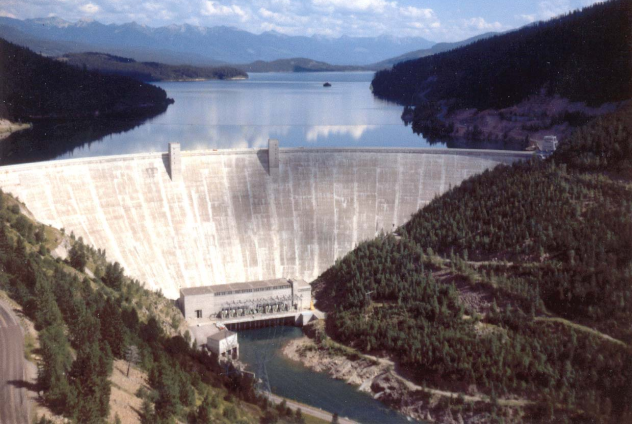
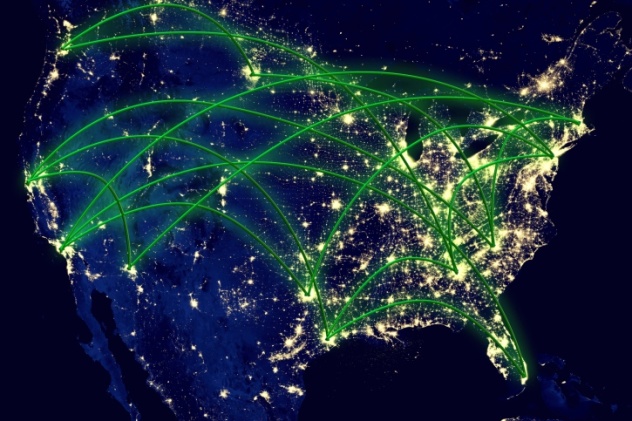
From 1959–72, the KGB began to photograph US power plants, dams, oil pipelines, and infrastructure for a nefarious operation that would disrupt the power supply to all of New York. Once they picked targets that they thought were vulnerable, the KGB set up a safe house near Harrisburg, Pennsylvania. From there, KGB agents sought to plan and carry out a series of attacks on America’s power systems.
Hydroelectric dams, which generate a significant portion of the US’s energy supply, were a target. The KGB formulated an elaborate plan to destroy two large hydroelectric dams, the Hungry Horse Dam and Flathead Dam, in Montana. Taking the two dams out of commission would cripple the power supply of the state and surrounding region. The attack was to begin 3 kilometers (2 mi) down the South Fork River from Hungry Horse Dam. The KGB planned to have operatives destroy power pylons on top of a tall mountain slope, which would be difficult to get back online, indefinitely knocking out power transmission from the dam. Then, the operatives were to seize the Hungry Horse Dam’s controls and destroy them. The attacks would have knocked out the power supply to all of New York state.
From the Soviet Union’s Canadian embassy, the KGB also planned to further disrupt America’s energy supply by attacking oil pipelines between Canada and the United States. The plot, called Operation Cedar, was planned for over a decade. The KGB even sought to destroy oil refineries in Canada, which supply a great deal of America’s gasoline.
All of the attacks on America’s power system were part of a larger scheme to attack New York City. Once they had knocked out most of the power in the United States with the earlier attacks, the KGB plotted to use the chaos and darkness to plant explosives on piers and warehouses along the Port of New York, a crucial harbor for America’s commerce and imports. 9 Hostage Crisis Retribution
In 1974, the KGB created an elite counterterrorism task force with the mysterious name “Alpha Group.” The Alpha Group was used by the KGB to carry out top secret and often dangerous missions for the USSR—and now Russia—including a bloody and vicious mission in Lebanon.
In 1985, the Soviet Union found itself with its first major hostage crisis after four Soviet diplomats were kidnapped in Lebanon by terrorists affiliated with an Islamic terrorist group. The kidnappers reportedly took the Soviets hostage to stop the USSR from giving support to Syria’s efforts in the Lebanese civil war, which the country was then embroiled in. After the Soviet diplomats were taken hostage, the kidnappers sent chilling photographs to news agencies of the hostages with guns to their heads. The terrorists demanded that the USSR force Syria-affiliated forces to stop attacking Iran-affiliated forces fighting in northern Lebanon, or the hostages would be executed.
Initially, the USSR was open to some form of negotiations with the terrorists to release the hostages unscathed. Things changed when the USSR didn’t seem to stop the Syrian forces’ involvement in the civil war, and the terrorists executed one of the hostages only two days after the initial demands were made.
That’s when the USSR abandoned negotiating, and the KGB took swift and bloody action. First, the KGB investigated what organization was behind the the kidnappings and found it to be the work of Hezbollah. That’s when the KGB did a bit of kidnapping of their own, snatching a close relative of a Hezbollah leader. They began to dismember him, castrating him and sending some of his dismembered body parts to the kidnappers of the Soviets. Soon after, the KGB killed the Hezbollah relative.
Then, the KGB sent the Hezbollah leader a message indicating that they knew of many more of his relatives and their whereabouts and warned that they would suffer the same fate if the hostages were not released. The Islamic terrorists holding the Soviets took notice and released the remaining three Soviet diplomats shortly after, entirely unscathed and without further demands.
8 Blackmail With Sex Tapes
The USSR had a plan for world domination. One country that the USSR sought to join their global communist rule was Indonesia. After the Indonesian Communist Party gained power with the help of President Sukarno, the USSR thought they would have an ally in the region. In order to ensure that Sukarno and Indonesia would remain allied with the Soviet Union, the KGB hatched a plan to get some dirt on Sukarno in case they needed to blackmail him to get their way.
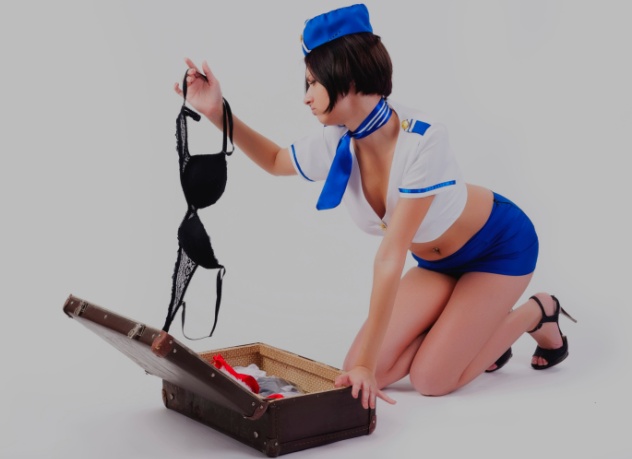
Sukarno had one weakness that the KGB thought they could use to their advantage—a legendary sexual appetite. They drew up a plan to blackmail President Sukarno worthy of an Austin Powers movie. They found a group of attractive young women whom they thought could exploit President Sukarno’s voracious sexual appetite. The KGB then dressed the women as airplane stewardesses and sent them to Sukarno’s hotel while he was visiting Moscow.
As you can imagine, President Sukarno engaged in sex with multiple pseudo-stewardesses at once, while the KGB recorded the entire wild night. However, things didn’t go according to plan when they later brought the videotapes to Sukarno in an attempt to blackmail him. President Sukarno not only said that he didn’t care that the KGB had taped the sex or that they threatened to release it to the public, he asked for more copies for himself.
The KGB’s sexual blackmail did work elsewhere. In 1956, they successfully created a honeypot for French ambassador Maurice Dejean, consisting of attractive women called “swallows” by the KGB. One of these swallows was said to have been a Russian actress. While Dejean was having sex with the woman, her fictional husband furiously burst into the room to witness the act. This fake husband then threatened to bring the affair to public light and take legal action. The plan worked, and Dejean was pushed into becoming a KGB asset. He began feeding France’s secrets to the KGB in exchange for their keeping the affair secret from the public and his wife. 7 KGB Hacker Accesses 400 US Military Computers
In the 1980s, the KGB was looking for a way to steal US military secrets through two relatively new precursors to the Internet, ARPANET and MILNET. To do so, they found and recruited a man named Markus Hess, who would soon become a Soviet spy and one of the most legendary computer hackers in history.
Hess began his hacking mission from the University of Bremen in Germany, far away from the US military computers that he was trying to access. From there, Hess was able to attack 400 computers used by the US military. Some of the computers were used at bases around the world in places like Germany and Japan. Some of the other computers were used at MIT for research. Another was used by the Pentagon. Hess was able to guess the password to gain access to the Pentagon’s Optimis database, which allowed him to gain access to “a bibliography of Army documents.”
Hess’s widespread hacking operation remained undetected until a systems administrator and astronomer named Clifford Stoll began investigating a tiny accounting error in a California computer laboratory. Stoll found what seemed like a small, 75-cent error in the computer usage at Lawrence Berkeley Laboratory, which conducts scientific research for the US Department of Energy. Stoll tried to track down where the 75-cent discrepancy came from and traced it to an unauthorized and unknown user who had used the lab’s computer systems for nine seconds without paying. Stoll investigated further and found that this unauthorized user was a skilled hacker who gained access to a system administer “superuser” account by exploiting a security flaw in the system.
Stoll spent the next 10 months trying to track down the whereabouts of the hacker. Eventually, he was able to do so when the hacker tried to access a defense contractor in Virginia. Stoll began to record everything the hacker was doing. He witnessed this mysterious hacker accessing computer systems at military bases throughout the United States, searching for files regarding military secrets and nuclear weapons.
Stoll quickly contacted authorities ranging from the US military to the CIA, NSA, and FBI. Stoll and the authorities then traced the hacker’s physical whereabouts to a West German university. They set up a scam to get the hacker to reveal his full identity, inventing a fake department at the Lawrence Berkley Laboratory made to look like it was working with the US military. When the hacker took the bait and tried to access this fake department’s files, they were able to track him right to his house in Hannover, West Germany.
West German authorities, working with the US, then stormed Hess’s house and arrested him. Little did they all know that this elite hacker had been contracted by the KGB and was selling military secrets to the Soviet Union for years. Hess was later found guilty of espionage and sentenced to up to three years in prison but was released early on probation. 6 Operation RYAN
In 1980s, the Cold War reached another flash point. Then-leader of the USSR Leonid Brezhnev claimed to have knowledge that the US was actively preparing for a war against the Soviet Union and might launch a surprise nuclear attack at any time. So, in preparation for this supposed impending doom, the KGB sought to launch Operation RYAN, one of largest surveillance operations in history.
Operation RYAN was meant to provide the Soviets with early warning signs of an impending US nuclear attack. The plan was to conduct state-of-the-art surveillance using the USSR’s COSMOS satellite. The KGB wanted to photograph US military bases around the clock, monitoring them closely for signs that the US would launch nuclear weapons at the USSR.
The operation also sought to monitor all uses of radar within the United States for any dramatic increases that would indicate preparation for an attack. Furthermore, Operation RYAN was meant to monitor the activities of all American citizens and military personnel when they exited the US. RYAN also put NATO under heavy surveillance. The operation even tried to intercept telephone calls made throughout the United States and Europe.
In addition to remote surveillance, Operation RYAN created a network of spies who were ready to act on a moment’s notice if it was believed that the US was starting a war with the Soviet Union. The massive and costly operation was eventually scaled down in 1984, only three years after it was set into motion.
5 Buying US Banks
When the KGB wasn’t trying to use spies to get their hands on the secrets of the US government, they were trying to use banks.
In the mid-1970s, the KGB devised a plan to covertly buy three US banks in Northern California as part of a secret operation to acquire information on high-tech companies in the region. The three banks were chosen by the KGB because they had previously made loans to technology companies. Many of these companies were contracted by the US military, so the KGB hoped to capture US military technology secrets.
To pull the operation off, the KGB contracted a businessman from Singapore named Amos Dawe to purchase the banks for them without letting the US government get wind of the USSR’s grand plan to steal technology secrets. However, before the KGB could take over the banks, their purchase was thwarted by the CIA. The CIA had first learned of the scheme when they noticed that the Singaporean businessman’s money was coming from a Soviet bank. Dawe had obtained a $50 million credit line from a Singapore branch of Moscow’s Norodny Bank. 4 Operation PANDORA
Photo via Wikimedia
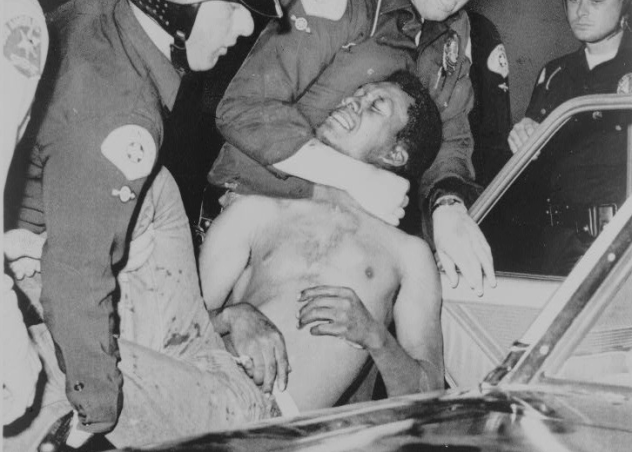
Racial tensions were high in the US during the 1960s. Race riots surrounding the Civil Rights Movement were causing mass unrest across the country. The KGB thought that they could exploit this and make it worse by inducing animosity or outright violence between racial groups in the US.
The plan, called Operation PANDORA, began with the KGB spreading fake pamphlets that appeared to be from the Jewish Defense League, a right-wing Jewish political organization now classified by the FBI as a terrorist organization. The pamphlets, which were actually penned by the KGB, claimed that black Americans were attacking Jews and looting Jewish-owned shops in New York. The fake pamphlets implored their readers to fight against “black mongrels.” The KGB then sent these anti-black flyers to black militant groups, hoping it would stir anti-Semitism in the black organizations, if not outright violence.
Concurrently, the KGB was also sending fake letters to black militant groups which claimed that the Jewish Defense League had been targeting and attacking blacks in America. The letters implored the black militants to attack the Jewish Defense League in retaliation. The Jewish Defense League’s leader, Meir Kahane, was assassinated a year later, though the act was carried out by an Arabic man who was seemingly unconnected to any black militant groups.
As part of their operation to stir racial unrest, the KGB also planned to blow up a black college. After the college was bombed with a planted explosive device, the KGB planned to make anonymous calls to a series of black organizations and claim that the Jewish Defense league had been behind the bombing. 3 Trying To Kill Josip Broz Tito
Photo via Wikimedia
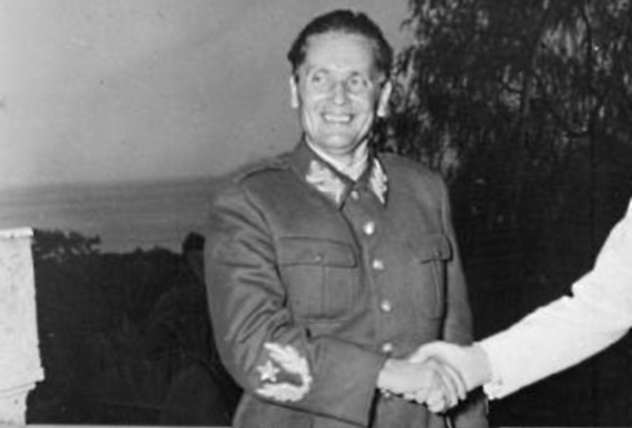
Though he was a communist himself, Yugoslavia’s head of state Josip Broz Tito surprisingly attracted the ire of the Soviet Union and Joseph Stalin in particular. Seeking to make Yugoslavia more independent and self-reliant, Tito distanced himself from both the United States and the USSR in a bitter conflict known as the Tito-Stalin Split.
Because of this, Stalin wanted Tito to be assassinated and contracted the predecessor to the KGB, the MGB, to go through with it. The USSR’s best secret agent was assigned to carry out Tito’s assassination. He had previously assassinated another foe of Stalin’s—Leon Trotsky. Tito, however, miraculously survived the assassination attempts unscathed.
In response to the assassination plots, Tito sent a warning to Stalin: “Stop sending people to kill me. We’ve already captured five of them, one of them with a bomb and another with a rifle.” Tito also wrote to Stalin: “If you don’t stop sending killers, I’ll send one to Moscow and I won’t have to send a second.”
When the MGB’s more conventional assassination plots failed to kill Tito, they got fiendishly creative. They then tried to assassinate him with his own personal plague. They specially designed a deadly bacteria and planned to release the plague at a diplomatic reception that Tito would be attending. Everyone in the room would have been killed by the plague expect for the KGB agent who was administering it, as he would have been immunized beforehand.
The KGB also designed a poison jewel box to try to kill Tito. The box would have been given to Tito as a gift, a Trojan horse of sorts, and would emit a deadly gas that would kill anyone who opened it. Fortunately, both poison plans were never carried out, and Tito outlived Stalin by nearly 30 years, dying in 1980 at age 87. 2 The Listening Floor
Photo credit: Samuli Lintula
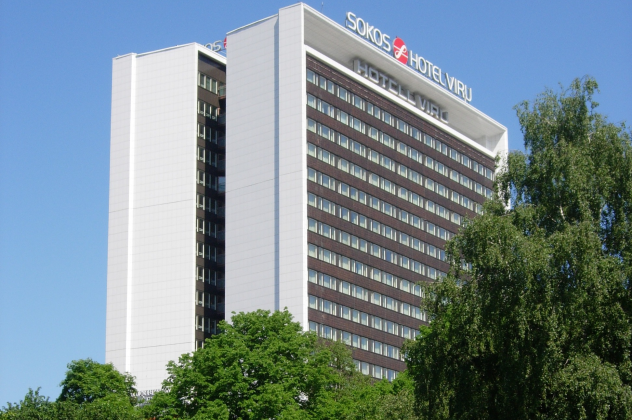
During the Cold War, the KGB became very good at bugging buildings and listening in on conversations. In fact, they were so good at such eavesdropping that they once bugged an entire floor of a hotel with audio surveillance microphones . . . for 20 years.
In the early 1970s, tourism began to flourish in the Soviet satellite country of Estonia. The USSR saw it as an opportunity to bring money into the struggling economy, and the KGB saw it as an opportunity to spy on foreigners. In 1972, the KGB took over the top floor of Hotel Viru in Estonia and wired most of the hotel with sophisticated audio surveillance devices. The hotel was in an area that was frequently traveled by international businessmen.
Sixty rooms in the hotel were permanently wired with secret microphones, and other rooms could be bugged at a moment’s notice. On the outside, Hotel Viru appeared to have 22 floors. In truth, it had the secret 23rd floor, which housed KGB agents and the technology that they used to spy on all of the guests at the hotel. The KGB remained there for two decades, until the collapse of the Soviet Union put an end to the surveillance operation in 1991.
The KGB has been found to have been using incredibly sophisticated audio surveillance technology in buildings around the world. In 1945, a group of Soviet children presented the US ambassador to the USSR a gift, a carved wooden plaque of the Great Seal of the United States, as a show of friendship between the two countries. However, the plaque contained a secret microphone. In fact, this bug was one of the first audio surveillance devices to use passive technology to transmit audio signals, making it undetectable by traditional methods and allowing it to be used for an extended period of time.
The bugged plaque allowed the KGB to listen in on conversations in the American ambassador’s office for nearly seven years, until it was accidentally detected in 1952 by a British radio operator. The radio operator was confused when he heard conversations between Americans coming from a radio channel near the embassy. That radio channel was being used by the KGB to listen in on the private conversations. 1 Financing Terrorism
After Yasir Arafat rose to power at the head of the Palestine Liberation Organization (PLO), he established an alliance with the KGB. The KGB then began to provide secret training to the PLO’s militants, who were taking up arms to violently achieve Palestinian statehood. In addition to training, the KGB began to ship arms to the PLO guerrillas in spite of the embargo placed upon the Palestinian territories.
Around this time, the PLO was carrying out many acts of terrorism. In 1969 alone, they performed 82 airline hijackings around the world. The head of foreign intelligence for the KGB, Aleksandr Sakharovsky, claimed that “airplane hijacking is my own invention.”
The KGB also financed another Palestinian militant group, the Popular Front for the Liberation of Palestine (PLPF), supplying them with rocket launders and machine guns. A leader of the PLPF, Wadie Haddad, was revealed to be a KGB agent. While Haddad was in charge of the PLPF, he carried out multiple hijackings of civilian airplanes. One of those hijackings, the Dawson’s Field Hijackings of 1970, provoked what’s known as Black September in Jordan, a bloody civil war that lasted from September 1970 until July 1971.
The KGB purportedly gave 100 machine guns, automatic rifles, pistols, and ammunition to the Official Irish Republican Army (IRA) in 1972. The Irish paramilitary group ushered in some of the most ruthless acts of violence and terrorism in the Northern Irish conflict known as the Troubles. One reason that the KGB and USSR took such interest in the IRA was because they had turned Marxist and had begun to support turning Ireland into a communist state.
When the KGB wasn’t trying to use spies to get their hands on the secrets of the US government, they were trying to use banks.
In the mid-1970s, the KGB devised a plan to covertly buy three US banks in Northern California as part of a secret operation to acquire information on high-tech companies in the region. The three banks were chosen by the KGB because they had previously made loans to technology companies. Many of these companies were contracted by the US military, so the KGB hoped to capture US military technology secrets.
Wataalazmu wa mambo ya intelijensia naomba msaada wenu, uzoefu wangu ni wakusoma vitabu vya espionage ziwe za kitechnolojia, uchumi , kijeshi au za kisiasa zinazohusisha mataifa makubwa ulimwenguni zikiwemo nchi za Marekani, Ulaya ya Magharibi kama Uingereza, Ujerumani Ufaransa na hata zilizokua nchi za kisoshalist za Ulaya ya Mashariki ikiwemo Urusi na Mashariki ya kati Israel ikiwa kinara
Katika usomaji wangu nakuta mara nyingi Urusi inafanya mambo ambayo kiakili unaona hayawezekani. Utakuta Shirika la Ujasusi la Urusi wakati huo linaitwa KGB(sijui sasa linaitwaje) linaendesha (lina run) ma agent wa CIA na kuwafanya kua double agents, yaani CIA agents wanakua informers kwa faida ya Urusi! Tena sio ofisa mmoja wa CIA au wawili ni kwa makumi kama ambavyo Marekani nao wanakua na watu wao ambao wana wa run ma agent wa Kirusi!
Kwa upeo mdogo wa mambo haya niliyokua nao naona ajabu sana Marekani kufanyiwa kitu hiki na Urusi mpaka najiuliza au ni kwavile vitabu ninavyosoma vingi ni fiction labda maana wahusika na matukio ya kubuni tu? Urusi kama inavyofanya Marekani ina run ma agents wa Nchi za Magharibi na kuna wengine wana defect kabisa na kuhamia Urusi!
Bado najiuliza kuna power ya Russia ambayo sisi hatuijui ila Marekani wanaitambua na kuiheshimu?Au Amerika inakua overrated na Russia inalijua hilo kwa hivyo hawaigopi?
Hapa nimemaliza kusoma litabu cha Frederick Forsyth THE DEVIL'S ALTERNATIVE, THE FOUTH PROTOCAl. Hawa jamaa wanapelelezana na wanajuana na huwezi jua nani zaidi. Ila sema tu kitabu ni fiction so sijui ukweli ukoje. Kama kuna anejua atupe darasa wana JF
Mmarekani ana tabia ya kubrainwash watu kwa kutumia movies na series zake ambazo asilimia kubwa huwa zinaonesha Mrusi ndo the bad guy so kuna kakitu kanakuwa kanajengeka kuona warusi ni watu wabaya lkn kumbe ni vice versa
Like the CIA, the Soviet (and now Russian) spy agency known as the KGB has engaged in decades of secret operations across the world, ranging from blackmail to kidnapping. Most of the secrets that we know about the KGB today are because of one man—Vasili Mitrokhin. Mitrokhin was an archivist for the KGB for 30 years before he defected to the UK and handed over his 25,000-page archive of secret KGB files. Here are some of the KGB’s most disturbing and outlandish secret operations.
Featured image credit: Vladimir Fedorenko
Listverse - Daily Highlights
Sponsored by Connatix
10 Attacks On America’s Infrastructure
Photo via Wikimedia
From 1959–72, the KGB began to photograph US power plants, dams, oil pipelines, and infrastructure for a nefarious operation that would disrupt the power supply to all of New York. Once they picked targets that they thought were vulnerable, the KGB set up a safe house near Harrisburg, Pennsylvania. From there, KGB agents sought to plan and carry out a series of attacks on America’s power systems.
Hydroelectric dams, which generate a significant portion of the US’s energy supply, were a target. The KGB formulated an elaborate plan to destroy two large hydroelectric dams, the Hungry Horse Dam and Flathead Dam, in Montana. Taking the two dams out of commission would cripple the power supply of the state and surrounding region. The attack was to begin 3 kilometers (2 mi) down the South Fork River from Hungry Horse Dam. The KGB planned to have operatives destroy power pylons on top of a tall mountain slope, which would be difficult to get back online, indefinitely knocking out power transmission from the dam. Then, the operatives were to seize the Hungry Horse Dam’s controls and destroy them. The attacks would have knocked out the power supply to all of New York state.
From the Soviet Union’s Canadian embassy, the KGB also planned to further disrupt America’s energy supply by attacking oil pipelines between Canada and the United States. The plot, called Operation Cedar, was planned for over a decade. The KGB even sought to destroy oil refineries in Canada, which supply a great deal of America’s gasoline.
All of the attacks on America’s power system were part of a larger scheme to attack New York City. Once they had knocked out most of the power in the United States with the earlier attacks, the KGB plotted to use the chaos and darkness to plant explosives on piers and warehouses along the Port of New York, a crucial harbor for America’s commerce and imports. 9 Hostage Crisis Retribution
In 1974, the KGB created an elite counterterrorism task force with the mysterious name “Alpha Group.” The Alpha Group was used by the KGB to carry out top secret and often dangerous missions for the USSR—and now Russia—including a bloody and vicious mission in Lebanon.
In 1985, the Soviet Union found itself with its first major hostage crisis after four Soviet diplomats were kidnapped in Lebanon by terrorists affiliated with an Islamic terrorist group. The kidnappers reportedly took the Soviets hostage to stop the USSR from giving support to Syria’s efforts in the Lebanese civil war, which the country was then embroiled in. After the Soviet diplomats were taken hostage, the kidnappers sent chilling photographs to news agencies of the hostages with guns to their heads. The terrorists demanded that the USSR force Syria-affiliated forces to stop attacking Iran-affiliated forces fighting in northern Lebanon, or the hostages would be executed.
Initially, the USSR was open to some form of negotiations with the terrorists to release the hostages unscathed. Things changed when the USSR didn’t seem to stop the Syrian forces’ involvement in the civil war, and the terrorists executed one of the hostages only two days after the initial demands were made.
That’s when the USSR abandoned negotiating, and the KGB took swift and bloody action. First, the KGB investigated what organization was behind the the kidnappings and found it to be the work of Hezbollah. That’s when the KGB did a bit of kidnapping of their own, snatching a close relative of a Hezbollah leader. They began to dismember him, castrating him and sending some of his dismembered body parts to the kidnappers of the Soviets. Soon after, the KGB killed the Hezbollah relative.
Then, the KGB sent the Hezbollah leader a message indicating that they knew of many more of his relatives and their whereabouts and warned that they would suffer the same fate if the hostages were not released. The Islamic terrorists holding the Soviets took notice and released the remaining three Soviet diplomats shortly after, entirely unscathed and without further demands.
8 Blackmail With Sex Tapes
The USSR had a plan for world domination. One country that the USSR sought to join their global communist rule was Indonesia. After the Indonesian Communist Party gained power with the help of President Sukarno, the USSR thought they would have an ally in the region. In order to ensure that Sukarno and Indonesia would remain allied with the Soviet Union, the KGB hatched a plan to get some dirt on Sukarno in case they needed to blackmail him to get their way.
Sukarno had one weakness that the KGB thought they could use to their advantage—a legendary sexual appetite. They drew up a plan to blackmail President Sukarno worthy of an Austin Powers movie. They found a group of attractive young women whom they thought could exploit President Sukarno’s voracious sexual appetite. The KGB then dressed the women as airplane stewardesses and sent them to Sukarno’s hotel while he was visiting Moscow.
As you can imagine, President Sukarno engaged in sex with multiple pseudo-stewardesses at once, while the KGB recorded the entire wild night. However, things didn’t go according to plan when they later brought the videotapes to Sukarno in an attempt to blackmail him. President Sukarno not only said that he didn’t care that the KGB had taped the sex or that they threatened to release it to the public, he asked for more copies for himself.
The KGB’s sexual blackmail did work elsewhere. In 1956, they successfully created a honeypot for French ambassador Maurice Dejean, consisting of attractive women called “swallows” by the KGB. One of these swallows was said to have been a Russian actress. While Dejean was having sex with the woman, her fictional husband furiously burst into the room to witness the act. This fake husband then threatened to bring the affair to public light and take legal action. The plan worked, and Dejean was pushed into becoming a KGB asset. He began feeding France’s secrets to the KGB in exchange for their keeping the affair secret from the public and his wife. 7 KGB Hacker Accesses 400 US Military Computers
In the 1980s, the KGB was looking for a way to steal US military secrets through two relatively new precursors to the Internet, ARPANET and MILNET. To do so, they found and recruited a man named Markus Hess, who would soon become a Soviet spy and one of the most legendary computer hackers in history.
Hess began his hacking mission from the University of Bremen in Germany, far away from the US military computers that he was trying to access. From there, Hess was able to attack 400 computers used by the US military. Some of the computers were used at bases around the world in places like Germany and Japan. Some of the other computers were used at MIT for research. Another was used by the Pentagon. Hess was able to guess the password to gain access to the Pentagon’s Optimis database, which allowed him to gain access to “a bibliography of Army documents.”
Hess’s widespread hacking operation remained undetected until a systems administrator and astronomer named Clifford Stoll began investigating a tiny accounting error in a California computer laboratory. Stoll found what seemed like a small, 75-cent error in the computer usage at Lawrence Berkeley Laboratory, which conducts scientific research for the US Department of Energy. Stoll tried to track down where the 75-cent discrepancy came from and traced it to an unauthorized and unknown user who had used the lab’s computer systems for nine seconds without paying. Stoll investigated further and found that this unauthorized user was a skilled hacker who gained access to a system administer “superuser” account by exploiting a security flaw in the system.
Stoll spent the next 10 months trying to track down the whereabouts of the hacker. Eventually, he was able to do so when the hacker tried to access a defense contractor in Virginia. Stoll began to record everything the hacker was doing. He witnessed this mysterious hacker accessing computer systems at military bases throughout the United States, searching for files regarding military secrets and nuclear weapons.
Stoll quickly contacted authorities ranging from the US military to the CIA, NSA, and FBI. Stoll and the authorities then traced the hacker’s physical whereabouts to a West German university. They set up a scam to get the hacker to reveal his full identity, inventing a fake department at the Lawrence Berkley Laboratory made to look like it was working with the US military. When the hacker took the bait and tried to access this fake department’s files, they were able to track him right to his house in Hannover, West Germany.
West German authorities, working with the US, then stormed Hess’s house and arrested him. Little did they all know that this elite hacker had been contracted by the KGB and was selling military secrets to the Soviet Union for years. Hess was later found guilty of espionage and sentenced to up to three years in prison but was released early on probation. 6 Operation RYAN
In 1980s, the Cold War reached another flash point. Then-leader of the USSR Leonid Brezhnev claimed to have knowledge that the US was actively preparing for a war against the Soviet Union and might launch a surprise nuclear attack at any time. So, in preparation for this supposed impending doom, the KGB sought to launch Operation RYAN, one of largest surveillance operations in history.
Operation RYAN was meant to provide the Soviets with early warning signs of an impending US nuclear attack. The plan was to conduct state-of-the-art surveillance using the USSR’s COSMOS satellite. The KGB wanted to photograph US military bases around the clock, monitoring them closely for signs that the US would launch nuclear weapons at the USSR.
The operation also sought to monitor all uses of radar within the United States for any dramatic increases that would indicate preparation for an attack. Furthermore, Operation RYAN was meant to monitor the activities of all American citizens and military personnel when they exited the US. RYAN also put NATO under heavy surveillance. The operation even tried to intercept telephone calls made throughout the United States and Europe.
In addition to remote surveillance, Operation RYAN created a network of spies who were ready to act on a moment’s notice if it was believed that the US was starting a war with the Soviet Union. The massive and costly operation was eventually scaled down in 1984, only three years after it was set into motion.
5 Buying US Banks
When the KGB wasn’t trying to use spies to get their hands on the secrets of the US government, they were trying to use banks.
In the mid-1970s, the KGB devised a plan to covertly buy three US banks in Northern California as part of a secret operation to acquire information on high-tech companies in the region. The three banks were chosen by the KGB because they had previously made loans to technology companies. Many of these companies were contracted by the US military, so the KGB hoped to capture US military technology secrets.
To pull the operation off, the KGB contracted a businessman from Singapore named Amos Dawe to purchase the banks for them without letting the US government get wind of the USSR’s grand plan to steal technology secrets. However, before the KGB could take over the banks, their purchase was thwarted by the CIA. The CIA had first learned of the scheme when they noticed that the Singaporean businessman’s money was coming from a Soviet bank. Dawe had obtained a $50 million credit line from a Singapore branch of Moscow’s Norodny Bank. 4 Operation PANDORA
Photo via Wikimedia
Racial tensions were high in the US during the 1960s. Race riots surrounding the Civil Rights Movement were causing mass unrest across the country. The KGB thought that they could exploit this and make it worse by inducing animosity or outright violence between racial groups in the US.
The plan, called Operation PANDORA, began with the KGB spreading fake pamphlets that appeared to be from the Jewish Defense League, a right-wing Jewish political organization now classified by the FBI as a terrorist organization. The pamphlets, which were actually penned by the KGB, claimed that black Americans were attacking Jews and looting Jewish-owned shops in New York. The fake pamphlets implored their readers to fight against “black mongrels.” The KGB then sent these anti-black flyers to black militant groups, hoping it would stir anti-Semitism in the black organizations, if not outright violence.
Concurrently, the KGB was also sending fake letters to black militant groups which claimed that the Jewish Defense League had been targeting and attacking blacks in America. The letters implored the black militants to attack the Jewish Defense League in retaliation. The Jewish Defense League’s leader, Meir Kahane, was assassinated a year later, though the act was carried out by an Arabic man who was seemingly unconnected to any black militant groups.
As part of their operation to stir racial unrest, the KGB also planned to blow up a black college. After the college was bombed with a planted explosive device, the KGB planned to make anonymous calls to a series of black organizations and claim that the Jewish Defense league had been behind the bombing. 3 Trying To Kill Josip Broz Tito
Photo via Wikimedia
Though he was a communist himself, Yugoslavia’s head of state Josip Broz Tito surprisingly attracted the ire of the Soviet Union and Joseph Stalin in particular. Seeking to make Yugoslavia more independent and self-reliant, Tito distanced himself from both the United States and the USSR in a bitter conflict known as the Tito-Stalin Split.
Because of this, Stalin wanted Tito to be assassinated and contracted the predecessor to the KGB, the MGB, to go through with it. The USSR’s best secret agent was assigned to carry out Tito’s assassination. He had previously assassinated another foe of Stalin’s—Leon Trotsky. Tito, however, miraculously survived the assassination attempts unscathed.
In response to the assassination plots, Tito sent a warning to Stalin: “Stop sending people to kill me. We’ve already captured five of them, one of them with a bomb and another with a rifle.” Tito also wrote to Stalin: “If you don’t stop sending killers, I’ll send one to Moscow and I won’t have to send a second.”
When the MGB’s more conventional assassination plots failed to kill Tito, they got fiendishly creative. They then tried to assassinate him with his own personal plague. They specially designed a deadly bacteria and planned to release the plague at a diplomatic reception that Tito would be attending. Everyone in the room would have been killed by the plague expect for the KGB agent who was administering it, as he would have been immunized beforehand.
The KGB also designed a poison jewel box to try to kill Tito. The box would have been given to Tito as a gift, a Trojan horse of sorts, and would emit a deadly gas that would kill anyone who opened it. Fortunately, both poison plans were never carried out, and Tito outlived Stalin by nearly 30 years, dying in 1980 at age 87. 2 The Listening Floor
Photo credit: Samuli Lintula
During the Cold War, the KGB became very good at bugging buildings and listening in on conversations. In fact, they were so good at such eavesdropping that they once bugged an entire floor of a hotel with audio surveillance microphones . . . for 20 years.
In the early 1970s, tourism began to flourish in the Soviet satellite country of Estonia. The USSR saw it as an opportunity to bring money into the struggling economy, and the KGB saw it as an opportunity to spy on foreigners. In 1972, the KGB took over the top floor of Hotel Viru in Estonia and wired most of the hotel with sophisticated audio surveillance devices. The hotel was in an area that was frequently traveled by international businessmen.
Sixty rooms in the hotel were permanently wired with secret microphones, and other rooms could be bugged at a moment’s notice. On the outside, Hotel Viru appeared to have 22 floors. In truth, it had the secret 23rd floor, which housed KGB agents and the technology that they used to spy on all of the guests at the hotel. The KGB remained there for two decades, until the collapse of the Soviet Union put an end to the surveillance operation in 1991.
The KGB has been found to have been using incredibly sophisticated audio surveillance technology in buildings around the world. In 1945, a group of Soviet children presented the US ambassador to the USSR a gift, a carved wooden plaque of the Great Seal of the United States, as a show of friendship between the two countries. However, the plaque contained a secret microphone. In fact, this bug was one of the first audio surveillance devices to use passive technology to transmit audio signals, making it undetectable by traditional methods and allowing it to be used for an extended period of time.
The bugged plaque allowed the KGB to listen in on conversations in the American ambassador’s office for nearly seven years, until it was accidentally detected in 1952 by a British radio operator. The radio operator was confused when he heard conversations between Americans coming from a radio channel near the embassy. That radio channel was being used by the KGB to listen in on the private conversations. 1 Financing Terrorism
After Yasir Arafat rose to power at the head of the Palestine Liberation Organization (PLO), he established an alliance with the KGB. The KGB then began to provide secret training to the PLO’s militants, who were taking up arms to violently achieve Palestinian statehood. In addition to training, the KGB began to ship arms to the PLO guerrillas in spite of the embargo placed upon the Palestinian territories.
Around this time, the PLO was carrying out many acts of terrorism. In 1969 alone, they performed 82 airline hijackings around the world. The head of foreign intelligence for the KGB, Aleksandr Sakharovsky, claimed that “airplane hijacking is my own invention.”
The KGB also financed another Palestinian militant group, the Popular Front for the Liberation of Palestine (PLPF), supplying them with rocket launders and machine guns. A leader of the PLPF, Wadie Haddad, was revealed to be a KGB agent. While Haddad was in charge of the PLPF, he carried out multiple hijackings of civilian airplanes. One of those hijackings, the Dawson’s Field Hijackings of 1970, provoked what’s known as Black September in Jordan, a bloody civil war that lasted from September 1970 until July 1971.
The KGB purportedly gave 100 machine guns, automatic rifles, pistols, and ammunition to the Official Irish Republican Army (IRA) in 1972. The Irish paramilitary group ushered in some of the most ruthless acts of violence and terrorism in the Northern Irish conflict known as the Troubles. One reason that the KGB and USSR took such interest in the IRA was because they had turned Marxist and had begun to support turning Ireland into a communist state.
Asante sana sana mkuu. Kumbe hawa watu nilikua nawachukulia poa ila kumbe si Taifa la kimchezo mchezo! Nilikua najiuliza Russia ina nini hasa cha kujivunia mpaka Marekani iwe inaongea kwa adabu na saa zingene kuufyata inapozungumzia issues zinazoihusu Urusi?
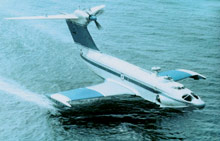
In 1967, whilst the U.S’s first spy satellite ‘Corona’ was busy photographing the Soviet Union, something unusual was spotted. It looked like a massive plane, but its wings were too short, it also sported the Soviet Navy Flag on it fuselage, so what was it? Maybe an unfinished aircraft or some new design of amphibious vehicle.
This leviathan was, in fact, the ‘Ekranoplan’, a new class of what is now known as a ‘ground-effect’ vehicles that made use a phenomenon that occurs when a wing is travelling close to the ground.
The ‘Ekranoplan’ was the brainchild of Rostislav Alexeyev, a Russian designer who began his career working on high-speed hydrofoils. Through the 1950s he developed a number of successful ships, rising to lead the Central Hydrofoil Design Bureau in the city of Gorky (now Nizhniy Novgorod) on the River Volga. But still, his thirst for speed led him to his most famous idea: to lift the hydrofoil’s fins out of the water entirely.
Alexeyev’s innovation was to use this ‘ground effect’ phenomenon and he envisioned a huge vehicle with the capacity of a ship but the speed of an aircraft.
The ground-effect works when a wing is provided with extra lift by the “cushion” of air trapped between the surface below and the wing and enables a combination of greater aircraft weight for less power and/or greater fuel efficiency.
However, his designs would cost a lot of money to build: a tough sell when resources were thinly spread in Soviet Russia. However, if a military use for the Ekranoplan could be found, then the project’s models could be scaled up.
The Gorky engineers drew up plans for a prototype Ekranoplan that would be large enough to transport hundreds of troops, or bring a battery of missiles in range of enemy territory. The benefits for the Navy were obvious: the Ekranoplan would travel at high speed just above the sea but below the enemy radar, it would also be immune to mines, torpedoes and anti-submarine nets.
In 1960 Alexeyev attended a Communist party meeting where Khrushchev was in attendance, and immediately captured the imagination of the Soviet Premier. Khrushchev saw the Ekranoplan as a way to face up to America’s mighty Aircraft Carriers and championed Alexeyev’s design bureau. Khrushchev would later boast that the USSR had ‘boats that could jump over bridges’, but everyone assumed that he was joking.
In the early 1960s everything about the ‘Ekranoplan’, including its name, was classified. The project was known as ‘steamboat’, which must have seemed appropriate as the prototype took shape around a boat-like hull. The first working model was known as ‘KM’ or ‘Korabl maket’ meaning simply: ‘Prototype ship’.
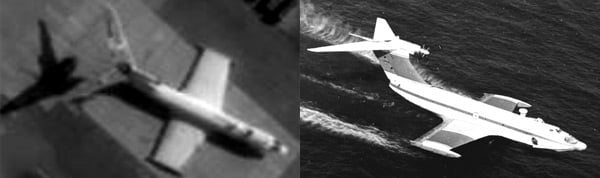
Although the ‘KM’ was hidden in a wooden casing and only moved at night, the strange shape was spotted in images from the American ‘Corona’ reconnaissance satellite. The Defence Intelligence Agency puzzled over what it could be: the squat wings didn’t seem capable of lifting an aircraft of that size. In fact, they were so concerned as to what it might be that the CIA was even going to use a special remote-controlled drone project called AQUILINE that originally been developed to spy on the Chinese nuclear program but its unreliability forced them to abandon the idea. Because of the letters ‘KM’ painted on its back, they gave it the nickname ‘Kaspian Monster’, but it became commonly known as the ‘Caspian Sea Monster’ by those in the west.
On October 16th, 1966, ‘KM’ was prepared for its maiden flight. Alexeyev himself was on board, against usual rules which dictated that designers should not ride in test vehicles. The giant Ekranoplan lifted from the waves and accelerated to 400km/h with the power of its eight huge turbojet engines at the front. Then the roar of its engines quietened, and ‘KM’ cruised just as Alexeyev had imagined. The eight engines not only provided the forward thrust, their exhaust was angled down to direct air under the short wings to give them an extra air cushion to ride on.
During that fifty minute flight, the fuselage flexed and rolled: an issue that would be later rectified by strengthening the body panels. But the Ekranoplan worked: they had proved that their Sea Monster could fly.
However, the political tides of the Soviet Union were about to turn. Khrushchev was ejected from office in 1964, and replaced by Leonid Brezhnev, who was deeply sceptical of oversized concepts like the ‘KM’.
Alexeyev and his engineering team went to Brezhnev to present their plans directly: but the Premier was unimpressed. At the end of the presentation, his only comment was about the lunch.
Under the new administration, Alexeyev’s dream of a fleet of giant Ekranoplans began to fade. However, his Central Hydrofoil Design Bureau was given the go-ahead to build a smaller transport vehicle based on the technology. Called the ‘Orlyonok’, or ‘Baby Eagle’, the first military Ekranoplan was still a huge beast, 80% as long as a Boeing 747 jet, and able to move 140 marines or 2 loaded Armoured Personnel Carrier vehicles.
Alexeyev’s Design Bureau also developed another military Ekranoplan: this time an ‘Aircraft Carrier Killer’ called ‘Lun’, (meaning ‘Harrier’). At 280 tons and 74 metres long, ‘Lun’ was equipped with six ‘Mosquito’ rocket launchers along its dorsal edge, which could engage an enemy ship from 90 kilometres away.
However, the Ekranoplan required considerable skill to operate and keep it at the optimal height of 20 meters above the water. Pilots also reported fatigue from constantly scanning the oncoming waves for small boats. In 1975 during a test flight of one of the ‘Orlyonok’ vehicles, the tail and rear engine broke off, in rough seas. Luckily, Alexeyev was on board, and took control from the pilot, quickly engaging the remaining engines to land the crippled Ekranoplan on the shore. Although he had saved the crew, Soviet Military chiefs blamed Alexeyev for the accident and removed him as Chief designer of the Bureau. Alexeyev’s independent character had put him at odds with the Soviet establishment, and within years he was demoted again, and eventually side-lined.
Alexeyev withdrew from his research, he spent long days sailing, battling storms in an elemental struggle with the sea. In his final years, he despaired, telling his daughter: ‘I didn’t achieve what I wanted.’ In 1980, aged 63, he died of injuries he received in an accident while testing a new Ekranoplan which was to be shown at the 1980 Olympics in Moscow.
That year would also see Alexeyev’s greatest invention laid to rest. On December 15th, the ‘KM’ prototype, by this time in poor condition, launched for a test flight. The inexperienced pilot reportedly attempted take-off without engaging full power, and the Sea Monster crashed, sinking in 20 metres of water. Although the giant tail and stabilizer protruded above the water for a time, the first Ekranoplan was too massive to be recovered, and remains in the Caspian Sea to this day, lurking beneath the waves.
In 1984, one of the ekranoplans main supporters the Minister of Defence, Dmitriy Ustinov died and soon after funding was removed from the from the project. In 1991 the Soviet Union collapsed and the remaining ekranoplans were abandoned. The massive Lun ended up in Kaspiysk where it is still there today, while one of the last Orlyonok’s was moved to the Russian Navy Museum in Moscow.
Although the Soviets and later Russians where the main proponents of the ground effect vehicles, other countries including South Korea, China and Germany have also built their own versions in varying sizes, nothing has been on the scale of the original Ekranoplans.
In 2002, Boeing in the US unveiled a monster-sized design called the Pelican which would have been the biggest plane ever built. The length of a football field with a wingspan of 152 meters and carrying capacity of 1400 tons, it would fly at 20,000ft over land but over open seas, it would fly at just 20 feet to use the ground effect to make it more efficient. However, since its unveiling nothing more has been heard about the Pelican.
So what do you think of the ekranoplans, a possible future transport system or technological dead end, let me know in the comments?
Caveat: some historical details and aircraft specifications in this piece are based on a variety of sources - not all of which agree. We've done our best to provide what we believe are the right facts and figures, but some aspects of the ekranoplan story are still open to debate.
During the mid-1960s chilly height of the Cold War, US photo reconnaisance spotted a strange apparition on the shores of the Caspian Sea - a gigantic 100m-long aircraft with inexplicably truncated square wings. US Intelligence dubbed the beast the "Caspian Sea Monster", unaware that the Russians were developing not, as they thought, an enormous conventional seaplane, but rather a 550-ton water-hugging behemoth designed to use the ground effect to skim the ocean at high speed, undetected by radar.
The Russians had a rather more prosaic name for the Caspian Sea Monster: the KM or "korabl-maket". This "ship-prototype" was the first in a series of Soviet "ekranoplan" ("screen plane") developments and was designed by Rostislav Evgenievich Alexeev of the Central Hydrofoil Design Bureau. The KM was intended as a test platform to examine the possibilities of the "Wing In Ground" (WIG) effect whereby (in very simple terms) a wing travelling close to the ground is provided with extra lift by the "cushion" of air compressed under it - thereby enabling a combination of greater aircraft weight for less power and/or enhanced fuel economy.
The KM, powered by eight Dobryin VD-7 turbojets on the front of the fuselage, and two on the tail for extra thrust during take-off, first took to the air in October 1966. During its extensive test career, it was continually modified. The wingspan was altered to between 32m and 40m, and the length varied from 92m to 106m.
The KM crashed in 1980, apparently due to the pilot ill-advisedly attempting to take off without giving it full throttle. An attempt to recover the leviathan from the depths was thwarted by its vast weight.
While the KM programme was ongoing, Alexeev began work on a medium-sized ekranoplan suitable for military transportation duties. Dubbed A-90 "Orlyonok" ("Eaglet"), the 140 tonne, 58 metre long aircraft had its maiden flight in 1972. The A-90 boasted two turbojets and one turboprop engine which propelled it to a speed of 400 km/h for 1,500 km at an cruise altitude of 5-10 m.
Four flying examples were built, one of which crashed in the Caspian in 1975 and was subsequently rebuilt. The aircraft entered military service in 1979 with three A-90s reportedly still operational in 1993. Thereafter, they were reportedly mothballed at the Kaspiysk naval base on the Caspian.
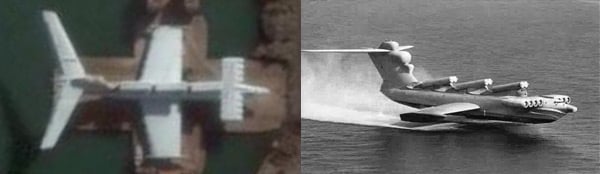
As indeed they were, or at least one of them. A quick Google Earth jaunt down to Kaspiysk reveals this fine view of an Orlyonok parked up:
There's more: sitting close by is this rather magnificent beast:
It is, as ekranoplan aficionados among you will know, the original military version of the "Lun" ("Hen Harrier"), designed as a sea-launched anti-shipping missile platform.
The 280 tonne, 74 metre long M-160 Lun was another ekranoplan developed from Alexeev designs. One was built in 1987, which entered service in 1989. A second example was under construction when the Soviet Union collapsed and, despite subsequent refitting as a search-and-rescue aircraft, remained unfinished when the authorities effectively pulled the plug on ekranoplan funding.
Russia wasn't the only country to take an active interest in the possibilities of WIG aircraft, though.
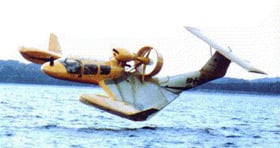
In the early 1960s, German designer Alexander Lippisch threw his hat into the ring with a series of small-scale designs based on a reverse delta-wing configuration.
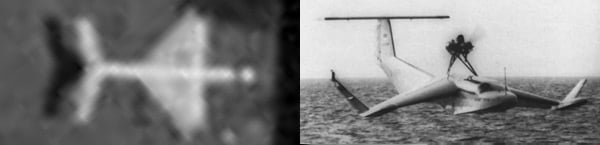
Lippisch was an expert in delta-wing aerondynamics, having played a large part in the design of the famous Me-163. His X-112 and X-113 designs were developed by Rhein Flugzeugbau (RFB) into the X-114 (seen here) for the German military.
Neither the X-114 nor any of its derivatives ever made it into military service, but there is some evidence that China may have taken a close interest in the design.
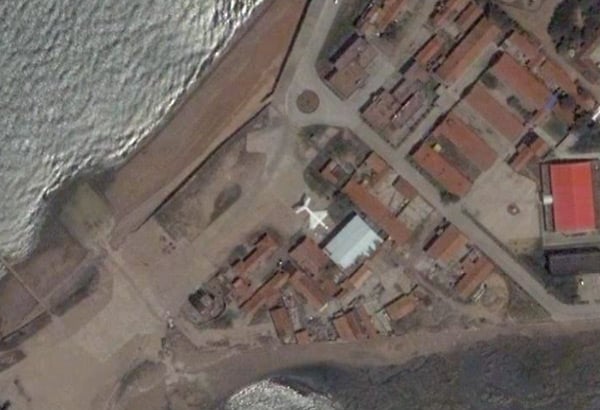
Specifically, readers are invited to speculate as to exactly what the Chinese are up to down at Qingdao naval base:
Well, the circumstantial evidence is there: a launch ramp down to the water's edge; hangar-type building; and the proximity of a seaplane base (click here. For the record, those are Shuihong-5 amphibious aircraft sunning themselves on the shore).
On the other hand, our Chinese Sea Monster is only 20 metres long, although a close-up examination adds weight to the theory that it may be the China Ship Scientific Research Centre's XTW-4 - based on the Lippisch X-113 (seen right) or X-114, as proposed by members of the Google Earth community:
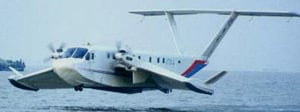
Shown here is a clearer view of the XTW-4. It's powered by two turboprop engines driving two five-blade propellors, and has a corrosion-resistant hull designed for salt-water operations.
It was built in 1999 and tested during 2000. Further information is scarce, and its current status is unknown, other than that it appears to be hanging around the Qingdao area. We'll leave it to you lot to fill in the blanks.
So, what of the future of the ekranoplan? In reality, the technical difficulties of developing a successful example often in the past outweighed the potential benefits of the technology.
There have been a few private outfits plugging away at their WIG aircraft, as evidenced by the Flightship FS-8 (seen here). It's another Lippisch-based design which - despite a lot of press back in 2000-2001 amid rumours that the company had sold seven examples to the Maldives - appears to have sunk without trace.
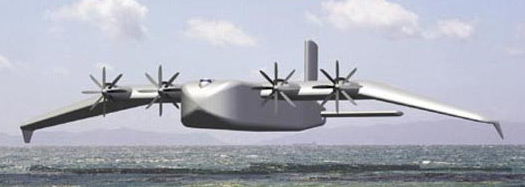
Enter stage right Boeing which, back in 2002, announced that it was developing the mother of all ekranoplans: the monstrous "Pelican" which would stretch "more than the length of a US football field and have a wingspan of 500 feet":
Designed primarily for "long-range, transoceanic transport", Boeing claimed the Pelican would be able to haul "1.5m pounds...10,000 nautical miles over water and 6,500 nautical miles over land".
Naturally, you're going to need a few wheels to hold up an oversized Pelican, and this particular bird - capable of lifting "17 M-1 main battle tanks on a single sortie" - would require no less than 76 tyres on 38 fuselage-mounted landing gears to support its weight.
Impressive specs to be sure, although whether we'll ever be able to do some Pelican-spotting on Google Earth remains to be seen. ®
JamiiForums uses cookies to help personalise content, tailor your experience and to keep you logged in if you register.
By continuing to use this site, you are consenting to our use of cookies.