Tehe!, Mu Israel haambiliki kweli anaendelea tu.
Lakini mnyoa kiduku ni kujianika sasa, wenzake wanachukua data za kila kitu anachotoa.
White House naona wametoa analysis yao kwenye hii Scud wanasema hazidumu sana hewani..
"It spun out of control after going only a fraction of its range," the official said of a liquid-fueled scud.
Mkuu, Scud za Kiduku sio hizo za kutumia liquid fuel, zinatumia solid fuel, bali inaonekana Kiduku ameshift kuelekea teknolojia ya kisasa ya kutumia solid fuel tena kwa ghafla mno ambayo inaipa changamoto US antimissile systems ktk kuziintercept. Pitia hapa chini.
Source:
The New York Times
North Korean Tests Add Urgency for U.S. to Fix Defense Flaws
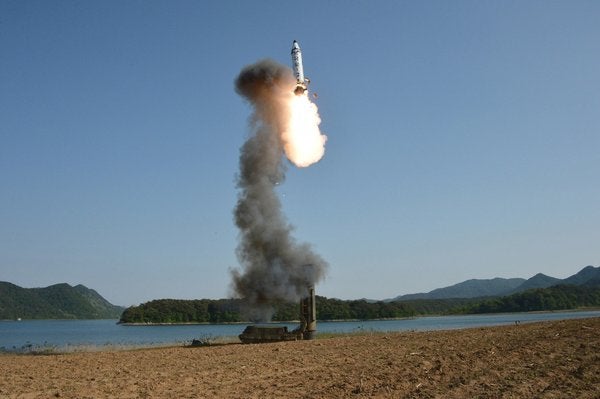
The medium-range strategic ballistic missile Pukguksong-2, shown in this undated image, was tested recently at an undisclosed location in North Korea. The North has successfully tested solid-fueled missiles four times.
KOREAN CENTRAL NEWS AGENCY, VIA EUROPEAN PRESSPHOTO AGENCY
By DAVID E. SANGER and WILLIAM J. BROAD
MAY 29, 2017
WASHINGTON — As the Pentagon prepares to conduct its first test in three years of the multibillion-dollar effort to intercept a North Korean warhead, it hopes to demonstrate that it has fixed a system that has worked in fewer than half of its previous nine tests.
But just as the Defense Department seeks to prove that it can strike a speeding target launched over the Pacific — in this case, an interceptor rocket is set to lift off from the California coast on Tuesday to try to smash a mock warhead — the North Koreans have delivered a new challenge.
The North has recently test-fired a series of missiles based on a technology that would give the United States little warning of an attack. The new generation of missiles uses solid fuels, enabling them to be rolled out from mountain hideaways and launched in minutes. That makes the job of intercepting them — already daunting — far harder, given that the American antimissile system works best with early alerts from satellites that a launch is imminent.
Even more worrisome is that these missiles actually seem to be functional, unlike older missiles that kept exploding or falling prematurely into the sea in past tests. Recent major tests were clearly successful, teaching the North Koreans a lot about how to fire missiles into space and drop warheads on distant targets. While the North has not yet flight-tested an intercontinental ballistic missile capable of crossing the Pacific, it has repeatedly claimed that it can strike the United States with a nuclear warhead.
Evidence suggests that American intelligence missed signals last year that the North was moving quickly to adopt the solid-fuel technology.
The test scheduled for Tuesday is of the more classic antimissile defenses that the United States has struggled to make work since the Eisenhower administration. Yet it is the first since Mr. Trump took office vowing to “solve” the North Korea problem, and since he began talking about ratcheting up economic sanctions and raising military pressure on the North.
But Mr. Trump is discovering what Mr. Obama learned before him: Intercepting intercontinental missiles over the Pacific is exquisitely hard, even when the tests, like the one scheduled for this week, are designed to give the interceptor its best shot.
Incoming warheads move extraordinarily fast — more than four miles a second. In war, the interceptors in Alaska and California would race skyward and release speeding projectiles meant to obliterate incoming warheads by force of impact — what experts call hitting a bullet with a bullet.
A terminal high altitude area defense interceptor during a successful test at an undisclosed location in the United States in 2013. Critics note that no mock weapon has moved nearly as fast as a true enemy warhead.
Huge amounts of cash have been spent on this challenge: more than $330 billion by the estimate of Stephen I. Schwartz, a military analyst at the Middlebury Institute of International Studies in Monterey, Calif. Yet neither the high cost nor the poor performance has dampened enthusiasm in Congress or at the Pentagon — or among military contractors — for deploying missile defenses. The Defense Department hopes to spend billions more dollars on the interceptors, including perhaps on a new site on the East Coast.
“Close only counts in horseshoes, not in nuclear war,” said Philip E. Coyle III, a former White House official and former head of weapons testing at the Pentagon who has long faulted the system as unreliable and misleading. If the glancing blow counts as a miss, the system’s failure rate is 67 percent.
Critics warn that the system would do worse in war, since the flight tests are highly scripted. They note that no mock weapon has moved nearly as fast as a true enemy warhead.
Portraying this week’s test as more realistic, Vice Adm. James D. Syring, the director of the Pentagon’s Missile Defense Agency, has called it “the first intercept of an ICBM-range target.” That means it is meant to approach the warhead speed of a true intercontinental ballistic missile.
While mock enemy missiles are always launched from Kwajalein, an atoll in the Pacific, North Korea uses large trucks to move around the intercontinental missiles it is developing, adding elements of surprise. Paul Bracken, a Yale military expert who is working on a book about mobile missiles, said foreign states saw movable arms as inherently safer from American strikes.
In the past, the North’s reliance on liquid-fueled missiles eased the targeting job for antimissile interceptors. American military surveillance planes and satellites could track missile transporters and convoys of fuel trucks. The process of fueling a missile takes several hours, making it vulnerable to a pre-emptive strike, and giving the antimissile systems on the West Coast time to lock in on expected trajectories.
With the new generation of weapons, the solid fuels are packed into the missile body in the factory, eliminating the need for fueling in the field. So the preparation time for an attack can drop from hours to minutes.
“It’s concerning,” Dr. Coyle said. “It can give you less warning time.”
Missile experts say the North’s shift to solids came as a surprise.
John Schilling, an aerospace engineer and an expert on North Korea’s missile program, predicted last year that the North might need five years or more to successfully deploy a solid-fueled missile. Recently, after the string of successes, he has updated his estimate, saying the North might start deployments this year.
Young-Keun Chang, an aerospace engineer and the director of the Global Surveillance Research Center at the Korean Aerospace University, in Seoul, said the North’s recent solid-fuel advances had moved the impoverished state closer to the “technological breakthrough” it needed to build a mobile intercontinental ballistic missile.


