BP and The US Oil Spill disaster!

BP and The US Oil Spill disaster!

r-OIL-SPILL-huge.jpg


slide_6569_96442_large.jpg


slide_6569_96429_large.jpg


slide_6569_96440_large.jpg


slide_6569_96432_large.jpg
 
Nikimwangalia Obama namuonea huruma sana, kwanza karithi matatizo makubwa sana kutoka kwa Kichaka matatizo ambayo hayakuwahi kurithiwa na Rais yoyote katika history ya US tangu ilipopata uhuru 1776 sasa tena limekuja hili la environmental disaster kubwa kuliko zote katika historia ya Marekani. Hiyo November 2010 kipigo watakachokipata Democrats kinaweza kuweka history.
 
Like Deepwater Horizon disaster, there were no quick fixes for Ixtoc

In this undated photo released by the National Oceanic and Atmospheric Administration, a fire burns near the Ixtoc exploratory well that blew out on June 3, 1979, in the Bay of Campeche, off Ciudad del Carmen, Mexico. Three decades later, the 1979 Ixtoc disaster remains the Gulf's, and the world's, worst oil spill.


MEXICO CITY - It started with a burst of gas through the drilling well. Workers scrambled to close the safety valves but within moments the platform caught fire and collapsed. Tens of millions of gallons of oil gushed into the Gulf of Mexico. Numerous attempts to stanch the spill failed.
Three decades later, the 1979 Ixtoc disaster remains the Gulf's — and the world's — worst peacetime oil spill.
The parallels between that disaster and the current BP oil spill offer sobering lessons. There were no quick fixes for Ixtoc: It took 10 months to stop the leak, with Mexico's state-owned oil company, Pemex, trying methods similar to those that BP has attempted at its Deepwater Horizon rig.

Pemex managed to slow the spill a little using several methods including forcing metal spheres into the well. But it couldn't stop the leak until two relief wells were drilled — and even that didn't work right away: the oil kept gushing for another three months after the first well was completed.
In the end, Ixtoc spewed a record 140 million gallons of oil. Massive slicks reached the northern Mexican Gulf coast and Texas, where it would eventually coat almost 170 miles of U.S. beaches.
But the most tragic thing about Ixtoc may be the lessons not learned.
After the oil stopped gushing and crude was no longer washing up on beaches, funding for research largely dried up and the oil industry missed an opportunity to study the disaster and apply what it learned to future offshore drilling endeavors, said Larry McKinney, the director of the Harte Research Institute for Gulf of Mexico Studies at Texas A&M University.
"Unfortunately, from a science standpoint, not much was followed up on, to learn from," says McKinney. "That was a mistake that was made that hopefully won't be repeated."
Shallower water
So far, Deepwater Horizon has spilled an estimated 21 million to 45 million gallons of oil. BP managed to place a funnel-like cap on the well late Thursday with the aim of pumping some crude to the surface, but it was too early to tell if would work or how much oil they could collect.
If the Pemex disaster serves as a precedent, the BP spill could continue even after the two relief wells are expected to be finished in August.
By then, it could surpass Ixtoc as the worst oil spill in history, said Tad Patzek, chair of the Petroleum and Geosystems Engineering Department at the University of Texas-Austin.
"We are looking at an August time frame for stopping it," Patzek said. "If for one reason or another that stopping is left imperfect or it takes another drill or what have you, we're looking at another four months, at that time this spill would look like the Ixtoc spill."
The BP spill, at a depth of nearly 5,000 feet, is proving more complicated to choke off than Ixtoc, a shallow-water rig about 150 feet deep. The Ixtoc well could be accessed directly, while the Deepwater spill must be combated remotely, using robots to wield clamps, saws and other tools while monitoring the action by video feed.
"They could fight Ixtoc from and at the surface," said Robert Bea, a professor of engineering at University of California at Berkeley who has studied offshore drilling for 55 years and worked for Pemex for a number of years. For Deepwater, "they must fight from the sea floor remotely, from the sea surface miles above."
Most recently, BP tried to stop the gusher by pumping in heavy drilling mud and cement. The tactic, called a "top kill," had never been tried 5,000 feet underwater. It didn't work.
The good news is the Ixtoc experience suggests the Gulf of Mexico has natural properties that help it cope with massive oil spills, scientists say. Warm waters and sunlight helped break down the oil faster than many expected. Weathering reduced much of the oil into tar balls by the time it reached Texas.
Two decades after the Ixtoc disaster, marine biologist Wes Tunnell sank his diving knife into an area where he had spotted a tar patch just after the spill. The blade came out black and tarry but the hardened surface of the patch was under sand, shells and algae that had completely covered it.
"No one else would know that it was anything other than a rock ledge," said Tunnell of the Harte institute. "I think that the Gulf of Mexico is hugely resilient, or at least it was 30 years ago. We've insulted it a lot since then in various ways."
'Out of mind'
The Gulf has also long dealt with oil that naturally seeps from the seafloor. Some experts estimate that tens of millions of gallons seep into the Gulf from natural up-wellings each year, fostering large populations of oil-eating bacteria and microorganisms.
However, it is unclear how much any of that will help this time around.
The Deepwater spill is closer to sensitive coastlines than Ixtoc was. And it is affecting Louisiana marshlands that are more sensitive than the more sparsely populated Texan and Mexican coastlines that Ixtoc reached.
"Obviously there were some helping factors — nature, climate, current — that in the end helped people (with Ixtoc) so that's good news," said Patzek. "However ... the Ixtoc well seemed to have been a little farther out from sensitive places."
The depth of the BP spill could also complicate the Gulf's ability to cope.
The oil-eating bacterial populations are located mainly on the surface or near shore, where the Ixtoc oil appeared. BP has tried to break up the oil deep underwater, pumping chemical dispersants directly into the damaged well.
That could be a mistake, McKinney said. While chemically dispersing the oil keeps the spill less visible and ugly than Ixtoc, it prevents the oil from floating up to the surface where wind, waves, bacteria and sunlight could help break it up, he said. And some environmentalists question the safety of the dispersant itself.
"I know, out of sight, out of mind," McKinney said. "But also, out of sight is what can kill you, like a cancer, and that may be the bigger problem."
Pemex estimates that about half the Ixtoc oil may have burned away in the rig fire that lasted months. About a quarter dispersed and the rest was either recovered or evaporated.
Ixtoc threatened coral, sea turtles, shrimp and commercially valuable fish. Some species have rebounded while others have drastically declined.
Jack Woody, a retired officer with the U.S. Fish and Wildlife Service, was in northern Mexico a month after the Ixtoc spill, leading the U.S.-Mexico effort to save the Kemp's ridley sea turtles.
He watched as the oil slick closed in and tar balls began washing up at the Rancho Nuevo beach, the only significant nesting ground for the female turtles, which had dwindled to a population of about 300. Hatchlings were just emerging, and helicopters desperately tried to ferry the baby turtles to open ocean beyond the slick.
"I thought we were too late," Woody said.

Turtles rebound
The turtle population continued to dwindle until 1988 but has since rebounded to up to 12,000, due in part to programs to relocate hatchlings to safer beaches in Texas and cut down on turtle deaths in shrimp nets.
"I was wrong. This is the one time I like to be wrong," Woody said.
Scientists say it is difficult to know how much long-term damage Ixtoc caused because it is hard to separate the effects of the spill from overfishing, sediment, runoff and other pollution.
Tunnel said his students saw coral islands ringed by oil "like black doughnuts" after Ixtoc. Many of those islands have since lost most of their coral cover but Tunnel could not say whether the spill was to blame. Other causes, he said, could include overfishing of coral-friendly fish, coral collecting and sewage.
After five years or so, the tar mats on Texas beaches largely disappeared, probably broken up and swept seaward, and Ixtoc was largely forgotten for 30 years, until another explosion on an offshore oil rig in a different part of the Gulf.

'79 Gulf spill leaves sobering lessons for BP - Disaster in the Gulf- msnbc.com
 
Obama promises to help coastal communities recover, defends actions

video.gif
Video

Oil takes terrible toll on wildlife
June 4: NBC's Kerry Sanders reports.
Nightly News

GRAND ISLE, La. - Efforts to siphon off oil gushing from a ruptured deep-sea wellhead in the Gulf of Mexico were starting to work, U.S officials said Saturday, while President Barack Obama defended his handling of the environmental crisis. The containment cap that British energy giant BP clamped over the ruptured wellhead collected about 6,000 barrels of oil on Friday, Coast Guard Admiral Thad Allen said at a briefing in Theodore, Ala. He told reporters the effort was working "with caveats", although it was still only collecting part of the leak.
On its Twitter feed, BP said that "a total of 6,077 barrels of oil was collected" on June 4. "Improvement in oil collection is expected over the next several days," the company said.

Allen said a higher collection rate could be achieved by closing vents in the cap as engineers stabilized pressure in the wellhead on the sea floor a mile deep. While the collection rate is still only about one-third of one day's flow from the leaking oil well, which has been estimated at about 19,000 barrels (800,000 gallons/3 million liters) per day, it was the first significant progress in an unfolding environmental disaster now into its 47th day.
With the cap in place over the wellhead, the plan is to funnel escaping oil and gas through a large hose from to the surface, where it would be collected in ships and safely removed.
Early estimates were that the cap might be about to capture only 1,000 barrels a day.
BP does not expect to fully halt the oil flow until August, when two relief wells are due to be completed.
Unfolding disaster
Meanwhile, Allen said that winds continue to push parts of the giant oil slick closer to the coastline across a wide area — roughly from the Mississippi/Alabama border to Port St. Joe in the Florida Panhandle, or more than 200 miles .
About 32 percent of Gulf federal waters, or 78,200 square miles, remains closed to fishing, the National Oceanic and Atmospheric Administration said.
Late Friday, NOAA reopened about 16,000 square miles that had been closed June 2 to fishing as a precaution.
The unfolding ecological and economic disaster has presented a stern test of Obama's leadership. The president has faced criticism that the U.S. government has not done enough to tackle the crisis.

In his weekly radio address Saturday, Obama said his administration has put in place the largest response to an environmental disaster in U.S. history. The government had been "mobilized on every front," with more than 1,900 ships and 20,000 people helping clean up the spill, he said.
The president paid his third visit Friday to the Gulf Coast since the offshore oil rig blowout.
video.gif
Video

Obama aims for damage control
June 4: Obama talked to local residents to emphasize his concern.
Nightly News

Obama also promised to stand with the people of the Gulf Coast "until they are made whole" and have recovered from the damage caused by the oil spill, as he defended his handling of the disaster.
He spoke of the people he'd met — an oyster fisherman named Floyd whose oyster beds have been destroyed by oil, and Terry, a shrimper who is losing income because shrimp fishing has been shut down.
"These folks work hard," Obama said. "They meet their responsibilities. But now because of a manmade catastrophe — one that's not their fault and that's beyond their control — their lives have been thrown into turmoil."
"It's brutally unfair. It's wrong. And what I told these men and women — and what I have said since the beginning of this disaster — is that I'm going to stand with the people of the Gulf Coast until they are made whole," the president said.
And in the increasingly forceful tone he has been directing toward BP, the British oil giant that was drilling the well that blew up, Obama said: "We will make sure they pay every single dime owed to the people along the Gulf coast."
BP, facing a U.S. criminal probe amid mounting lawsuits, dwindling investor confidence and growing questions about its credit-worthiness, delayed word on Friday on whether it would suspend an upcoming dividend payment to shareholders, as some U.S. politicians demanded.
RT-Containment.gif

U.K. minister complains
In the U.K., a government minister reportedly complained about anti-British language used about BP — formerly known as British Petroleum — and the spill.
"It's clear that some of the rhetoric in the U.S. is extreme and unhelpful," Business Secretary Vince Cable said, according to the Daily Mail.
However, he added Obama was not treating BP any more harshly than he would treat a U.S. company in such circumstances, the newspaper said, and cautioned against any "gunboat diplomacy" to lobby Washington on the company's behalf.


BP cap collects 6,000 barrels of oil - Disaster in the Gulf- msnbc.com
 
Wenzenu huku wanasema kuwa Obama anakuwa anti-British kwa jinsi anavyolifuatilia hili suala
 
Takwimu za mafuta yanayofoka kutoka chini ya bahari zinatisha.BP yenyewe mpaka sasa inaonekana imesalimu amri.New BP oil spill flow estimates: 20,000 to 40,000 barrels per day - CSMonitor.com
Sasa hawa jamaa wamechanganyikiwa Global protest planned over BP's handling of oil disaster - CNN.com. Mafuta kweli yanatuhusu sote lakini bado hili tatizo linawahusu wao kwanza.Wacha wajadiliane wenyewe BBC News - Cameron and Obama to discuss BP oil spill waroho wa mafuta ambao wameshatoa roho za watu nyingi kutaka kuyahodhi.Sisi tunaweza kushiriki baadae kwa dua, ikiwa wenyewe watashindwa kutambua kuwa hizi ni ghadhabu za Mungu aliyetukuka.
 
Global protest against BP? Leo hii? Labda hii ni fursa nzuri kuwaamsha wakubwa kuhusu pia uchafuzi uliofanywa na BP katika delta ya Niger - tena kwa makusudi kabisa na ambao wameupuuzia kwa muda mrefu bila kujali kuwa kuna binadamu waishio huko ambao wameathiriwa vibaya sana kiuchumi na kiafya.
 
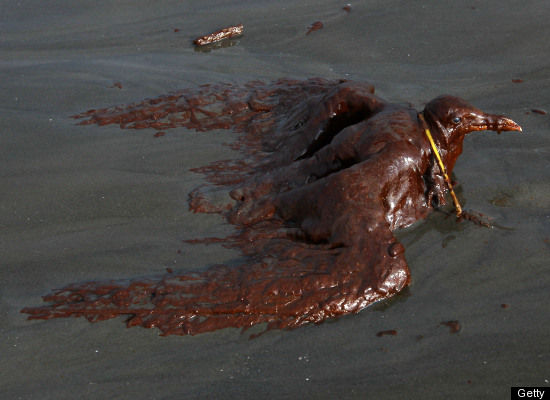
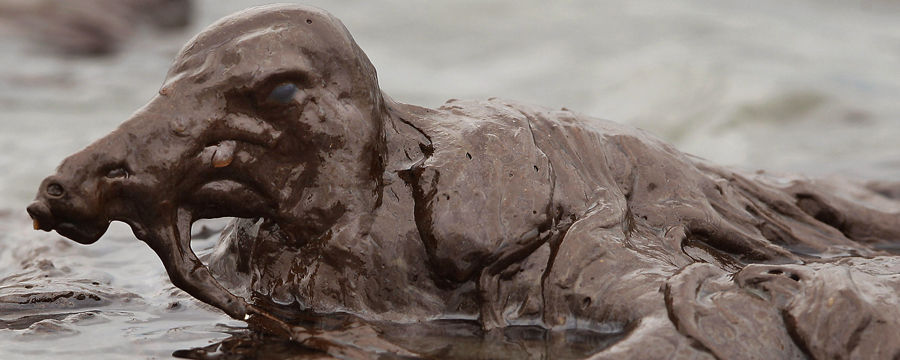
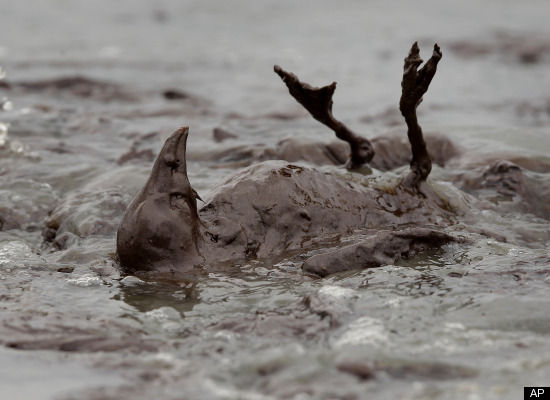
Hizo picha hapo juu za viumbe wanoangamia kwa mafuta ni uchuro kwa Marekani.Haraka sana ikome kuuwa waislamu kila kona kutaka Mafuta.Inanikumbusha tafsiri ya Qur'an;suratul Fiil (105)

KWA JINA LA MWENYEEZI MUNGU MWINGI WA REHEMA MWENYE KUREHEMU 0
Kwani hukuona jinsi Mola wako Mlezi alivyo watenda wale wenye tembo? 1
Kwani hakujaalia vitimbi vyao kuharibika? 2
Na akawapelekea ndege makundi kwa makundi, 3
Wakiwatupia mawe ya udongo wa Motoni, 4
Akawafanya kama majani yaliyo liwa! 5

Sura hii iliteremka kumkumbusha Mtume Muhammad rehema na amani zimshukie, kuelezea jinsi mbabe wa wakati huo mfalme Abraha alivyopata kiburi kutokana na nguvu kubwa ya kijeshi aliyokuwa nayo mpaka akapata moyo wa kutaka kuivunja Alkaaba.Wenye akili wajuwe kwamba Marekani kutokana na kiburi chake iko njiani kuangamizwa na mwenye nguvu wa mwisho-Allah s.w
 
Na Bado, hii ni kidogo sana,dua za waumini hazipotei bure, wanalumbana hawajui la kufanya wamezoea kila linalotokea kutafuta wa kulaumu, sasa hilo pelekeni majeshi yakapigane na mafuta si mnaamini masuluhisho yote duniani ni nguvu,
Kujua ujinga wao badala ya kufikiria jinsi ya kuyaziba yasitoke, mawazo yote yako kwenye pesa za fidia na kusafisha, na kutafuta nani wa kumlaumu hakusaidii kitu ikiwa bado liki inaendelea.
 
Account to be led by Kenneth Feinberg, who handled 9/11 compensation

Susan Walsh / AP
BP CEO Tony Hayward, left, BP America Chairman Lamar McKay, center, BP Chairman Carl-Henric Svanberg, second from right, and other BP representatives arrive at the White House.

WASHINGTON - BP will set aside $20 billion to pay claims stemming from the nation's worst oil spill and will create a $100 million fund to pay oil industry workers left jobless, President Barack Obama said Wednesday after meeting with the oil giant's top executives. "What this is about is accountability. At the end of the day that's what every American wants and expects," Obama said.
The president spoke after meeting for several hours with top BP executives at the White House.
The independent fund for damage claims will be directed by lawyer Kenneth Feinberg, who oversaw payments to families of victims of the Sept. 11, 2001, terrorist attacks. At present, Feinberg is known as Obama's "pay czar," setting salary limits for companies getting the most aid from a $700 billion government bailout fund. The $20 billion is not a cap - if legitimate claims outstrip that amount, then BP will be required to pay more. A three-person panel will decide appeals of rejected claims.
The president said that BP will be able to meet its obligations. He called BP "strong and viable" - and said it was in everyone's interests that it remain so.
Shortly after Obama spoke, BP Chairman Carl-Henric Svanberg announced the company is suspending its quarterly dividend to shareholders. He said the company and the Obama administration are "fully aligned" in the goals of closing the leak, cleaning the beaches and caring for those affected.
Svanberg also apologized to victims of the spill, saying, "This tragic accident ... should have never happened."
The eight-week disaster in the Gulf, with tens of thousands of gallons of oil still pouring from the broken well daily, is jeopardizing the environment as well as the livelihoods of tens of thousands of people across the coastal areas of Louisiana, Mississippi, Alabama and Florida. Those affected range from fishermen to restaurateurs to oil rig workers idled by Obama's temporary halt to new deep-sea oil drilling.
Several big questions remain unanswered, including when BP would start processing claims and paying people from the fund, who and what would exactly be covered, how the White House and BP came up with the dollar figure and whether other involved companies would be required to chip in.
At $20 billion, the size of the fund is the same that was recommended by congressional Democrats.
Paying for the damage
The meeting with BP executives came a day after Obama, in a televised address to Americans, accused BP of recklessness and vowed to fight the spill "with everything we've got."
"We will make BP pay for the damage their company has caused," Obama declared in his first Oval Office address, a venue often reserved for matters of war. Obama described the massive spill as a "siege" on the shores of America.
Obama said he would tell the chairman of the British-based oil company that it must set aside "whatever resources are required" to compensate the Gulf Coast people whose lives have been upended because of what he called BP's recklessness.
Obama said this new damages fund, used to pay claims to workers and business owners, won't be run by BP. He said an independent third party will be in charge to ensure people are paid in a fair and timely way.
BP declined to offer details about what proposals it would bring to the meeting or any reaction to Obama's biting words.
video.gif
Video

BP will ‘pay every dime they owe'
June 16: White House senior adviser David Axelrod tells TODAY's Matt Lauer that the government will oversee accounting of damages and there will be no upward cap on victims' claims.
Today show

The company said in a statement that it shares Obama's goal of "shutting off the well as quickly as possible, cleaning up the oil and mitigating the impact on the people and environment of the Gulf Coast. We look forward to meeting with President Obama tomorrow for a constructive discussion about how to best achieve these mutual goals."
Obama also has announced that former Mississippi Gov. Ray Mabus will develop a long-term Gulf Coast Restoration Plan - to be funded by BP - in concert with local communities.
Obama's forceful tone about BP's behavior shows how far matters have deteriorated. The White House once had described BP as an essential partner in plugging the crude oil spewing from the broken well beneath nearly a mile of water. Now Obama says BP has threatened to destroy a whole way of life.
"I refuse to let that happen," Obama said in his televised address.
Short on details
Yet even as Obama pledged not to rest until the Gulf Coast region is restored, he didn't detail exactly how he would keep that promise.
Meanwhile, the frantic effort to stop the leak and contain the worst environmental disaster in U.S. history plods on. So does the venting and search for answers on Capitol Hill, with three more congressional hearings set for Wednesday.
The president is straddling a line. He must show he is a leader not a shouter, yet also one who can relate and respond to the intense emotion of this catastrophe. And public confidence is slipping with every day the oily mess keeps pluming away.

An Associated Press-GfK poll released Tuesday showed 52 percent now disapprove of Obama's handling of the oil spill, up significantly from last month. Most people - 56 percent - think the government's actions in response to the disaster really haven't had any impact on the situation.
Obama's Oval Office address was the most prominent sign yet that the oil spill response has become his agenda; everything else must compete for his time. He managed to use the forum to extensively plug his effort for a massive clean-energy bill.
Already forgotten was that Obama wasn't supposed to be in the White House on Tuesday night but rather in Indonesia as part of his outreach to the Muslim world. He scrapped that trip to deal with this crisis, using his time to tour the Gulf cleanup once again, address the nation and call in BP officials for direct talks.
The damages are huge. A government panel of scientists determined that the well is leaking even more oil than previously thought, as much as 2.52 million gallons a day - or enough to fill the Oval Office where Obama sat more than 22 times. The total spilled so far could be as much as 116 million gallons.
video.gif
Video

A 'good thing'
June 16: Sen. Kay Bailey Hutchinson welcomes news that BP will set up a $20 billion escrow fund for Gulf oil spill victims.
msnbc tv

BP OKs $20 billion escrow fund, halts dividend - Disaster in the Gulf- msnbc.com
 
wonderful pictures, really captures the mess these oil companies have struck down upon our beautiful world, saddened by this but i have hope.
 
Congressman concerned oil giant is 'stiffing' people who file claims

Digitalglobe / Getty Images
Vessels are seen at the site of the Gulf oil spill in a satellite image taken this week.
View related photos


Hayward hands off BP's daily Gulf operations
June 18: NBC's Dawna Friesen reports.
As BP reported progress in drilling the first of two relief wells to plug the massive Gulf of Mexico leak, lawmakers in Washington on Friday expressed concern the oil giant was "stiffing" victims who filed damage claims.Kent Wells, senior vice president of exploration and production, said the first relief well being drilled is within 200 feet of the blown-out well. The aim is for one or both relief wells to intersect with the leaking well to pump in heavy drilling fluids and cement.
BP hopes that the relief wells now being drilled will halt the leak in August. As the crisis entered its 60th day, the U.S. Coast Guard official leading the federal relief effort also said BP had increased the amount of oil it was siphoning off from to 25,000 barrels on Thursday. It was the highest amount yet collected by BP.
But putting that figure in context, Adm. Thad Allen said 35,000 barrels a day, and possibly as much as 60,000 barrels, were gushing into the sea from the well, which ruptured after an April 20 explosion on an offshore oil rig that killed 11 workers.
The spill has idled much of the U.S. Gulf Coast's multibillion-dollar fishing industry and seeped into ecologically sensitive marches and wetlands despite the efforts of an army of workers to keep it at bay with oil-soaking booms.
Damage claims
Kenneth Feinberg, the man picked by President Barack Obama to oversee a $20 billion claims fund set up by BP at the White House's urging, was visiting the Gulf coast states of Mississippi and Louisiana on Friday.
Feinberg, who administered a federal fund for victims of the Sept. 11, 2001 attacks, pledged in a statement that he would work tirelessly to provide "prompt, appropriate" compensation to victims of the disaster.
His appointment followed a barrage of complaints from Gulf Coast residents that the BP claims process has been too bureaucratic and has paid out too little money.
The House Judiciary Committee says that data it has collected shows that BP has paid less than 12 percent of claims submitted by people and businesses arising from the spill.
The committee said Friday that only $71 million out of an estimated $600 million had been paid as of Tuesday. In addition, the panel said that BP didn't make any payments in the first two weeks following the explosion and oil spill.
Michigan Democratic Rep. John Conyers said he's concerned that BP "is stiffing too many victims and shortchanging others."
The committee said BP hasn't made a single payment for bodily injury or diminished home property value. BP officials did not immediately respond to a request for comment.
BP said it has paid a higher percentage of claims than was indicated by data from the House committee. As of Friday, BP spokesman Scott Dean said the dollar value of payouts was $95 million.
Dean also said that the company has paid about half of the 60,000 claims made so far. In other words, the company has cut 30,000 checks.
The likely cost of cleanup, compensation and fines has almost halved the value of BP, once Britain's biggest company.
Hayward role diminished
BP Chairman Carl-Henric Svanberg, in an interview with Sky News television, said Friday the company remains in a strong financial position despite the market uncertainty that has followed the spill.
video.gif
Video

BP shakeup 'not unexpected'
June 18: Rep. Marsha Blackburn, R-Tenn., says she is "not surprised" over the removal of BP CEO Tony Hayward as point man in the Gulf.
Andrea Mitchell Reports


He also confirmed that Chief Executive Tony Hayward is handing over the day-to-day handling of the spill to managing director Bob Dudley.
BP had already announced June 4 that Dudley would lead the long-term response to the spill once the leak had been stopped. Svanberg's statement appeared to accelerate that timeline.
"Now (Hayward) has been out there for eight weeks and he is now handing over the operations, the daily operations to Bob Dudley and he will be more home and be there and be here, but I think it has been a difficult period and as long as we don't close the well and take care of this, there will be criticisms about many things," Svanberg told Sky News. "Right now that is our focus to make that happen."
On Thursday, Hayward told lawmakers on a U.S. House investigations panel that he was out of the loop on decisions at the well. Both Democrats and Republicans were infuriated when he asserted, "I'm not stonewalling."
It also follows a string of gaffes from the BP chief that made him appear tone-deaf. He was quoted by the Times of London suggesting that Americans were particularly likely to file bogus claims, and later shocked residents in Louisiana by saying that "no one wants this over more than I do. I would like my life back."
Svanberg said "it is clear that Tony has made remarks that have upset people," but he also defended the chief executive.
"Here is also a man who has (been through) 100 hours of TV time and maybe 500 interviews," he told the broadcaster. He added that Hayward's grilling in Washington was "a very, very difficult hearing to go through."
Also Friday, the Department of the Interior issued a directive to oil and gas lessees and operators requiring them, when they file for a new drilling permit, exploration plan or development plan, to submit information that addresses the possibility of a blowout and steps they take to prevent it.
"The BP oil spill has laid bare fundamental shortcomings in the oil and gas industry's ability to prevent and stop catastrophic blowouts," said Interior Secretary Ken Salazar. "While the challenges of intervening in a catastrophic blowout are significantly greater in deep water than in shallow water, all operators should provide basic information about potential blowouts, and steps that are being taken to reduce the possibility of a blowout."
Added Salazar, "this is basic information that applicants should be able to provide; it should not delay permitting of appropriate shallow water drilling."


BP reports progress on relief well - Disaster in the Gulf- msnbc.com
 
Hii itawafanya Wamarekani wajifunze na mengi kuhusu Mafuta kama walivyokuwa wanaiba huko Mashariki ya kati sasa kazi kwao Mungu hulipa hapa hapa Dunia akhera hesabu tu. Kila Mtu atauchukuwa Mzigo wake Mwenyewe siku inakuja.
 
Back
Top Bottom