
FRANCIS DA DON
JF-Expert Member
- Sep 4, 2013
- 40,834
- 46,950
What is nuclear power
Nuclear power generation involves nuclear fission of uranium in a nuclear reactor and the use of steam generated by the heat associated with the fission reaction. The nuclear reactor and uranium fuel are respectively analogous to the boiler and oil or coal fuel in thermal power generation.
The security of energy supply is a critical issue for many countries, hence nuclear energy is used to service a large portion of the electricity demand in those countries. Nuclear power generation is characterized by good availability of uranium as fuel, the capability to supply electricity stably for a long period, and the capability to recycle fuel. Nuclear power, therefore, is an indispensable power generation method in the developed nations. Another significant advantage of nuclear power is that it does not emit carbon dioxide (CO2) during power generation.
Because uranium, used as fuel for nuclear power generation, is a radioactive material, multilayered safety measures are taken based on the "defense in depth" concept, so that radioactivity will not be released in the event of an accident.
Nuclear power generation involves nuclear fission of uranium in a nuclear reactor and the use of steam generated by the heat associated with the fission reaction. The nuclear reactor and uranium fuel are respectively analogous to the boiler and oil or coal fuel in thermal power generation.
The security of energy supply is a critical issue for many countries, hence nuclear energy is used to service a large portion of the electricity demand in those countries. Nuclear power generation is characterized by good availability of uranium as fuel, the capability to supply electricity stably for a long period, and the capability to recycle fuel. Nuclear power, therefore, is an indispensable power generation method in the developed nations. Another significant advantage of nuclear power is that it does not emit carbon dioxide (CO2) during power generation.
Because uranium, used as fuel for nuclear power generation, is a radioactive material, multilayered safety measures are taken based on the "defense in depth" concept, so that radioactivity will not be released in the event of an accident.
Mechanism of Nuclear Power Generation
In nuclear power plants, uranium fuel undergoes nuclear fission and generates an enormous amount of heat. The heat makes high-temperature and high-pressure steam that rotates turbines to generate electricity.
Light Water Reactor (LWR)
LWRs use light water (normal water) as coolant and moderator. Coolant removes heat produced during nuclear fission from a reactor core. Moderator reduces the speed of neutrons produced in nuclear fission to facilitate further fission reaction and sustain a chain reaction.
There are two types of LWRs - a boiling water reactor (BWR) and a pressurized water reactor (PWR). Each type is adopted in almost equal numbers in Japan.
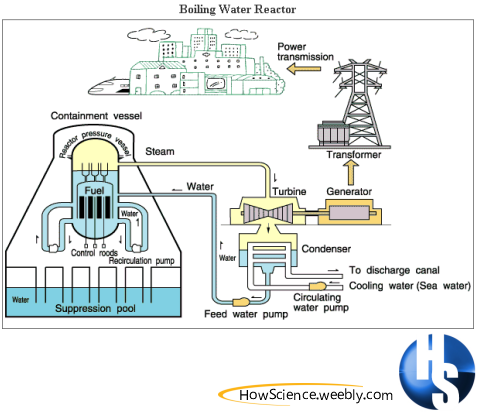
Boiling Water Reactor (BWR)
The same water loop serves as a steam source for turbines.
In nuclear power plants, uranium fuel undergoes nuclear fission and generates an enormous amount of heat. The heat makes high-temperature and high-pressure steam that rotates turbines to generate electricity.
Light Water Reactor (LWR)
LWRs use light water (normal water) as coolant and moderator. Coolant removes heat produced during nuclear fission from a reactor core. Moderator reduces the speed of neutrons produced in nuclear fission to facilitate further fission reaction and sustain a chain reaction.
There are two types of LWRs - a boiling water reactor (BWR) and a pressurized water reactor (PWR). Each type is adopted in almost equal numbers in Japan.
Boiling Water Reactor (BWR)
The same water loop serves as a steam source for turbines.
- A reactor pressure vessel is made of steel and fuel assemblies are installed inside.
- A control rod controls the power of a nuclear reactor. By inserting control rods, excessive fission is prevented.
- A reactor containment vessel, made of steel, accommodates a reactor pressure vessel.
Learn More: Howscience/Nuclear power generation


