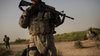
Washington concealed US troops exposure to chemical weapons in Iraq

Washington concealed US troops exposure to chemical weapons in Iraq

Extraterrestrial

JF-Expert Member
Joined
Aug 23, 2013
Posts
413
Reaction score
265
39.si.jpg

American soldiers discovered more than 4,990 chemical munitions in Iraq, according to Iraqi and US officials and previously classified intelligence documents, which may now be in the hands of Islamic State militants.

For much of the duration of the Iraq War, which saw US soldiers open a military invasion against the Ba'athist country in March 2003 amid tremendous international outcry, US forces "repeatedly encountered, and on six occasions were wounded by, chemical weapons" leftover from the Iraq-Iran War, reported the New York Times.

The hefty eight-part report, largely based on interviews and highly redacted intelligence documents, said "17 American service members and seven Iraqi police officers…were exposed to nerve or mustard agents" between 2004 and 2011.

The article detailed the harrowing chemical encounters of several servicemen, including Sergeant Duling, who in August 2008 unwittingly led his unit into a munitions pit outside Baghdad.

"This is mustard agent," he said, after carrying out an examination of the contents of the rusting artillery. "We've all been exposed."

At first blush, it may seem inconceivable that the United States, which had argued for an invasion of Iraq on the grounds that it was harboring weapons of mass destruction (an accusation that the UN weapons inspectors on the ground in Iraq prior to the American invasion/occupation had proven to be incorrect), would want to keep the discovery of WMDs in Iraq under wraps.

One reason for the hush-up, the report suggests, is that the United States was largely responsible for Iraq having chemical weapons in the first place.

"In five of six incidents in which troops were wounded by chemical agents, the munitions appeared to have been designed in the United States, manufactured in Europe and filled in chemical agent production lines built in Iraq by Western companies," it said.

Many of the casings were M110s, which the United States military had developed decades ago to disperse white phosphorous or mustard gas.


40.jpg
"The United States also exported the shells and the technology behind them," the Times reported. "When Iraq went arms shopping in the 1980s, it found manufacturers in Italy and Spain willing to deal their copies. By 1988, these two countries alone had sold Iraq 85,000 empty M110-type shells, according to confidential United Nations documents."

This is where the story begins to get very disturbing.

During the Iraq-Iran War (1980-1988), Baghdad actively sought the development of chemical weapons with the help of a number of Western countries, including the United States, West Germany, the Netherlands, the United Kingdom, and France, according to internal Iraqi documents.

It is has already been widely documented that at least 50,000 Iranian civilians and soldiers were killed by Iraqi chemical weapons in the course of the war.

As the Times report detailed, many of the chemical weapons incidents were centered around the now largely destroyed Muthanna State Establishment, which was "the center of Iraqi chemical agent production in the 1980s."

This is especially worrying because since June, that sensitive area has been in the possession of the Islamic State, which recently appeared on the scene in northern Iraq and Syria with public displays of extreme savagery that included the alleged beheading of American and British journalists and aid workers, not to mention Christian babies.

So the question as to how the United States kept the exposure of its troops to chemical weapons contamination in Iraq secret for so long has taken a back seat to the more immediate question as to whether or not the Islamic State has also gained possession of chemical weapons.

On Sunday, former Vice President Dick Cheney predicted that the next attack on the United States would be "far deadlier" than the last one.

"We're in a very dangerous period," Cheney, who regularly appears on the US talkshow circuit despite the dismal record of the Bush administration, told the Weekly Standard's Bill Kristol in a video interview. "I think it's more threatening than the period before 9/11.

"I think 9/11 will turn out to be not nearly as bad as the next mass casualty attack against the United States, which, if and when it comes, will be with something far deadlier than airline tickets and box cutters."

Does Mr. Cheney know something that the American public - much as it has been clueless about the chemical weapons in Iraq - does not yet know about?

That would be a far more disturbing revelation.


Source: RT

http://rt.com/news/196152-us-iraq-chemical-weapons/
 
If these weapons will fall under the arms of ISIS, the outcome will be deadly
 
If these weapons will fall under the arms of ISIS, the outcome will be deadly

Inavyosemekana tayari ISIS wanazo mkuu soma hiyo habari vizuri.Kuna kipindi raisi wa US aliyepita George Bush alisema,one day ISIS will possess chemical weapons in Iraq and u will agree when he said Iraq had chemical weapons.Ndiyo maana wanapredict attach itakayotokea US will be deadly kuliko ile ya sept 11.
 
US ndo wanameitengeza ISIS, na wanajua wanachotaka kufanya middle east.
 
''which may now be in the hands of Islamic State militants.'' hii ni hatari sana, maana kwa jinsi jamaa walivyo naona itakuwa ni total chaos kuanzia middle east na maeneo mengine duniani.

Mpaka sasa nina mashaka kama mashambulizi ya US na washirika wake ni effective kuwa sambaratisha ISIS labda wabadili namna wanavyoendesha mashambulizi.

ISIS inaweza kuwa more deadly kuliko Al Qaeda?


Inavyosemekana tayari ISIS wanazo mkuu soma hiyo habari vizuri.Kuna kipindi raisi wa US aliyepita George Bush alisema,one day ISIS will possess chemical weapons in Iraq and u will agree when he said Iraq had chemical weapons.Ndiyo maana wanapredict attach itakayotokea US will be deadly kuliko ile ya sept 11.
 
Iraq loses control of chemical weapons depot to ISIS militants

Published time: July 09, 2014 04:06
Edited time: July 10, 2014 17:26 Get short URL

http://img.rt.com/files/news/29/d7/c0/00/35.si.jpg

The Iraqi government has informed the United Nations that it has lost control of a former chemical weapons depot to Islamist insurgents affiliated with ISIS, or IS, and cannot carry out its obligations to destroy what’s stored in the compound.

In a letter penned by Iraq’s UN Ambassador Mohamed Ali Alhakim, it was revealed that “armed terrorist groups” took over the Muthanna complex on June 11. Located north of Baghdad, the facility was the main center for chemical weapons production prior to the 1991 Gulf War, and is still home to 2,500 rockets containing the lethal nerve agent sarin.

According to the Associated Press, the compound is now in the hands of the Islamic State extremist group, also known as the Islamic State of Iraq and Syria (ISIS). In the letter to UN Secretary General Ban Ki-moon, Alhakim said that Iraqi officials witnessed the intruders looting some of the equipment before the surveillance system was taken offline.

As RT reported previously, ISIS’ rapid gains through northern and western Iraq – the militants also control portions of Syria – have led it to shed part of its name and declare the territory under its control to be a new Islamic state, or caliphate. The group is primarily composed of radical Sunni Muslims, and has won support among those in Iraq disgruntled with the exclusive nature of Iraq’s Shia-dominated central government.

Until the Iraqi government can recover control of the Muthanna facility and stabilize the country’s security situation, Alhakim said it cannot make progress in eliminating the leftover chemical weapons stockpile.

"The Government of Iraq requests the States Members of the United Nations to understand the current inability of Iraq, owing to the deterioration of the security situation, to fulfill its obligations to destroy chemical weapons," he said, as quoted by Reuters.

It’s unclear exactly what the Islamic State was able to obtain from the facility, but American officials said that whatever is still in the compound is largely ineffective and perhaps impossible to even move. Speaking in late June about the compound’s takeover, US State Department spokeswoman Jen Psaki said that while the situation is troubling, the leftover stockpile does not include “intact chemical weapons ... and would be very difficult, if not impossible, to safely use this for military purposes or, frankly, to move it."

This sentiment was echoed by US Defense Department spokesman Rear Admiral John Kirby, who told Reuters, "We aren't viewing this particular site and their holding it as a major issue at this point. Should they even be able to access the materials, frankly, it would likely be more of a threat to them than anyone else."

Still, Alhakim’s letter to the UN highlighted two specific bunkers when referring to the compound’s capture, the contents of which were revealed by the AP via a 2003-era UN report.

In Bunker 13 were 2,500 sarin-filled chemical rockets – all produced before 1991 – and 180 tons of the “very toxic chemical” sodium cyanide. Bunker 41, meanwhile, contained 2,000 empty artillery shells that were contaminated with mustard gas, more than 600 one-ton mustard containers holding residue, and severely contaminated construction material. These could not be used for warfare, but they are still “highly toxic.”

When the Iraqi government will be able to regain control of the chemical weapons depot also remain unknown, as lawmakers are still debating over what kind of government to form in order give themselves the best opportunity to unite the country and strike back against the Islamic State militants.
 
Back
Top Bottom