mchambawima1
JF-Expert Member
- Oct 16, 2014
- 2,487
- 738
By Steve Vogel August 25, 1994 Follow steve vogel KIGALI, RWANDA -- Paul Kagame, commander of the Rwandan Patriotic Front with the rank of major general, was watching a soccer match on television April 6 at rebel headquarters in the northern Rwandan town of Mulindi when an aide came rushing in with stunning news.
A plane carrying the presidents of Rwanda and neighboring Burundi had been shot down at the Kigali airport, the aide said, repeating initial news reports. Shooting was reported across the Rwandan capital. No one knew who shot down the plane or why. But, Kagame recalled in an interview, he summoned his top commanders that night and told them to brace for trouble.
The unexplained plane crash was followed by a murderous campaign by extremists of the majority Hutu tribe within the government against Rwanda's 14 percent Tutsi minority. An estimated half-million Tutsis and moderate Hutus were slaughtered. In retrospect, the plane crash also was the signal for renewal of the country's quiescent but not forgotten civil war.
Within a day, Kagame launched an offensive that would sweep the entrenched Hutu government from power, put an end to one of this century's most ferocious slaughters and trigger a refugee exodus of equally historic proportions.
In the process, Kagame, 37 and now Rwanda's vice president and defense minister, leaped from obscurity into modern military history. In little more than three months, his Tutsi-led force defeated a government army that, at 30,000, outnumbered his guerrillas roughly 2 to 1, was trained and equipped by the French military and had tens of thousands of armed Hutu militiamen in reserve.
Behind the rebel victory lay years of careful preparation and training, plus a campaign so tactically well executed and strategically clever that already it is drawing attention from military schools as worthy of study, according to qualified military observers.
"In my opinion, it will certainly be a useful tool in staff colleges on low-intensity warfare," said Maj. Gen. Romeo Dallaire, the Canadian who commanded U.N. forces in Rwanda during the past year.
"Kagame is an intellectual figure. I would rate him as a first-rate operational fighter," said Col. Jim McDonough, commander of American forces in Rwanda and a former director of the U.S. Army School for Advanced Military Studies. "He understands discipline. He understands speed. He understands mobility."
After meeting Kagame, Gen. George Joulwan, the U.S. supreme commander of NATO forces, described the U.S.-trained officer as "a visionary."
By April 7, the day after the presidential plane was shot down, Kagame was receiving numerous reports that a pogrom was underway against Tutsis and that the Presidential Guard had murdered Prime Minister Agathe Uwilingiyimana. A 600-man rebel contingent based in Kigali under a previous truce agreement was taking fire.
Kagame said he ordered troops from four of his battalions to move to assembly points in northern Rwanda, territory controlled by the rebels since they initially invaded from neighboring Uganda in 1990.
"I knew by the time they assembled, I would have assessed the situation to the point of making the decision to move or not to move," he said. "But of course, with every single hour that passed, the situation was deteriorating. By the time we reached the assembly points, the country was already in chaos."
Kagame decided to move, and the force headed south. A large government force of seven battalions was near the northern city of Byumba, but Kagame bypassed it to the west.
The rebels took four days to cover the 40 miles to Kigali, moving entirely on foot and carrying their equipment on their backs. A second prong was directed eastward.
Throughout the war, all the rebel movements were on foot, and they fought with mostly East European weapons -- reportedly obtained in Uganda -- as well as howitzers, mortars and recoilless rifles captured from government troops.
The government forces had modern, French-supplied armaments in its arsenal -- including armored vehicles and helicopters -- but they soon ran short of ammunition and their stocks were not replenished -- the result of a U.N.-mandated arms embargo put in place in May.
From the start, government forces were hampered by command-and-control problems. The army chief of staff was among those killed in the presidential plane crash. His successor was replaced within days, apparently because Hutu hard-liners wanted their own choice in the job, further confusing the situation.
The rebels scored a key early victory: Despite heavy assaults by government troops, the outnumbered rebel battalion in Kigali managed to break out of its compound near the parliament and link up with rebel reinforcements.
Most observers of the war assumed that rebel forces were preparing an assault to capture the capital. But Kagame had other ideas.
Much of the government force was concentrated in and around Kigali. "If I put all my forces into Kigali, I would be sucked into pitched battles that would go on for a long time," Kagame said. "I would lose my other objectives of capturing territory and saving the people."
At the same time, Kagame put enough force into Kigali to harass government troops and prevent them from reinforcing other areas of the country out of fear that the rebels would then easily take the city. "They were in a fix either way," Kagame said.
By mid-April, rebel fire had closed the Kigali airport, neutralizing an important government advantage. On May 22, the rebels captured both the heavily defended airport and the Kanombe barracks, the main stronghold of government forces in the capital. Fighting continued in and around Kigali, but the rebels delayed a full-fledged assault.
"At the operational level, {Kagame} kept them focused on the fact that they thought he wanted Kigali, and then he feinted to the west, where the homeland of Hutu hard-liners was," Dallaire said.
Instead, the rebels, whose numbers grew to around 25,000 as the fighting continued, were sweeping through eastern Rwanda, moving south swiftly but careful to consolidate their advances.
"We were fighting government forces and at the same time looking for civilians who were threatened to save them," Kagame said. "So it was a multi-pronged kind of objective, and that more or less overstretched us."
Early on in the war, Kagame and Dallaire had a conversation about battle stress. Said the U.N. commander: "He was concerned more about fact that as his soldiers were approaching different villages, these guys were all of a sudden seeing members of their family and so on that had been wiped out, and that shock could create reactions that would have to be controlled."
Still outnumbered by government troops, Kagame's strategy was to minimize his casualties by using tactics that avoided any frontal assaults.
"This is why throughout the war you did not see any major battles," said Maj. Jean-Guy Plante, a Canadian officer with the United Nations who was in Kigali during most of the fighting.
The rebels would infiltrate and surround government or militia positions, often at night, and harass them with mortars but always permit the enemy a single avenue of escape. Then, as government troops retreated, the rebels would attack from the flanks and rear, inflicting heavy casualties but suffering few of their own.
The attacks took their toll on government troops. "Their morale was suffering," Plante said. "From the beginning, they were constantly on the defensive, withdrawing from one position to another, launching the odd counterattack but having to withdraw and consolidate new positions."
Government advantages such as armor, helicopters and an airborne battalion were rendered largely useless by this style of fighting.
As rebel forces in the east began an enveloping move below Kigali, putting a squeeze on the capital, diplomats and military observers realized a rout was on. "Then it was a function of whether the {rebels} would stop," said one. They did not.
The one setback to the rebels came in late June, when France decided to intervene for what it said were humanitarian reasons, sending 2,500 troops to create a protection zone in southwestern Rwanda and prevent the rebels from taking control of the area. But Kagame avoided confrontation. "Instead of pursuing that, he simply concentrated on the north and punched through," Dallaire said.
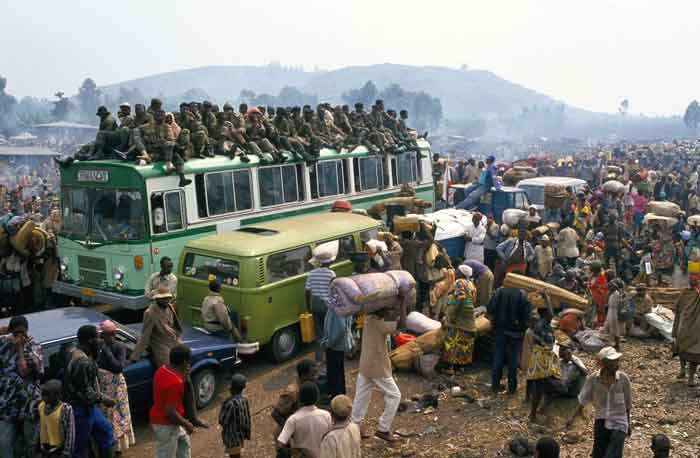
On July 4, with the government army collapsing, rebel forces captured Kigali and, to the south, seized the city of Butare. In the days that followed, hundreds of thousands took flight as the rebels advanced on several fronts. More than a half-million fled the final rebel advance on Gisenyi, on the border with Zaire, where the Hutu government had taken refuge.
The rebels declared the war over July 18. Pasteur Bizimungu and Faustin Twagiramungu, both Hutus, were appointed president and prime minister, respectively.
It had been a long road for Kagame. In October 1990, when the rebel front launched its first offensive against the government, Kagame was at Fort Leavenworth, Kan., studying at the U.S. Army Command and General Staff College.
Kagame, then a major in the Ugandan army who had directed intelligence operations, had been chosen to participate in a U.S. government program that brought officers from numerous countries to Fort Leavenworth for military education.
Kagame was born in Rwanda but, like thousands of Tutsis, fled with his family at an early age into neighboring Uganda after a Hutu revolt overthrew the Tutsi monarchy in 1959 and sent thousands of Tutsis into exile.
Many of these same Tutsis, Kagame among them, were opposed to the oppressive regime of Ugandan dictator Milton Obote and joined the rebellion that brought Yoweri Museveni to power in that country in 1986.
The Tutsi support given to Museveni paid off in the form of military experience, a base in southern Uganda for the Rwandan Patriotic Front (formed in the 1980s), and Ugandan weaponry, stolen or otherwise, used in the 1990 offensive.
The 8,000-man rebel force captured some territory in the north, but the offensive quickly went sour. Rebel leader Fred Rwigyema, a close friend of Kagame's, was killed in the fighting.
With some regret, Kagame knew he would have to immediately withdraw from Fort Leavenworth without completing the course. But the time had not been wasted.
"I finished the most useful part of the course: military tactics," Kagame said.
A plane carrying the presidents of Rwanda and neighboring Burundi had been shot down at the Kigali airport, the aide said, repeating initial news reports. Shooting was reported across the Rwandan capital. No one knew who shot down the plane or why. But, Kagame recalled in an interview, he summoned his top commanders that night and told them to brace for trouble.
The unexplained plane crash was followed by a murderous campaign by extremists of the majority Hutu tribe within the government against Rwanda's 14 percent Tutsi minority. An estimated half-million Tutsis and moderate Hutus were slaughtered. In retrospect, the plane crash also was the signal for renewal of the country's quiescent but not forgotten civil war.
Within a day, Kagame launched an offensive that would sweep the entrenched Hutu government from power, put an end to one of this century's most ferocious slaughters and trigger a refugee exodus of equally historic proportions.
In the process, Kagame, 37 and now Rwanda's vice president and defense minister, leaped from obscurity into modern military history. In little more than three months, his Tutsi-led force defeated a government army that, at 30,000, outnumbered his guerrillas roughly 2 to 1, was trained and equipped by the French military and had tens of thousands of armed Hutu militiamen in reserve.
Behind the rebel victory lay years of careful preparation and training, plus a campaign so tactically well executed and strategically clever that already it is drawing attention from military schools as worthy of study, according to qualified military observers.
"In my opinion, it will certainly be a useful tool in staff colleges on low-intensity warfare," said Maj. Gen. Romeo Dallaire, the Canadian who commanded U.N. forces in Rwanda during the past year.
"Kagame is an intellectual figure. I would rate him as a first-rate operational fighter," said Col. Jim McDonough, commander of American forces in Rwanda and a former director of the U.S. Army School for Advanced Military Studies. "He understands discipline. He understands speed. He understands mobility."
After meeting Kagame, Gen. George Joulwan, the U.S. supreme commander of NATO forces, described the U.S.-trained officer as "a visionary."
By April 7, the day after the presidential plane was shot down, Kagame was receiving numerous reports that a pogrom was underway against Tutsis and that the Presidential Guard had murdered Prime Minister Agathe Uwilingiyimana. A 600-man rebel contingent based in Kigali under a previous truce agreement was taking fire.
Kagame said he ordered troops from four of his battalions to move to assembly points in northern Rwanda, territory controlled by the rebels since they initially invaded from neighboring Uganda in 1990.
"I knew by the time they assembled, I would have assessed the situation to the point of making the decision to move or not to move," he said. "But of course, with every single hour that passed, the situation was deteriorating. By the time we reached the assembly points, the country was already in chaos."
Kagame decided to move, and the force headed south. A large government force of seven battalions was near the northern city of Byumba, but Kagame bypassed it to the west.
The rebels took four days to cover the 40 miles to Kigali, moving entirely on foot and carrying their equipment on their backs. A second prong was directed eastward.
Throughout the war, all the rebel movements were on foot, and they fought with mostly East European weapons -- reportedly obtained in Uganda -- as well as howitzers, mortars and recoilless rifles captured from government troops.
The government forces had modern, French-supplied armaments in its arsenal -- including armored vehicles and helicopters -- but they soon ran short of ammunition and their stocks were not replenished -- the result of a U.N.-mandated arms embargo put in place in May.
From the start, government forces were hampered by command-and-control problems. The army chief of staff was among those killed in the presidential plane crash. His successor was replaced within days, apparently because Hutu hard-liners wanted their own choice in the job, further confusing the situation.
The rebels scored a key early victory: Despite heavy assaults by government troops, the outnumbered rebel battalion in Kigali managed to break out of its compound near the parliament and link up with rebel reinforcements.
Most observers of the war assumed that rebel forces were preparing an assault to capture the capital. But Kagame had other ideas.
Much of the government force was concentrated in and around Kigali. "If I put all my forces into Kigali, I would be sucked into pitched battles that would go on for a long time," Kagame said. "I would lose my other objectives of capturing territory and saving the people."
At the same time, Kagame put enough force into Kigali to harass government troops and prevent them from reinforcing other areas of the country out of fear that the rebels would then easily take the city. "They were in a fix either way," Kagame said.
By mid-April, rebel fire had closed the Kigali airport, neutralizing an important government advantage. On May 22, the rebels captured both the heavily defended airport and the Kanombe barracks, the main stronghold of government forces in the capital. Fighting continued in and around Kigali, but the rebels delayed a full-fledged assault.
"At the operational level, {Kagame} kept them focused on the fact that they thought he wanted Kigali, and then he feinted to the west, where the homeland of Hutu hard-liners was," Dallaire said.
Instead, the rebels, whose numbers grew to around 25,000 as the fighting continued, were sweeping through eastern Rwanda, moving south swiftly but careful to consolidate their advances.
"We were fighting government forces and at the same time looking for civilians who were threatened to save them," Kagame said. "So it was a multi-pronged kind of objective, and that more or less overstretched us."
Early on in the war, Kagame and Dallaire had a conversation about battle stress. Said the U.N. commander: "He was concerned more about fact that as his soldiers were approaching different villages, these guys were all of a sudden seeing members of their family and so on that had been wiped out, and that shock could create reactions that would have to be controlled."
Still outnumbered by government troops, Kagame's strategy was to minimize his casualties by using tactics that avoided any frontal assaults.
"This is why throughout the war you did not see any major battles," said Maj. Jean-Guy Plante, a Canadian officer with the United Nations who was in Kigali during most of the fighting.
The rebels would infiltrate and surround government or militia positions, often at night, and harass them with mortars but always permit the enemy a single avenue of escape. Then, as government troops retreated, the rebels would attack from the flanks and rear, inflicting heavy casualties but suffering few of their own.
The attacks took their toll on government troops. "Their morale was suffering," Plante said. "From the beginning, they were constantly on the defensive, withdrawing from one position to another, launching the odd counterattack but having to withdraw and consolidate new positions."
Government advantages such as armor, helicopters and an airborne battalion were rendered largely useless by this style of fighting.
As rebel forces in the east began an enveloping move below Kigali, putting a squeeze on the capital, diplomats and military observers realized a rout was on. "Then it was a function of whether the {rebels} would stop," said one. They did not.
The one setback to the rebels came in late June, when France decided to intervene for what it said were humanitarian reasons, sending 2,500 troops to create a protection zone in southwestern Rwanda and prevent the rebels from taking control of the area. But Kagame avoided confrontation. "Instead of pursuing that, he simply concentrated on the north and punched through," Dallaire said.
On July 4, with the government army collapsing, rebel forces captured Kigali and, to the south, seized the city of Butare. In the days that followed, hundreds of thousands took flight as the rebels advanced on several fronts. More than a half-million fled the final rebel advance on Gisenyi, on the border with Zaire, where the Hutu government had taken refuge.
The rebels declared the war over July 18. Pasteur Bizimungu and Faustin Twagiramungu, both Hutus, were appointed president and prime minister, respectively.
It had been a long road for Kagame. In October 1990, when the rebel front launched its first offensive against the government, Kagame was at Fort Leavenworth, Kan., studying at the U.S. Army Command and General Staff College.
Kagame, then a major in the Ugandan army who had directed intelligence operations, had been chosen to participate in a U.S. government program that brought officers from numerous countries to Fort Leavenworth for military education.
Kagame was born in Rwanda but, like thousands of Tutsis, fled with his family at an early age into neighboring Uganda after a Hutu revolt overthrew the Tutsi monarchy in 1959 and sent thousands of Tutsis into exile.
Many of these same Tutsis, Kagame among them, were opposed to the oppressive regime of Ugandan dictator Milton Obote and joined the rebellion that brought Yoweri Museveni to power in that country in 1986.
The Tutsi support given to Museveni paid off in the form of military experience, a base in southern Uganda for the Rwandan Patriotic Front (formed in the 1980s), and Ugandan weaponry, stolen or otherwise, used in the 1990 offensive.
The 8,000-man rebel force captured some territory in the north, but the offensive quickly went sour. Rebel leader Fred Rwigyema, a close friend of Kagame's, was killed in the fighting.
With some regret, Kagame knew he would have to immediately withdraw from Fort Leavenworth without completing the course. But the time had not been wasted.
"I finished the most useful part of the course: military tactics," Kagame said.
Last edited by a moderator: