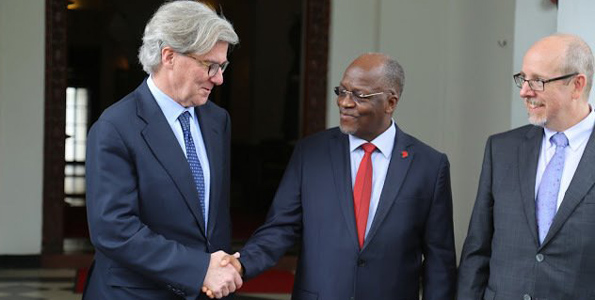
Sababu ya kulipuuza gazeti la the Economist

Sababu ya kulipuuza gazeti la the Economist

Wasitupangie jinsi ya kuendesha siasa nchini...Marekani watu wanatwanga risasi ila kwa kuwa ni blacks huwezi sikia Economist akimuita Trump brutal dictator
Kwan wewe unacholalamika ni kuandikwa uongo au wewe tu kuandikwa kila mara na si wengine??.. Maana wewe Jinga inaeza ukawa hujui unacholalamika na sishangai ni elimu ya hovyo iliyochanganywa na siasa za buku 7 inakuchanganya
 
mnachokiogopa ni nini ilhali Bob kashasema hatishiwi wala kuyumbishwa??
 
The Economist has been Talk Of The Town Huh!, they keeping some of us on toes with their bumper to bumper, hawt news about Tanzania heh! 😀

Gotta subscribe to see what's up with them..
 
Mimi kwasasa naungana na mtu yeyote anaepambana na hili BAKAYOKO la MAGOGONI hata kama ni shetani, hata kama nikimkuta nyoka anapambana na hilo shetani ni bora umsaidie huyo nyoka. Jitu la ajabu sana
Sasa uunategemea ukae upande wa shetani umshinda mteule wa Mungu?
Tulieni mbatizwe
..kwa John the babtist
 
Ivyo kwenye hii dunia kuna mtu mwenye utimamu kichwani anaeweza kumsifia Kagame au Museveni..!?
Well, kwa CCM ya wauwaji na watekaji ni sawa.
Asiyemsifia Kaghame ndio mkosefu wa Akili
 
Facts The Economist Got Them Wrong on Magufuli

DAR ES SALAAM, East Africa:

By Dr. Herman Louise Verhofstadt*


“A BIT like President Donald Trump, Tanzania’s president, John Magufuli, likes to fire employees on television. In November Mr. Magufuli used a live broadcast from a small town in the north of the country summarily to dismiss two officials,” this is an extract from a recent online article I came across from the newspaper that I admired when I was growing up in Europe back in 1990’s; the Economist.


Before I venture into other serious issues, the excerpts above contains gross factual errors; my own fact-check indicates that in the named public rally during the opening of Kagera Airport, there was no summary dismissal of the two officials instantly on television, as alleged. Instead, the two, one District Executive Directors for Bukoba Urban and another for Rural were relieved their duties later through a press release from President’s Office.

This is my prima impressio reading the Economist this week, a publication known for its top notch ethical and analytical standards, that has now vanished into a hell of sensational journalism, half baked facts, lack of objectivity and a clear sense of bias.

Contrary to the fact deprived article, it is my candid observation that to objectively critique Magufuli’s presidency in the circumstances of the transformation he is doing for his people in Tanzania, requires the level of conscious that is unfortunately lacking in the current editorial team at the Economist.

Living in Tanzania for close to half a decade now, it makes me a better eye-witness than the Westminster based editorial team. To say the least, this man Magufuli rose into power in a country that was downed by massive corruption scandals, political demonstrations that caused deaths and worse enough he found media fraternity that was being corrupted to work for interest groups.

In my stay here before and after his presidency, I have witnessed real transformation, his work is exemplary and fascinating one. Everybody here—may be just like what Theresa May is doing in London and what Trump is focusing in Washington, is aware that Tanzania is on the move towards pro-people development; something the Economist is unhappy for and would frame it with usual western biases; suppression of democracy, violation of press rights etc etc!

Under Magufuli’s “rogueness” I have seen leaders going into prison or dismissed for lack of action in protecting public funds, I’m seeing public service regaining its lost fame and massive social projects being implemented across the country-sadly the Economist would reduce all these far-fetching achievements to nothing but “rogueness.”

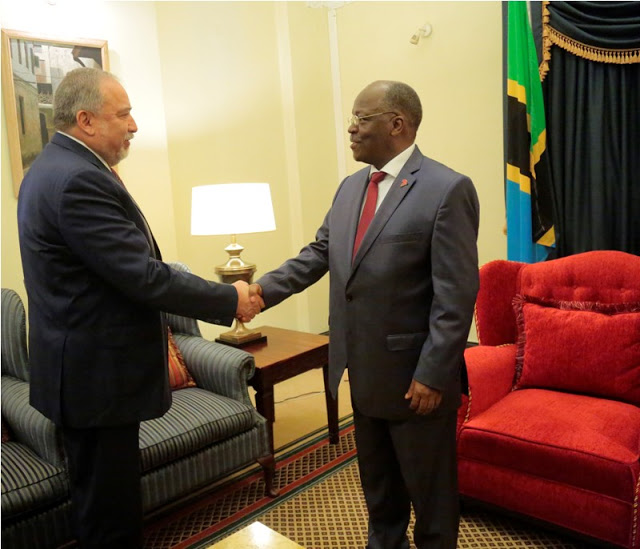
Magufuli's diplomatic acumen cannot be underestimated; He meets Israel Defense Minister in Dar es Salaam


As a European social-worker who had a rare opportunity to experience the real lives of the people in downtown Tanzanian cities and villages, I may not be best placed to analyze all of the Economist’s wrong facts about Tanzania, but for the sake of truth-an important cardinal principle in social as well as medical science, I co-own the truth of some of the major reforms on the ground and this is my scent on some of the issues raised:

“Magufuli’s impossible tax demands”

Looking at this allegation, in the Economist team, there seems to exist a general knowledge gap. Various reports from World Bank, IMF and other international institutions and pro-development authors have pointed to how Africa is grabbed of its mineral reserves. One author, in this regard, went far to coin the term: “development without development.”

What Magufuli is doing, is to come up with policies and leadership approaches to rescind the situation in Tanzania. Acacia, who seems to enjoy warm protection from the Economist story, after prolonged discussions and confronted with impeccable evidence on their wrong doings, bowed down to negotiate and reached a better “21stCentury” deal. Why is the Economist so pained by this? Now many countries in Africa are coming up with such huge bills.

How can the once pro development Economist be unhappy with a young and poor nation striving and trying to reap what is due for its people? If Acacia/Barrick settled to pay, albeit part of the claim, then what is impossible tax demand mean?

“Pregnant girls to be kicked out of school”

Upon reading some of the excerpts, I wished I could sponsor editors of the Economist to come to Africa and learn the practical lessons before writing sensational half-truths. Seems no one ever knows that one of the critical social issues in the Continent is early marriages and pre-mature pregnancies.

To see a leader confronting these issues with a view to encourage parents and students to work together to prevent early pregnancies is something to loud the government of Tanzania. I wonder, a western media trying to challenge these efforts to impose its own persona on a different culture, what do we want to achieve?

In my childhood I studied around Elephant and Castle in the UK; at one time we heard about 20,000 under 18’s went pregnant in a year, later on, few secured a chance to return to school. In Tanzania, and some other African countries, the number could go by far beyond UK in a year.

With such stats, you don’t need a civilized western media to teach you what to do than support stern measures by the “Rogue President,” well intended to protect young girls from engaging into sexual life before the coming of age to enjoy their right to education.

“Locked immoral musicians who criticize him”

This is a fact that the Economist may need to prove to its esteemed audiences. I’m not a keen music fan, but I’m able to comprehend events in Tanzania and never heard of a musician who was “locked up” for criticizing Magufuli.

Like any other country, Tanzania is grappling with issues of morals and ethics in its society. Use of obscene language and pornography are some of the immoral that irks many music lovers in this part of the world. Government has taken steps to ban some from TV and redio airings. This is standard. Its everywhere.

"Democracy and political rallies”

Like in music, I may also not be better placed to justify or condemn the banning of political rallies but just to share with my fellows in the Economist; I once had to quit my social work in Arusha, the Northern tourist city, due to insecurity when opposition parties were allowed to conduct prolonged demos.

It is their civil rights which I have no doubt about it-but shops were being closed, businesses deteriorated and tourism suffered, as dozens of people lost lives in the ensuing violence and incidents of planted bombs.

I have never been back to Arusha since then, but listening to stories of how the once lost glory is back to the city after controlled political rallies, makes me thrilled to read somebody from London crying advocating for more political demonstrations!

“Economy is Grinding”

A mesmerizing phrase in the Economist’s article about Tanzania goes: “Rather than being freed from corruption, the economy is grinding to a halt under the weight of arbitrary tax demands.”

Reading the phrase it would cling to one’s mind that someone authoring the article is vividly a bonafide member of the pool of victims of Magufuli’s justifiable crusade on mineral resources. How can, serious a journalist, make such analogy; arbitrary tax demands and dwindling economy?”

His negotiation skills: Agreed a deal to settle Acacia's huge tax bill by meeting top Barrick bosses who own Acacia Tanzania. Barrick will reimburse Tanzania and reform ownership of Acacia.
Yes, in Tanzania, I have heard stories of some businesses closing down due to new tax systems, still high bank interest rates as well as dwindling foreign exports. On the other hand, there are good stories too; ranging from how the country has scored high in monthly revenue collection, the Investment Center is recording huge number of new foreign investors, Africa’s wealthiest man Dangote’s cement plant is already launched and hundreds of new industries are blossoming up and the economy is steadfastly above 6 percent for the last 10 years.

Be aware: Magufuli's focus on infrastructure is unique, he has just inaugurated construction of a multi-billion Dollar modern standard gauge railway, thanks to improved own internal revenue sources.

The new Standard Gauge Rail construction is on as the country further embarks into a 2,100 megawatts historic power project along the Rufiji River Basin—of course I’m opposed to the latter on environmental consideration but I do realize the vision of the President and stand with the people of Tanzania.


It needs courage-but above all vendetta backed type of journalism to be bold enough to undermine and under write positive transformations happening in Tanzania under Mr. Magufuli in support and in favour of isolated incidents which are peculiar to the nature of politics in Tanzania and other neighbouring geo-politics.

*The author is a Belgian health expert working with an international NGO in EAC countries who is currently ending his tenure in Tanzania. He has worked with poor communities for four years now.
 
Ivyo kwenye hii dunia kuna mtu mwenye utimamu kichwani anaeweza kumsifia Kagame au Museveni..!?
Well, kwa CCM ya wauwaji na watekaji ni sawa.
Wewe ukimezeshwa na walami kwamba Kagame ni mbaya na wewe unakuwa kama kasuku unasema ni mbaya
 
The Economist is just another propaganda outlet, all Western media should be subject to intense scrutiny by us Africans. It is definitely owned by those Satanic Jewish bankers in America, which is why they support all these degenerate things (legal prostitution, drugs, homosexuality, porn industry...etc) that cannot produce a healthy society. They are pro-Israel because nearly all press is controlled by Zionist Jews.
Seems to me that we also becoming pro Israel slowly but surely. Wouldn't have dreamed of cozy diplomatic relationship with those fellas born and raised as I was in the Nyerere era though I must admit that barring their apartheid like policies, I don't have much else against them.
 
Ushoga Tanzania is very minor, yani hata mimi mwenyewe ninayekuwaga Tanzania siujui hata kama umekuwa sana, watu hawaandiki tu, lakini kuna issue zina shout sana inakuwa rahisi kuandika!
Mkuu. Hata hayo ya uchumi na haki za binadamu hawajapata kuungwa mkono na wote. Mfano mzuri ni wewe mwenyewe.Maana yangu ni kwamba wasomaji wengi ukiwamo wewe mwenyewe wanapendelea habari na maoni yanayokazia kile ambacho tayari wanakiamini. Na hawatakubali kubadlika.
Sio kwa ushawishi wako.
 
Oh mkuu thetruthbetold niwie radhi hapo. Mwitikio wangu ulikuwa kwa #76.
 
Nimetafuta kupitia google kuhusu gazeti hili la The economist na nikaona pamoja na mengi linaloandika lakini kuna mabaya kuhusu uandishi wao na maadili yetu kama watanzania.soma hizi comments ili uchukue msimamo.
Hasa hasa katika eneo la kijamii.

Economic issues: Usually but not always conservative. They prefer lower taxes and fewer regulations, and they approve of schemes such as privatization of government assets. However, they are very much orthodox economically, so they support Keynesian policies such as economic stimulus that some people see as left-wing. There are a few issues where they don't align to the right at all. For example they are strongly in favor of action to address climate change, whether through a cap-and-trade scheme or a carbon tax, even though it will require massive government intervention in the economy.

Social issues: Liberal in all cases that I can recall. They support gay marriage, reproductive rights, drug legalization (of all street drugs), legal prostitution, legal euthanasia, and civil rights in general. They support high levels of immigration, and for example in the US they support amnesty for illegal immigrants, they support universal healthcare (though they prefer private market delivery mechanisms). They believe in lowering prison populations and in liberal sentencing. And so on[B\]

Foreign Policy: They are strongly in favor of a world dominated by western values, and prefer the US to openly exert its influence in the world. But they are not always in favor of military action. They think Liberal Democracy is the best form of government and that US and western foreign policy should promote it. They are slightly, but not extremely, pro-Israel. In my experience, Foreign policy is the area where they are the most inconsistent. They seem to be alternately hawkish and dove-ish.


Tunamsoma msiba usiwe na shaka
 
watanzania tuendelee kuwapuuza hawa mabwanyenye
 
Konki Konki Konki Master hebu tupe neno juu ya jarida hili linalosupport ushoga
 
Nimetafuta kupitia google kuhusu gazeti hili la The economist na nikaona pamoja na mengi linaloandika lakini kuna mabaya kuhusu uandishi wao na maadili yetu kama watanzania.soma hizi comments ili uchukue msimamo.
Hasa hasa katika eneo la kijamii.

Economic issues: Usually but not always conservative. They prefer lower taxes and fewer regulations, and they approve of schemes such as privatization of government assets. However, they are very much orthodox economically, so they support Keynesian policies such as economic stimulus that some people see as left-wing. There are a few issues where they don't align to the right at all. For example they are strongly in favor of action to address climate change, whether through a cap-and-trade scheme or a carbon tax, even though it will require massive government intervention in the economy.

Social issues: Liberal in all cases that I can recall. They support gay marriage, reproductive rights, drug legalization (of all street drugs), legal prostitution, legal euthanasia, and civil rights in general. They support high levels of immigration, and for example in the US they support amnesty for illegal immigrants, they support universal healthcare (though they prefer private market delivery mechanisms). They believe in lowering prison populations and in liberal sentencing. And so on[B\]

Foreign Policy: They are strongly in favor of a world dominated by western values, and prefer the US to openly exert its influence in the world. But they are not always in favor of military action. They think Liberal Democracy is the best form of government and that US and western foreign policy should promote it. They are slightly, but not extremely, pro-Israel. In my experience, Foreign policy is the area where they are the most inconsistent. They seem to be alternately hawkish and dove-ish.


We can't ignore The economist magazine for the sake of defending a Dictator, our local medias have been curbed to report on crucial issues, JF is here to reign simply because the Dictator was told by his political aides that if JF will be completely shut down the government won't be able to learn from what people create their views on it since JF is unlike FB.
So,the world has already learnt that Tanzania is now under the brutal regime of the blood thirsty tyrant.
If it pains you to have your details made in public over the face of the world, tell your master to send his men the so called unknown men to UK so that they should open fire at the journalists of the magazine just as they did to Tundu Lissu.
 
Tunapoyasoma haya magazeti ni vyema tukatambua misimamo yao kuhusu mambo kadhaa kwani wanaweza wakawa wanaandika kwa niaba ya mabwa.bwa bila sisi kujua na tukaona wako sahihi.
So what? Wakamateni kama ni waongo
 
Back
Top Bottom