
MaxShimba
Platinum Member
- Apr 11, 2008
- 36,008
- 4,093
[h=1]cross Forbidden Border, Doctors in Israel Quietly Tend to Syrias Wounded[/h]

[h=6]By ISABEL KERSHNER[/h]
NAHARIYA, Israel The 3-year-old girl cried Mama, Mama over and over as a stranger rocked her and tried to comfort her. She had been brought from Syria to the government hospital in this northern Israeli town five days earlier, her face blackened by what doctors said was probably a firebomb or a homemade bomb.
In the next bed, a girl, 12, lay in a deep sleep. She had arrived at the pediatric intensive care unit with a severe stomach wound that had already been operated on in Syria, and a hole in her back.
Another girl, 13, has been here more than a month recovering from injuries that required complex surgery to her face, arm and leg. She and her brother, 9, had gone to the supermarket in their village when a shell struck. Her brother was killed in the attack.
As fighting between Syrian government forces and rebels has raged in recent months in areas close to the Israeli-held Golan Heights, scores of Syrian casualties have been discreetly spirited across the hostile frontier for what is often lifesaving treatment in Israel, an enemy country.
Most are men in their 20s or 30s, many of them with gunshot wounds who presumably were involved in the fighting. But in recent weeks there have been more civilians with blast wounds, among them women and children who have arrived alone and traumatized.
Israel has repeatedly declared a policy of nonintervention in the Syrian civil war, other than its readiness to strike at stocks of advanced weapons it considers a threat to its security. Officials have also made clear that Israel would not open its increasingly fortified border to an influx of refugees, as Turkey and Jordan have, given that Israel and Syria officially remain in a state of war.
But the Israeli authorities have sanctioned this small, low-profile humanitarian response to the tragedy taking place in Syria, balancing decades of hostility with the demands of proximity and neighborliness.
Most come here unconscious with head injuries, said Dr. Masad Barhoum, the director general of the Western Galilee Hospital here in Nahariya, on the Mediterranean coast six miles south of the Lebanese border. They wake up after a few days or whenever and hear a strange language and see strange people, he said. If they can talk, the first question is, Where am I?
He added, I am sure there is an initial shock when they hear they are in Israel.
The identity of the patients is closely guarded so they will not be in danger when they return to Syria. Soldiers sit outside the wards where the adults are to protect them from possible threats and prying journalists. But doctors granted access to the children in the closed intensive care wing, on the condition that no details that could compromise their safety were published.
Like many Israeli hospitals, this one serves a mixed population of Jews and Arabs; its staff includes Arabic-speaking doctors, nurses and social workers. In the lobby, a glass display case contains the remnants of a Katyusha rocket that was fired from Lebanon and hit the hospitals eye department during the 2006 war between Israel and Hezbollah. The rocket penetrated four floors but nobody was injured because all the north-facing wards had been moved underground.
With more than 100,000 people estimated to have died in the Syrian civil war, Dr. Barhoum, an Arab Christian citizen of Israel, acknowledged that the Israeli medical assistance was a drop in the ocean.
But he said he was proud of the level of treatment his teams could provide and proud to be a citizen of a country that allowed him to treat every person equally. He said the cost of the treatment so far had amounted to hundreds of thousands of dollars and would be paid for by the Israeli government.
Since late March, almost 100 Syrians have arrived at two hospitals in Galilee. Forty-one severely wounded Syrians have been treated here at the Western Galilee Hospital, which has a new neurosurgical unit as well as pediatric intensive care facilities. Two of them have died, 28 have recovered and been transferred back to Syria, and 11 remain here.
An additional 52 Syrians have been taken to the Rebecca Sieff Hospital in the Galilee town of Safed. The latest, a 21-year-old man with gunshot and shrapnel wounds, arrived there on Saturday. A woman, 50, arrived Friday with a piece of shrapnel lodged in her heart and was sent to the Rambam hospital in the northern port city of Haifa for surgery.
http://www.nytimes.com/2013/08/06/w...d-to-syrias-wounded.html?ref=middleeast&_r=2&
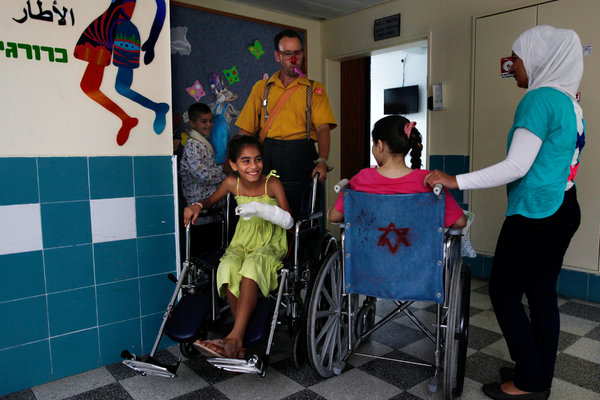
Rina Castelnuovo for The New York Times
An Israeli girl, left, and a Syrian girl, wounded in her countrys civil war, meeting at the Western Galilee Hospital in Nahariya, Israel, where scores of Syrians have been taken for treatment.[h=6]By ISABEL KERSHNER[/h]
NAHARIYA, Israel The 3-year-old girl cried Mama, Mama over and over as a stranger rocked her and tried to comfort her. She had been brought from Syria to the government hospital in this northern Israeli town five days earlier, her face blackened by what doctors said was probably a firebomb or a homemade bomb.
In the next bed, a girl, 12, lay in a deep sleep. She had arrived at the pediatric intensive care unit with a severe stomach wound that had already been operated on in Syria, and a hole in her back.
Another girl, 13, has been here more than a month recovering from injuries that required complex surgery to her face, arm and leg. She and her brother, 9, had gone to the supermarket in their village when a shell struck. Her brother was killed in the attack.
As fighting between Syrian government forces and rebels has raged in recent months in areas close to the Israeli-held Golan Heights, scores of Syrian casualties have been discreetly spirited across the hostile frontier for what is often lifesaving treatment in Israel, an enemy country.
Most are men in their 20s or 30s, many of them with gunshot wounds who presumably were involved in the fighting. But in recent weeks there have been more civilians with blast wounds, among them women and children who have arrived alone and traumatized.
Israel has repeatedly declared a policy of nonintervention in the Syrian civil war, other than its readiness to strike at stocks of advanced weapons it considers a threat to its security. Officials have also made clear that Israel would not open its increasingly fortified border to an influx of refugees, as Turkey and Jordan have, given that Israel and Syria officially remain in a state of war.
But the Israeli authorities have sanctioned this small, low-profile humanitarian response to the tragedy taking place in Syria, balancing decades of hostility with the demands of proximity and neighborliness.
Most come here unconscious with head injuries, said Dr. Masad Barhoum, the director general of the Western Galilee Hospital here in Nahariya, on the Mediterranean coast six miles south of the Lebanese border. They wake up after a few days or whenever and hear a strange language and see strange people, he said. If they can talk, the first question is, Where am I?
He added, I am sure there is an initial shock when they hear they are in Israel.
The identity of the patients is closely guarded so they will not be in danger when they return to Syria. Soldiers sit outside the wards where the adults are to protect them from possible threats and prying journalists. But doctors granted access to the children in the closed intensive care wing, on the condition that no details that could compromise their safety were published.
Like many Israeli hospitals, this one serves a mixed population of Jews and Arabs; its staff includes Arabic-speaking doctors, nurses and social workers. In the lobby, a glass display case contains the remnants of a Katyusha rocket that was fired from Lebanon and hit the hospitals eye department during the 2006 war between Israel and Hezbollah. The rocket penetrated four floors but nobody was injured because all the north-facing wards had been moved underground.
With more than 100,000 people estimated to have died in the Syrian civil war, Dr. Barhoum, an Arab Christian citizen of Israel, acknowledged that the Israeli medical assistance was a drop in the ocean.
But he said he was proud of the level of treatment his teams could provide and proud to be a citizen of a country that allowed him to treat every person equally. He said the cost of the treatment so far had amounted to hundreds of thousands of dollars and would be paid for by the Israeli government.
Since late March, almost 100 Syrians have arrived at two hospitals in Galilee. Forty-one severely wounded Syrians have been treated here at the Western Galilee Hospital, which has a new neurosurgical unit as well as pediatric intensive care facilities. Two of them have died, 28 have recovered and been transferred back to Syria, and 11 remain here.
An additional 52 Syrians have been taken to the Rebecca Sieff Hospital in the Galilee town of Safed. The latest, a 21-year-old man with gunshot and shrapnel wounds, arrived there on Saturday. A woman, 50, arrived Friday with a piece of shrapnel lodged in her heart and was sent to the Rambam hospital in the northern port city of Haifa for surgery.
http://www.nytimes.com/2013/08/06/w...d-to-syrias-wounded.html?ref=middleeast&_r=2&

