Bavaria
JF-Expert Member
- Jun 14, 2011
- 53,109
- 53,627
Apple’s China Problem Is That Local Phones are Good -- and Cheap
Alex Webb atbwebb
July 24, 2016 — 11:00 PM AST
That’s because the lion’s share of his 7,000 yuan monthly pay goes toward the mortgage on the downtown apartment he bought last year. And he’s perfectly happy with the 2,000 yuan handset he got from Huawei Technologies Co.
The 29-year-old embodies the challenges in China for Apple, which has lost ground to local competitors. It’s been almost two years since the Cupertino, California-based company revamped the iPhone for the sixth generation. In the meantime, rivals like Huawei and Xiaomi Corp. have developed their own cheaper products with similar specifications, while the relative success of the iPhone 6 has made it harder for Apple to sustain its growth rates.
After forecasting a second consecutive quarterly sales tumble in April, Chief Executive Officer Tim Cook will reveal the extent of the decline when he reports earnings July 26. China generates about a quarter of Apple’s revenue, and deterioration there accounted for much of the sales drop.
Huawei supplied one in four new phones in the three months through May, leapfrogging Apple to become the biggest phonemaker by market share in urban China, according to a Kantar Group study published this month. Guangdong Oppo Electronics Co.’s share meanwhile jumped fourfold to 8 percent of the total.
“It’s a function of cheaper phones becoming good enough,” said Abhey Lamba, a San Francisco-based analyst at Mizuho Securities who recommends buying Apple shares. “Apple has done well at the upper end, but there’s not much more growth at the upper end of the market.”

The cheaper iPhone SE, which Apple started selling in March, was partially aimed at securing new customers in emerging markets such as China. So far, it has failed to meet those expectations, even as sales have exceeded forecasts in developed economies, Lamba said.
Apple may boost its China sales when the new iPhone arrives later this year, aided by the growing popularity of the App Store and customers’ tendency to upgrade their handsets every two years. That’s one reason why Huawei and Oppo introduced their flagship phones earlier this year -- to get a head start on Apple.
After last year’s surge in Chinese phone sales, Apple has reaped the benefit in its App Store, with China overtaking Japan to become the second-biggest source of spending in the shop for mobile games, services, music and more, according to researcher AppAnnie. Once customers have paid to download programs from the marketplace, they are more likely to continue to buy Apple hardware to preserve those purchases. The iPhone 6S, released in September, came too soon after the original iPhone 6 model in 2014 to encourage upgrades.
“In China it’s about a two-year upgrade cycle,” said Lauren Guenveur, an analyst at Kantar. “They will probably upgrade with the new iPhone 7 where they didn’t with the 6S and 6S Plus.”
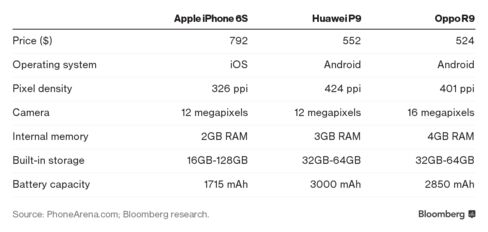
Cost, however, is a mounting issue. While a 16 gigabyte iPhone 6S starts at 5,288 yuan, Huawei’s top-of-the-range P9 costs 3,688 yuan, and includes 64 GB of storage, a fingerprint scanner and front and rear cameras.
“It is a fairly premium phone compared to the other models but it is a relatively lower price compared to the iPhone,” said Guenveur. “There is also a sense of pride of being a Chinese phone user and owning a Chinese phone.”
‘Really Good’
The smartphone market has fundamentally changed since the iPhone was first introduced in 2007. Back then, Apple marketed the device as a lifestyle accessory, but as smartphones have become ubiquitous, consumers’ focus has increasingly shifted to the features on offer.
“If you look at Huawei phones, or Xiaomi phones, it’s like ‘Wow they’re really good’,” said John Butler, a Bloomberg Intelligence analyst. “They’ve got great battery life, the screens are really sharp, the features are great.”
Apple more than doubled its Chinese revenue between 2013 and 2015 to $59 billion, expanding aggressively: it had 35 stores in the region by the end of March, up from 21 a year earlier, and aimed to add another five by the end of June. Apple has made efforts to remain on good terms with the Chinese government, including a visit by Cook in May that coincided with a $1 billion investment in the country’s biggest car-sharing service, Didi Chuxing Technology Co.
And yet sales in Greater China -- which comprises the mainland, Taiwan and Hong Kong -- fell 26 percent in the fiscal second quarter, accounting in large part for Apple’s 13 percent sales tumble. Analysts expect total revenue to decline by a further 15 percent in the three months through June compared with a year earlier.
Cook attributed the fall primarily to the strength of the Hong Kong dollar, which is pegged to its American cousin and made it more expensive for tourists visiting the former British colony to shop. Excluding currency effects, sales in mainland China still fell 7 percent.
“Apple is expecting growth to come from the expansion of the middle class but these people are now choosing the local brands instead,” said Nicole Peng, a research analyst at Canalys in Shanghai. “The locals are taking a lot of share in the mid-range segment. Although they are not yet in direct competition, they have certainly taken a lot of potential Apple customers."
Apple’s rigidly self-contained iOS mobile operating system, which leaves little space for personalization when compared with Google’s Android, has made it harder to attract the sometimes capricious Chinese consumer. Take Zhang Bin, who ditched his iPhone 5S for a handset from Meizu Technology Co. Ltd in 2014 and hasn’t looked back.
“I wanted more flexibility for my phone: customized fonts and interface,” said the 32-year-old computer technician from Beijing, who likes to try out trial versions of new apps on his Android-driven handset. “Apple doesn’t offer any of that."
Apple has also faced mounting regulatory pressure in China. The company was forced to shut down its iTunes Movies and iBooks services there in April six months after they were permitted to operate. It also recently lost a patent case against a little-known Chinese rival relating to the iPhone 6 and 6 Plus, along with a trademark dispute over the use of the word ‘IPHONE’ on leather goods.
“It’s hard as an American company to do business in China,” said Julie Ask, a Forrester Research analyst. “It seems there’s an endless stream of ways to give their own companies an advantage.”
Apple’s China Problem Is That Local Phones are Good -- and Cheap
Alex Webb atbwebb
July 24, 2016 — 11:00 PM AST
- Maker of iPhone has lost market share to Huawei and Oppo
- Apple third-quarter sales on July 26 seen showing decline
That’s because the lion’s share of his 7,000 yuan monthly pay goes toward the mortgage on the downtown apartment he bought last year. And he’s perfectly happy with the 2,000 yuan handset he got from Huawei Technologies Co.
The 29-year-old embodies the challenges in China for Apple, which has lost ground to local competitors. It’s been almost two years since the Cupertino, California-based company revamped the iPhone for the sixth generation. In the meantime, rivals like Huawei and Xiaomi Corp. have developed their own cheaper products with similar specifications, while the relative success of the iPhone 6 has made it harder for Apple to sustain its growth rates.
After forecasting a second consecutive quarterly sales tumble in April, Chief Executive Officer Tim Cook will reveal the extent of the decline when he reports earnings July 26. China generates about a quarter of Apple’s revenue, and deterioration there accounted for much of the sales drop.
Huawei supplied one in four new phones in the three months through May, leapfrogging Apple to become the biggest phonemaker by market share in urban China, according to a Kantar Group study published this month. Guangdong Oppo Electronics Co.’s share meanwhile jumped fourfold to 8 percent of the total.
“It’s a function of cheaper phones becoming good enough,” said Abhey Lamba, a San Francisco-based analyst at Mizuho Securities who recommends buying Apple shares. “Apple has done well at the upper end, but there’s not much more growth at the upper end of the market.”
The cheaper iPhone SE, which Apple started selling in March, was partially aimed at securing new customers in emerging markets such as China. So far, it has failed to meet those expectations, even as sales have exceeded forecasts in developed economies, Lamba said.
Apple may boost its China sales when the new iPhone arrives later this year, aided by the growing popularity of the App Store and customers’ tendency to upgrade their handsets every two years. That’s one reason why Huawei and Oppo introduced their flagship phones earlier this year -- to get a head start on Apple.
After last year’s surge in Chinese phone sales, Apple has reaped the benefit in its App Store, with China overtaking Japan to become the second-biggest source of spending in the shop for mobile games, services, music and more, according to researcher AppAnnie. Once customers have paid to download programs from the marketplace, they are more likely to continue to buy Apple hardware to preserve those purchases. The iPhone 6S, released in September, came too soon after the original iPhone 6 model in 2014 to encourage upgrades.
“In China it’s about a two-year upgrade cycle,” said Lauren Guenveur, an analyst at Kantar. “They will probably upgrade with the new iPhone 7 where they didn’t with the 6S and 6S Plus.”
Cost, however, is a mounting issue. While a 16 gigabyte iPhone 6S starts at 5,288 yuan, Huawei’s top-of-the-range P9 costs 3,688 yuan, and includes 64 GB of storage, a fingerprint scanner and front and rear cameras.
“It is a fairly premium phone compared to the other models but it is a relatively lower price compared to the iPhone,” said Guenveur. “There is also a sense of pride of being a Chinese phone user and owning a Chinese phone.”
‘Really Good’
The smartphone market has fundamentally changed since the iPhone was first introduced in 2007. Back then, Apple marketed the device as a lifestyle accessory, but as smartphones have become ubiquitous, consumers’ focus has increasingly shifted to the features on offer.
“If you look at Huawei phones, or Xiaomi phones, it’s like ‘Wow they’re really good’,” said John Butler, a Bloomberg Intelligence analyst. “They’ve got great battery life, the screens are really sharp, the features are great.”
Apple more than doubled its Chinese revenue between 2013 and 2015 to $59 billion, expanding aggressively: it had 35 stores in the region by the end of March, up from 21 a year earlier, and aimed to add another five by the end of June. Apple has made efforts to remain on good terms with the Chinese government, including a visit by Cook in May that coincided with a $1 billion investment in the country’s biggest car-sharing service, Didi Chuxing Technology Co.
And yet sales in Greater China -- which comprises the mainland, Taiwan and Hong Kong -- fell 26 percent in the fiscal second quarter, accounting in large part for Apple’s 13 percent sales tumble. Analysts expect total revenue to decline by a further 15 percent in the three months through June compared with a year earlier.
Cook attributed the fall primarily to the strength of the Hong Kong dollar, which is pegged to its American cousin and made it more expensive for tourists visiting the former British colony to shop. Excluding currency effects, sales in mainland China still fell 7 percent.
“Apple is expecting growth to come from the expansion of the middle class but these people are now choosing the local brands instead,” said Nicole Peng, a research analyst at Canalys in Shanghai. “The locals are taking a lot of share in the mid-range segment. Although they are not yet in direct competition, they have certainly taken a lot of potential Apple customers."
Apple’s rigidly self-contained iOS mobile operating system, which leaves little space for personalization when compared with Google’s Android, has made it harder to attract the sometimes capricious Chinese consumer. Take Zhang Bin, who ditched his iPhone 5S for a handset from Meizu Technology Co. Ltd in 2014 and hasn’t looked back.
“I wanted more flexibility for my phone: customized fonts and interface,” said the 32-year-old computer technician from Beijing, who likes to try out trial versions of new apps on his Android-driven handset. “Apple doesn’t offer any of that."
Apple has also faced mounting regulatory pressure in China. The company was forced to shut down its iTunes Movies and iBooks services there in April six months after they were permitted to operate. It also recently lost a patent case against a little-known Chinese rival relating to the iPhone 6 and 6 Plus, along with a trademark dispute over the use of the word ‘IPHONE’ on leather goods.
“It’s hard as an American company to do business in China,” said Julie Ask, a Forrester Research analyst. “It seems there’s an endless stream of ways to give their own companies an advantage.”
Apple’s China Problem Is That Local Phones are Good -- and Cheap